2016 Hyundai Creta lock
[x] Cancel search: lockPage 48 of 512

2-18
Safety system of your vehicle
•When returning the rear seatbacks
to the upright position, remember
to return the rear shoulder belts to
their proper position.
•Routing the seat belt webbing
through the rear seat belt guides
will help keep the seat belts from
being trapped behind or under the
seats.
NOTICE
Cargo
Cargo should always be secured to
prevent it from being thrown about
the vehicle in a collision and caus
ing injury to the vehicle occupants.
Do not place objects in the rear
seats, since they cannot be proper
ly secured and may hit the front
seat occupants in a collision.
WARNING
When you return the rear seat
back to its upright position after
being folded down:
Be careful not to damage the seat
belt webbing or buckle. Do not
allow the seat belt webbing or
buckle to get caught or pinched in
the rear seat. Ensure that the
seatback is completely locked into
its upright position by pushing on
the top of the seatback.
Otherwise, in an accident or sud
den stop, the seat could fold down
and allow cargo to enter the pas
senger compartment, which could
result in serious injury or death.
WARNING
Cargo loading
Make sure the engine is off, the
manual transaxle is in R (Reverse)
or 1st, and the parking brake is
securely applied whenever loading
or unloading cargo. Failure to take
these steps may allow the vehicle
to move if the shift lever is inadver
tently moved to another position.
WARNING
Page 52 of 512

2-22
Safety system of your vehicle
Lap/shoulder belt
To fasten your seat belt:
To fasten your seat belt, pull it out of
the retractor and insert the metal tab
(1) into the buckle (2). There will be
an audible "click" when the tab locks
into the buckle.
The seat belt automatically adjusts to
the proper length only after the lap
belt portion is adjusted manually so
that it fits snugly around your hips. If
you lean forward in a slow, easy
motion, the belt will extend and let
you move around. If there is a sud
den stop or impact, however, the belt
will lock into position. It will also lock
if you try to lean forward too quickly.
Information
If you are not able to pull out the safe
ty belt from the retractor, firmly pull
the belt out and release it. After
release, you will be able to pull the belt
out smoothly.
Height adjustment (if equipped)
You can adjust the height of the shoul
der belt anchor to one of 3 positions
for maximum comfort and safety.
The height of the adjusting seat belt
should not be too close to your neck.
You will not be getting the most effec
tive protection. The shoulder portion
should be adjusted so that it lies
across your chest and midway over
your shoulder near the door and not
your neck.
i
ODH033055
OGC034026
■ Front seat
Page 53 of 512

2-23
Safety system of your vehicle
2
To adjust the height of the seat belt
anchor, lower or raise the height
adjuster into an appropriate position.
To raise the height adjuster, pull it up
(1). To lower it, push it down (3) while
pressing the height adjuster button(2).
Release the button to lock the
anchor into position. Try sliding the
height adjuster to make sure that it
has locked into position.
To release the seat belt:
The seat belt is released by pressing
the release button (1) in the locking
buckle. When it is released, the belt
should automatically draw back into
the retractor.
If this does not happen, check the
belt to be sure it is not twisted, then
try again.
OLMB033025
You should place the lap belt por
tion as low as possible and snugly
across your hips, not on your waist.
If the lap belt is located too high on
your waist, it may increase the
chance of injury in the event of a
collision. Both arms should not be
under or over the belt. Rather, one
should be over and the other
under, as shown in the illustration.
Never wear the seat belt under the
arm nearest the door.
WARNING
OLMB033088
Page 54 of 512

2-24
Safety system of your vehicle
Lap belt (if equipped)
To fasten your seat belt:
To fasten a 2point static type belt,
insert the metal tab into the locking
buckle. There will be an audible
"click" when the tab locks into the
buckle. Check to make sure the belt
is properly locked and that the belt is
not twisted. With a 2point static type seat belt, the
length must be adjusted manually so
it fits snugly around your body. Fasten
the belt and pull on the loose end to
tighten. The belt should be placed as
low as possible on your hips, not on
your waist. If the belt is too high, it
could increase the possibility of your
being injured in an accident.
When using the rear center seat belt,
the buckle with the “CENTER” mark
must be used.
OLMB033089
OLMB033090
Too high
ShortenCorrect
OGS035045
Page 55 of 512
2-25
Safety system of your vehicle
2
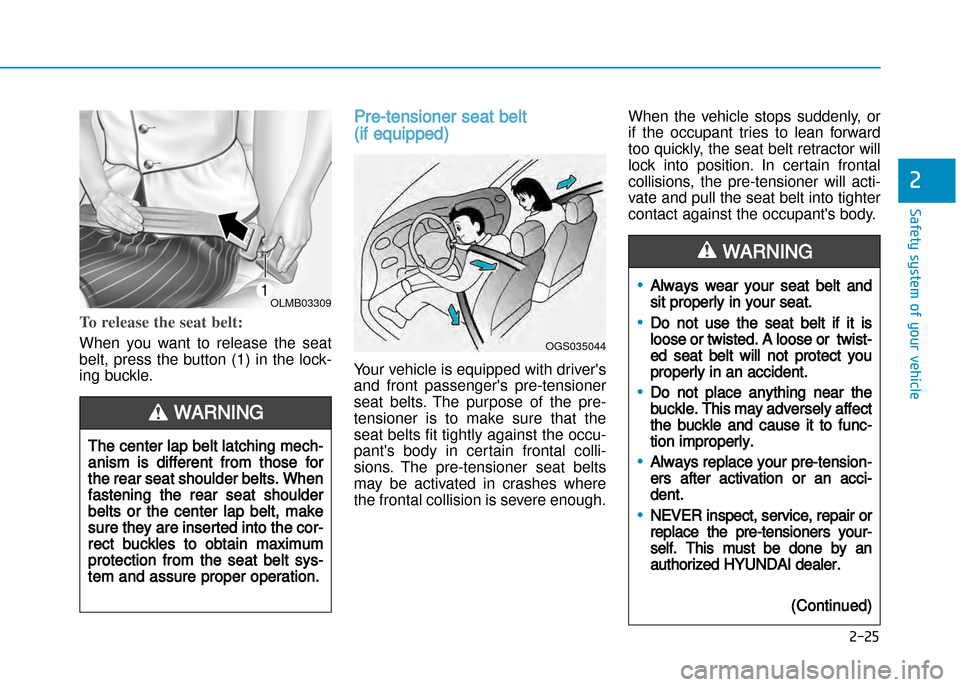
To release the seat belt:
When you want to release the seat
belt, press the button (1) in the lock
ing buckle.
Pretensioner seat belt
(if equipped)
Your vehicle is equipped with driver's
and front passenger's pretensioner
seat belts. The purpose of the pre
tensioner is to make sure that the
seat belts fit tightly against the occu
pant's body in certain frontal colli
sions. The pretensioner seat belts
may be activated in crashes where
the frontal collision is severe enough. When the vehicle stops suddenly, or
if the occupant tries to lean forward
too quickly, the seat belt retractor will
lock into position. In certain frontal
collisions, the pretensioner will acti
vate and pull the seat belt into tighter
contact against the occupant's body.
OGS035044
The center lap belt latching mech
anism is different from those for
the rear seat shoulder belts. When
fastening the rear seat shoulder
belts or the center lap belt, make
sure they are inserted into the cor
rect buckles to obtain maximum
protection from the seat belt sys
tem and assure proper operation.
WARNING
OLMB03309
•Always wear your seat belt and
sit properly in your seat.
•Do not use the seat belt if it is
loose or twisted. A loose or twist
ed seat belt will not protect you
properly in an accident.
•Do not place anything near the
buckle. This may adversely affect
the buckle and cause it to func
tion improperly.
•Always replace your pretension
ers after activation or an acci
dent.
•NEVER inspect, service, repair or
replace the pretensioners your
self. This must be done by an
authorized HYUNDAI dealer.
(Continued)
WARNING
Page 62 of 512

2-32
Safety system of your vehicle
To reduce the chance of serious or
fatal injuries:
•Children of all ages are safer
when restrained in the rear seat.
A child riding in the front passen
ger seat can be forcefully struck
by an inflating air bag resulting in
serious or fatal injuries.
•Always follow the instructions for
installation and use of the child
restraint maker.
•Always make sure the child seat
is secured properly in the car and
your child is securely restrained
in the child seat.
•Never hold a child in your arms or
lap when riding in a vehicle. The
violent forces created during a
crash will tear the child from your
arms and throw the child against
the car’s interior.
(Continued)
WARNING (Continued)
•Never put a seat belt over yourself
and a child. During a crash, the
belt could press deep into the
child causing serious internal
injuries.
•Never leave children unattended
in a vehicle – not even for a short
time. The car can heat up very
quickly, resulting in serious
injuries to children inside. Even
very young children may inadver
tently cause the vehicle to move,
entangle themselves in the win
dows, or lock themselves or oth
ers inside the vehicle.
•Never allow two children, or any
two persons, to use the same seat
belt.
•Children often squirm and reposi
tion themselves improperly.
Never let a child ride with the
shoulder belt under their arm or
behind their back. Always proper
ly position and secure children in
rear seat.
(Continued)
(Continued)
•Never allow a child to standup or
kneel on the seat or floorboard of
a moving vehicle. During a colli
sion or sudden stop, the child can
be violently thrown against the
vehicles interior, resulting in seri
ous injury.
•Never use an infant carrier or a
child safety seat that "hooks"
over a seatback, it may not pro
vide adequate security in an acci
dent.
•Seat belts can become very hot,
especially when the car is parked
in direct sunlight. Always check
seat belt buckles before fasten
ing them over a child.
•After an accident, we recom
mend that the system be
checked by an authorized
HYUNDAI dealer.
•If there is not enough space to
place the child restraint system
because of the driver's seat,
install the child restraint system
in the rear right seat.
Page 76 of 512

2-46
Safety system of your vehicle
Do not install a child restraint on
the front passenger's seat.
(if equipped)
Never place a rearfacing child
restraint in the front passenger’s
seat. If the air bag deploys, it would
impact the rearfacing child restraint,
causing serious or fatal injury.In addition, do not place frontfacing
child restraints in the front passen
ger’s seat either. If the front passen
ger air bag inflates, it would cause
serious or fatal injuries to the child.
OLM034310
OYDESA2042
■
Type A
■Type B
•NEVER use a rearward facing
child restraint on a seat protect
ed by an ACTIVE AIR BAG in
front of it, DEATH or SERIOUS
INJURY to the CHILD can
occur.
•Never put a child restraint in the
front passenger’s seat. If the
front passenger air bag inflates,
it would cause serious or fatal
injuries.
(Continued)
WARNING
(Continued)
•When children are seated in the
rear outboard seats of vehicle
equipped with curtain air bags,
be sure to install the child
restraint system as far away
from the door side as possible,
and securely lock the child
restraint system in position.
Inflation of curtain air bags could
cause serious injury or death to
an infant or child.
Page 80 of 512

2-50
Safety system of your vehicle
(Continued)
•When installing a container of
liquid air freshener inside the
vehicle, do not place it near the
instrument cluster nor on the
instrument panel surface.
It may become a dangerous pro
jectile and cause injury if the pas
senger's air bag inflates.
•If an air bag deploys, there may
be a loud noise followed by a fine
dust released in the vehicle.
These conditions are normal and
are not hazardous the air bags
are packed in this fine powder.
The dust generated during air
bag deployment may cause skin
or eye irritation as well as aggra
vate asthma for some persons.
Always wash all exposed skin
areas thoroughly with cold water
and a mild soap after an accident
in which the air bags were
deployed.
(Continued)
WARNING (Continued)
•The SRS can function only
when the ignition switch is in the
ON position.
•Before you replace a fuse or dis
connect a battery terminal, turn
the ignition switch to the LOCK
position and remove the ignition
key. Never remove or replace
the air bag related fuse(s) when
the ignition switch is in the ON
position. Failure to heed this
warning will cause the SRS air
bag warning light to illuminate.