Page 554 of 585
553
uuFusesuFuse Locations
Continued
Handling the Unexpected
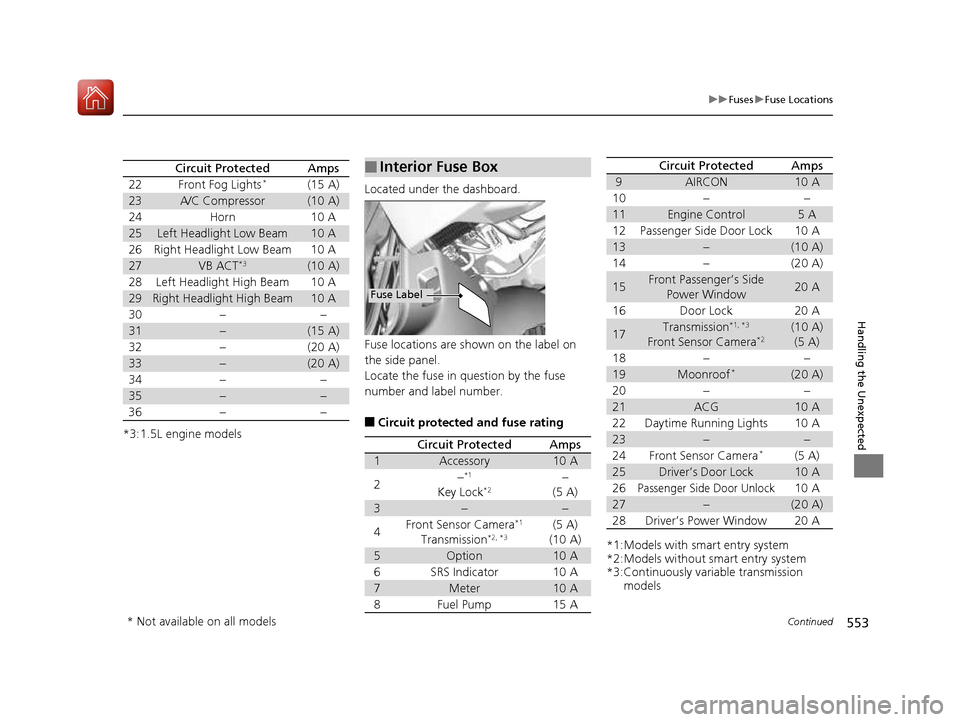
*3:1.5L engine models
Circuit ProtectedAmps
22 Front Fog Lights *
(15 A)
23A/C Compressor(10 A)
24 Horn 10 A
25Left Headlight Low Beam10 A
26 Right Headlight Low Beam 10 A
27VB ACT *3(10 A)
28 Left Headlight High Beam 10 A
29Right Headlight High Beam10 A
30 − −
31−(15 A)
32 − (20 A)
33−(20 A)
34 − −
35−−
36 − −
Located under the dashboard.
Fuse locations are shown on the label on
the side panel.
Locate the fuse in question by the fuse
number and label number. ■ Circuit protected and fuse rating
■Interior Fuse Box
Fuse Label
Circuit ProtectedAmps
1Accessory10 A
2−*1
Key Lock *2−
(5 A)
3−−
4Front Sensor Camera *1
Transmission *2, *3(5 A)
(10 A)
5Option10 A
6SRS Indicator10 A
7Meter10 A
8Fuel Pump15 A
*1:Models with smart entry system
*2:Models without smart entry system
*3:Continuously variable transmission models
9AIRCON10 A
10−−
11Engine Control5A
12Passenger Side Door Lock10 A
13−(10 A)
14−(20 A)
15Front Passenger’s Side
Power Window20 A
16Door Lock20 A
17Transmission *1, *3
Front Sensor Camera *2(10 A)
(5 A)
18−−
19Moonroof *(20 A)
20−−
21ACG10 A
22Daytime Running Lights10 A
23−−
24Front Sensor Camera *(5 A)
25Driver’s Door Lock10 A
26Passenger Side Door Unlock10 A
27−(20 A)
28Driver’s Power Window20 A
Circuit ProtectedAmps
* Not available on all models
16 CIVIC 2D HC2 (0A 01 0C)-31TBG6000.book 553 ページ >0>.>/6年>0月>/>0日
金曜日 午後4時>/6分
Page 557 of 585
556
Handling the Unexpected
Emergency Towing
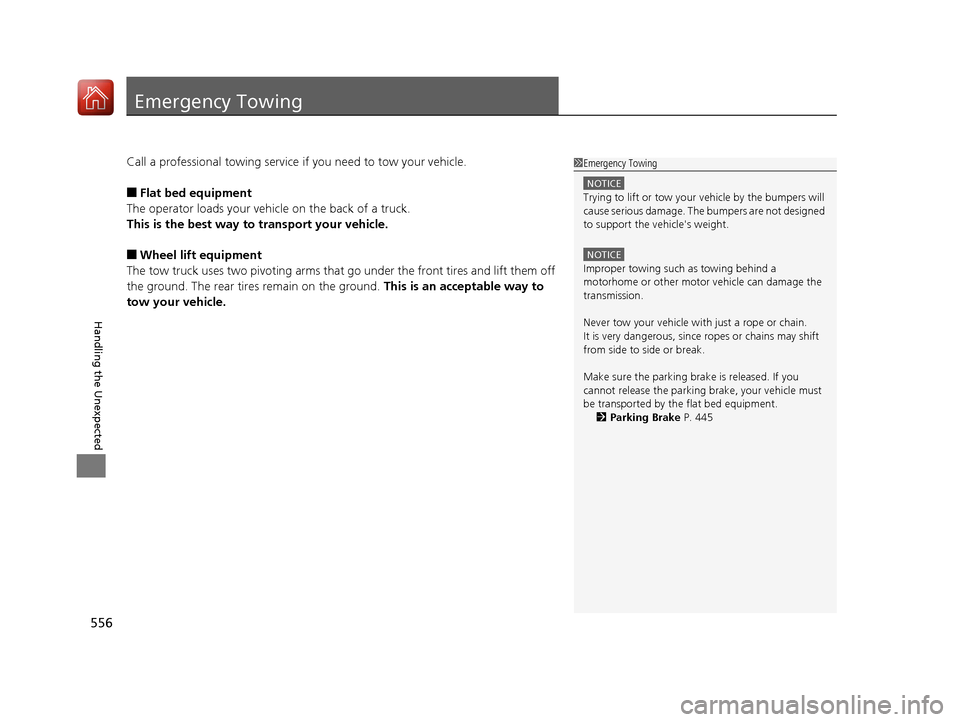
Call a professional towing service if you need to tow your vehicle. ■Flat bed equipment
The operator loads your vehicle on the back of a truck.
This is the best way to transport your vehicle. ■ Wheel lift equipment
The tow truck uses two pivoti ng arms that go under the front tires and lift them off
the ground. The rear tires remain on the ground. This is an acceptable way to
tow your vehicle.1Emergency Towing
NOTICE
Trying to lift or tow your vehicle by the bumpers will
cause serious damage. The bumpers are not designed
to support the vehicle's weight.
NOTICE
Improper towing such as towing behind a motorhome or other motor vehicle can damage the
transmission.
Never tow your vehicle with just a rope or chain.
It is very dangerous, since ropes or chains may shift
from side to side or break.
Make sure the parking brake is released. If you
cannot release the parking brake, your vehicle must
be transported by the flat bed equipment.
2 Parking Brake P. 445
16 CIVIC 2D HC2 (0A 01 0C)-31TBG6000.book 556 ページ >0>.>/6年>0月>/>0日 金曜日 午後4時>/6分
Page 562 of 585
561
Information
This chapter includes your vehicl e's specifications, locations of identification numbers, and other
information required by regulation.
Specifications .................................... 562
Identification Numbers Vehicle Identification Number (VIN),
Engine Number and Transmission
Number ......................................... 566
Devices that Emit Radio Waves ....... 567
Reporting Safety Defects ................. 568Emissions Testing
Testing of Readiness Codes.............. 569
Warranty Coverages ........................ 571
Authorized Manuals ......................... 573
Customer Service Information ......... 574
16 CIVIC 2D HC2 (0A 01 0C)-31TBG6000.book 561 ページ >0>.>/6年>0月>/>0日 金曜日 午後4時>/6分
Page 564 of 585
563
uuSpecificationsu
Continued
Information
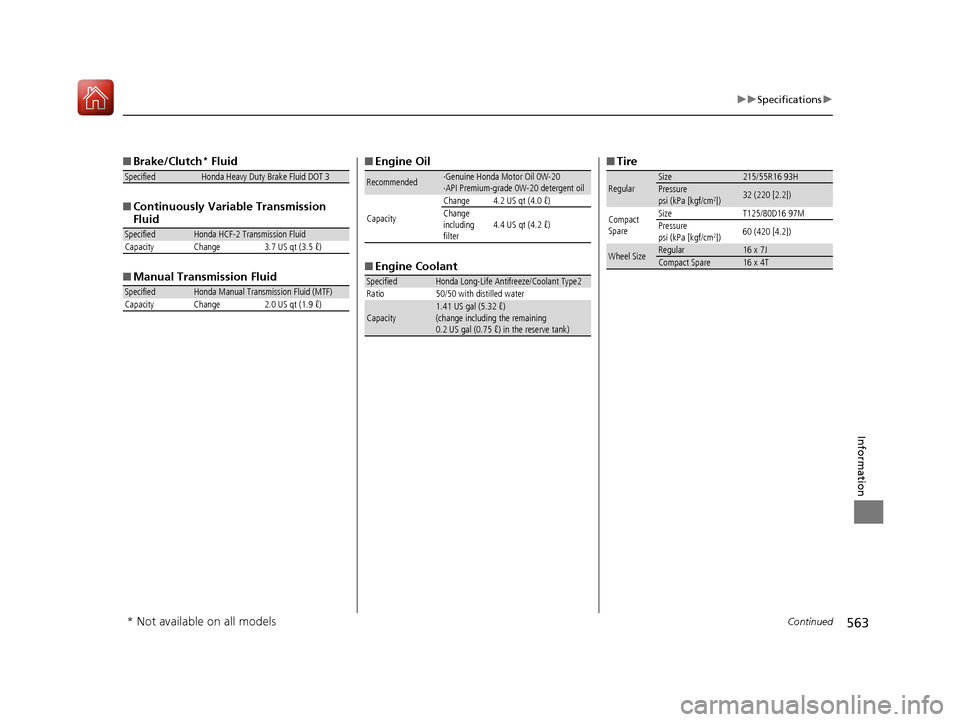
■Brake/Clutch*
Fluid
■Continuously Variable Transmission Fluid
■Manual Transmission Fluid
SpecifiedHonda Heavy Duty Brake Fluid DOT 3
SpecifiedHonda HCF-2 Transmission Fluid
Capacity Change 3.7 US qt (3.5 ℓ)
SpecifiedHonda Manual Transmission Fluid (MTF)
Capacity Change 2.0 US qt (1.9 ℓ)
■Engine Oil
■Engine Coolant
Recommended
Page 566 of 585
565
uuSpecificationsu
Information
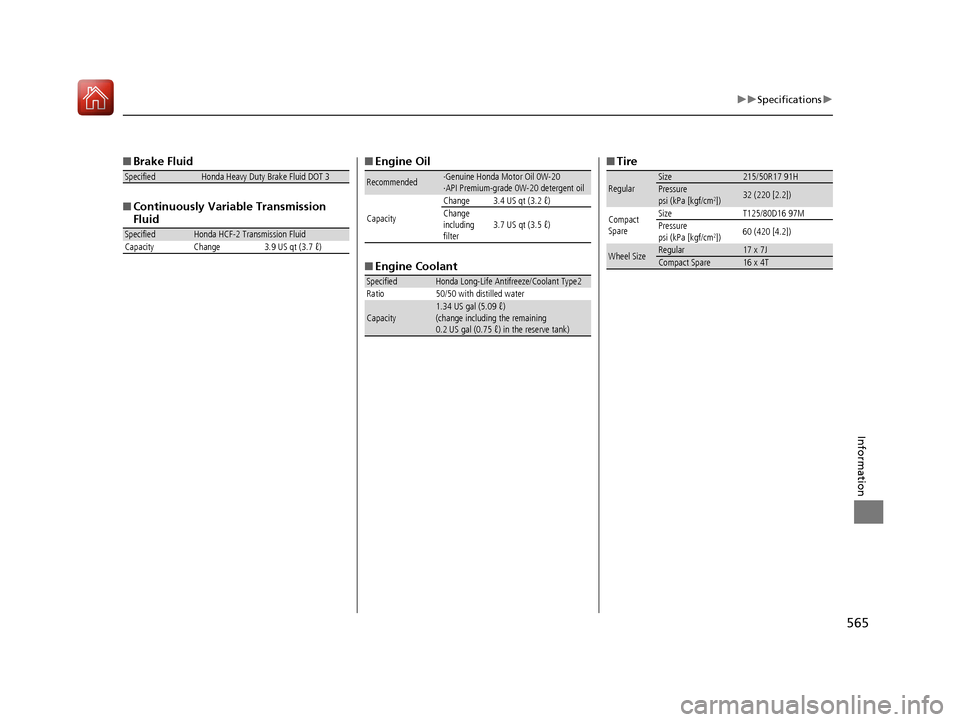
■Brake Fluid
■Continuously Variable Transmission Fluid
SpecifiedHonda Heavy Duty Brake Fluid DOT 3
SpecifiedHonda HCF-2 Transmission Fluid
Capacity Change 3.9 US qt (3.7 ℓ)
■Engine Oil
■Engine Coolant
Recommended
Page 567 of 585
566
Information
Identification Numbers
Vehicle Identification Number (VIN), Engine Number
and Transmission Number
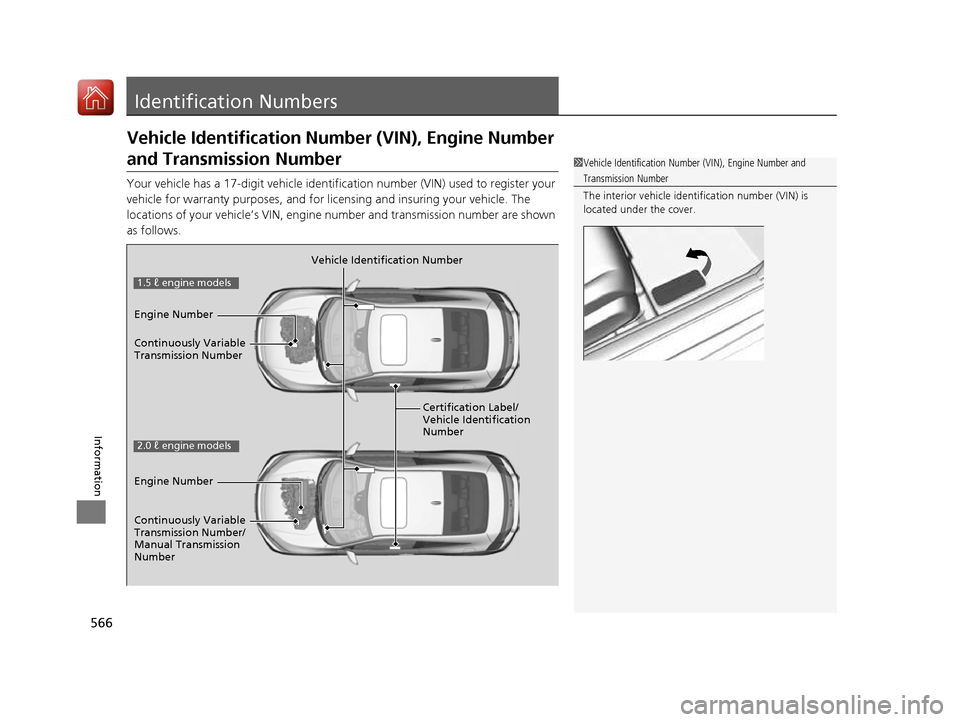
Your vehicle has a 17-digit vehicle identification number (VIN) used to register your
vehicle for warranty purposes, and for licensing and insuring your vehicle. The
locations of your vehicle’s VIN, engine number and transmission number are shown
as follows.1Vehicle Identification Number (VIN), Engine Number and
Transmission Number
The interior vehicle identification number (VIN) is
located under the cover.
Vehicle Identification Number
Engine Number
Certification Label/
Vehicle Identification
Number
2.0 ℓ engine models
1.5 ℓ engine models
Continuously Variable
Transmission Number
Engine Number
Continuously Variable
Transmission Number/
Manual Transmission
Number
16 CIVIC 2D HC2 (0A 01 0C)-31TBG6000.book 566 ページ >0>.>/6年>0月>/>0日 金曜日 午後4時>/6分
Page 570 of 585
569
Continued
Information
Emissions Testing
Testing of Readiness Codes
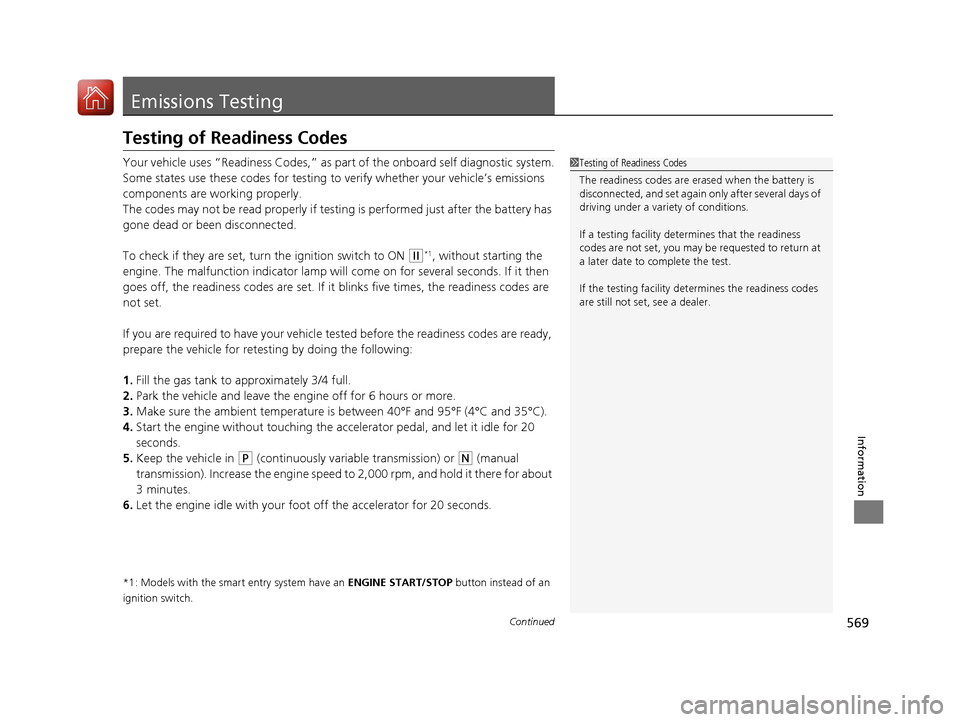
Your vehicle uses “Readiness Codes,” as part of the onboard self diagnostic system.
Some states use these codes for testing to
verify whether your vehicle’s emissions
components are working properly.
The codes may not be read properly if testing is performed just after the battery has
gone dead or been disconnected.
To check if they are set, tu rn the ignition switch to ON
(w*1
, without starting the
engine. The malfunction indicator lamp will co me on for several seconds. If it then
goes off, the readiness codes are set. If it blinks five times, the readiness codes are
not set.
If you are required to have your vehicle te sted before the readiness codes are ready,
prepare the vehicle for retest ing by doing the following:
1. Fill the gas tank to approximately 3/4 full.
2. Park the vehicle and leave the engine off for 6 hours or more.
3. Make sure the ambient temperature is between 40°F and 95°F (4°C and 35°C).
4. Start the engine without touching the ac celerator pedal, and let it idle for 20
seconds.
5. Keep the vehicle in
(P (continuously variable transmission) or (N (manual
transmission). Increase the engine speed to 2,000 rpm, and hold it there for about
3 minutes.
6. Let the engine idle with your foot off the accelerator for 20 seconds.
*1: Models with the smart entry system have an ENGINE START/STOP button instead of an
ignition switch.
1Testing of Readiness Codes
The readiness codes are erased when the battery is
disconnected, and set again onl y after several days of
driving under a vari ety of conditions.
If a testing facility determines that the readiness
codes are not set, you may be requested to return at
a later date to complete the test.
If the testing facility determines the readiness codes
are still not set, see a dealer.
16 CIVIC 2D HC2 (0A 01 0C)-31TBG6000.book 569 ページ >0>.>/6年>0月>/>0日 金曜日 午後4時>/6分
Page 571 of 585
570
uuEmissions TestinguTesting of Readiness Codes
Information
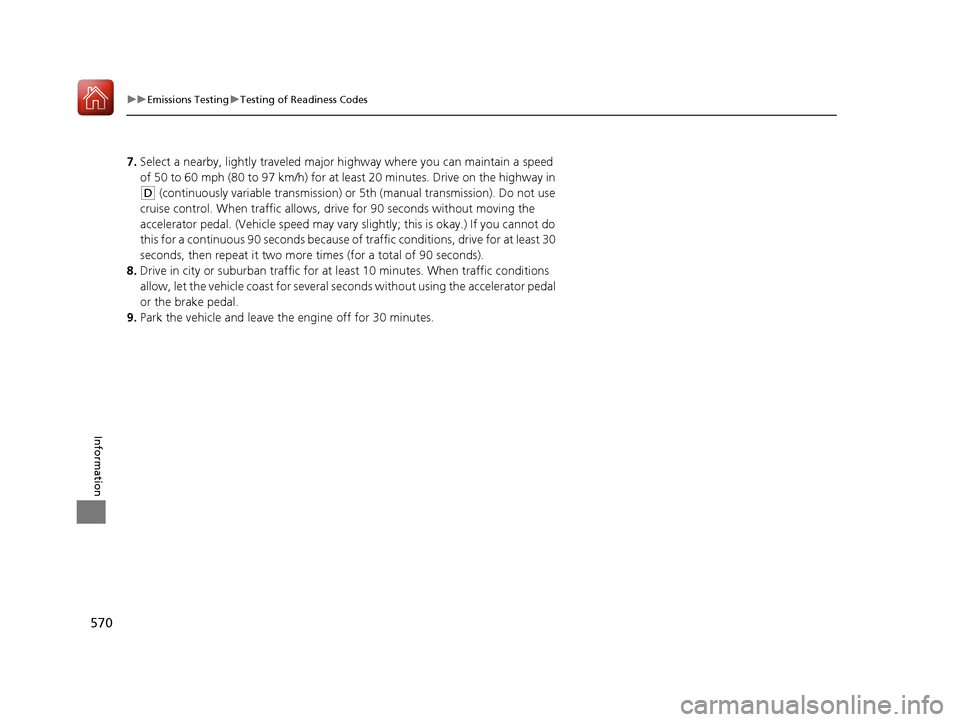
7.Select a nearby, lightly traveled major hi ghway where you can maintain a speed
of 50 to 60 mph (80 to 97 km/h) for at least 20 minutes. Drive on the highway in
(D (continuously variable transmission) or 5th (manual transmission). Do not use
cruise control. When tra ffic allows, drive for 90 seconds without moving the
accelerator pedal. (Vehicle speed may vary slightly; this is okay.) If you cannot do
this for a continuous 90 seconds because of traffic conditions, drive for at least 30
seconds, then repeat it two more times (for a total of 90 seconds).
8. Drive in city or suburban traffic for at le ast 10 minutes. When traffic conditions
allow, let the vehicle coast for several se conds without using the accelerator pedal
or the brake pedal.
9. Park the vehicle and leave the engine off for 30 minutes.
16 CIVIC 2D HC2 (0A 01 0C)-31TBG6000.book 570 ページ >0>.>/6年>0月>/>0日 金曜日 午後4時>/6分