2016 FORD TAURUS check engine light
[x] Cancel search: check engine lightPage 244 of 424
WARNINGS
Do not put engine coolant in the
windshield washer fluid container. If
sprayed on the windshield, engine
coolant could make it difficult to see
through the windshield. To reduce the risk of personal injury,
make sure the engine is cool before
unscrewing the coolant pressure
relief cap. The cooling system is under
pressure. Steam and hot liquid can come
out forcefully when you loosen the cap
slightly. Do not add coolant further than the
MAX mark.
Checking the Engine Coolant
When the engine is cold, check the
concentration and level of the engine
coolant at the intervals listed in the
scheduled maintenance information.
See
Scheduled Maintenance (page 375).
Note: Make sure that the coolant level is
between the
MIN and MAX marks on the
coolant reservoir.
Note: Coolant expands when it is hot. The
level may extend beyond the
MAX mark.
Note: If the level is at the MIN mark, below
the MIN mark, or empty, add coolant
immediately.
Maintain coolant concentration within
48% to 50%, which equates to a freeze
point between -30°F (-34°C) and -34°F
(-37°C).
Note: For best results, coolant
concentration should be tested with a
refractometer such as Robinair® Coolant
and Battery Refractometer 75240. We do
not recommend the use of hydrometers or
coolant test strips for measuring coolant
concentrations. Note:
Automotive fluids are not
interchangeable. Do not use engine coolant,
antifreeze or windshield washer fluid outside
of its specified function and vehicle location.
Adding Engine Coolant
Note: Do not use stop leak pellets, cooling
system sealants or additives as they can
cause damage to the engine cooling or
heating systems. Your warranty may not
cover these damages.
Note: During normal vehicle operation, the
coolant may change color from orange to
pink or light red. As long as the coolant is
clear and uncontaminated, this color change
does not indicate the coolant has degraded
nor does it require the coolant to be drained,
the system to be flushed, or the coolant to
be replaced.
Do not mix different colors or types of
coolant in your vehicle. Mixing of engine
coolants may harm your engine ’s cooling
system. Use prediluted engine coolant
meeting the correct specification. See
Capacities and Specifications
(page
294). The use of an incorrect coolant may
harm the engine or cooling system
components and may not be covered by
the vehicle Warranty.
In case of emergency, you can add a large
amount of water without engine coolant
in order to reach a vehicle service location.
In this instance, qualified personnel:
1. Must drain the cooling system.
2. Chemically clean the cooling system with Motorcraft Premium Cooling
System Flush.
3. Refill with engine coolant as soon as possible.
Water alone, without engine coolant, can
cause engine damage from corrosion,
overheating or freezing.
241
Taurus (CPH) Canada/United States of America, enUSA, First Printing Maintenance
Page 245 of 424
Do not use the following as a coolant
substitute:
•
Alcohol.
• Methanol.
• Brine.
• Any engine coolant mixed with alcohol
or methanol antifreeze or coolant.
Alcohol and other liquids can cause engine
damage from overheating or freezing.
Do not add extra inhibitors or additives to
the coolant. These can be harmful and
compromise the corrosion protection of
the engine coolant.
When adding coolant:
1. Unscrew the cap slowly. Any pressure will escape as you unscrew the cap.
2. Add prediluted engine coolant meeting
the correct specification. See
Capacities and Specifications (page
294).
3. Check the coolant level in the coolant reservoir the next few times you drive
your vehicle.
4. If necessary, add enough prediluted engine coolant to bring the coolant
level to the proper level.
Recycled Engine Coolant
We do not recommend the use of recycled
engine coolant as an approved recycling
process is not yet available.
Used engine coolant should be disposed
of in an appropriate manner. Follow your
community ’s regulations and standards
for recycling and disposing of automotive
fluids. Severe Climates
If you drive in extremely cold climates:
•
It may be necessary to have an
authorized dealer increase the coolant
concentration above 50%.
• A coolant concentration of 60%
provides improved freeze point
protection. Engine coolant
concentrations above 60% decrease
the overheat protection characteristics
of the engine coolant and may cause
engine damage.
If you drive in extremely hot climates:
• It may be necessary to have an
authorized dealer decrease the coolant
concentration to 40%.
• A coolant concentration of 40%
provides improved overheat protection.
Engine coolant concentrations below
40% decrease the freeze and corrosion
protection characteristics of the engine
coolant and may cause engine
damage.
Vehicles driven year-round in non-extreme
climates should use prediluted engine
coolant for optimum cooling system and
engine protection.
What You Should Know About Fail-
Safe Cooling
If you deplete the engine coolant supply,
fail-safe cooling allows you to temporarily
drive your vehicle before you incur
incremental component damage. The
fail-safe distance depends on ambient
temperatures, vehicle load and terrain.
How Fail-Safe Cooling Works
If the engine begins to overheat, the engine
coolant temperature gauge will move to
the red (hot) area and: the coolant temperature warning
light will illuminate
242
Taurus (CPH) Canada/United States of America, enUSA, First Printing Maintenance
Page 268 of 424

General Information
WARNING
Failure to follow these guidelines
could result in an increased risk of
loss of vehicle control, injury or death.
Note:
Do not use the kit if a tire has become
severely damaged by driving the vehicle with
a tire that has insufficient air pressure. Only
punctured areas located within the tire tread
can be sealed with the kit.
Do not attempt to repair punctures larger
than ¼ inch (6 millimeters) or damage to
the tire's sidewall. The tire may not
completely seal.
Loss of air pressure may adversely affect
tire performance. For this reason:
Note: Do not drive the vehicle above
50 mph (80 km/h).
Note: Do not drive further than
120 mi
(200 km). Drive only to the closest
authorized Ford dealer or tire repair shop to
have your tire inspected.
• Drive carefully and avoid abrupt
steering maneuvers.
• Periodically monitor tire inflation
pressure in the affected tire. If the tire
is losing pressure, have the vehicle
towed.
• Read the information in the Tips for
Use of the Kit section to make sure safe
operation of the kit and your vehicle.
Tips for Use of the Kit
Read the following list of tips to ensure
safe operation of the kit: •
Before operating the kit, make sure
your vehicle is safely off the road and
away from moving traffic. Turn on the
hazard lights.
• Always set the parking brake to ensure
the vehicle does not move
unexpectedly.
• Do not remove any foreign objects,
such as nails or screws, from the tire.
• When using the kit, leave the engine
running (only if the vehicle is outdoors
or in a well-ventilated area) so the
compressor does not drain the vehicle
battery.
• Do not allow the compressor to
operate continuously for more than 15
minutes. This will help prevent the
compressor from overheating.
• Never leave the kit unattended when
it is operating.
• Sealant compound contains latex.
Make sure that you use the non-latex
gloves provided to avoid an allergic
reaction.
• Keep the kit away from children.
• Only use the kit when the ambient
temperature is between
-22°F (-30°C)
and 158°F (70°C).
• Only use the sealing compound before
the use by date. The use by date is on
the lower right hand corner of the label
located on the sealant canister
(bottle). Check the use by date
regularly and replace the canister after
four years.
• Do not store the kit unsecured inside
the passenger compartment of the
vehicle as it may cause injury during a
sudden stop or crash. Always store the
kit in its original location.
• After sealant use, the tire pressure
monitoring system sensor and valve
stem on the wheel must be replaced
by an authorized Ford dealer.
265
Taurus (CPH) Canada/United States of America, enUSA, First Printing Wheels and Tires
Page 269 of 424
•
When inflating a tire or other objects,
use the black air hose only. Do not use
the transparent hose which is designed
for sealant application only.
• Operating the kit could cause an
electrical disturbance in radio, CD, and
DVD player operation.
What to do when a Tire Is
Punctured
A tire puncture within the tire tread area
can be repaired in two stages with the kit.
• In the first stage, the tire will be
reinflated with a sealing compound
and air. After the tire has been
reinflated, you will need to drive the
vehicle a short distance 4 mi (6 km) to
distribute the sealant in the tire.
• In the second stage, you will need to
check the tire pressure and adjust, if
necessary, to the vehicle tire inflation
pressure.
First Stage: Reinflating the Tire
with Sealing Compound and Air WARNINGS
Do not stand directly over the kit
while inflating the tire. If you notice
any unusual bulges or deformations
in the tire sidewall during inflation, stop
and call roadside assistance. If the tire does not inflate to the
recommended tire pressure within
15 minutes, stop and call roadside
assistance. Preparation: Park the vehicle in a safe, level
and secure area, away from moving traffic.
Turn the hazard lights on. Apply the parking
brake and turn the engine off. Inspect the
flat tire for visible damage. Sealant compound contains latex. To
avoid any allergic reactions, use the
non-latex gloves located in the accessory
box on the underside of the kit housing.
Do not remove any foreign object that has
pierced the tire. If a puncture is located in
the tire sidewall, stop and call roadside
assistance.
1. Remove the valve cap from the tire
valve.
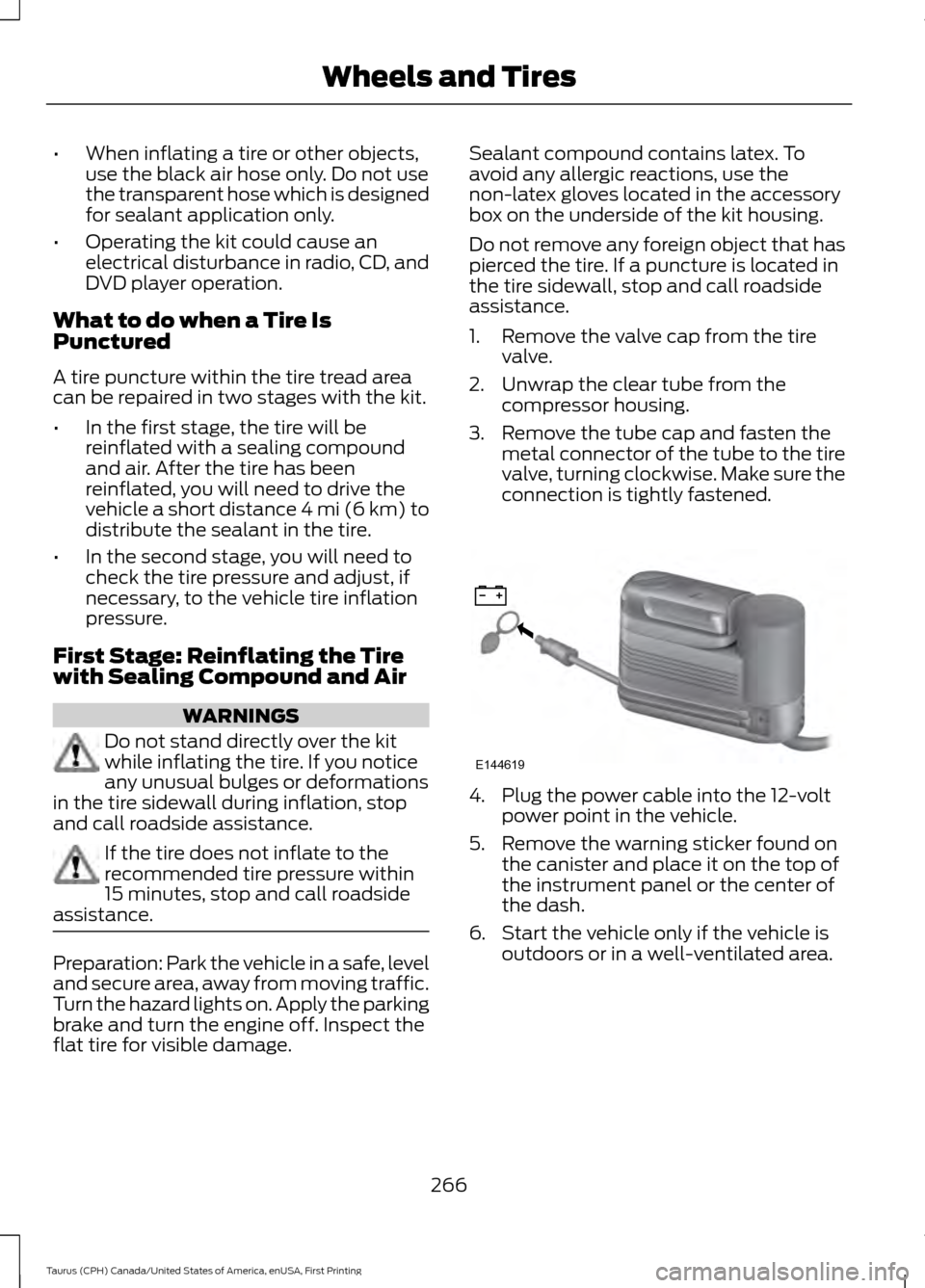
2. Unwrap the clear tube from the compressor housing.
3. Remove the tube cap and fasten the metal connector of the tube to the tire
valve, turning clockwise. Make sure the
connection is tightly fastened. 4. Plug the power cable into the 12-volt
power point in the vehicle.
5. Remove the warning sticker found on the canister and place it on the top of
the instrument panel or the center of
the dash.
6. Start the vehicle only if the vehicle is outdoors or in a well-ventilated area.
266
Taurus (CPH) Canada/United States of America, enUSA, First Printing Wheels and TiresE144619
Page 380 of 424
Check every month
Engine oil level.
Function of all interior and exterior lights.
Tires (including spare) for wear and proper pressure. Windshield washer fluid level. Check every six months
Battery connections. Clean if necessary.
Body and door drain holes for obstructions. Clean if necessary. Cooling system fluid level and coolant strength.
Door weatherstrips for wear. Lubricate if necessary.
Hinges, latches and outside locks for proper operation. Lubricate if necessary. Parking brake for proper operation.
Safety belts and seat latches for wear and function.
Safety warning lamps (brake, ABS, airbag and safety belt) for operation.
Washer spray and wiper operation. Clean or replace blades as necessary.
Multi-Point Inspection
In order to keep your vehicle running right,
it is important to have the systems on your
vehicle checked regularly. This can help
identify potential issues and prevent major
problems. We recommend having the
following multi-point inspection performed
at every scheduled maintenance interval
to help make sure your vehicle keeps
running great.
377
Taurus (CPH) Canada/United States of America, enUSA, First Printing Scheduled Maintenance
Page 416 of 424
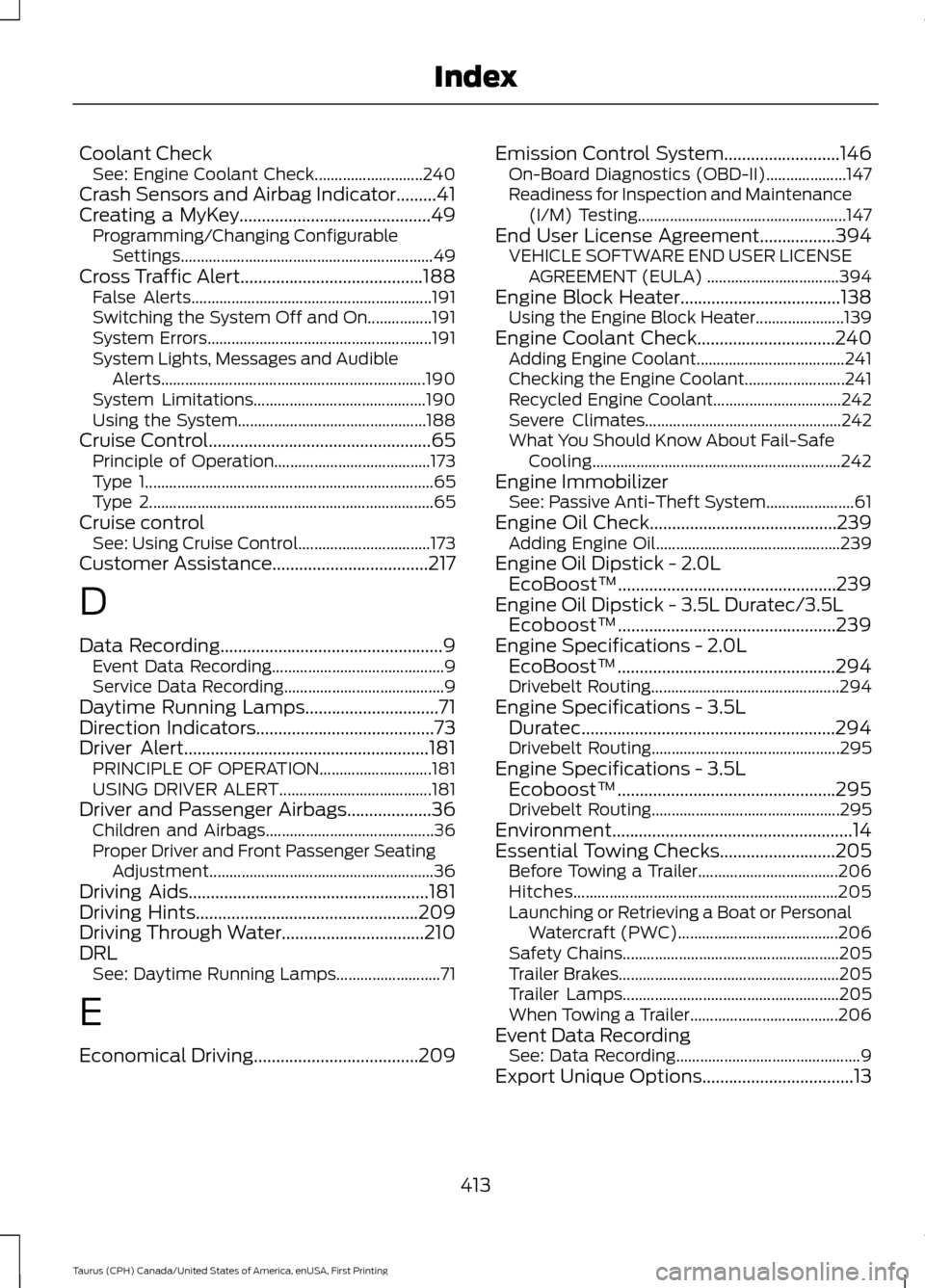
Coolant Check
See: Engine Coolant Check........................... 240
Crash Sensors and Airbag Indicator.........41
Creating a MyKey...........................................49
Programming/Changing Configurable
Settings............................................................... 49
Cross Traffic Alert.........................................188 False Alerts............................................................ 191
Switching the System Off and On................191
System Errors........................................................ 191
System Lights, Messages and Audible Alerts.................................................................. 190
System Limitations........................................... 190
Using the System............................................... 188
Cruise Control..................................................65 Principle of Operation....................................... 173
Type 1........................................................................\
65
Type 2....................................................................... 65
Cruise control See: Using Cruise Control................................. 173
Customer Assistance
...................................217
D
Data Recording
..................................................9
Event Data Recording........................................... 9
Service Data Recording........................................ 9
Daytime Running Lamps..............................71
Direction Indicators
........................................73
Driver Alert.......................................................181 PRINCIPLE OF OPERATION............................ 181
USING DRIVER ALERT...................................... 181
Driver and Passenger Airbags...................36 Children and Airbags.......................................... 36
Proper Driver and Front Passenger Seating Adjustment........................................................ 36
Driving Aids......................................................181
Driving Hints
..................................................209
Driving Through Water................................210
DRL See: Daytime Running Lamps.......................... 71
E
Economical Driving
.....................................209 Emission Control System..........................146
On-Board Diagnostics (OBD-II).................... 147
Readiness for Inspection and Maintenance (I/M) Testing.................................................... 147
End User License Agreement.................394 VEHICLE SOFTWARE END USER LICENSE
AGREEMENT (EULA) ................................. 394
Engine Block Heater....................................138 Using the Engine Block Heater...................... 139
Engine Coolant Check...............................240 Adding Engine Coolant..................................... 241
Checking the Engine Coolant......................... 241
Recycled Engine Coolant................................ 242
Severe Climates................................................. 242
What You Should Know About Fail-Safe Cooling.............................................................. 242
Engine Immobilizer See: Passive Anti-Theft System...................... 61
Engine Oil Check
..........................................239
Adding Engine Oil.............................................. 239
Engine Oil Dipstick - 2.0L EcoBoost™.................................................239
Engine Oil Dipstick - 3.5L Duratec/3.5L Ecoboost™.................................................239
Engine Specifications - 2.0L EcoBoost™.................................................294
Drivebelt Routing............................................... 294
Engine Specifications - 3.5L Duratec.........................................................294
Drivebelt Routing............................................... 295
Engine Specifications - 3.5L Ecoboost™.................................................295
Drivebelt Routing............................................... 295
Environment......................................................14
Essential Towing Checks
..........................205
Before Towing a Trailer................................... 206
Hitches.................................................................. 205
Launching or Retrieving a Boat or Personal Watercraft (PWC)........................................ 206
Safety Chains...................................................... 205
Trailer Brakes....................................................... 205
Trailer Lamps...................................................... 205
When Towing a Trailer..................................... 206
Event Data Recording See: Data Recording.............................................. 9
Export Unique Options..................................13
413
Taurus (CPH) Canada/United States of America, enUSA, First Printing Index
Page 423 of 424
Using Stability Control...............................163
Using Summer Tires...................................283
Using SYNC™ With Your Media Player.............................................................352
Accessing Your Play Menu.............................. 357
Connecting Your Digital Media Player to the USB Port........................................................... 352
Media Menu Features...................................... 355
Media Voice Commands................................ 354
System Settings................................................. 359
What's Playing?................................................. 353
Using SYNC™ With Your Phone
............329
Accessing Features Through the Phone
Menu.................................................................. 333
Accessing Your Phone Settings................... 338
Making a Call....................................................... 332
Pairing a Cell Phone for the First Time................................................................... 329
Pairing Subsequent Cell Phones.................330
Phone Options during an Active Call.........332
Phone Voice Commands................................ 330
Receiving Calls.................................................... 332
System Settings................................................. 339
Text Messaging................................................... 336
Using Traction Control.................................161 Switching the System Off................................ 161
System Indicator Lights and Messages........................................................... 161
Using a Switch...................................................... 161
Using the Information Display Controls.............................................................. 161
Using Voice Recognition...........................326 Initiating a Voice Session................................ 326
System Interaction and Feedback...............327
Utilizing the Mediation/Arbitration Program (Canada Only)
........................220
V
Vehicle Care
....................................................257
General Information.......................................... 257
Vehicle Certification Label
......................300
Vehicle Identification Number...............299 Vehicle Storage
.............................................262
Battery................................................................... 263
Body........................................................................\
262
Brakes.................................................................... 263
Cooling system................................................... 263
Engine.................................................................... 262
Fuel system.......................................................... 263
General.................................................................. 262
Miscellaneous..................................................... 263
Removing Vehicle From Storage.................263
Tires........................................................................\
263
Ventilation See: Climate Control......................................... 106
VIN See: Vehicle Identification Number............299
Voice Control
...................................................65
W
Warning Lamps and Indicators
.................82
Adaptive Cruise Control..................................... 82
Anti-Lock Braking System................................ 82
Automatic High Beam Control........................ 82
Battery...................................................................... 82
Blind Spot Monitor............................................... 82
Brake System......................................................... 83
Cruise Control........................................................ 83
Direction Indicator............................................... 83
Door Ajar.................................................................. 83
Engine Coolant Temperature.......................... 83
Engine Oil................................................................ 83
Fasten Seatbelt.................................................... 83
Front Airbag............................................................ 83
Front Fog Lamps.................................................. 83
Heads Up Display................................................ 84
High Beam.............................................................. 84
Lane Keeping Aid................................................. 84
Low Fuel Level...................................................... 84
Low Tire Pressure Warning............................... 84
Low Washer Fluid................................................ 84
Parking Lamps...................................................... 84
Powertrain Fault................................................... 84
Service Engine Soon........................................... 84
Stability Control................................................... 85
Stability Control Off............................................ 85
Washer Fluid Check....................................248
420
Taurus (CPH) Canada/United States of America, enUSA, First Printing Index