2016 FORD FOCUS ELECTRIC light
[x] Cancel search: lightPage 166 of 276
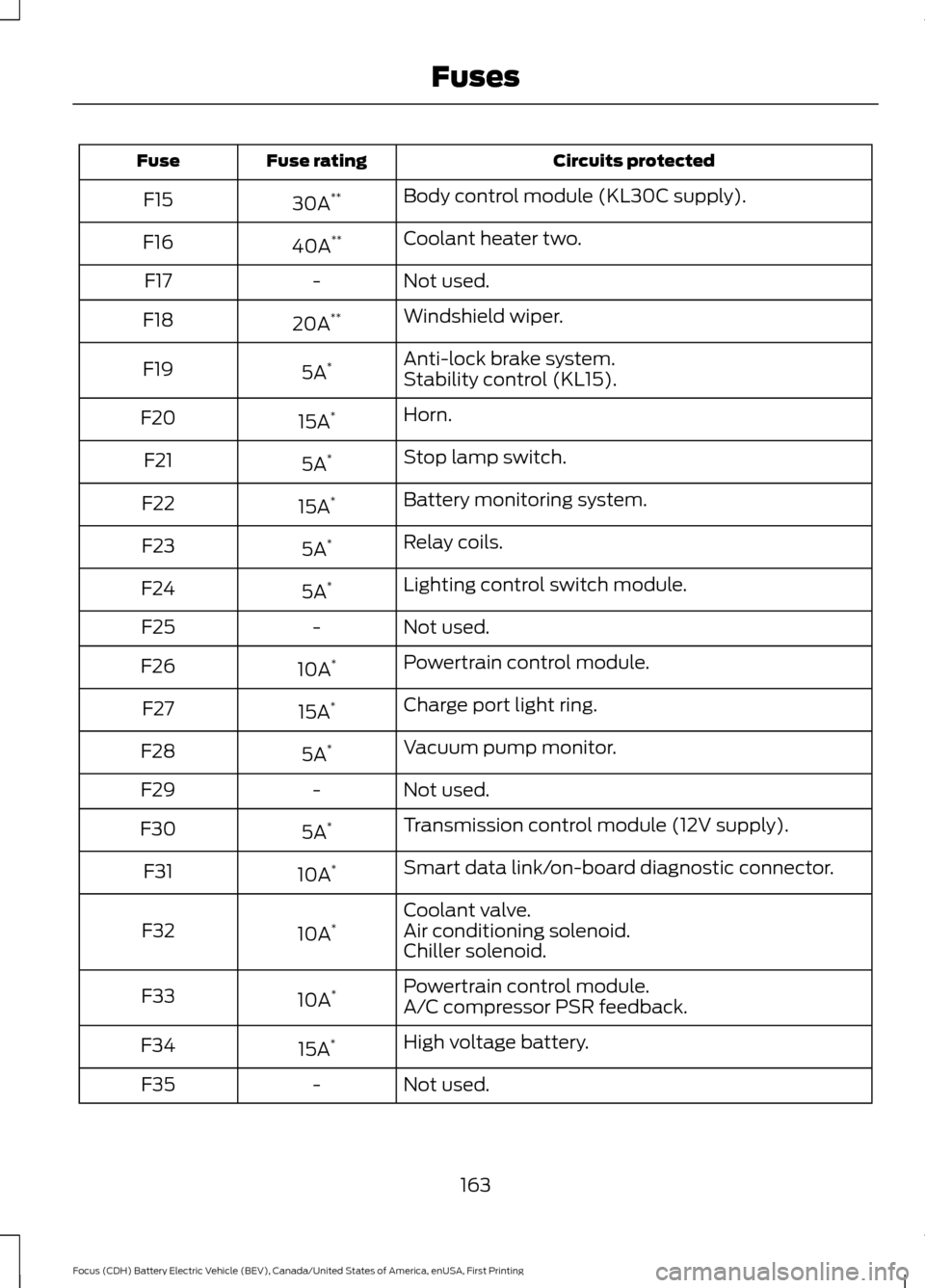
Circuits protected
Fuse rating
Fuse
Body control module (KL30C supply).
30A **
F15
Coolant heater two.
40A **
F16
Not used.
-
F17
Windshield wiper.
20A **
F18
Anti-lock brake system.
5A *
F19
Stability control (KL15).
Horn.
15A *
F20
Stop lamp switch.
5A *
F21
Battery monitoring system.
15A *
F22
Relay coils.
5A *
F23
Lighting control switch module.
5A *
F24
Not used.
-
F25
Powertrain control module.
10A *
F26
Charge port light ring.
15A *
F27
Vacuum pump monitor.
5A *
F28
Not used.
-
F29
Transmission control module (12V supply).
5A *
F30
Smart data link/on-board diagnostic connector.
10A *
F31
Coolant valve.
10A *
F32 Air conditioning solenoid.
Chiller solenoid.
Powertrain control module.
10A *
F33
A/C compressor PSR feedback.
High voltage battery.
15A *
F34
Not used.
-
F35
163
Focus (CDH) Battery Electric Vehicle (BEV), Canada/United States of America, enUSA, First Printing Fuses
Page 167 of 276
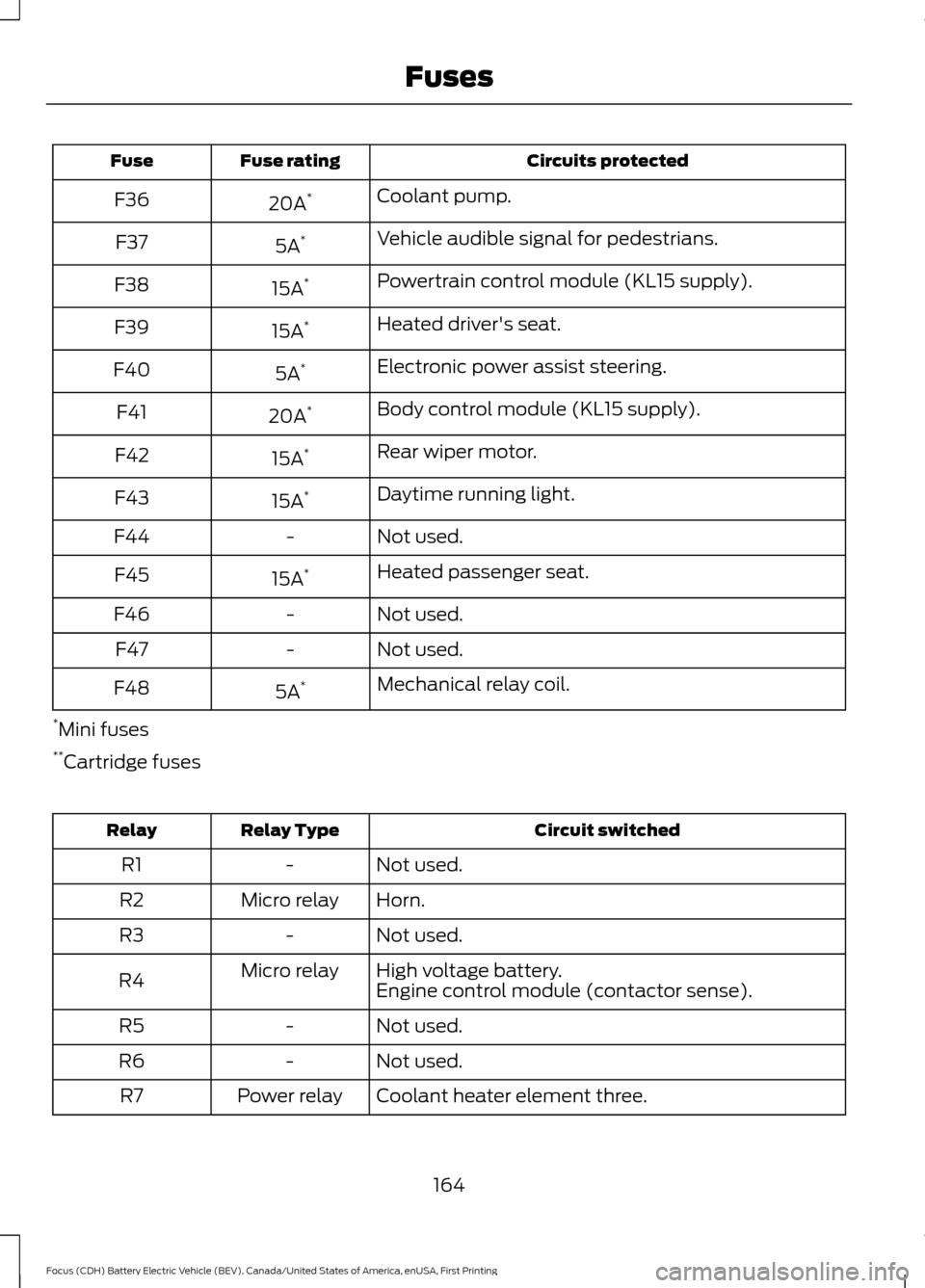
Circuits protected
Fuse rating
Fuse
Coolant pump.
20A *
F36
Vehicle audible signal for pedestrians.
5A *
F37
Powertrain control module (KL15 supply).
15A *
F38
Heated driver's seat.
15A *
F39
Electronic power assist steering.
5A *
F40
Body control module (KL15 supply).
20A *
F41
Rear wiper motor.
15A *
F42
Daytime running light.
15A *
F43
Not used.
-
F44
Heated passenger seat.
15A *
F45
Not used.
-
F46
Not used.
-
F47
Mechanical relay coil.
5A *
F48
* Mini fuses
** Cartridge fuses Circuit switched
Relay Type
Relay
Not used.
-
R1
Horn.
Micro relay
R2
Not used.
-
R3
High voltage battery.
Micro relay
R4 Engine control module (contactor sense).
Not used.
-
R5
Not used.
-
R6
Coolant heater element three.
Power relay
R7
164
Focus (CDH) Battery Electric Vehicle (BEV), Canada/United States of America, enUSA, First Printing Fuses
Page 170 of 276
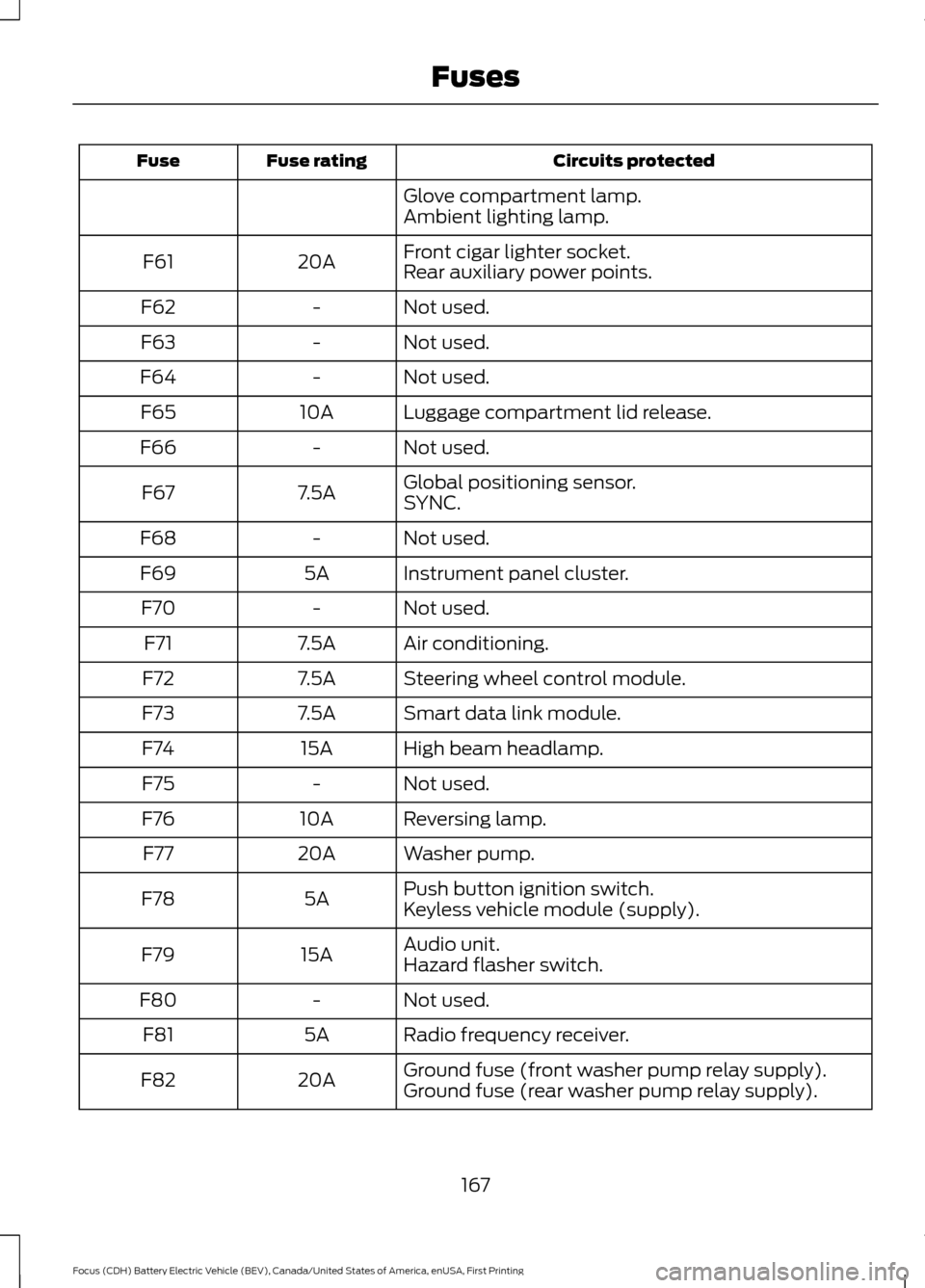
Circuits protected
Fuse rating
Fuse
Glove compartment lamp.
Ambient lighting lamp.
Front cigar lighter socket.
20A
F61
Rear auxiliary power points.
Not used.
-
F62
Not used.
-
F63
Not used.
-
F64
Luggage compartment lid release.
10A
F65
Not used.
-
F66
Global positioning sensor.
7.5A
F67
SYNC.
Not used.
-
F68
Instrument panel cluster.
5A
F69
Not used.
-
F70
Air conditioning.
7.5A
F71
Steering wheel control module.
7.5A
F72
Smart data link module.
7.5A
F73
High beam headlamp.
15A
F74
Not used.
-
F75
Reversing lamp.
10A
F76
Washer pump.
20A
F77
Push button ignition switch.
5A
F78
Keyless vehicle module (supply).
Audio unit.
15A
F79
Hazard flasher switch.
Not used.
-
F80
Radio frequency receiver.
5A
F81
Ground fuse (front washer pump relay supply).
20A
F82
Ground fuse (rear washer pump relay supply).
167
Focus (CDH) Battery Electric Vehicle (BEV), Canada/United States of America, enUSA, First Printing Fuses
Page 174 of 276
Circuit switched
Relay Type
Relay
Not used.
-
R4
Not used.
-
R5
Not used.
-
R6
CHANGING A FUSE
Fuses WARNING
Always replace a fuse with one that
has the specified amperage rating.
Using a fuse with a higher amperage
rating can cause severe wire damage and
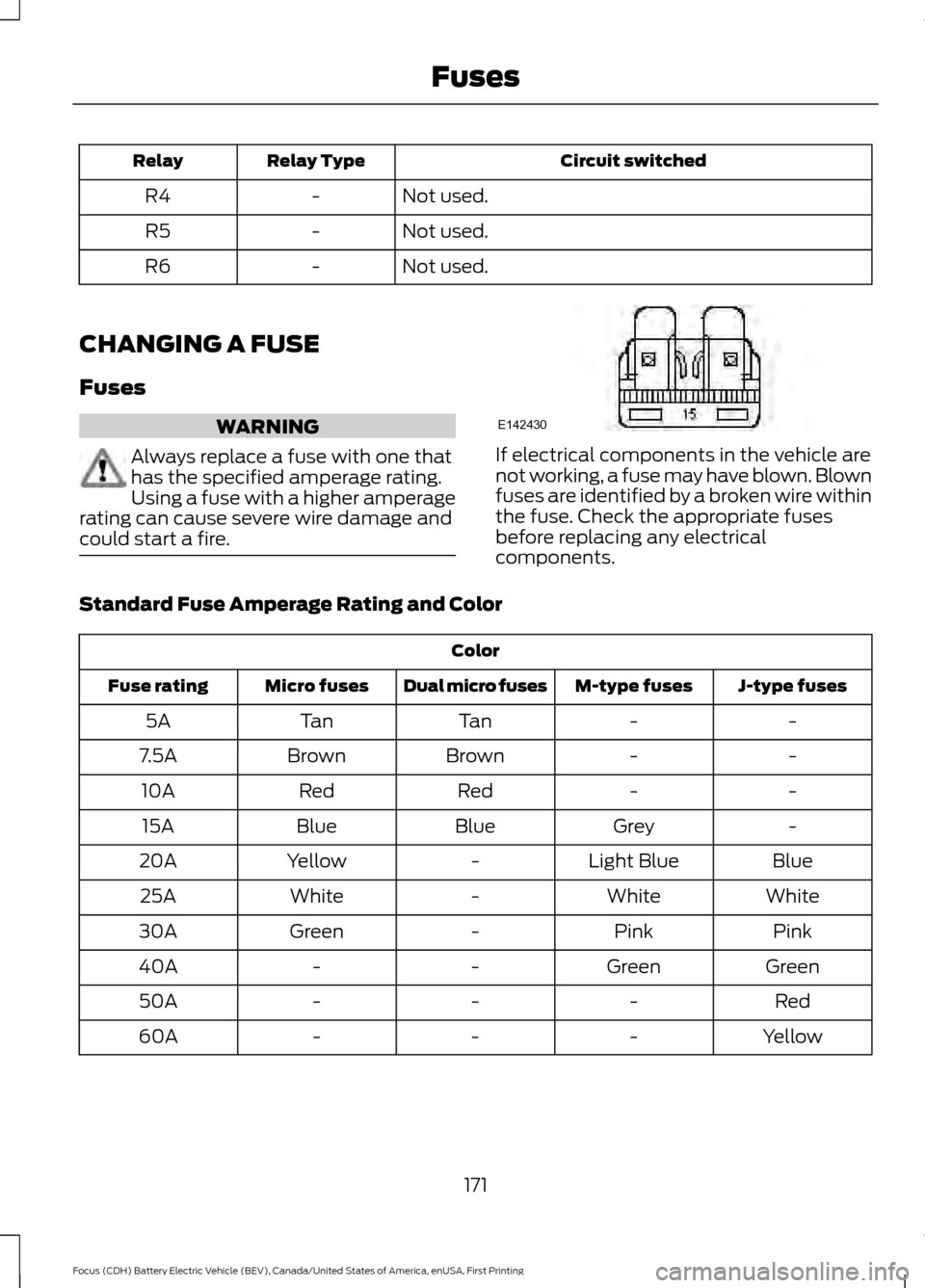
could start a fire. If electrical components in the vehicle are
not working, a fuse may have blown. Blown
fuses are identified by a broken wire within
the fuse. Check the appropriate fuses
before replacing any electrical
components.
Standard Fuse Amperage Rating and Color Color
J-type fuses
M-type fuses
Dual micro fuses
Micro fuses
Fuse rating
-
-
Tan
Tan
5A
-
-
Brown
Brown
7.5A
-
-
Red
Red
10A
-
Grey
Blue
Blue
15A
Blue
Light Blue
-
Yellow
20A
White
White
-
White
25A
Pink
Pink
-
Green
30A
Green
Green
-
-
40A
Red
-
-
-
50A
Yellow
-
-
-
60A
171
Focus (CDH) Battery Electric Vehicle (BEV), Canada/United States of America, enUSA, First Printing FusesE142430
Page 178 of 276
WARNINGS
To reduce the risk of personal injury,
make sure the electric motor is cool
before unscrewing the coolant
pressure relief cap. The cooling system is
under pressure; steam and hot liquid can
come out forcefully when the cap is
loosened slightly. Failure to follow this
warning could result in serious personal
injury. Do not add coolant further than the
MAX mark.
When the electric motor is cold, check the
concentration and level of the motor
coolant at the intervals listed in the
scheduled maintenance information. See
General Maintenance Information
(page 233).
Note: Make sure that the coolant level is
between the MIN and MAX marks on the
coolant reservoir.
Note: Coolant expands when it is hot. The
level may extend beyond the MAX mark.
Note: If the level is at the MIN mark, below
the MIN mark or empty, add coolant
immediately.
Maintain coolant concentration within
48% to 50%, which equates to a freeze
point between -30°F (-34°C) and -34°F
(-37°C).
Note: For best results, coolant
concentration should be tested with a
refractometer such as Robinair® Coolant
and Battery Refractometer 75240. We do
not recommend the use of hydrometers or
coolant test strips for measuring coolant
concentrations. Note:
It is very important to use prediluted
coolant meeting the Ford specification in
order to avoid plugging the small coolant
passageways. Use of concentrated coolant
and water may cause coolant passageway
plugging and void the warranty. See
Capacities and Specifications (page 223
).
Note: Automotive fluids are not
interchangeable; do not use coolant,
antifreeze or windshield washer fluid outside
of its specified function and vehicle location.
Adding Coolant
Note: Do not use stop leak pellets or
cooling system sealants or additives as they
can cause damage to the cooling and
heating systems. This damage would not
be covered under your vehicle warranty.
Note: During normal vehicle operation, the
electric motor coolant may change color
from orange to pink or light red. As long as
the electric motor coolant is clear and
uncontaminated, this color change does not
indicate that the electric motor coolant has
degraded, nor does it require that qualified
personnel drain the electric motor coolant,
flush the system or replace the electric
motor coolant.
Do not mix different colors or types of
coolant in your vehicle. Make sure the
correct coolant is used. Mixing of coolants
may harm your cooling system. The use of
an improper coolant may harm the electric
motor or cooling system components and
may invalidate the vehicle warranty.
In case of emergency, you can add a large
amount of water without coolant in order
to reach a vehicle service location. In this
instance, qualified personnel:
1. Must drain the cooling system.
2. Chemically clean the coolant system with Motorcraft Premium Cooling
System Flush.
3. Refill with coolant as soon as possible.
175
Focus (CDH) Battery Electric Vehicle (BEV), Canada/United States of America, enUSA, First Printing Maintenance
Page 180 of 276
WARNINGS
Only use brake fluid from a sealed
container. Contamination with dirt,
water, petroleum products or other
materials may result in brake system
damage or failure. Failure to adhere to this
warning could result in the loss of vehicle
control, serious personal injury or death. Do not allow the fluid to touch your
skin or eyes. If this happens, rinse the
affected areas immediately with
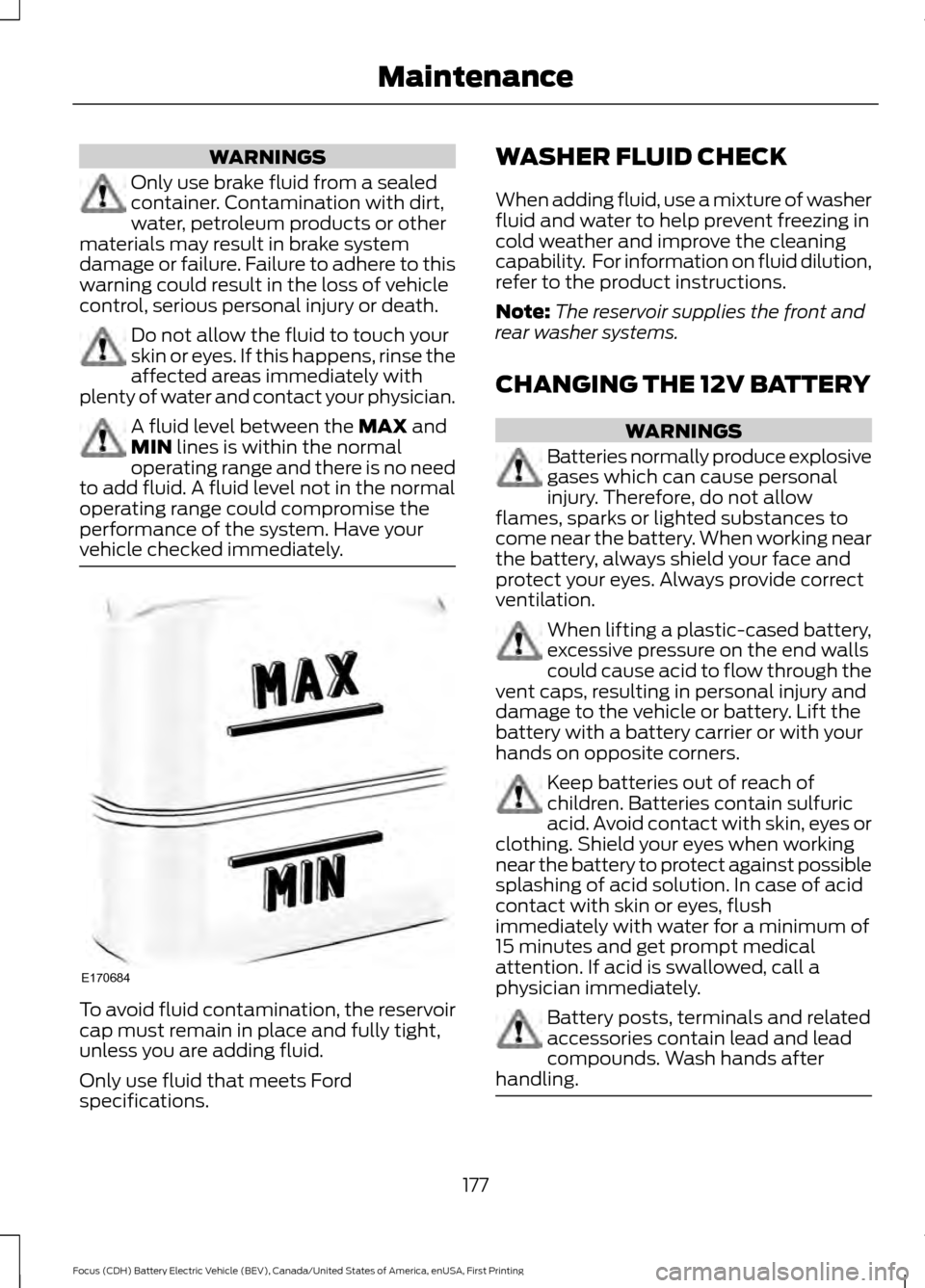
plenty of water and contact your physician. A fluid level between the MAX and
MIN lines is within the normal
operating range and there is no need
to add fluid. A fluid level not in the normal
operating range could compromise the
performance of the system. Have your
vehicle checked immediately. To avoid fluid contamination, the reservoir
cap must remain in place and fully tight,
unless you are adding fluid.
Only use fluid that meets Ford
specifications. WASHER FLUID CHECK
When adding fluid, use a mixture of washer
fluid and water to help prevent freezing in
cold weather and improve the cleaning
capability. For information on fluid dilution,
refer to the product instructions.
Note:
The reservoir supplies the front and
rear washer systems.
CHANGING THE 12V BATTERY WARNINGS
Batteries normally produce explosive
gases which can cause personal
injury. Therefore, do not allow
flames, sparks or lighted substances to
come near the battery. When working near
the battery, always shield your face and
protect your eyes. Always provide correct
ventilation. When lifting a plastic-cased battery,
excessive pressure on the end walls
could cause acid to flow through the
vent caps, resulting in personal injury and
damage to the vehicle or battery. Lift the
battery with a battery carrier or with your
hands on opposite corners. Keep batteries out of reach of
children. Batteries contain sulfuric
acid. Avoid contact with skin, eyes or
clothing. Shield your eyes when working
near the battery to protect against possible
splashing of acid solution. In case of acid
contact with skin or eyes, flush
immediately with water for a minimum of
15 minutes and get prompt medical
attention. If acid is swallowed, call a
physician immediately. Battery posts, terminals and related
accessories contain lead and lead
compounds. Wash hands after
handling. 177
Focus (CDH) Battery Electric Vehicle (BEV), Canada/United States of America, enUSA, First Printing MaintenanceE170684
Page 183 of 276
2. Press the locking buttons together.
3. Rotate and remove the wiper blade.
4. Install in the reverse order.
Note:
Make sure that the wiper blade locks
into place.
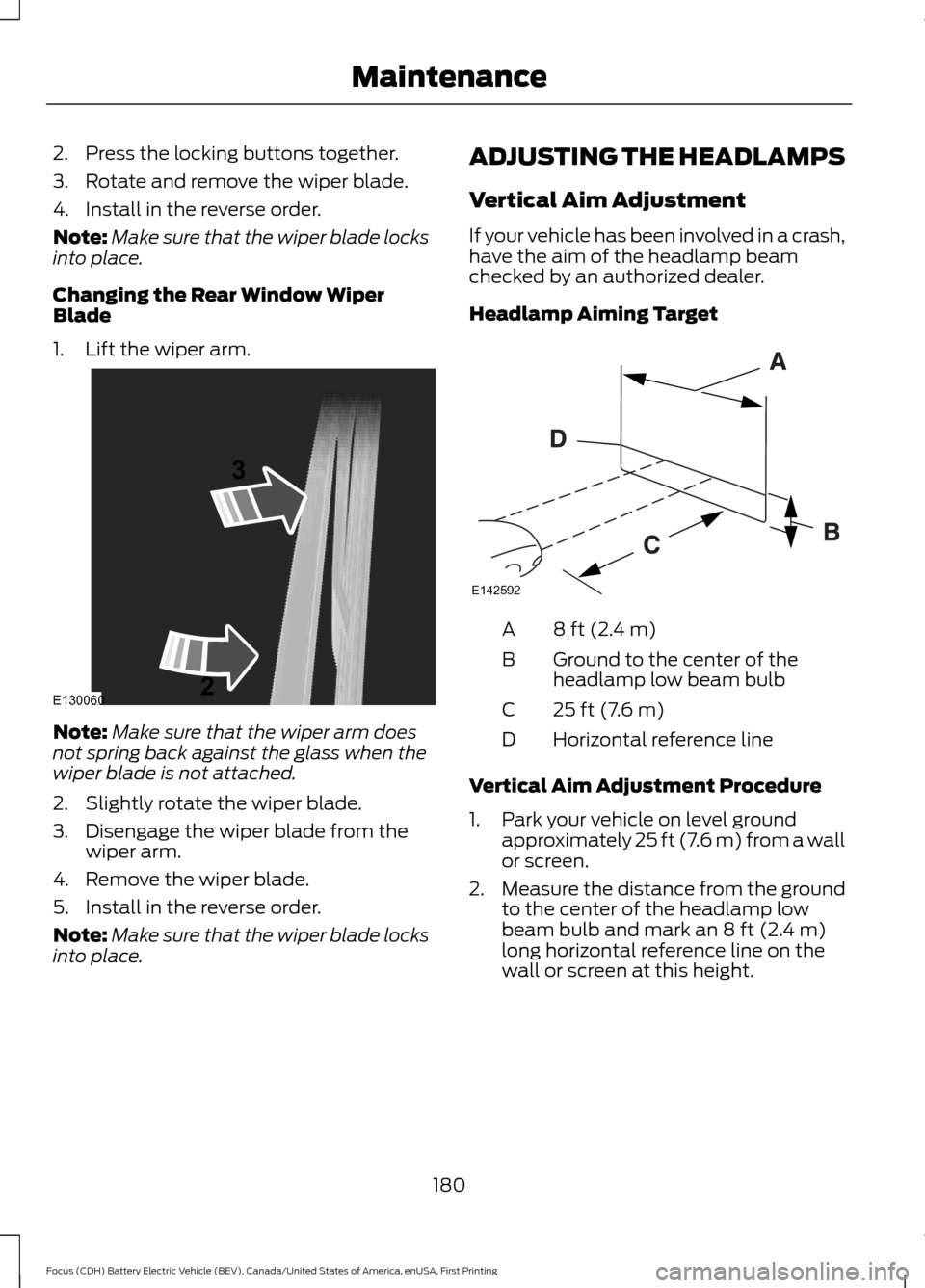
Changing the Rear Window Wiper
Blade
1. Lift the wiper arm. Note:
Make sure that the wiper arm does
not spring back against the glass when the
wiper blade is not attached.
2. Slightly rotate the wiper blade.
3. Disengage the wiper blade from the wiper arm.
4. Remove the wiper blade.
5. Install in the reverse order.
Note: Make sure that the wiper blade locks
into place. ADJUSTING THE HEADLAMPS
Vertical Aim Adjustment
If your vehicle has been involved in a crash,
have the aim of the headlamp beam
checked by an authorized dealer.
Headlamp Aiming Target
8 ft (2.4 m)
A
Ground to the center of the
headlamp low beam bulb
B
25 ft (7.6 m)
C
Horizontal reference line
D
Vertical Aim Adjustment Procedure
1. Park your vehicle on level ground approximately 25 ft (7.6 m) from a wall
or screen.
2. Measure the distance from the ground
to the center of the headlamp low
beam bulb and mark an
8 ft (2.4 m)
long horizontal reference line on the
wall or screen at this height.
180
Focus (CDH) Battery Electric Vehicle (BEV), Canada/United States of America, enUSA, First Printing MaintenanceE130060
3
2 E142592
Page 184 of 276
Note:
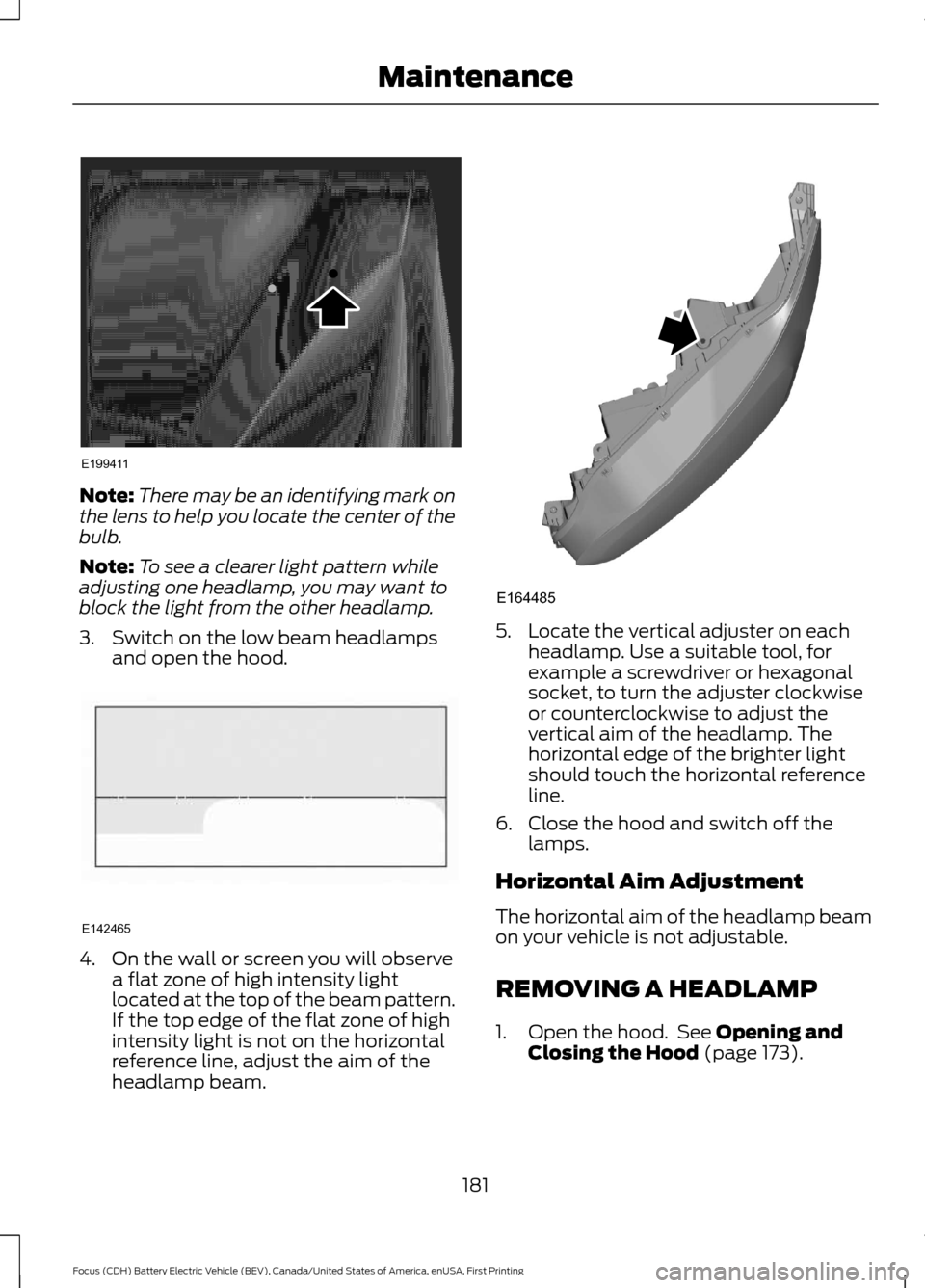
There may be an identifying mark on
the lens to help you locate the center of the
bulb.
Note: To see a clearer light pattern while
adjusting one headlamp, you may want to
block the light from the other headlamp.
3. Switch on the low beam headlamps and open the hood. 4. On the wall or screen you will observe
a flat zone of high intensity light
located at the top of the beam pattern.
If the top edge of the flat zone of high
intensity light is not on the horizontal
reference line, adjust the aim of the
headlamp beam. 5. Locate the vertical adjuster on each
headlamp. Use a suitable tool, for
example a screwdriver or hexagonal
socket, to turn the adjuster clockwise
or counterclockwise to adjust the
vertical aim of the headlamp. The
horizontal edge of the brighter light
should touch the horizontal reference
line.
6. Close the hood and switch off the lamps.
Horizontal Aim Adjustment
The horizontal aim of the headlamp beam
on your vehicle is not adjustable.
REMOVING A HEADLAMP
1. Open the hood. See Opening and
Closing the Hood (page 173).
181
Focus (CDH) Battery Electric Vehicle (BEV), Canada/United States of America, enUSA, First Printing MaintenanceE199411 E142465 E164485