2016 FORD FOCUS ELECTRIC heater
[x] Cancel search: heaterPage 92 of 276
Your current energy use is the white line
that moves up and down in the Budget
Gauge. A higher line means you are using
more energy (lower is better). Your energy
use includes input from the accelerator
pedal as well as the accessories, such as
Climate Control.
The Budget is shown by the blue cup shape
around the Budget Gauge. As long as your
current energy use is within the cup, you
are staying within your budget. Your
Budget represents the maximum energy
usage you can maintain in order to achieve
your vehicle range estimate, or reach your
intended charge point. Driving for extended
periods outside of the Budget Cup reduces
your budget and could put you at risk of
not reaching your intended charge point.
Range view
Shows your range relative to your charge
point as well as performance to your
budget.
A blue charge point icon means you have
a Surplus. If an E appears to the left of an
amber charge point icon, then you are
projected to run out of charge prior to
reaching your charge point.
Current performance to your budget is
represented by the glow of the car icon:
more Blue = better performance to budget,
more Amber = worse.
The optional Surplus Graphic displays
available range beyond your charge point.
If you didn
’t enter your charge point
through the Navigation system, your
budget will be set to the range estimate at
the start of your trip. The gauge will show
your estimated distance to E (empty)
along with your current performance to
budget. The optional Surplus Graphic is
not available in this case. MyView
You can choose what to display in this
view. Selecting Change MyView in the
options menu allows you to scroll through
two columns of content choices.
• Press the up or down arrow to view
content.
• Press
OK to save your selected
content.
Unique content available in MyView:
• Accessory Power - Indicates electrical
power demands from your vehicle ’s
accessory systems. Accessories use
power but do not contribute to
propelling your vehicle. The gauge
separately displays power demand in
kilowatts (kW) for climate and other
accessories. Climate includes the
power being used by high voltage
climate control components such as
the electric A/C compressor and the
electric heater. Other includes all
power being used by the low voltage
accessories (cabin fans, headlights,
heated seats, etc.).
• Budget + Avg - The white pointers on
the outside of the budget gauge
indicate your average watt hours per
mi (km) since you last charged your
vehicle. Immediately after charging the
white pointers will start out at the top
of the gauge, as you begin driving they
will reflect your average energy use.
Note: The trip data cannot be reset in
MyView.
Trip 1 & 2 Use the arrow buttons to choose
between the following.
89
Focus (CDH) Battery Electric Vehicle (BEV), Canada/United States of America, enUSA, First Printing Information DisplaysE138660
Page 95 of 276
Information
Displays the associated driver alert graphic.
Driver Alert
Displays the number of warnings that need immediate attention in
red. You can only view the warnings from the System Check menu.
View them immediately by pressing OK and then OK again to enter
system check. Use the up and down arrows to scroll through the
warnings.
XX Warnings
All active warnings will display first if applicable. The system check
menu may appear different based upon equipment options and
current vehicle status. Use the up/down arrow buttons to scroll
through the list.
System Check
Settings In this mode, you can configure
different driver setting choices.
Note: Some items are optional and may not appear.
Note: Some MyKey items will only appear if a MyKey is set. Settings
On or Off
Traction Ctrl
Driver Assist
On or Off
Home Range
warn
On or Off
Rear Park Aid
On or Off
Auto Light
Rain
Lighting
Vehicle
Manual or select time interval
Home Light
Auto or Last
Settings
Heater - A/C
Climate
Control
Remote Start
Auto or Off
Front Defrost
Auto or Off
Rear Defrost
5, 10 or 15 minutes
Duration
On or Off
Quiet Start
Enable or Disable
System
92
Focus (CDH) Battery Electric Vehicle (BEV), Canada/United States of America, enUSA, First Printing Information DisplaysE100023
Page 106 of 276
Note:
Remove any snow, ice, or leaves from
the air intake area at the base of the
windshield.
Note: To improve air conditioning when
starting your vehicle, drive with the windows
slightly open for two to three minutes.
Recommended Settings for
Cooling
1. Press the AUTO button.
2. Adjust the temperature control to the desired setting.
Side Window Defogging in Cold
Weather
1. Select air distribution through the floor
vent.
2. Select air distribution through the panel
vent.
3. Select
A/C.
4. Adjust the temperature control to the desired setting.
5. Adjust the outer panel vents toward the side windows.
Note: To increase airflow to the outer panel
vents, close the vents in the middle of the
instrument panel.
Improving Vehicle Drive Range
Your vehicle is equipped with a high
voltage electric compressor and a high
voltage electric heater. You can increase
your driving range by minimizing the
amount of energy expended to cool or heat
the interior during the drive.
Pre-condition the interior temperature
during vehicle charging reduces the battery
energy use on the interior comfort and
improves range.
Note: Your vehicle may not always reach
the set cabin temperature due to charging
and ambient temperature conditions. Hot and cold temperatures make your
vehicle use more energy to achieve and
maintain a comfortable interior
temperature. Park the vehicle in the shade
or in a parking structure when hot, and in
a garage when cold.
Consider partially opening a window (or
windows) to let fresh air circulate, if
weather conditions permit. You can
achieve maximum energy savings by
switching the climate system off. Do this
only if conditions exist for safe vehicle
operation.
Reduce fan speed.
Set the
AUTO temperature a couple
degrees cooler than you normally do on
cold days and a couple degrees higher on
hot days. Use the heated seats on cold
days to increase interior comfort.
Switch the air conditioning off in mild
temperatures or low humidity conditions.
Defrost mode automatically turns the air
conditioning on to dehumidify the air, and
cannot be switched off. If defogging or
defrosting is not necessary, select a
non-defrost mode and disengage air
conditioning to extend vehicle range.
Air conditioning and heating functions are
automatically switched off (unless in
defrost mode) when driving distance to
empty is zero miles (zero km). The interior
fan will continue to operate.
HEATED WINDOWS AND
MIRRORS
Heated Rear Window
Note: Make sure the vehicle is running
before operating the heated windows.
103
Focus (CDH) Battery Electric Vehicle (BEV), Canada/United States of America, enUSA, First Printing Climate Control
Page 165 of 276
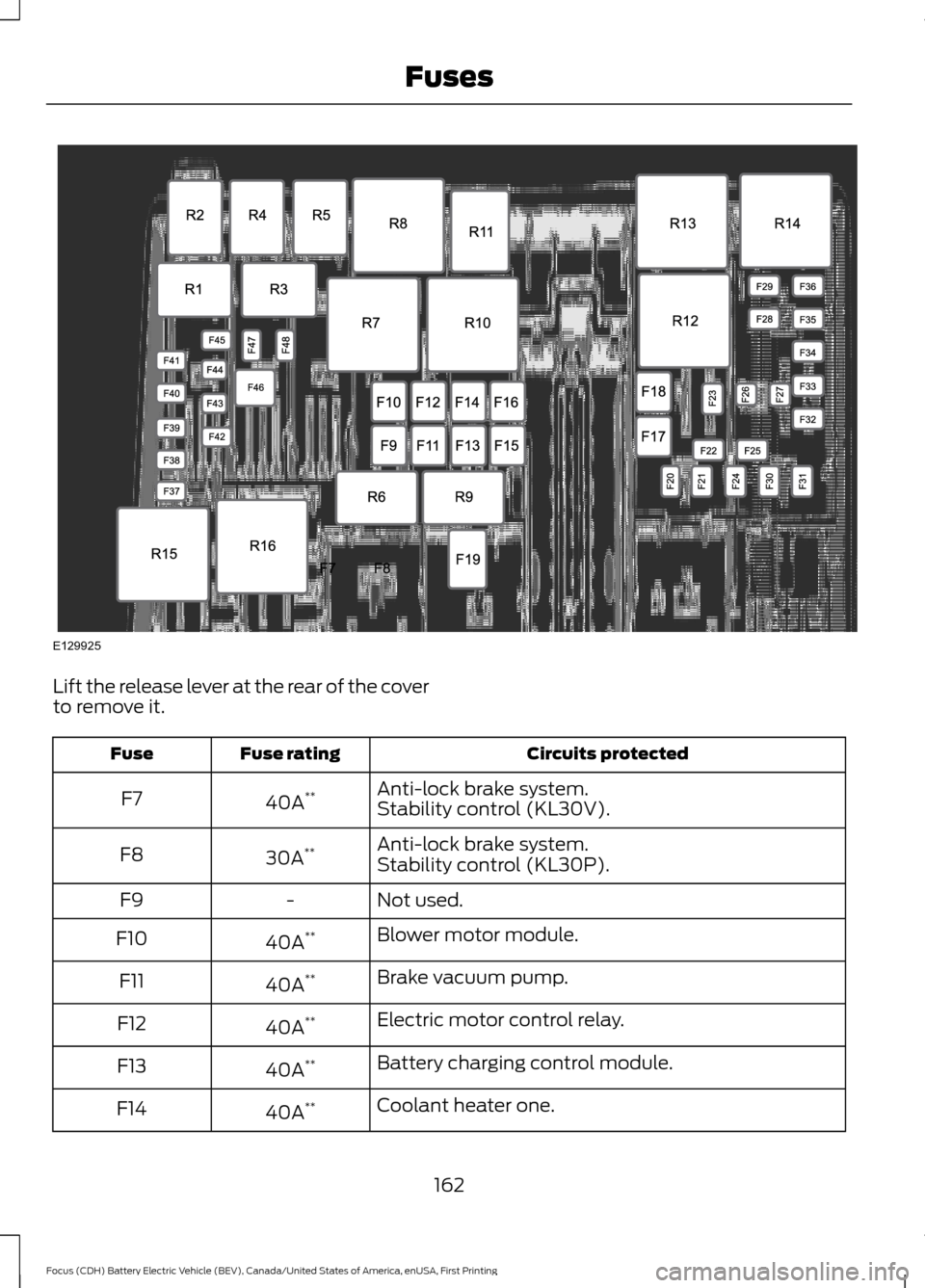
Lift the release lever at the rear of the cover
to remove it.
Circuits protected
Fuse rating
Fuse
Anti-lock brake system.
40A **
F7
Stability control (KL30V).
Anti-lock brake system.
30A **
F8
Stability control (KL30P).
Not used.
-
F9
Blower motor module.
40A **
F10
Brake vacuum pump.
40A **
F11
Electric motor control relay.
40A **
F12
Battery charging control module.
40A **
F13
Coolant heater one.
40A **
F14
162
Focus (CDH) Battery Electric Vehicle (BEV), Canada/United States of America, enUSA, First Printing FusesE129925
Page 166 of 276
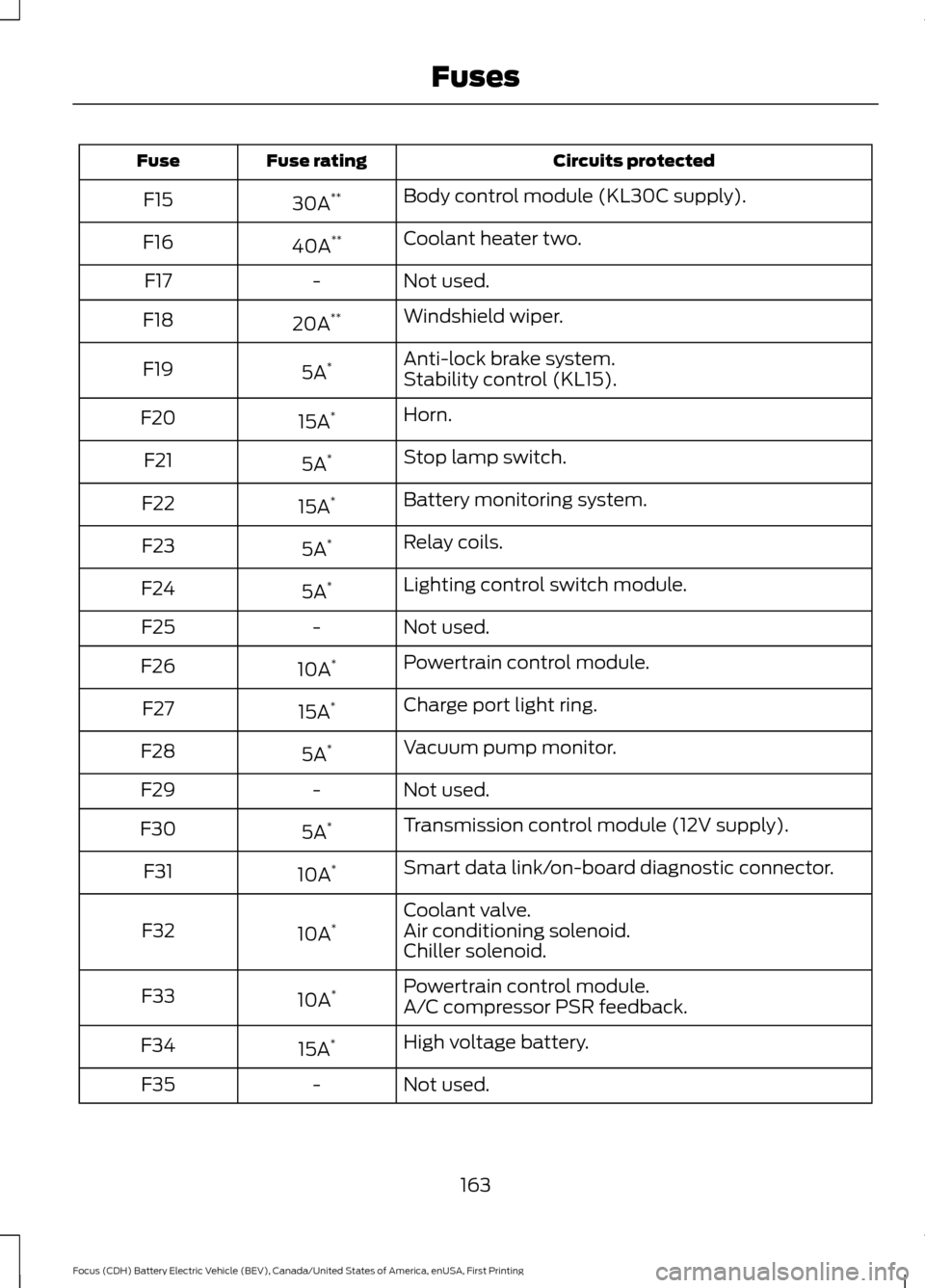
Circuits protected
Fuse rating
Fuse
Body control module (KL30C supply).
30A **
F15
Coolant heater two.
40A **
F16
Not used.
-
F17
Windshield wiper.
20A **
F18
Anti-lock brake system.
5A *
F19
Stability control (KL15).
Horn.
15A *
F20
Stop lamp switch.
5A *
F21
Battery monitoring system.
15A *
F22
Relay coils.
5A *
F23
Lighting control switch module.
5A *
F24
Not used.
-
F25
Powertrain control module.
10A *
F26
Charge port light ring.
15A *
F27
Vacuum pump monitor.
5A *
F28
Not used.
-
F29
Transmission control module (12V supply).
5A *
F30
Smart data link/on-board diagnostic connector.
10A *
F31
Coolant valve.
10A *
F32 Air conditioning solenoid.
Chiller solenoid.
Powertrain control module.
10A *
F33
A/C compressor PSR feedback.
High voltage battery.
15A *
F34
Not used.
-
F35
163
Focus (CDH) Battery Electric Vehicle (BEV), Canada/United States of America, enUSA, First Printing Fuses
Page 167 of 276
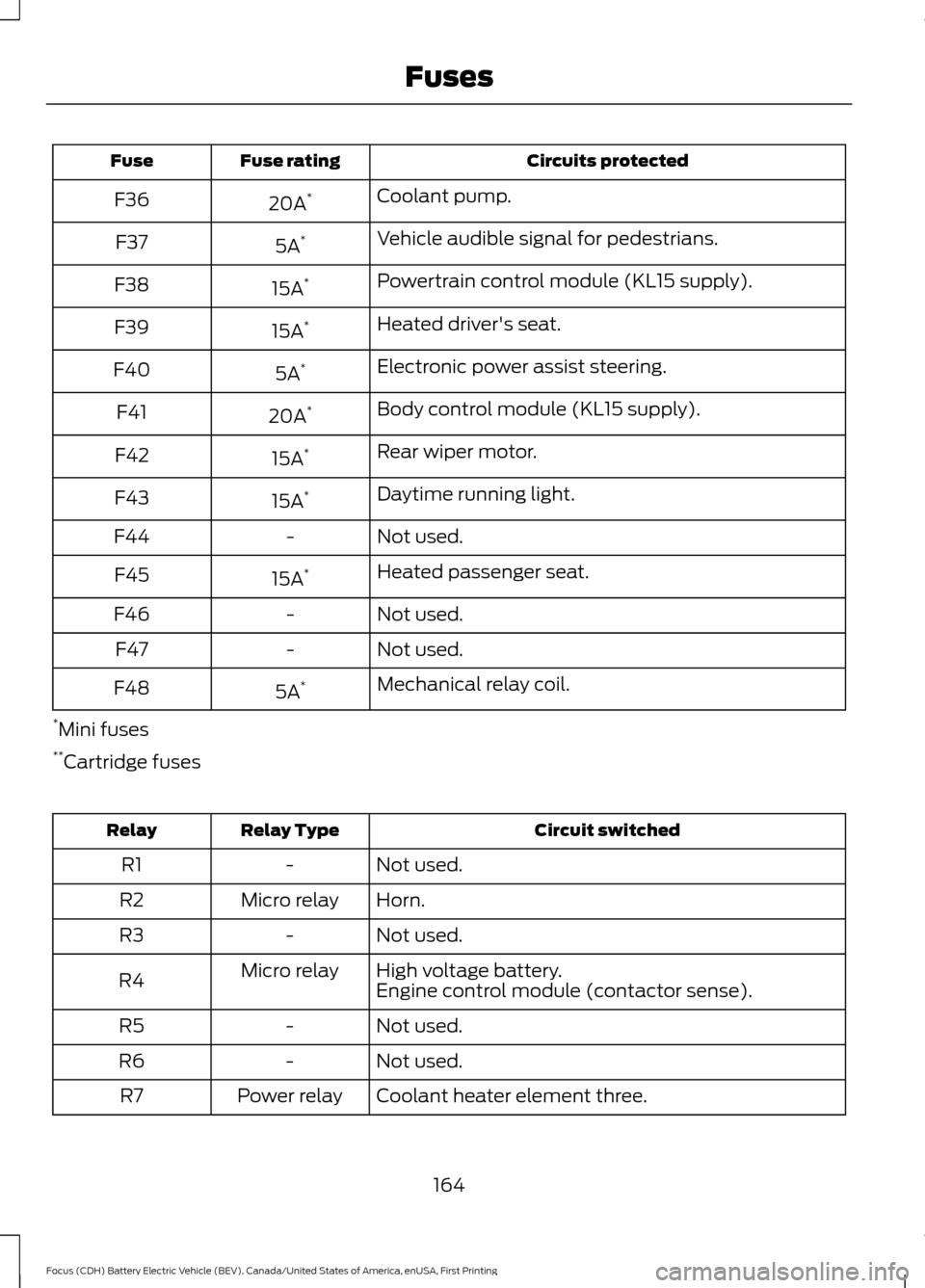
Circuits protected
Fuse rating
Fuse
Coolant pump.
20A *
F36
Vehicle audible signal for pedestrians.
5A *
F37
Powertrain control module (KL15 supply).
15A *
F38
Heated driver's seat.
15A *
F39
Electronic power assist steering.
5A *
F40
Body control module (KL15 supply).
20A *
F41
Rear wiper motor.
15A *
F42
Daytime running light.
15A *
F43
Not used.
-
F44
Heated passenger seat.
15A *
F45
Not used.
-
F46
Not used.
-
F47
Mechanical relay coil.
5A *
F48
* Mini fuses
** Cartridge fuses Circuit switched
Relay Type
Relay
Not used.
-
R1
Horn.
Micro relay
R2
Not used.
-
R3
High voltage battery.
Micro relay
R4 Engine control module (contactor sense).
Not used.
-
R5
Not used.
-
R6
Coolant heater element three.
Power relay
R7
164
Focus (CDH) Battery Electric Vehicle (BEV), Canada/United States of America, enUSA, First Printing Fuses
Page 168 of 276
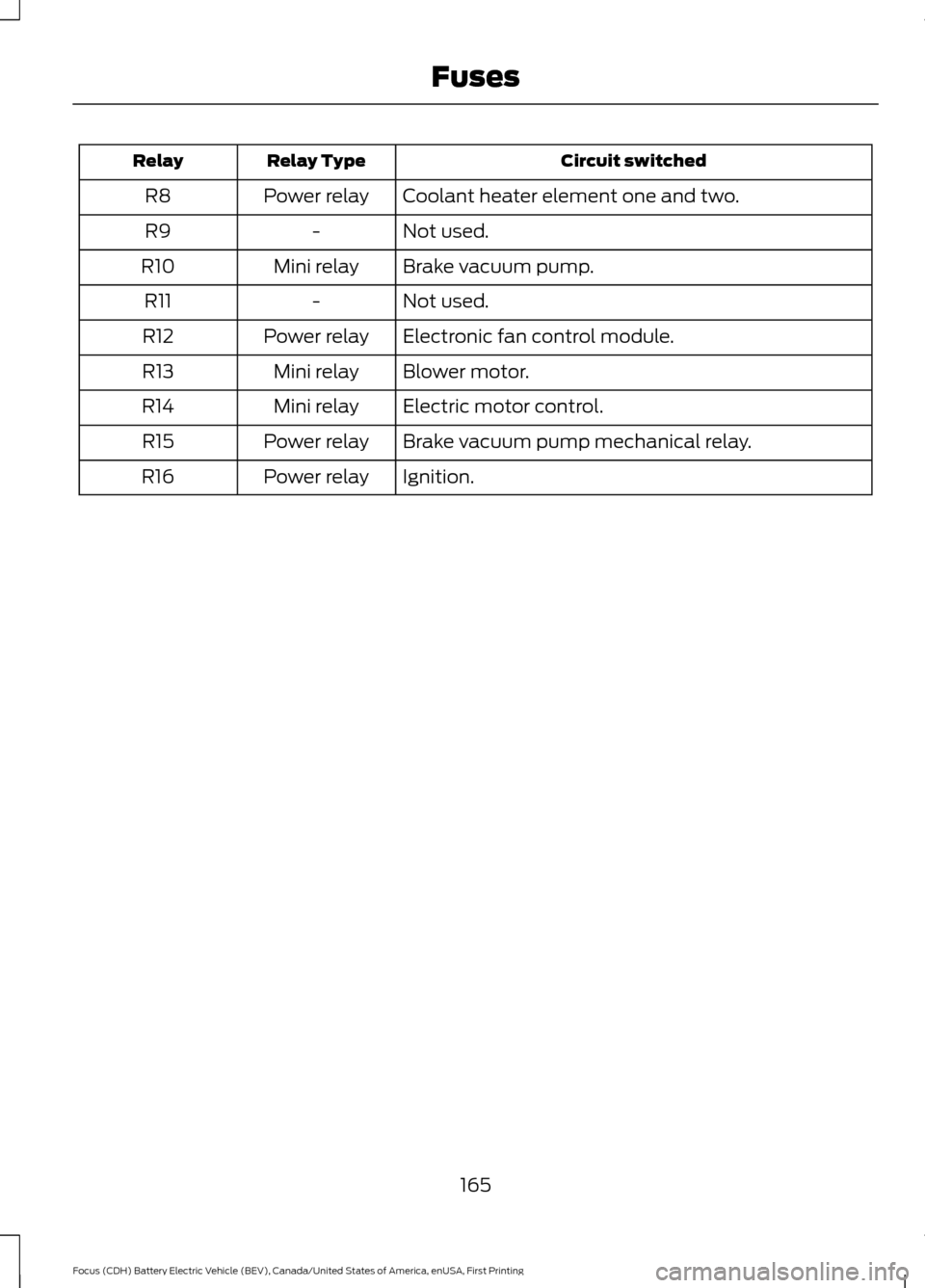
Circuit switched
Relay Type
Relay
Coolant heater element one and two.
Power relay
R8
Not used.
-
R9
Brake vacuum pump.
Mini relay
R10
Not used.
-
R11
Electronic fan control module.
Power relay
R12
Blower motor.
Mini relay
R13
Electric motor control.
Mini relay
R14
Brake vacuum pump mechanical relay.
Power relay
R15
Ignition.
Power relay
R16
165
Focus (CDH) Battery Electric Vehicle (BEV), Canada/United States of America, enUSA, First Printing Fuses
Page 238 of 276
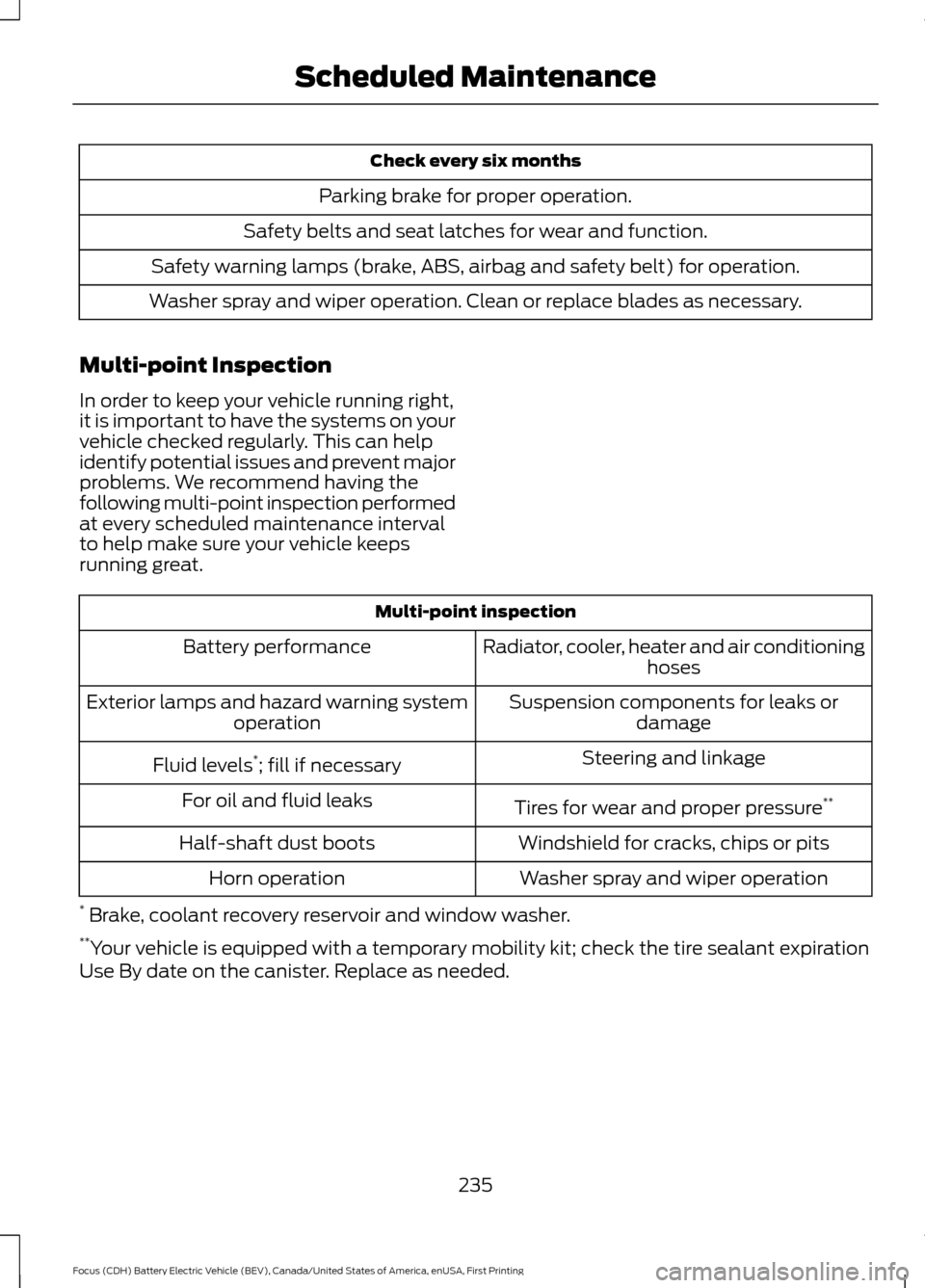
Check every six months
Parking brake for proper operation.
Safety belts and seat latches for wear and function.
Safety warning lamps (brake, ABS, airbag and safety belt) for operation.
Washer spray and wiper operation. Clean or replace blades as necessary.
Multi-point Inspection
In order to keep your vehicle running right,
it is important to have the systems on your
vehicle checked regularly. This can help
identify potential issues and prevent major
problems. We recommend having the
following multi-point inspection performed
at every scheduled maintenance interval
to help make sure your vehicle keeps
running great. Multi-point inspection
Radiator, cooler, heater and air conditioning hoses
Battery performance
Suspension components for leaks ordamage
Exterior lamps and hazard warning system
operation
Steering and linkage
Fluid levels *
; fill if necessary
Tires for wear and proper pressure **
For oil and fluid leaks
Windshield for cracks, chips or pits
Half-shaft dust boots
Washer spray and wiper operation
Horn operation
* Brake, coolant recovery reservoir and window washer.
** Your vehicle is equipped with a temporary mobility kit; check the tire sealant expiration
Use By date on the canister. Replace as needed.
235
Focus (CDH) Battery Electric Vehicle (BEV), Canada/United States of America, enUSA, First Printing Scheduled Maintenance