2016 FIAT FULLBACK wheel
[x] Cancel search: wheelPage 131 of 312
Active Traction Control function
On slippery surfaces, the active traction
control function prevents the drive
wheels from spinning excessive, thus
helping the vehicle to start moving from
a stopped condition. It also provides
sufficient driving force and steering
performance as the vehicle turns while
pressing the acceleration pedal.
196)
WARNING
180)The brake assist system is not a
device designed to exercise braking force
greater than its capacity. Make sure to
always keep a sufficient distance between
vehicles in front of you without relying too
much on the brake assist system.
181)The ABS cannot prevent accidents. It
is your responsibility to take safety
precautions and to drive carefully.
182)To prevent failure of the ABS, be sure
all 4 wheels and tyres are the same size
and the same type.
183)Do not install any aftermarket limited
slip differential (LSD) on your vehicle. The
ABS may stop functioning properly.
184)The ABS exploits the grip available to
the full, but it cannot improve it. Therefore,
you should take great care when driving on
slippery surfaces, without taking
unnecessary risks.185)When the ABS intervenes and you
notice the brake pedal pulsating, keep the
pedal pushed down and don’t be alarmed.
This will help you to stop in the shortest
distance possible, depending on the road
conditions.
186)If the ABS intervenes, it means you
have almost reached the grip limit between
the tyres and the road surface: slow down
to make sure that you drive in accordance
with the available grip.
187)The ABS cannot overrule the natural
laws of physics, and can’t increase the grip
available according to the condition of the
road.
188)The ABS cannot prevent accidents,
including those due to excessive speed on
corners, driving on low-grip surfaces or
aquaplaning.
189)The capability of the ABS must never
be tested irresponsibly and dangerously, in
such a way as to compromise personal
safety and the safety of others.
190)Do not over-rely on the ASTC. Even
the ASTC cannot prevent the natural laws
of physics from acting on the vehicle. This
system, like any other system, has limits
and cannot help you to maintain traction
and control of the vehicle in all
circumstances. Reckless driving can lead
to accidents. It is the driver’s responsibility
to drive carefully. This means into account
the traffic, road and environmental
conditions.
191)The ASTC system cannot prevent
accidents, including those due to excessive
speed on corners, driving on low-grip
surfaces or aquaplaning.192)Be sure to use the same specified
type and size of tyre on all 4 wheels.
Otherwise, the ASTC may not work
correctly.
193)Do not install any aftermarket limited
slip differential (LSD) on your vehicle. The
active stability control function may stop
functioning properly.
194)For safety reasons, the “ASC OFF”
switch should only be operated when the
vehicle is stopped.
195)Be sure to keep the active stability
control function on while driving in normal
circumstances.
196)When driving a vehicle on a snowy or
icy road, be sure to install snow tyres and
drive the vehicle at moderate speeds.
129
Page 132 of 312

AUXILIARY DRIVING
SYSTEMS
Hill Start Assist (where provided)
The hill start assist makes it easy to
start off on a steep uphill slope by
preventing the vehicle from moving
backwards. It keeps the braking force
for about 2 seconds when you move
your foot from the brake pedal to the
accelerator pedal.
69) 70)
197) 198)
To operate
1. Stop the vehicle completely using the
brake pedal.
2. On vehicles equipped with M/T,
place the gearshift lever into the 1st
position. On vehicles equipped with
A/T, place the selector lever into the “D”
position.
NOTE When reversing on an uphill
slope, place the selector lever or
gearshift lever into the “R” position.
3. Release the brake pedal and the hill
start assist will maintain the braking
force applied while stopping for
approximately 2 seconds.
4. Depress the accelerator pedal and
the hill start assist gradually will
decrease the braking force as the
vehicle starts moving.NOTE The hill start assist is activated
when all of the following conditions are
met.
The engine is running (the hill start
assist will not be activated while the
engine is starting or immediately after
the engine is started).
On vehicles equipped with M/T, the
gearshift lever is in the following
position: When starting an uphill slope
forwards > The gearshift lever is in any
position other than “R” (the hill start
assist will operate, even if the gearshift
lever is in the “N” position). When
starting an uphill slope backwards >
The gearshift lever is in the “R” position
(the hill start assist will not operate
when the gearshift lever is in the “N”
position).
On vehicles equipped with A/T, the
selector lever is in any position other
than “P” or “N”.
The vehicle is completely stationary,
with the brake pedal depressed.
The parking brake is released.
NOTE The hill start assist will not
operate if the accelerator pedal is
depressed before the brake pedal is
released.
NOTE The hill start assist also operates
when reversing on an uphill slope.NOTE When the hill start assist is
activated, you may feel the operating
sound. This is a normal result of the hill
start assist operation, and does not
indicate a problem.
Warning indicator
If an abnormal condition occurs in the
system, the indicator lamp will turn on.
ASC indicator
71) 72)
Power Steering System
The power steering system operates
while the engine is running. It helps
reduce the effort needed to turn the
steering wheel.
The power steering system has
mechanical steering capability in case
the power assist is lost. If the power
assist is lost for some reason, you will
still be able to steer your vehicle, but
you will notice it takes much more effort
to steer. If this happens, have your
vehicle inspected at a Fiat Dealership.
73) 74)
WARNING
197)When facing uphill, do not rely on
using the hill start assist to maintain a
stopped position as an alternative to
depressing the brake pedal. Doing so
could cause an accident.
130
SAFETY
Page 133 of 312

198)Do not turn the ignition switch to the
“LOCK” or “ACC” position or the operation
mode in ACC or OFF while the hill start
assist is operating. The hill start assist
could stop operating, which could result in
an accident.
IMPORTANT
69)Do not over-rely on the hill start assist
to prevent backwards movement of the
vehicle. Under certain circumstances, even
when hill start assist is activated, the
vehicle may move backwards if the brake
pedal is not sufficiently depressed, if the
vehicle is heavily loaded, if the road is very
steep or slippery or if the vehicle tows a
trailer, etc.
70)The hill start assist is not designed to
keep the vehicle stopped in place on uphill
slopes for more than 2 seconds.
71)If the warning is turn on, the hill start
assist will not operate. Start off carefully.
72)Park your vehicle in a safe place and
stop the engine. Restart the engine and
check whether the warning indicator went
out, in which case the hill start assist is
again working normally. If they warning
remains displayed or reappear frequently, it
is not necessary to stop the vehicle
immediately, but the vehicle should be
inspected by a Fiat Dealership.
73)Do not stop the engine while the
vehicle is moving. Stopping the engine
would make the steering wheel extremely
hard to turn, possibly resulting in an
accident.74)Do not leave the steering wheel turned
all the way in one direction. This can cause
damage to the power steering system.
131
Page 134 of 312

STARTING AND DRIVING
Let’s get to the "heart" of the vehicle:
seeing how you can exploit all of its
potential to the full.
We’ll look at how to drive it safely in any
situation, so that it can be a welcome
companion, with our comfort and our
wallets in mind.ECONOMICAL DRIVING........133
DRIVING, ALCOHOL AND DRUGS .134
SAFE DRIVING TECHNIQUES. . . .134
RUNNING-IN
RECOMMENDATIONS.........135
PARKING BRAKE............139
PARKING.................140
STARTING AND STOPPING THE
ENGINE..................141
TURBOCHARGER OPERATION . . .145
MANUAL TRANSMISSION......146
AUTOMATIC TRANSMISSION
SPORT MODE 5A/T..........149
EASY SELECT 4WD..........154
SUPER SELECT 4WD II........162
REAR DIFFERENTIAL LOCK.....166
4 WHEEL DRIVE OPERATION. . . .170
CAUTIONS ON HANDLING OF
4 WHEEL DRIVE VEHICLES.....173
BRAKING SYSTEM...........175
CRUISE CONTROL...........176
REAR VIEW CAMERA.........180
132
STARTING AND DRIVING
Page 141 of 312

PARKING BRAKE
To park the vehicle, first bring it to a
complete stop, fully apply the parking
brake sufficiently to hold the vehicle.
To apply
Firmly depress and hold the brake
pedal, then pull the lever up (A) without
pushing the button at the end of hand
grip.
76)
NOTE Apply sufficient force to the
parking brake lever to hold the vehicle
stationary after the foot brake is
released.
NOTE If the parking brake does not
hold the vehicle stationary after the foot
brake is released, have your vehicle
checked immediately.To release
Firmly depress and hold the brake
pedal, then pull the lever up slightly (A).
Push the button at the end of hand grip
(B).
Lower the lever fully (C).
77) 78)
NOTE To prevent the parking brake
from being released unintentionally, the
lever must be pulled up slightly before it
can be pushed down. Simply pressing
the button does not enable the lever to
be pushed down.
IMPORTANT
76)When you intend to apply the parking
brake, firmly press the brake pedal to bring
the vehicle to a complete stop before
pulling the parking brake lever. Pulling the
parking brake lever with the vehicle moving
could make the rear wheels lock up,
thereby making the vehicle unstable. It
could also make the parking brake
malfunction.
77)Before driving, be sure that the parking
brake is fully released and brake warning
lamp is off. If a vehicle is driven without
releasing the parking brake, the brake will
be overheated, resulting in ineffective
braking and possible brake failure.
78)If the brake warning lamp does not
extinguish when the parking brake is fully
released, the brake system may be an
abnormal. Have your vehicle checked
immediately. For details, refer to “Brake
warning lamp”.
A
225AA0001018
AB
C
226AA0001021
139
Page 142 of 312

PARKING
To park the vehicle, fully engage the
parking brake, and then move the
gearshift lever to 1st or “R” (Reverse)
position for vehicles equipped with M/T,
or set the selector lever to “P” (PARK)
position for vehicles equipped with A/T.
Parking on a hill
To prevent the vehicle from rolling,
follow these procedures:
Parking on a downhill slope
Turn the front wheels towards the kerb
and move the vehicle forward until the
kerb side wheel gently touches the
kerb.
On vehicles equipped with M/T, apply
the parking brake and place the
gearshift lever into the “R” (Reverse)
position.
On vehicles equipped with A/T, apply
the parking brake and place the
selector lever into the “P” (PARK)
position. If necessary, apply chocks to
wheels.
Parking on a uphill slope
Turn the front wheels away from the
kerb and move the vehicle back until
the kerb side wheel gently touches the
kerb.
On vehicles equipped with M/T, apply
the parking brake and place the
gearshift lever into the 1st position.
On vehicles equipped with A/T, apply
the parking brake and place theselector lever into the “P” (PARK)
position. If necessary, apply chocks to
wheels.
If your vehicle is equipped with A/T, be
sure to apply the parking brake before
moving selector lever to the “P” (PARK)
position. If you move selector lever to
the “P” (PARK) position before applying
the parking brake, it may be difficult to
disengage selector lever from the “P”
(PARK) position when next you drive the
vehicle, requiring application of a strong
force the selector lever to move from
the “P” (PARK) position.
Parking with the engine running
Never leave the engine running while
you take a short sleep/rest. Also, never
leave the engine running in a closed or
poorly ventilated place.
When leaving the vehicle
Always carry the key and lock all doors
when leaving the vehicle unattended.
Always try to park your vehicle in a well
lit area.
201) 202)
WARNING
201)Leaving the engine running risks injury
or death from accidentally moving the
gearshift lever (with M/T) or the selector
lever (with A/T) or the accumulation of toxic
exhaust fumes on the passenger
compartment.202)Do not park your vehicle in areas
where combustible materials such as dry
grass or leaves can come in contact with a
hot exhaust, since a fire could occur.
140
STARTING AND DRIVING
Page 153 of 312

Selector lever positions
“P” PARK
This position locks the transmission to
prevent the vehicle from moving. The
engine can be started in this position.
“R” REVERSE
This position is to back up.
93)
“N” NEUTRAL
At this position the transmission is
disengaged. It is the same as the
neutral position on a manual
transmission, and should only be used
when the vehicle is stationary for an
extended length of time during driving,
such as in a traffic jam.
94) 95) 96)
“D” DRIVE
This position is used for most city and
highway driving. The transmission will
automatically change its gear
depending on road and driving
conditions.
97)
Sport mode
Whether the vehicle is stationary or in
motion, sports mode is selected by
gently pushing the selector lever from
the “D” (DRIVE) position into the manual
gate (A). To return to “D” range
operation, gently push the selector lever
back into the main gate (B).
In sports mode, gear shifts can be
made rapidly simply by moving the
selector lever backward and forward.
For vehicles equipped with the shift
paddles, shift paddles at the steering
wheel can also be used to perform
gearshift. In contrast to a manual
transmission, the sports mode allows
gear shifts with the accelerator pedal
depressed.
If your vehicle is equipped with the shift
paddles, you can shift into sports mode
with shift paddles when the selector
lever is in the main gate as well. Also,
you can return to the “D” range
operation in any of following ways.
When returning to “D” range operation,
the selector lever position display will
change to “D” (DRIVE) position.
Pull the + (SHIFT UP) side shift
paddle forward (toward the driver) for
over 2 seconds.
Stop the vehicle.
Push the selector lever from the “D”
(DRIVE) position into the manual gate
(A) and push the selector lever back
into the main gate (B).
+ Shift up
The transmission shifts up by one gear
with each operation.
— Shift down
The transmission shifts down by one
gear with each operation.
98) 99) 100)
Only the 5 forward gears can be
selected. To reverse or park the vehicle,
move the selector lever to the “R”
(REVERSE) or “P” (PARK) position as
required.
To maintain good running performance,
the transmission may refuse to perform
an upshift when the selector lever or the
shift paddles is moved to the “+ (SHIFT
UP)” position at certain vehicle speeds.
Also, to prevent over-revving of the
engine, the transmission may refuse to
B
A
240AHA106056
151
Page 156 of 312
100)For vehicles equipped with the shift
paddles, do not use the left- and right-hand
shift paddles at the same time. Doing so
could cause a shift of gear ratio that you do
not expect.
101)If the selector lever position display
blinks while you are driving, it is likely that a
safety device is operating because of a
malfunction in the automatic transmission.
Have the vehicle inspected by a Fiat
Dealership as soon as possible.
102)If the lamp comes on, reduce the
engine speed and stop the vehicle in a safe
area. Then set the selector lever to “P”
(PARK) position and idle the engine until the
warning lamp goes off. When the warning
lamp goes off, resume normal driving. If the
warning lamp does not go off, we
recommend you to have your vehicle
inspected.
103)Before selecting a gear with the
engine running and the vehicle stationary,
fully depress the brake pedal to prevent the
vehicle from creeping. The vehicle will begin
to move as soon as the gear is engaged,
especially when the engine speed is high,
at fast idle or with the air conditioner
operating, the brakes should only be
released when you are ready to drive away.
104)Depress the brake pedal with the right
foot at all times. Using the left foot could
cause driver movement delay in case of an
emergency.
105)To prevent sudden acceleration, never
race the engine when shifting from the “P”
(PARK) or “N” (NEUTRAL) position.
106)Operating the accelerator pedal while
the other foot is resting on the brake pedal
will affect braking efficiency and may cause
premature wear of brake pads.107)Use the selector lever in the correct
shift position in accordance with driving
conditions. Never coast downhill backward
with the selector lever in the {“D” (DRIVE) or
sports mode} or coast forward with the
selector lever in the “R” (REVERSE)
position. The engine may stop and the
unexpected increase in brake pedal effort
and steering wheel weight could lead to an
accident.
108)Do not race the engine with brake
pedal pressed when the vehicle is
stationary. This can damage the A/T. Also,
when you depress the accelerator pedal
while holding down the brake pedal with
the selector lever in the “P” (PARK), “N”
(NEUTRAL) or “D” (DRIVE) position, the
engine revolutions may not rise as high as
when performing the same operation with
the selector lever in the “N” (NEUTRAL)
position.
109)Never hold the vehicle stationary on a
hill using the accelerator pedal (without
using the brake pedal). Always apply the
parking brake and/or service brakes.EASY SELECT 4WD
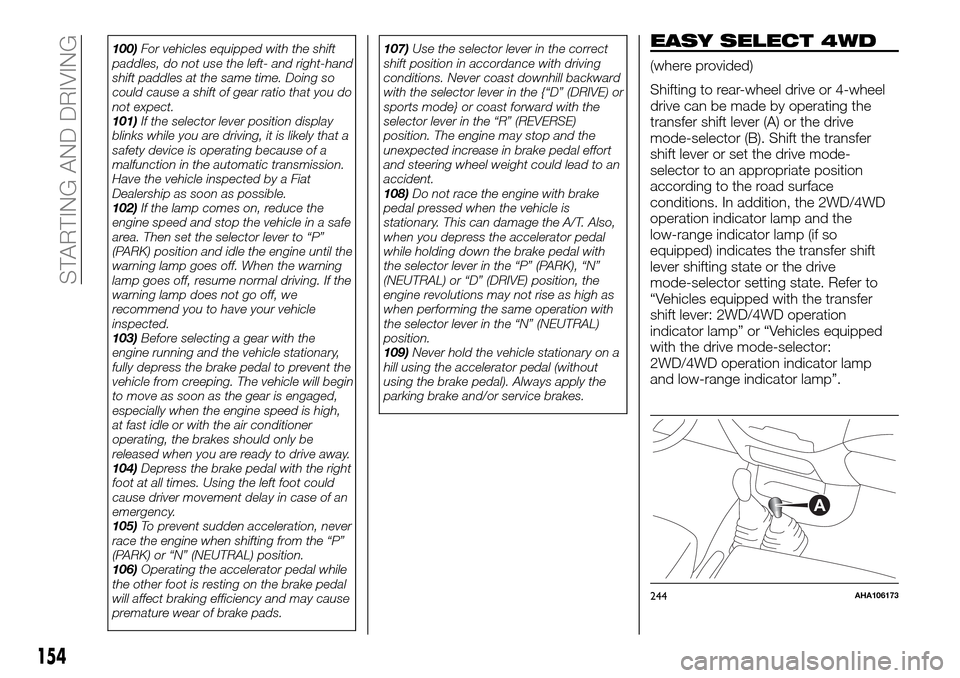
(where provided)
Shifting to rear-wheel drive or 4-wheel
drive can be made by operating the
transfer shift lever (A) or the drive
mode-selector (B). Shift the transfer
shift lever or set the drive mode-
selector to an appropriate position
according to the road surface
conditions. In addition, the 2WD/4WD
operation indicator lamp and the
low-range indicator lamp (if so
equipped) indicates the transfer shift
lever shifting state or the drive
mode-selector setting state. Refer to
“Vehicles equipped with the transfer
shift lever: 2WD/4WD operation
indicator lamp” or “Vehicles equipped
with the drive mode-selector:
2WD/4WD operation indicator lamp
and low-range indicator lamp”.
A
244AHA106173
154
STARTING AND DRIVING