2016 FIAT FULLBACK Instrument
[x] Cancel search: InstrumentPage 126 of 312

WARNING
145)Airbags inflate at an extremely rapid
speed. In certain situations, contact with
inflating airbags can result in abrasions,
bruises, light cuts, and the like.
146)IT IS VERY IMPORTANT TO BE
PROPERLY SEATED. A driver or front
passenger too close to the steering wheel
or instrument panel during airbag
deployment can be killed or seriously
injured. Airbags inflate very fast, and with
great force. If the driver and front
passenger are not properly seated and
restrained, the airbags may not protect you
properly, and could cause serious or fatal
injuries when they inflate.
147)Do not sit on the edge of the seat, or
sit with your lower legs too close to the
instrument panel, or lean head or chest
close to the steering wheel or instrument
panel. Do not put feet or legs on or against
the instrument panel.
148)Always drive with your hands on the
rim of the steering wheel so that the airbag
can inflate freely if required. Do not drive
with your body bent forward. Keep your
back straight against the backrest.149)Place all infants and small children in
the rear seat and properly restrained using
an appropriate child restraint system. The
rear seat is the safest for infants and
children.
150)Infants and small children should
never be unrestrained, stand up against
the instrument panel or held in your arms
or on your lap. They could be seriously
injured or killed in a collision, including
when the airbag inflates. They should be
properly seated in an appropriate child
restraint system. See the “Child restraint”
section of this owner’s manual.
151)When there is an active passenger
airbag, DO NOT install rearward facing
child restraint systems on the front seat.
Deployment of the airbag in an accident
could cause fatal injuries to the child
regardless of the severity of the impact.
Therefore, always deactivate the passenger
side airbag when a rearward facing child
restraint system is installed on the front
passenger seat. The front passenger seat
must also be positioned back as far as
possible in order to prevent the child
restraint system from coming into contact
with the dashboard. Immediately reactivate
the passenger airbag as soon as the child
restraint system has been removed.
152)Older children should be seated,
properly wearing the seat belt, with an
appropriate booster seat if needed.
153)Extreme Hazard! NEVER use a
rearward facing child restraint on a seat
protected by an ACTIVE AIRBAG in front of
it, DEATH or SERIOUS INJURY to the
CHILD can occur.154)Do not fit any accessory that makes
the indicator impossible to see, and do not
cover the indicator with a sticker. You
would not be able to verify the status of the
passenger airbag system.
155)To reduce risk of serious or fatal
injury: always turn the ignition switch to the
“LOCK” position or put the operation mode
in OFF, before operating the front
passenger’s airbag ON-OFF switch. Failure
to do so could adversely affect the airbag
performance; Wait at least 60 seconds to
operate the front passenger’s airbag
ON-OFF switch after turning the ignition
switch to the “LOCK” position or putting
the operation mode in OFF. The SRS
airbag system is designed to retain enough
voltage to deploy the airbag; Always
remove the key from the front passenger’s
airbag ON-OFF switch after operating that
switch. Failure to do so could lead to
improper position of the front passenger’s
airbag ON-OFF switch; Do not turn OFF
the front passenger’s airbag ON-OFF
switch except when a child restraint
system is fitted to the front passenger seat;
If the OFF indicator does not come on
when the front passenger’s airbag ONOFF
switch is turned OFF, do not fit a child
restraint system to the front passenger
seat. We recommend you to have the
system inspected by a Fiat Dealership; if
the OFF indicator remains on when the
front passenger’s airbag ON-OFF switch is
turned ON, do not allow anyone to sit on
the front passenger seat. We recommend
you to have the system inspected by a Fiat
Dealership.
124
SAFETY
Page 127 of 312
156)Do not apply stickers or other objects
to the steering wheel, the dashboard in the
passenger side airbag area and the seats.
Never put objects (e.g. mobile phones) on
the passenger side of the dashboard since
they could interfere with correct inflation of
the passenger airbag and also cause
serious injury to the passengers.
157)Do not set anything on, or attach
anything to, the instrument panel above the
glove box. It might strike and injure an
occupant if the airbag inflates.
158)Do not attach accessories to, or put
them in front of, the windscreen. These
objects could restrict the airbag inflation, or
strike and injure an occupant if the airbags
inflate.
159)Do not attach additional keys or
accessories (hard, pointed or heavy
objects) to the ignition key. Such objects
could prevent the driver’s knee airbag from
inflating normally or could be propelled to
cause serious injury if the airbag inflates.
160)Do not attach accessories to the
lower portion of the driver’s side instrument
panel. Such objects could prevent the
driver’s knee airbag from inflating normally
or could be propelled to cause serious
injury if the airbag inflates.
161)Do not put packages, pets or other
objects between the airbags and the driver
or front passenger. It could affect airbag
performance, or could cause injury when
the airbag inflates.
162)Right after the airbag inflation, several
airbag system components will be hot. Do
not touch these components. There is a
danger of being burnt.163)The airbag system is designed to
work only once. Once the airbags have
deployed, they will not work again. They
must promptly be replaced and we
recommend you to have the entire airbag
system inspected by a Fiat Dealership.
164)Do not affix rigid objects to the
garment hooks or support handles.
165)Do not rest your head, arms or
elbows on the door, windows or the area in
which the Window bag is located to avoid
possible injury during airbag inflation.
166)The airbag does not replace seat
belts but increases their efficiency.
Furthermore, since front airbags are not
deployed in low-speed frontal impacts,
side impacts, rear shunts or roll-overs, the
passengers are protected only by the seat
belts which must therefore be fastened at
all times.
167)The side airbags and curtain airbags
are designed to supplement the driver and
passenger seat belts in certain side
impacts. Seat belts should always be worn
properly, and the driver and passenger
should sit well back and upright without
leaning against the window or door.
168)The side airbag and curtain airbag
inflate with great force. The driver and
passenger should not put their arms out
the window, and should not lean against
the door, in order to reduce risk of serious
or possible fatal injury from the deploying
side airbag and curtain airbag.
169)Do not allow any rear seat occupant
to hold onto the seatback of either front
seat, in order to reduce risk of injury from
the deploying side airbag. Special care
should be taken with children.170)Do not place any objects near or in
front of the seatback of either front seat.
They could interfere with proper side airbag
inflation, and also could cause injury if
thrown free by side airbag deployment.
171)Do not install seat covers on seats
with side airbags. Do not re-cover seats
that have side airbags. This could interfere
with proper side airbag inflation.
172)Do not attach a microphone (A) or
any other device or object around the part
where the curtain airbags (B) activate such
as on the windscreen, side door glass,
front and rear pillars and roof side or assist
grips. When the curtain airbags inflate, the
microphone or other device or object will
be hurled with great force or the curtain
airbags may not activate correctly, resulting
in death or serious injury.
173)Do not allow the child to lean against
or close to the front door even if the child is
seated in a child restraint system. The
child’s head should also not be leaned
against or be close to the area where the
side airbag and curtain airbag are located.
It is dangerous if the side airbag and
curtain airbag inflate. Failure to follow all of
these instructions could lead to serious or
fatal injury to the child.
174)We recommend work around and on
the side airbags and curtain airbags
system to be done by a Fiat Dealership.
175)We recommend any maintenance
performed on or near the components of
the SRS to be performed by a Fiat
Dealership. Improper work on the SRS
components or wiring could result in
inadvertent deployment of the airbags, or
could render the SRS inoperative; either
situation could result in serious injury.
125
Page 154 of 312
perform a downshift when the selector
lever or the shift paddles is moved to
the “— (SHIFT DOWN)” position at
certain vehicle speeds.
Downward shifts are made
automatically when the vehicle slows
down. When the vehicle stops, 1st gear
is automatically selected.
When driving away on a slippery road,
push the selector lever forward into the
“+ (SHIFT UP)” position. This cause the
transmission to shift into the 2nd gear
which is better for smooth driving away
on a slippery road. Push the selector
lever to the “— (SHIFT DOWN)” side to
shift back to the 1st gear.
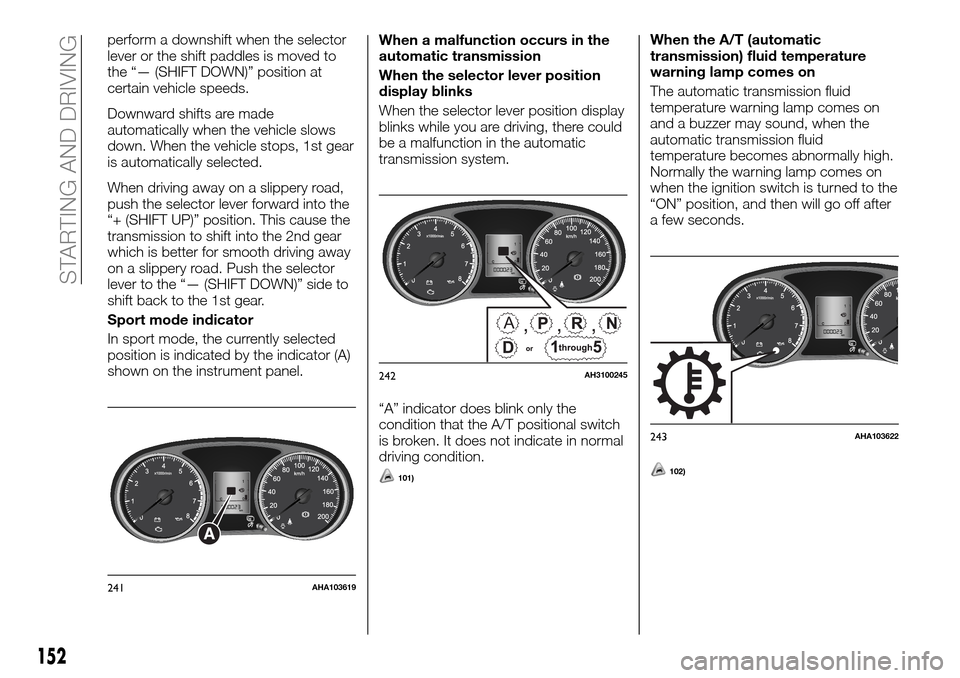
Sport mode indicator
In sport mode, the currently selected
position is indicated by the indicator (A)
shown on the instrument panel.When a malfunction occurs in the
automatic transmission
When the selector lever position
display blinks
When the selector lever position display
blinks while you are driving, there could
be a malfunction in the automatic
transmission system.
“A” indicator does blink only the
condition that the A/T positional switch
is broken. It does not indicate in normal
driving condition.
101)
When the A/T (automatic
transmission) fluid temperature
warning lamp comes on
The automatic transmission fluid
temperature warning lamp comes on
and a buzzer may sound, when the
automatic transmission fluid
temperature becomes abnormally high.
Normally the warning lamp comes on
when the ignition switch is turned to the
“ON” position, and then will go off after
a few seconds.
102)
A
241AHA103619
,,,A
242AH3100245
243AHA103622
152
STARTING AND DRIVING
Page 155 of 312

Operation of the A/T
103) 104) 105) 106) 107) 108)
Passing acceleration
To gain extra acceleration in “D” (DRIVE)
position, push the accelerator to the
floor. The A/T will automatically
downshift.
In sport mode, downshifts do not take
place when the accelerator is
depressed all the way to the floor.
Waiting
For short waiting periods, such as at
traffic signals the vehicle can be left in
gear and held stationary with the
service brake. For longer waiting
periods with the engine running, place
the selector lever in the “N” (NEUTRAL)
position and apply the parking brake,
while holding the vehicle stationary with
the service brake.
109)
Parking
To park the vehicle, first bring it to a
complete stop, fully engage the parking
brake, and then move the selector lever
to the “P” (PARK) position.
If you are going to leave the vehicle
unattended, always switch off the
engine and carry the key.
On a slope, be sure to apply the
parking brake before moving the
selector lever to the “P” (PARK)
position. If you move the selector lever
to the “P” (PARK) position beforeapplying the parking brake, it may be
difficult to disengage the selector lever
from the “P” (PARK) position when next
you drive the vehicle, requiring
application of a strong force to the
selector lever to move from the “P”
(PARK) position.
When the A/T makes no speed
change
If the transmission does not change
speeds while driving, or your vehicle
does not pick up enough speed when
starting on an uphill slope, it may be
that there is something unusual
happening in the transmission, causing
a safety device to activate. Have your
vehicle checked by a Fiat Dealership as
soon as possible.
1. If your vehicle has difficulty moving
uphill, shift the selector lever into 2nd
gear of the sports mode. This method
might not work depending on the
transmission malfunction.
2. Once the vehicle is moving on a level
road, move the selector lever back to
“D” (DRIVE).
When the selector lever position display
in the instrument panel blinks, it means
that there is an abnormal condition in
the transmission. Refer to “When the
selector lever position display blinks”.
IMPORTANT
92)Always depress the brake pedal when
shifting the selector lever into a gear from
the “P” (PARK) or “N” (NEUTRAL) position.
Never put your foot on the accelerator
pedal while shifting the selector lever from
the “P” (PARK) or “N” (NEUTRAL) position.
93)Never shift into the “P” (PARK) or “R”
(REVERSE) position while the vehicle is in
motion to avoid a transmission damage.
94)Never move the selector lever to the
“N” (NEUTRAL) position while driving. A
serious accident could occur since you
could accidentally move the lever into the
“P” (PARK) or “R” (REVERSE) position or
you will lose engine braking.
95)On a gradient, the engine should be
started in the “P” (PARK) position, not in the
“N” (NEUTRAL) position.
96)To prevent rolling, always keep your
foot on the brake pedal when the vehicle is
in “N” (NEUTRAL) position, or when shifting
into or out of “N” (NEUTRAL) position.
97)To prevent transmission damage, never
shift into the “D” (DRIVE) position from the
“R” (REVERSE) position while the vehicle is
in motion.
98)In sports mode, the driver must
execute upward shifts in accordance with
prevailing road conditions, taking care to
keep the engine speed below the red zone.
99)Repeated continuous operation of the
selector lever or the shift paddles will
continuously switch shift position.
153
Page 190 of 312

IMPORTANT
131)Do not add coolant while the engine is
hot. Suddenly adding cold coolant could
damage the engine. Wait for the engine to
cool down, then add coolant a little at a
time.
BLEEDING THE FUEL
SYSTEM
The fuel system should be bled to
remove air as described below if the
fuel supply is exhausted during travel.
Pump the hand pump (A) at the top of
the fuel filter until the hand pump
becomes stiff.
Then try again to start the engine. If the
engine does not start, repeat the
process above.
253) 254)
WARNING
253)Do not smoke or have any other open
flame near the vehicle while bleeding the
fuel system.
254)Be sure to carefully clean away any
spilt fuel which could ignite and cause a
fire.
REMOVAL OF WATER
FROM THE FUEL
FILTER
If the fuel filter indicator lamp in the
instrument panel illuminates during
driving, it indicates that water has
accumulated in the fuel filter. If this
occurs, remove the water as described
below.
1. Loosen the drain plug (A) of the fuel
filter.
2. Operate the hand pump (B) slowly
6 or 7 times in order to force the water
out through the drain plug (A).
A
288AHA102090
A
289AHA102104
188
IN CASE OF EMERGENCY
Page 227 of 312

SCHEDULED SERVICING PLAN
PETROL-POWERED ENGINE
Thousand of miles9 182736455463728190
Thousand of kilometers15 30 45 60 75 90 105 120 135 150
Years12345678910
Check tyre conditions/wear and adjust
pressure, if necessary●●●●●●●●●●
Check operation of lighting system
(headlights, direction indicators, hazard
warning lights, boot, passenger
compartment, glove compartment,
instrument panel warning lights, etc.)
●●●●●●●●●●
Check and, if necessary, top up fluid levels
(1)●●●●●●●●●●
Check battery condition●●●●●●●●●●
Change engine coolant(2)
Check exhaust emissions/smokiness
●●●●●●●●●●
Use the diagnosis socket to check
supply/engine management systems
operation, emissions and, for
versions/markets, where provided, engine
oil degradation
●●●●●●●●●●
Perform the "Small Injection Quantity
Learning” procedure●●●●●●●●●●
(1) Always only use the liquids shown in the handbook for topping up after having checked that the system is not damaged.
(2) This should be done every two years or 40,000 km.
225
Page 232 of 312

DIESEL ENGINE 4N15
Thousands of miles6 121825313743505662
Thousands of kilometers or10 20 30 40 50 60 70 80 90 100
Years12345678910
Check tyre conditions/wear and adjust
pressure, if necessary●●●●●●●●●●
Check operation of lighting system
(headlights, direction indicators, hazard
warning lights, boot, passenger
compartment, glove compartment,
instrument panel warning lights, etc.)
●●●●●●●●●●
Check and, if necessary, top up fluid levels
(1)●●●●●●●●●●
Check battery condition●●●●●●●●●●
Change engine coolant(7)
Adjust the tappet clearance (where there is
no hydraulic clearance adjustment) (8)
●
Check exhaust emissions/smokiness●●●●●●●●●●
Use the diagnosis socket to check
supply/engine management systems
operation, emissions and, for
versions/markets, where provided, engine
oil degradation
●●●●●●●●●●
(1) Always only use the liquids shown in the handbook for topping up after having checked that the system is not damaged.
(7) The engine coolant should be replaced after 8 years or 160,000 km, then every 5 years or 100,000 km
(8) to be done only on a mileage basis, independently of the time.
230
SERVICING AND MAINTENANCE
Page 237 of 312

DIESEL ENGINE 4D56
Thousands of miles6 121825313743505662
Thousands of kilometers or10 20 30 40 50 60 70 80 90 100
Years12345678910
Check tyre conditions/wear and adjust
pressure, if necessary●●●●●●●●●●
Check operation of lighting system
(headlights, direction indicators, hazard
warning lights, boot, passenger
compartment, glove compartment,
instrument panel warning lights, etc.)
●●●●●●●●●●
Check and, if necessary, top up fluid levels
(1)●●●●●●●●●●
Check battery condition●●●●●●●●●●
Change engine coolant(13)
Adjust the tappet clearance (where there is
no hydraulic clearance adjustment)
●●●●●
Check exhaust emissions/smokiness●●●●●●●●●●
Use the diagnosis socket to check
supply/engine management systems
operation, emissions and, for
versions/markets, where provided, engine
oil degradation
●●●●●●●●●●
(1) Always only use the liquids shown in the handbook for topping up after having checked that the system is not damaged.
(13) The engine coolant should be changed every two years or 40,000 km.
235