Page 215 of 312

IMPORTANT
147)If it is necessary to wash the engine
compartment, take care not to directly hit
the fuse box and the window wiper motor
with the water jet
REPLACEMENT OF
LAMP BULBS
299) 300) 301) 302) 303) 304)
Before replacing a bulb, ensure the
lamp is off. Do not touch the glass part
of the new bulb with your bare fingers;
the skin oil left on the glass will
evaporate when the bulb gets hot and
the vapor will condense on the reflector
and dim the surface.
NOTE If you are unsure of how to carry
out the work as required, we
recommend you to consult a specialist.
Be careful not to scratch the vehicle
body when removing a lamp and lens.
When it rains, or when the vehicle has
been washed, the inside of the lens
sometimes becomes foggy. This is the
same phenomenon as when window
glass mists up on a humid day, and
does not indicate a functional problem.When the lamp is switched on, the heat
will remove the fog. However, if water
gathers inside the lamp, we
recommend you to have the lamp
checked.
Bulb location and capacity
When replacing a bulb, use a new bulb
with the same wattage and colour.
Outside
Front
Except for vehicles with high
intensity discharge headlamps
1. Position lamps: 5 W (W5W)
2. Front turn-signal lamps: 21 W
(PY21W/P21W)
3. Headlamps, high/low beam:
60/55 W (H4)
4. Type 1: Front fog lamps: 35 W (H8)
Daytime running lamps: 13 W (P13W).
351AA0030717352AHA104603
213
Page 224 of 312
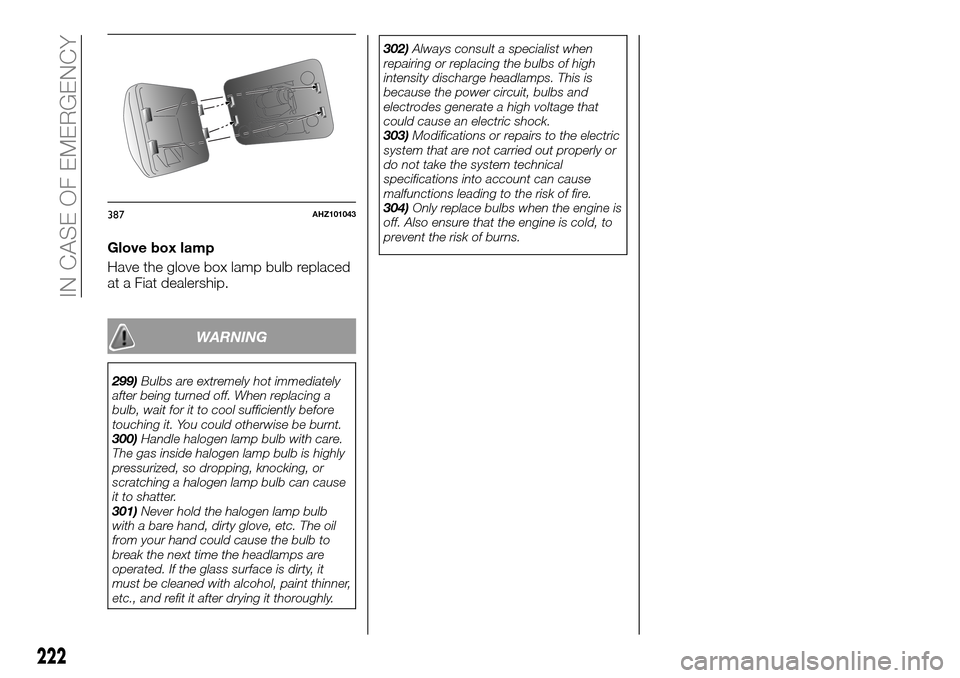
Glove box lamp
Have the glove box lamp bulb replaced
at a Fiat dealership.
WARNING
299)Bulbs are extremely hot immediately
after being turned off. When replacing a
bulb, wait for it to cool sufficiently before
touching it. You could otherwise be burnt.
300)Handle halogen lamp bulb with care.
The gas inside halogen lamp bulb is highly
pressurized, so dropping, knocking, or
scratching a halogen lamp bulb can cause
it to shatter.
301)Never hold the halogen lamp bulb
with a bare hand, dirty glove, etc. The oil
from your hand could cause the bulb to
break the next time the headlamps are
operated. If the glass surface is dirty, it
must be cleaned with alcohol, paint thinner,
etc., and refit it after drying it thoroughly.302)Always consult a specialist when
repairing or replacing the bulbs of high
intensity discharge headlamps. This is
because the power circuit, bulbs and
electrodes generate a high voltage that
could cause an electric shock.
303)Modifications or repairs to the electric
system that are not carried out properly or
do not take the system technical
specifications into account can cause
malfunctions leading to the risk of fire.
304)Only replace bulbs when the engine is
off. Also ensure that the engine is cold, to
prevent the risk of burns.
387AHZ101043
222
IN CASE OF EMERGENCY
Page 225 of 312
SERVICING AND MAINTENANCE
Correct maintenance permits the
performance of the car to be
maintained over time, as well as limited
running costs and safeguarding the
efficiency of the safety systems.
This chapter explains how.SERVICE PRECAUTIONS.......224
SCHEDULED SERVICING PLAN . .225
PERIODIC CHECKS..........240
DEMANDING VEHICLE USE.....240
CHECKING LEVELS..........241
CATALYTIC CONVERTER.......245
ENGINE OIL...............245
ENGINE COOLANT...........247
WASHER FLUID.............249
BRAKE FLUID..............249
CLUTCH FLUID.............250
POWER STEERING FLUID......251
BATTERY.................252
WIPER BLADE RUBBER
REPLACEMENT.............254
GENERAL MAINTENANCE......255
VEHICLE CARE PRECAUTIONS. . .255
CLEANING THE INTERIOR OF
YOUR VEHICLE.............256
CLEANING THE EXTERIOR OF
YOUR VEHICLE.............257
TYRES...................260
223
Page 227 of 312

SCHEDULED SERVICING PLAN
PETROL-POWERED ENGINE
Thousand of miles9 182736455463728190
Thousand of kilometers15 30 45 60 75 90 105 120 135 150
Years12345678910
Check tyre conditions/wear and adjust
pressure, if necessary●●●●●●●●●●
Check operation of lighting system
(headlights, direction indicators, hazard
warning lights, boot, passenger
compartment, glove compartment,
instrument panel warning lights, etc.)
●●●●●●●●●●
Check and, if necessary, top up fluid levels
(1)●●●●●●●●●●
Check battery condition●●●●●●●●●●
Change engine coolant(2)
Check exhaust emissions/smokiness
●●●●●●●●●●
Use the diagnosis socket to check
supply/engine management systems
operation, emissions and, for
versions/markets, where provided, engine
oil degradation
●●●●●●●●●●
Perform the "Small Injection Quantity
Learning” procedure●●●●●●●●●●
(1) Always only use the liquids shown in the handbook for topping up after having checked that the system is not damaged.
(2) This should be done every two years or 40,000 km.
225
Page 230 of 312

Thousand of miles9 182736455463728190
Thousand of kilometers15 30 45 60 75 90 105 120 135 150
Years12345678910
Check the brake and clutch pedal play●●●●●●●●●●
Visually inspect conditions and check the
tension of the accessory drive belts●●●●●●●●●●
Visually inspect conditions and check the
tension of the toothed timing drive belts●●●●● ●●●●
Visually check for any fluid leaks from the
front and rear differentials (if leaks are found,
check the oil level)
●●● ●●● ●●
Change front and rear differential oil (5)●●
Change rear limited slip differential oil
(where present) (6)●●●
Visually check for any fluid leaks from the
transfer case (if leaks are found, check the
oil level)
●●●●● ●●●●
Change transfer case oil (8)●
Change engine oil and replace oil filter●●●●●●●●●●
Replace accessory drive belts(7)
(5) To be done only on a mileage basis, independently of the time. In case of heavy use, it is recommended to change every 40,000 km.
(6) To be done only on a mileage basis, independently of the time. In case of heavy use, it is recommended to change every 20,000 km.
(8)To be done only on a mileage basis.
(7) The belt should only be replaced if damage/wear is found during the periodic inspection.
228
SERVICING AND MAINTENANCE
Page 232 of 312

DIESEL ENGINE 4N15
Thousands of miles6 121825313743505662
Thousands of kilometers or10 20 30 40 50 60 70 80 90 100
Years12345678910
Check tyre conditions/wear and adjust
pressure, if necessary●●●●●●●●●●
Check operation of lighting system
(headlights, direction indicators, hazard
warning lights, boot, passenger
compartment, glove compartment,
instrument panel warning lights, etc.)
●●●●●●●●●●
Check and, if necessary, top up fluid levels
(1)●●●●●●●●●●
Check battery condition●●●●●●●●●●
Change engine coolant(7)
Adjust the tappet clearance (where there is
no hydraulic clearance adjustment) (8)
●
Check exhaust emissions/smokiness●●●●●●●●●●
Use the diagnosis socket to check
supply/engine management systems
operation, emissions and, for
versions/markets, where provided, engine
oil degradation
●●●●●●●●●●
(1) Always only use the liquids shown in the handbook for topping up after having checked that the system is not damaged.
(7) The engine coolant should be replaced after 8 years or 160,000 km, then every 5 years or 100,000 km
(8) to be done only on a mileage basis, independently of the time.
230
SERVICING AND MAINTENANCE
Page 235 of 312

Thousands of miles6 121825313743505662
Thousands of kilometers or10 20 30 40 50 60 70 80 90 100
Years12345678910
Check handbrake lever travel and adjust, if
necessary●●●●●●●●●●
Check the brake and clutch pedal play●●●●●●●●●●
Visually inspect conditions and check the
tension of the accessory drive belts●●●●●●●●●●
Visually check for any fluid leaks from the
front and rear differentials (if leaks are found,
check the oil level)
●●●●●●● ●●
Change front and rear differential oil (10)●
Change rear limited slip differential oil
(where present) (11)●●
Visually check for any fluid leaks from the
transfer case (if leaks are found, check the
oil level)
●●●●●●●●●
Change transfer case oil (8)●
Change engine oil and replace oil filter●●●●●●●●●●
Replace accessory drive belts(3)
(10) to be done only on a mileage basis, independently of the time. In case of heavy use, it is recommended to change every 40,000 km.
(11) to be done only on a mileage basis, independently of the time. In case of heavy use, it is recommended to change every 20,000 km.
(8) to be done only on a mileage basis, independently of the time.
(3) The belt should only be replaced if damage/wear is found during the periodic inspection.
233
Page 237 of 312

DIESEL ENGINE 4D56
Thousands of miles6 121825313743505662
Thousands of kilometers or10 20 30 40 50 60 70 80 90 100
Years12345678910
Check tyre conditions/wear and adjust
pressure, if necessary●●●●●●●●●●
Check operation of lighting system
(headlights, direction indicators, hazard
warning lights, boot, passenger
compartment, glove compartment,
instrument panel warning lights, etc.)
●●●●●●●●●●
Check and, if necessary, top up fluid levels
(1)●●●●●●●●●●
Check battery condition●●●●●●●●●●
Change engine coolant(13)
Adjust the tappet clearance (where there is
no hydraulic clearance adjustment)
●●●●●
Check exhaust emissions/smokiness●●●●●●●●●●
Use the diagnosis socket to check
supply/engine management systems
operation, emissions and, for
versions/markets, where provided, engine
oil degradation
●●●●●●●●●●
(1) Always only use the liquids shown in the handbook for topping up after having checked that the system is not damaged.
(13) The engine coolant should be changed every two years or 40,000 km.
235
