2016 FIAT FULLBACK battery
[x] Cancel search: batteryPage 78 of 312

CIGARETTE LIGHTER
(where provided)
The cigarette lighter can be used while
the ignition switch or the operation
mode is in ON or ACC.A — Push all the way in.
The cigarette lighter will automatically
return to its original position with a
“click” when ready. Pull it out for use.
After use, insert the cigarette lighter to
its original position in the socket.
NOTE Do not leave the cigarette lighter
removed from its socket, because the
socket might become clogged by
foreign material and be short-circuited.
80)
Do not allow children to operate or play
with the cigarette lighter as burns may
occur.
Do not use any electric appliance that is
not approved by FCA. Doing so could
damage the socket. If you used the
cigarette lighter after damaging the
socket, the cigarette lighter might pop
out or fail to come out after being
pushed in.Something is wrong with the cigarette
lighter if it does not pop back out within
approximately 30 seconds of being
pushed in. Pull it out and have the
problem corrected at Fiat Dealership.
When the cigarette lighter socket is
used as a power source for an electric
appliance, be sure that the electric
appliance operates at 12 V and has an
electric capacity of 120 W or less. In
addition, long use of the electric
appliance without running the engine
may run down the battery.
ACCESSORY SOCKET
(where provided)
The accessory socket can be used
while the ignition switch or the
operation mode is in ON or ACC. To
use a plug-in type accessory, open the
lid, and insert the plug in the accessory
socket.
139AH3100258
A
140AHA104805
141AHA101644
76
GETTING TO KNOW YOUR VEHICLE
31) 32)
Page 79 of 312

DIGITAL CLOCK
(where provided)
The digital clock indicates the time with
the ignition switch or the operation
mode is in ON or ACC.
To set the time
Set the time by pressing the various
buttons as described below.
1. To adjust the hour
2. To adjust the minutes
3. To reset the minutes to zero
If the battery cables are disconnected
during repairs or for any other reason,
reset the clock to the correct time after
they are reconnected.
STORAGE SPACES
28)
81)
1. Glove box 2. Sunglasses holder
3. Floor console box 4. Centre
console under tray
Glove box Type 1
To open, push the button (A).Glove box Type 2
The glove box can be locked and
unlocked using the key.
A — To lock
B — To unlock
C — To open, push the button
NOTE When the lamp switch is in the
orposition, the glove box lamp
illuminates. Refer to “Combination
headlamps and dipper switch”.142AHA105961
143AHA105974
A
144AHA105987
B
C
A
145AHA106160
77
Page 83 of 312

WARNING
79)Don’t put papers and other things that
burn into your ashtrays. If you do,
cigarettes or other smoking materials could
set them on fire, causing damage.
80)Do not touch the heating element or
the cigarette lighter housing, hold the knob
only to prevent burns.
81)Keep the lids of storage spaces closed
while driving the vehicle. A lid or the
contents of a storage space could
otherwise cause injuries.
82)The holder should not be used to store
anything heavier than sunglasses. These
objects could drop out.
83)Do not drink beverages while driving.
This is distracting and could cause an
accident.
84)Drinks could be spilled by the vibration
and jolts while driving. If the spilt drink is
very hot, you could be burnt.
85)Do not put a hanger or any heavy or
pointed object on the coat hook. If the
curtain airbag was activated, any such item
could be propelled away with great force
and could prevent the curtain airbag from
inflating correctly. Hang clothes directly on
the coat hook (without using a hanger).
Make sure there are no heavy or sharp
objects in the pockets of clothes that you
hang on the coat hook.
IMPORTANT
27)When the accessory socket is not in
use, be sure to close the lid, because the
socket might become clogged by foreign
material and be short-circuited.
28)Never leave lighters, canned
carbonated beverage, and spectacles in
the cabin when parking the vehicle in hot
sunshine. The cabin will become extremely
hot, so lighters and other flammable items
may catch fire and unopened drink cans
may rupture. Also, spectacles with plastic
lenses or materials could deform or crack.
29)Put out matches and cigarettes before
they are placed in the ashtray.
30)Always close the ashtray. If left open,
other cigarette butts in the ashtray may be
rekindled.
31)Be sure to use a “plug-in” type
accessory operating at 12 V and at 120 W
or less. When using more than one socket
at the same time, make sure that the
electrical accessories are 12 V accessories
and that the total power consumption does
not exceed 120 W.
32)Long use of the electric appliance
without running the engine may run down
the battery.
FUEL SELECTION
RecommendedPetrol-powered vehicles:
Unleaded petrol octane number
90 RON or higher
Diesel-powered vehicles: Cetane
number (EN590) 51 or higher
Ethanol/Gasohol (Petrol-powered
vehicles only)
A mixture of up to 10 % ethanol (grain
alcohol) and 90 % unleaded petrol may
be used in your vehicle, provided the
octane number is at least as high as
that recommended for Fuel selection
unleaded petrol.
33) 34) 35) 36) 37) 38)
In petrol-powered vehicles, repeatedly
driving short distance at low speeds
can cause deposits to form in the fuel
system and engine, resulting in poor
starting and poor acceleration. If these
problems occur, you are advised to add
a detergent additive to the petrol when
you refuel the vehicle. The additive will
remove the deposits, thereby returning
the engine to a normal condition. Be
sure to use a FCA GENUINE FUEL
SYSTEM CLEANER. Using an
unsuitable additive could make the
engine malfunction. For details, please
contact the nearest Fiat Dealership.
Poor quality petrol can cause problems
such as hard starting, stalling, engine
noise and hesitation. If your experience
these problems, try another brand
and/or grade of petrol. If the check
81
Page 90 of 312

Odometer
The odometer indicates the distance
travelled
Tripmeter
The tripmeter indicates the distance
travelled between two points.
Example usage of tripmeter A and
tripmeter B.
It is possible to measure two currently
travelled distances, from home using
tripmeter A and from a particular point
on the way using tripmeter B.
To reset tripmeter
To return the display to 0, hold down
the multi information display switch for
about 2 seconds or more. Only the
currently displayed value will be reset.
Example
If tripmeter A is displayed, only
tripmeter A will be reset.
NOTE When disconnecting the battery
terminal, the memory of tripmeter A and
B are cleared, and the display returns to
“0”.
Meter illumination control
Each time you press and hold the multi
information display switch (2) for about
2 seconds or more, there is a sound
and the brightness of the instruments
changes.NOTE You can adjust to 8 different
levels respectively for when the position
lamps are illuminated and when they
are not. Each time you reduce two
brightness levels, the segment display
of the brightness level decreases one
by one.
NOTE If the vehicle is equipped with
the automatic lamp control, when the
lamp switch is in a position other than
the “OFF” position, the meter
illumination switches automatically to
the adjusted brightness, depending on
the brightness outside the vehicle.
NOTE The brightness level of the
instruments is stored when the ignition
switch is turned off or the operation
mode is put in OFF.Driving range display
This displays the approximate driving
range (how many more kilometres or
miles you can drive). When the driving
range falls below approximately 50 km
(30 miles), “---” is displayed.
NOTE The driving range is determined
based on the fuel consumption data.
This may vary depending on the driving
conditions and habits. Treat the
distance displayed as just a rough
guideline.
NOTE When you refuel, the driving
range display is updated. However, if
you only add a small amount of fuel, the
correct value will not be displayed. Fill
with a full tank whenever possible.
NOTE On rare occasions, the value
displayed for the driving range may
change if you are parked on an
extremely steep incline. This is due to
the movement of fuel in the tank and
does not indicate any malfunction.
NOTE The display setting can be
changed to the preferred units (km or
miles). Refer to “Changing the function
settings”.
Average fuel consumption display
This displays the average fuel
consumption from the last reset to the
present time. The reset mode
conditions for the average fuel
consumption display can be switched
170AHA101282
88
KNOWING THE INSTRUMENT PANEL
Page 91 of 312

between “Auto reset” and “Manual
reset”.
For information on how to change the
average fuel consumption display
setting, refer to “Changing the function
settings”.
NOTE The average fuel consumption
display can be reset separately for the
auto reset mode and for the manual
reset mode.
NOTE “---” is displayed when the
average fuel consumption cannot be
measured.
NOTE The initial (default) setting is
“Auto reset mode”.
NOTE The average fuel consumption
will depend on the driving conditions
(road conditions, how you drive, etc.).
The displayed fuel consumption may
vary from the actual fuel consumption.
Treat the fuel consumption displayed as
just a rough guideline.
NOTE The memory of the manual reset
mode or auto reset mode for the
average fuel consumption display is
erased if the battery is disconnected.
NOTE The display setting can be
changed to the preferred units {km/L,
L/100 km, mpg}. Refer to “Changing
the function settings”.Outside temperature display (if so
equipped)
This displays the temperature outside
the vehicle.
NOTE The display setting can be
changed to the preferred units (°C or
°F). Refer to “Changing the function
settings”.
NOTE Depending on factors such as
the driving conditions, the displayed
temperature may vary from the actual
outside temperature.
Frozen road warning (if so
equipped)
If the outside air temperature drops
below approx. 3°C (37 °F), the alarm
sounds and the outside air temperature
warning symbol (A) flashes for about 10
seconds.
98)
Engine coolant temperature display
This indicates the engine coolant
temperature. If the coolant becomes
hot,
will blink.
Pay careful attention to the engine
coolant temperature display while you
are driving.
99)
Fuel remaining display
The fuel remaining display indicates the
fuel level in the fuel tank when the
ignition switch or the operation mode is
ON.
1 — Full
0 — Empty
NOTE It may take several seconds to
stabilise the display after refilling the
tank.
A
171AHA101295
A
172AHA101309
89
Page 94 of 312

Auto reset modeWhen the average fuel consumption
is being displayed, if you hold down the
multi information display switch, the
average fuel consumption displayed at
that time are reset.
When the engine switch or the
operation mode is in the following
conditions, the average fuel
consumption display is automatically
reset. Except for vehicles equipped with
the keyless operation system: the
ignition switch is in the “ACC” or
“LOCK” position for about 4 hours or
longer. For vehicles equipped with the
keyless operation system: the operation
mode is in ACC or OFF for about
4 hours or longer.
IMPORTANT The average fuel
consumption display can be reset
separately for the auto reset mode and
for the manual reset mode.
IMPORTANT The memory of the
manual reset mode or auto reset mode
for the average fuel consumption
display is erased if the battery is
disconnected.
The initial (default) setting is “Auto reset
mode”.Changing the fuel consumption
display unit
The display unit for fuel consumption
can be switched. The distance and
amount units are also switched to
match the selected fuel consumption
unit.When you lightly press the multi
information display switch a few times,
the information display switches to the
average fuel consumption display. Refer
to “Information display”.
Press and hold the multi information
display switch for about 5 seconds or
more until buzzer sound is heard twice.
Press and hold the multi information
display switch to switch in sequence
from “km/L” > “L/100 km” > “mpg” >
“km/L”.
The display units for the driving range,
the average fuel consumption areswitched, but the units for the indicating
needle (speedometer), the odometer,
the tripmeter and the service reminder
will remain unchanged.
The memory of the unit setting is
erased if the battery is disconnected,
and it returns automatically to factory
setting.
The distance units is also switched in
the following combinations to match the
selected fuel consumption unit.
Fuel
consumptionDistance (driving
range)
km/L km
L/100 km km
mpg mile (s)
Changing the temperature unit
The display unit for outside temperature
can be switched.
1. When you lightly press the multi
information display switch a few times,
the information display switches to the
outside temperature display. Refer to
“Information display”.
2. Each time you press the multi
information display switch for
2 seconds or more on outside
temperature display, you can switch
from °C to °F or from °F to °C unit of
outside temperature display.
The temperature value on air
conditioner panel is switched in
178AHA101367
92
KNOWING THE INSTRUMENT PANEL
Page 99 of 312
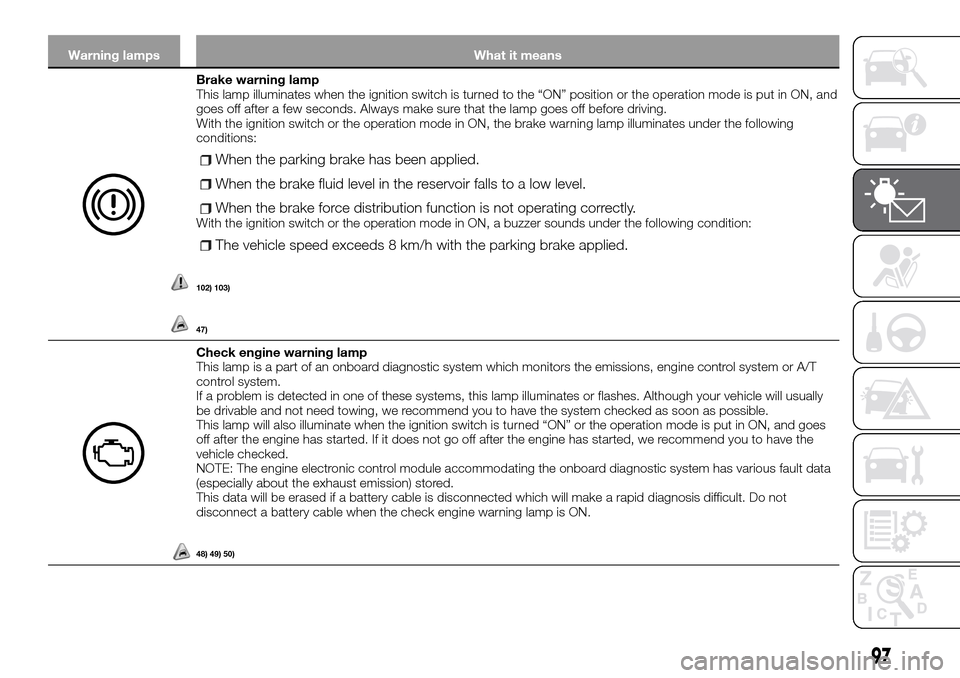
Warning lamps What it means
Brake warning lamp
This lamp illuminates when the ignition switch is turned to the “ON” position or the operation mode is put in ON, and
goes off after a few seconds. Always make sure that the lamp goes off before driving.
With the ignition switch or the operation mode in ON, the brake warning lamp illuminates under the following
conditions:
When the parking brake has been applied.
When the brake fluid level in the reservoir falls to a low level.
When the brake force distribution function is not operating correctly.With the ignition switch or the operation mode in ON, a buzzer sounds under the following condition:
The vehicle speed exceeds 8 km/h with the parking brake applied.
102) 103)
47)
Check engine warning lamp
This lamp is a part of an onboard diagnostic system which monitors the emissions, engine control system or A/T
control system.
If a problem is detected in one of these systems, this lamp illuminates or flashes. Although your vehicle will usually
be drivable and not need towing, we recommend you to have the system checked as soon as possible.
This lamp will also illuminate when the ignition switch is turned “ON” or the operation mode is put in ON, and goes
off after the engine has started. If it does not go off after the engine has started, we recommend you to have the
vehicle checked.
NOTE: The engine electronic control module accommodating the onboard diagnostic system has various fault data
(especially about the exhaust emission) stored.
This data will be erased if a battery cable is disconnected which will make a rapid diagnosis difficult. Do not
disconnect a battery cable when the check engine warning lamp is ON.
48) 49) 50)
97
Page 143 of 312

STARTING AND
STOPPING THE
ENGINE
Tips for starting
Except for vehicles equipped with
the keyless operation system
Do not operate the starter motor
continuously longer than 10 seconds;
doing so could run down the battery. If
the engine does not start, turn the
ignition switch back to “LOCK”, wait a
few seconds, and then try again. Trying
repeatedly with the starter motor still
turning will damage the starter
mechanism.
203)
79) 80) 81) 82) 83) 84)
For vehicles equipped with the
keyless operation system
The operation mode can be in any
mode to start the engine.
The starter motor will be turning for up
to approximately 15 seconds if the
engine switch is released at once.
Pressing the engine switch again while
the starter motor is still turning will stop
the starter motor. The starter motor will
be turning for up to approximately
30 seconds while the engine switch is
pressed. If the engine does not start,
wait for a while and then attempt to
start the engine again. Trying repeatedly
with the starter motor still turning will
damage the starter mechanism.
203)
80) 81) 82)
Starting the engine (petrol-powered
vehicles)
Except for vehicles equipped with
the keyless operation system
Your vehicles equipped with an
electronically controlled fuel injection
system. When starting the engine, do
not depress the accelerator pedal.
The starting procedure is as follows:
Insert the ignition key and fasten the
seat belt.
Make sure the parking brake is
applied.
Depress and hold the brake pedal.
Depress the clutch pedal all the way
and place the gearshift lever in the “N”
(Neutral) position.
After turning the ignition key to the
“ON” position, make certain that all
warning lamps are functioning properly
before starting the engine
Turn the ignition key to the “START”
position without depressing the
accelerator pedal, and release it when
the engine starts.A ticking noise may be heard after
starting the engine. This is not an
abnormal condition. The noise will
disappear after a short time of engine
running. If the ticking noise continues
after the engine is warmed up, have
your vehicle checked at a Fiat
Dealership.
Minor noises may be heard on engine
startup. These will disappear as the
engine warms up.
When the engine is hard to start
After several attempts, you may
experience that the engine still does not
start.
Make sure that all electric devices,
such as lamps, air conditioning blower
and rear window demister, are turned
off.
While depressing the clutch pedal,
press the accelerator pedal halfway and
hold it there, then crank the engine.
Release the accelerator pedal,
N
227AHA106001
141
immediately after the engine starts.