Page 149 of 312
Possible driving speed
Avoid shifting down at high speed, as this may cause excessive engine speed (the tachometer needle into the red zone) and
damage the engine.
2WD models
Shift point Speed limit
Petrol-powered
vehiclesDiesel-powered vehicles
4N15 4D56 without intercooler 4D56 with intercooler
1st gear 40 km/h 30 km/h 30 km/h 30 km/h
2nd gear 75 km/h 60 km/h 60 km/h 60 km/h
3rd gear 115 km/h 100 km/h 100 km/h 100 km/h
4th gear 160 km/h 140 km/h 135 km/h 145 km/h
5th gear — 185 km/h — —
Vehicles with 5 M/T, use 5th gear whenever vehicle speed allows, for maximum fuel economy.
Vehicles with 6 M/T, use 6th gear whenever vehicle speed allows, for maximum fuel economy.
4WD models
Shift pointSpeed limit
Petrol-powered vehicles
2H, 4H 4L
1st gear 40 km/h 20 km/h
2nd gear 75 km/h 40 km/h
3rd gear 120 km/h 60 km/h
4th gear 160 km/h 85 km/h
5th gear — —
147
Page 206 of 312

142)Never tow an automatic transmission
vehicle with the front wheels up (and the
rear wheels on the ground) (Type B) when
the automatic transmission fluid level is low.
This may cause serious and expensive
damage to the transmission.
143)When the engine is not running, the
brake booster and power steering pump do
not operate. This means higher brake
depression force and higher steering effort
are required. Therefore, vehicle operation is
very difficult.
144)Do not leave the ignition switch in the
“LOCK” position or the operation mode in
OFF. The steering wheel will lock, causing
loss of control.
145)On vehicles with super select 4WD II,
when you are going to tow another vehicle,
set the drive mode-selector to “4H”
position. Selecting “2H” drive may increase
the differential oil temperature, resulting in
possible damage to the driving system.
Further, the drive train will be subjected to
excessive loading possibly leading to oil
leakage, component seizure, or other
serious faults.OPERATION UNDER
ADVERSE DRIVING
CONDITIONS
On a flooded road
Avoid flooded roads. Water could enter
the brake discs, resulting in temporarily
ineffective brakes. In such cases, lightly
depress the brake pedal to see if the
brakes operate properly. If they do not,
lightly depress the pedal several times
while driving in order to dry the brake
pads.
When driving in rain or on a road with
many puddles a layer of water may
form between the tyres and the road
surface. This reduces a tyre’s frictional
resistance on the road, resulting in loss
of steering stability and braking
capability.
To cope with this, observe the following
items:
(a) Drive your vehicle at a slow speed.
(b) Do not drive on worn tyres.
(c) Always maintain the specified tyre
inflation pressures.On a snow-covered or frozen road
When driving on a snow-covered or
frozen road, it is recommended that you
use snow tyres or snow traction device
(tyre chains). Refer to the “Snow tyres”
and “Snow traction device (tyre chains)”
sections.
Avoid high-speed operation, sudden
acceleration, abrupt brake application
and sharp cornering.
Depressing the brake pedal during
travel on snowy or icy roads may cause
tyre slippage and skidding. When
traction between the tyres and the road
is reduced the wheels may skid and the
vehicle cannot readily be brought to a
stop by conventional braking
techniques. Braking will differ,
depending upon whether you have
anti-lock brake system (ABS). If you do
have ABS, brake by pressing the brake
pedal hard, and keeping it pressed. If
you do not have ABS, pump the brake
pedal with short rapid jabs, each time
fully applying and fully releasing for
greatest effect.
Allow extra distance between your
vehicle and the vehicle in front of you,
and avoid sudden braking.
Accumulation of ice on the braking
system can cause the wheels to lock.
Pull away from a standstill slowly after
confirming safety around the vehicle.
292)
204
IN CASE OF EMERGENCY
Page 218 of 312

Position lamps
1. When replacing the bulb on the left
side of the vehicle, remove the clip (A)
holding down the washer tank spout
and move the spout towards the rear of
the vehicle.
2. When replacing the bulb on the right
side of the vehicle in case of
petrol-powered vehicles,
diesel-powered vehicles (4D56), remove
the bolt (B) holding down the power
steering fluid reservoir tank and move
the tank towards the rear of the vehicle.3. Turn the bulb socket anticlockwise to
remove it. And remove the bulb from
the socket by pulling out.
4. To install the bulb, perform the
removal steps in reverse.Front turn-signal lamps
Except for vehicles with high
intensity discharge headlamps
1. When replacing the bulb on the left
side of the vehicle, remove the clip (A)
holding down the washer tank spout
and move the spout towards the rear of
the vehicle.
2. When replacing the bulb on the right
side of the vehicle in case of
petrol-powered vehicles,
diesel-powered vehicles (4D56), remove
the bolt (B) holding down the power
steering fluid reservoir tank and move
the tank towards the rear of the vehicle.
A
360AHA103967
11
361AHA103970
362AHA102801
A
363AHA103967
216
IN CASE OF EMERGENCY
Page 219 of 312
3. Turn the bulb socket anticlockwise to
remove it. And remove the bulb from
the socket by turning it anticlockwise
while pressing in.
3. To install the bulb, perform the
removal steps in reverse.Vehicles with high intensity
discharge headlamps
1. When replacing the bulb on the left
side of the vehicle, remove the clip (A)
holding down the washer tank spout
and move the spout towards the rear of
the vehicle.
2. When replacing the bulb on the right
side of the vehicle in case of
petrol-powered vehicles,
diesel-powered vehicles (4D56), remove
the bolt (B) holding down the power
steering fluid reservoir tank and move
the tank towards the rear of the vehicle.3. Turn the bulb socket anticlockwise to
remove it. And remove the bulb from
the socket by turning it anticlockwise
while pressing in.
3. To install the bulb, perform the
removal steps in reverse.
11
364AHA103970
365AHA102814
A
366AHA103967
11
367AHA103970
368AHA102827
217
Page 224 of 312
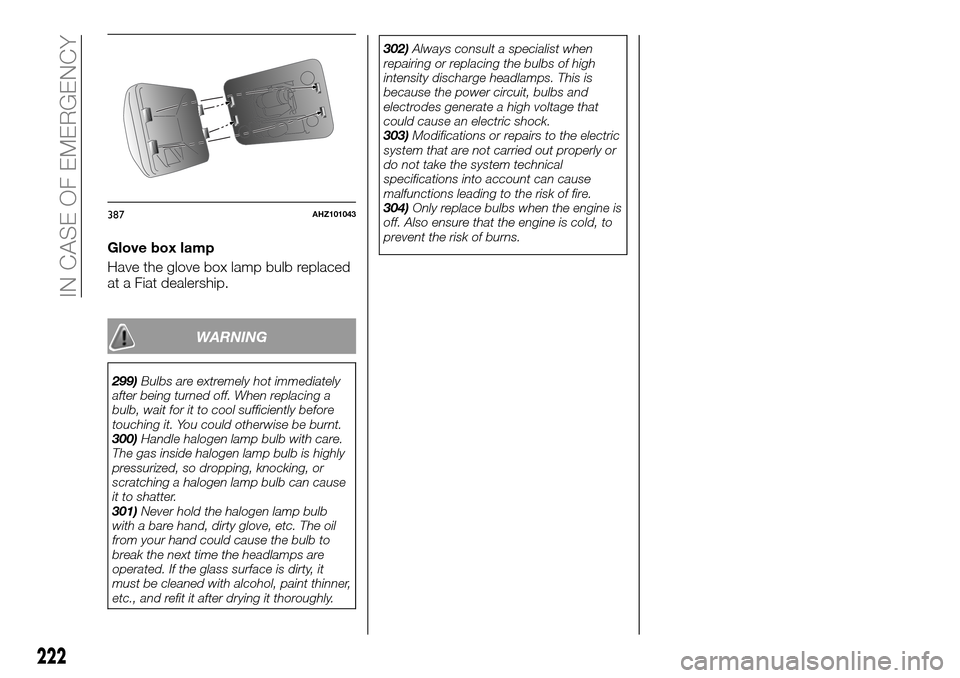
Glove box lamp
Have the glove box lamp bulb replaced
at a Fiat dealership.
WARNING
299)Bulbs are extremely hot immediately
after being turned off. When replacing a
bulb, wait for it to cool sufficiently before
touching it. You could otherwise be burnt.
300)Handle halogen lamp bulb with care.
The gas inside halogen lamp bulb is highly
pressurized, so dropping, knocking, or
scratching a halogen lamp bulb can cause
it to shatter.
301)Never hold the halogen lamp bulb
with a bare hand, dirty glove, etc. The oil
from your hand could cause the bulb to
break the next time the headlamps are
operated. If the glass surface is dirty, it
must be cleaned with alcohol, paint thinner,
etc., and refit it after drying it thoroughly.302)Always consult a specialist when
repairing or replacing the bulbs of high
intensity discharge headlamps. This is
because the power circuit, bulbs and
electrodes generate a high voltage that
could cause an electric shock.
303)Modifications or repairs to the electric
system that are not carried out properly or
do not take the system technical
specifications into account can cause
malfunctions leading to the risk of fire.
304)Only replace bulbs when the engine is
off. Also ensure that the engine is cold, to
prevent the risk of burns.
387AHZ101043
222
IN CASE OF EMERGENCY
Page 253 of 312

Fluid type
Brake fluid conforming to DOT 3 or
DOT 4 should be used. The reservoir
cap must be fully tightened to avoid
contamination from foreign matter or
moisture. DO NOT ALLOW
PETROLEUM- BASED FLUID TO
CONTACT, MIX WITH, OR OTHERWISE
CONTAMINATE THE BRAKE FLUID.
SEAL DAMAGE WILL RESULT.
323)
WARNING
323)Clutch fluid is poisonous and highly
corrosive. In the event of accidental
contact, immediately wash the affected
parts with water and mild soap. Then rinse
thoroughly. Call a doctor immediately if
swallowed.
POWER STEERING
FLUID
324)
3)
To check the fluid level
Check the fluid level in the reservoir
while the engine is idling. Check to
make certain that the power steering
fluid level is always between the “MAX”
and “MIN” level markings on the fluid
reservoir and refill the fluid, if necessary.
WARNING
324)Prevent power steering fluid from
coming into contact with hot engine parts:
it is flammable.
IMPORTANT
3)Power steering fluid consumption is
extremely low; if another top-up is required
after only a short period of time, have the
system checked for leaks at a Fiat
Dealership.
MAX
MIN
399AHA102582
251
Page 272 of 312
ItemDiesel-powered vehicles
4D56
Without intercoolerWith intercooler
Not for vehicles with 15 inch tyreWith intercooler
Vehicles with 15 inch tyre
Engine models 4D56
No. of cylinders 4 in line
Total displacement 2,477 cc
Bore91.1 mm
Stroke95.0 mm
Camshaft Double overhead
Mixture preparation Electronic direct injection
Maximum output (EEC net) 81 kW/4,000 r/min100 kW/4,000 r/min
131 kW/4,000 r/min
(1)94 kW/4,000 r/min
Maximum torque (EEC net)200 Nm/1,500
–3,500 r/min324 Nm/2,000 r/min
400 Nm/2,000 r/min
(1)240 Nm/1,500 – 3,500 r/min
(1) Vehicles with high power engine
344)
WARNING
344)Modifications or repairs to the fuel supply system that are not carried out properly or do not take the system’s technical specifications
into account may cause malfunctions leading to a risk of fire.
270
TECHNICAL SPECIFICATIONS
Page 282 of 312
Double Cab
Petrol-powered vehicles
Item 2WD 2WD Hi-Rider 4WD
Maximum speed 169 km/h 161 km/h 161 km/h
Diesel-powered vehicles (4D56)
Item 2WD 2WD Hi-Rider4WD
Without intercooler4WD
With intercooler
M/T A/T
Maximum
speed152 km/h167 km/h
169 km/h(2)147 km/h167 km/h
179 km/h(2)165 km/h
175 km/h(2)
(2) Vehicles with high power engine
Diesel-powered vehicles (4N15)
Item 2WD Hi-Rider4WD
Without wide fender4WD
With wide fender
M/T A/T
Maximum
speed169 km/h 169 km/h174 km/h
179 km/h(2)173 km/h
177 km/h(2)
(2) Vehicles with high power engine
280
TECHNICAL SPECIFICATIONS


