2016 FIAT DUCATO Automatic
[x] Cancel search: AutomaticPage 181 of 296

VERSIONS WITH
START&STOP SYSTEM
To recharge, proceed as follows:
disconnect the connector A
(pressing the button B) from the sensor
C monitoring the battery conditions,
on the negative pole D of the battery;
connect the positive battery charger
lead to the positive battery terminal E
and the negative lead to the sensor
terminal F as in fig. 178;
turn on the charger;
at the end of the charging process,
switch the battery charger off;
after disconnecting the charger,
reconnect the connector A to the
sensor C as in fig. 178.
WARNING
168)Battery fluid is poisonous and
corrosive: avoid contact with your skin and
eyes. The battery should be charged in a
well ventilated place, away from naked
flames or possible sources of sparks:
danger of explosion and fire.
169)Do not attempt to charge a frozen
battery: it must be thawed first, otherwise it
may explode. If freezing has occurred, the
battery should be checked by skilled
personnel to make sure that the internal
elements are not damaged and that the
body is not cracked, with the risk of leaking
poisonous and corrosive acid.
FUEL CUT-OFF
SWITCH
The vehicle is fitted with a safety switch
that, in the event of a crash, comes
into operation by cutting off the fuel
supply and turning off the engine as a
consequence.
When the inertia switch cuts in, it cuts
off the fuel supply and also activates
the hazard warning lights, side lights
and courtesy lights while releasing
all the doors and displaying the relevant
message; they are deactivated by
pressing button A. On some versions,
there is also a safety relay that activates
in the event of impact to cut off the
electrical supply. In this way, fuel is
prevented from escaping if the pipes
are broken and the formation of sparks
or electrical discharges following
damage to the vehicle electrical
components is avoided.
170) 171)
IMPORTANT After an accident,
remember to remove the key from the
ignition device to prevent the battery
from running down. If no fuel leaks
or damage to vehicle's electrical
devices (e.g. headlights) are detected
after the impact and the vehicle is
able to set off again, reactivate the
automatic fuel cut-off switch.
178F1A0219
179
Page 187 of 296
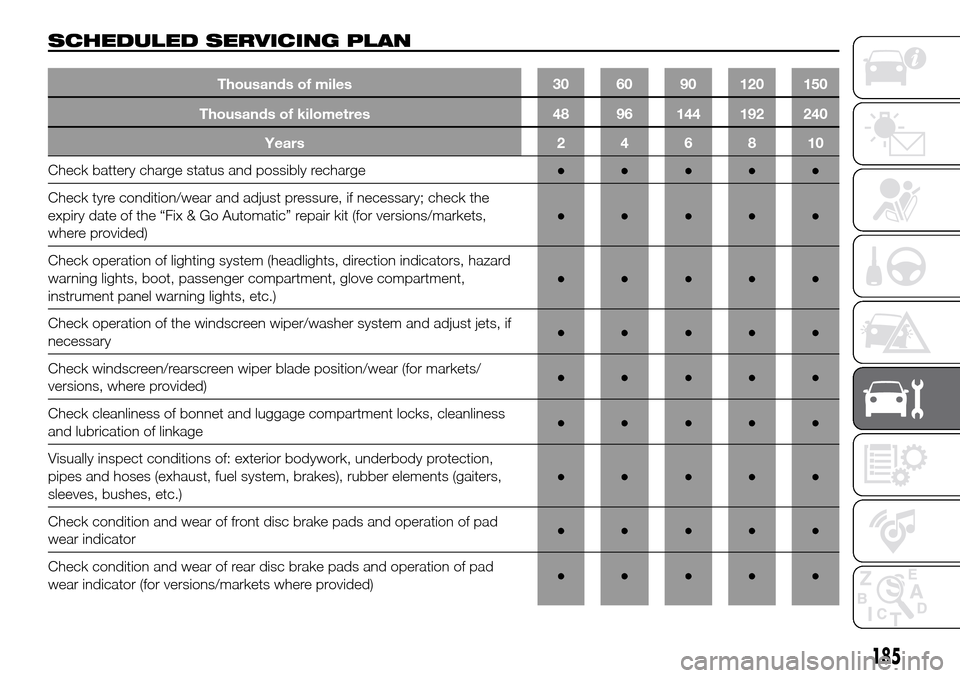
SCHEDULED SERVICING PLAN
Thousands of kilometres 48 96 144 192 240
Years 2 4 6 8 10
Check battery charge status and possibly recharge●●●●●
Check tyre condition/wear and adjust pressure, if necessary; check the
expiry date of the “Fix & Go Automatic” repair kit (for versions/markets,
where provided)●●●●●
Check operation of lighting system (headlights, direction indicators, hazard
warning lights, boot, passenger compartment, glove compartment,
instrument panel warning lights, etc.)●●●●●
Check operation of the windscreen wiper/washer system and adjust jets, if
necessary●●●●●
Check windscreen/rearscreen wiper blade position/wear (for markets/
versions, where provided)●●●●●
Check cleanliness of bonnet and luggage compartment locks, cleanliness
and lubrication of linkage●●●●●
Visually inspect conditions of: exterior bodywork, underbody protection,
pipes and hoses (exhaust, fuel system, brakes), rubber elements (gaiters,
sleeves, bushes, etc.)●●●●●
Check condition and wear of front disc brake pads and operation of pad
wear indicator●●●●●
Check condition and wear of rear disc brake pads and operation of pad
wear indicator (for versions/markets where provided)●●●●●
185
Thousands of miles 30 60 90 120 150
Page 188 of 296

Thousands of kilometres 48 96 144 192 240
Years 2 4 6 8 10
Check and, if necessary, top up fluid levels (1) (2)●●●●●
Check COMFORT-MATIC transmission hydraulic system fluid level (3) (*)●●●●●
Check oil for hydraulic clutch activation system (for versions with
COMFORT-MATIC transmission) (3) (*)●●●●●
Change oil for hydraulic clutch activation system (for versions with
COMFORT-MATIC transmission) (4) (*)●●
Visual check of accessory drive belt(s) (versions without automatic
tensioner) (130 - 150 - 180 Multijet 2 versions)●●
Check tension of accessory drive belt (versions without automatic tensioner)
(5)●●
Check tension of auxiliary drive belt (versions without automatic tensioner)
(115 MultiJet 2 versions) (5)●●●
Check condition of toothed timing drive belt (130-150-180 Multijet 2
versions)●●
Check condition of toothed timing drive belt (115 Multijet 2 versions)●●●●●
(1) Always only use the liquids shown in the handbook for topping up after having checked that the system is not damaged.
(2) Consumption of additive for emissions (UREA) depends on the condition of use of the vehicle and is indicated by a warning light and message on the instrument
panel (for versions/markets, where provided).
(3) Check to be performed every year in case of use in cold climates.
(*) NOTE (for COMFORT-MATIC versions): to check the transmission fluid level and to check/change the clutch hydraulic system fluid, go to a Fiat Dealership.
(4) Or every 2 years
(5) When the engine oil is changed for the first time, check the tension of the accessory drive belt
186
SERVICING AND CARE
Thousands of miles 30 60 90 120 150
Page 191 of 296

Natural Power versions
Thousands of kilometres 40 80 120 160 200
Years246810
Check battery charge status and possibly recharge●●●●●
Check tyre conditions/wear and adjust pressure, if necessary●●●●●
Check operation of lighting system (headlights, direction indicators, hazard
warning lights, boot, passenger compartment, glove compartment,
instrument panel warning lights, etc.)●●●●●
Check operation of the windscreen wiper/washer system and adjust jets, if
necessary●●●●●
Check the position/wear of the windscreen/rear window wiper blades●●●●●
Check cleanliness of bonnet and luggage compartment locks, cleanliness
and lubrication of linkage●●●●●
Visually inspect conditions of: exterior bodywork, underbody protection,
pipes and hoses (exhaust, fuel system, brakes), rubber elements (gaiters,
sleeves, bushes, etc.)●●●●●
Visually inspect conditions and wear of front disc brake pads and operation
of pad wear indicator●●●●●
Visually inspect condition and wear of rear disc brake pads and operation of
pad wear indicator (for versions/markets, where provided)●●●●●
Check and, if necessary, top up fluid levels (engine coolant, hydraulic clutch/
brakes, windscreen washer, battery, etc.)●●●●●
Visually inspect accessory drive belt(s) (versions without automatic
tensioner)●●
189
Thousands of miles 30 60 90 120 150
Page 192 of 296

Thousands of kilometres 40 80 120 160 200
Years246810
Check tension of accessory drive belt (versions without automatic tensioner)●●
Check handbrake lever travel and adjust, if necessary●●●●●
Check exhaust emissions●●●●●
Check operation of engine management systems (using diagnosis socket)●●●●●
Check cleanliness of sliding side door lower guides for versions with S.S.D.
(or every 6 months)●●●●●
Spark plug replacement●●●●●
Replace accessory drive belt/s●
Replace air cleaner cartridge (1)●●●●●
Change engine oil and replace oil filter (2)●●●●●
Change the brake fluid(3)
Replace the passenger compartment cleaner●●●●●
Visually inspect the condition of the methane pipes and fittings, methane
tank fastening, possible restoration●●●●●
Check the pressure regulator and, if necessary, replace the internal filter●●●●●
Check operation and parameters of fuel supply system using self-diagnosis
socket●●●●●
(1) If the vehicle is equipped with a special air filter for dusty areas: - every 20,000 km, check and clean the filter
(2) If the vehicle annual mileage is less than 10,000 km, the engine oil and filter must be replaced every 12 months.
(3) The brake fluid replacement has to be done every two years, irrespective of the mileage.
190
SERVICING AND CARE
Thousands of miles 30 60 90 120 150
Page 202 of 296

USEFUL ADVICE FOR
EXTENDING THE LIFE OF
YOUR BATTERY
To avoid draining your battery and
make it last longer, observe the
following instructions:
when you park the vehicle, ensure
that the doors, tailgate and bonnet are
closed properly, to prevent any roof
lights from remaining on inside the
passenger's compartment;
switch off all roof lights inside the
vehicle: the vehicle is however
equipped with a system which switches
all internal lights off automatically;
do not keep accessories (e.g. radio,
hazard warning lights, etc.) switched
on for a long time when the engine
is not running;
before carrying out any operation on
the electrical system, disconnect the
negative battery cable through the
suitable terminal;
completely tighten the battery
terminals.IMPORTANT After turning the ignition
key to STOP and having closed the
driver side door, wait at least one
minute before disconnecting the
electrical supply from the battery. When
reconnecting the electrical supply to
the battery, make sure that the ignition
key is in the STOP position and the
driver side door is closed.
IMPORTANT If the charge level remains
under 50% for a long time, the battery
is damaged by sulphation, reducing
its capacity and efficiency at start-up.
The battery will also be more at risk
of freezing (this can happen already at
-10°C).
Refer to the paragraph "Car inactivity"
in "Starting and driving" if the car is
left parked for a long time.If, after buying the vehicle, you want to
install electrical accessories which
require permanent electric supply
(alarm, etc.) or accessories that in any
case burden the electrical supply,
contact a Fiat Dealership, whose
qualified personnel, in addition
to suggesting the most suitable devices
from Lineaccessori Fiat, will evaluate
the overall electrical consumption,
checking whether the vehicle’s electrical
system is capable of withstanding the
load required, or whether it should
be integrated with a more powerful
battery.
Since some of these devices continue
to consume electricity even when
the engine is off, they gradually run
down the battery.
IMPORTANT If a tachograph is fitted, if
the vehicle is parked for a long period
of 5 days, it is advisable to disconnect
the negative battery terminal to
maintain its charge.
If the vehicle is equipped with a battery
disconnection function (disconnector),
see the description of the procedure
in the "Controls" paragraph in the
"Dashboard and controls" section.
200
SERVICING AND CARE
Page 204 of 296

NOZZLES
Windscreen (washer) fig. 193
If there is no jet, first check that there is
fluid in the reservoir.
Then check that the nozzle holes are
not clogged; use a needle to unblock
them if necessary.
The washer jets should be positioned
by adjusting the angle of the sprays
using a small straight-headed
screwdriver.
The jets should be directed at about a
third of the height from the top edge
of the windscreen.HEADLIGHT WASHERS
Check the correct condition and
cleanliness of nozzles at regular
intervals.
The headlight washers come on
automatically when the windscreen
washer is operated with the low beams
on.
WARNING
195)Driving with worn windscreen wiper
blades is a serious risk, because visibility is
reduced in bad weather conditions.
WARNING
56)Do not operate the windscreen wiper
with the blades lifted from the windscreen.
LIFTING THE
VEHICLE
If the vehicle needs to be lifted, go to a
Fiat Dealership which is equipped
with the arm hoist or workshop lift.
193F1A0242
202
SERVICING AND CARE
Page 207 of 296

WARNING
57)Keep your speed down when snow
chains are fitted; do not exceed 50 km/h.
Avoid potholes, steps and pavements
and avoid driving for long distances on
roads not covered with snow to prevent
damaging the vehicle and the roadbed.
BODYWORK
PROTECTION AGAINST
ATMOSPHERIC AGENTS
The main causes of corrosion are the
following:
atmospheric pollution;
salty air and humidity (coastal areas,
or hot humid climates);
seasonal environmental conditions.
ADVICE FOR
PRESERVING THE
BODYWORK
Paintwork
Paintwork does not only serve an
aesthetic purpose, but also protects the
underlying sheet metal.
Touch up abrasions and scratches
immediately to prevent rust formation.
Use only original paint products for
touch-ups (see “Bodywork paint
identification plate” in the “Technical
specifications” section).
Normal maintenance of paintwork
consists in washing the car: the
frequency depends on the conditions
and environment where the car is used.
For example, it is advisable to wash
the vehicle more often in areas with
high levels of environmental pollution or
on roads spread with salt.To correctly wash the vehicle, proceed
as follows:
wash the bodywork using a low
pressure jet of water;
wipe a sponge with a slightly soapy
solution over the bodywork, frequently
rinsing the sponge;
rinse well with water and dry with a
jet of air or a chamois leather.
If you put the vehicle through a car
wash, follow these recommendations:
remove the aerial from the roof
so it does not get damaged;
the vehicle should be washed with
water added to a soapy solution;
rinse thoroughly to avoid soap
marks remaining on the bodywork or
less visible parts.
58)
6)
WARNING
58)Some automatic systems equipped
with old generation blades and/or with
a poor maintenance can damage the paint,
promoting the creation of microscoring
which give an opaque/coated appearance
to the paint, especially on dark colours.
In this case, just lightly polish with specific
products.
205