Page 417 of 587
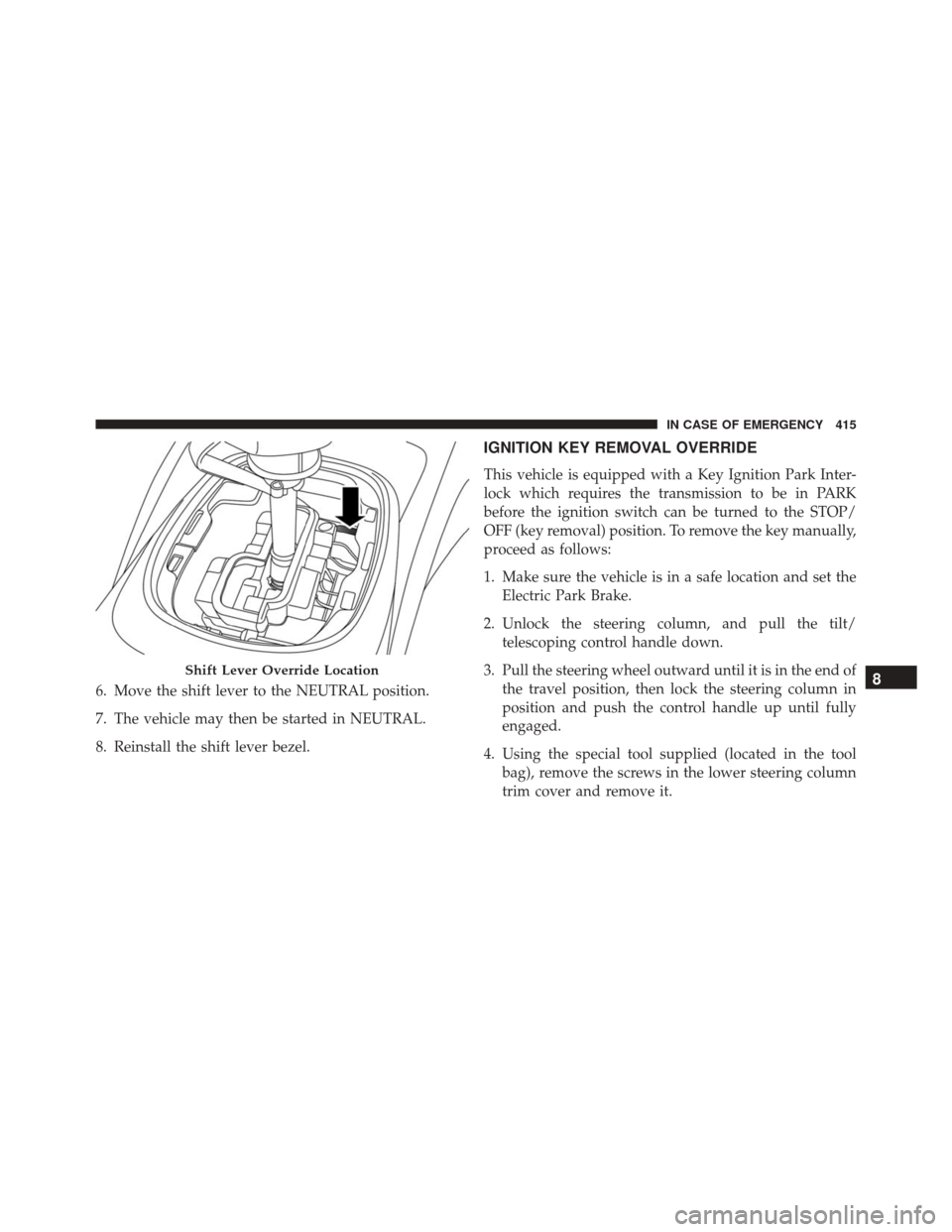
6. Move the shift lever to the NEUTRAL position.
7. The vehicle may then be started in NEUTRAL.
8. Reinstall the shift lever bezel.
IGNITION KEY REMOVAL OVERRIDE
This vehicle is equipped with a Key Ignition Park Inter-
lock which requires the transmission to be in PARK
before the ignition switch can be turned to the STOP/
OFF (key removal) position. To remove the key manually,
proceed as follows:
1. Make sure the vehicle is in a safe location and set theElectric Park Brake.
2. Unlock the steering column, and pull the tilt/ telescoping control handle down.
3. Pull the steering wheel outward until it is in the end of the travel position, then lock the steering column in
position and push the control handle up until fully
engaged.
4. Using the special tool supplied (located in the tool bag), remove the screws in the lower steering column
trim cover and remove it.
Shift Lever Override Location8
IN CASE OF EMERGENCY 415
Page 420 of 587
FREEING A STUCK VEHICLE
If your vehicle becomes stuck in mud, sand or snow, it
can often be moved using a rocking motion. Turn the
steering wheel right and left to clear the area around the
front wheels. For vehicles with automatic transmission,
push and hold the lock button on the shift lever. Then
shift back and forth between DRIVE and REVERSE (with
automatic transmission) or 2ND GEAR and REVERSE
(with manual transmission), while gently pressing the
accelerator.
Use the least amount of accelerator pedal pressure that
will maintain the rocking motion without spinning the
wheels or racing the engine.
For Vehicles With Automatic Transmission:
Shifts between DRIVE and REVERSE can only be
achieved at wheel speeds of 5 mph (8 km/h) or less.Whenever the transmission remains in NEUTRAL for
more than two seconds, you must push the brake pedal
to engage DRIVE or REVERSE.
NOTE:
Push the �ESC Off� switch (if necessary), to place
the Electronic Stability Control (ESC) system in �Partial
Off� mode, before rocking the vehicle. Refer to “Elec-
tronic Brake Control” in “Starting And Operating” for
further information. Once the vehicle has been freed,
push the �ESC Off� switch again to restore �ESC On�
mode.
CAUTION!
• Racing the engine or spinning the wheels may lead
to transmission overheating and failure. Allow the
engine to idle with the transmission in NEUTRAL
for at least one minute after every five rocking-
motion cycles. This will minimize overheating and
(Continued)
418 IN CASE OF EMERGENCY
Page 422 of 587
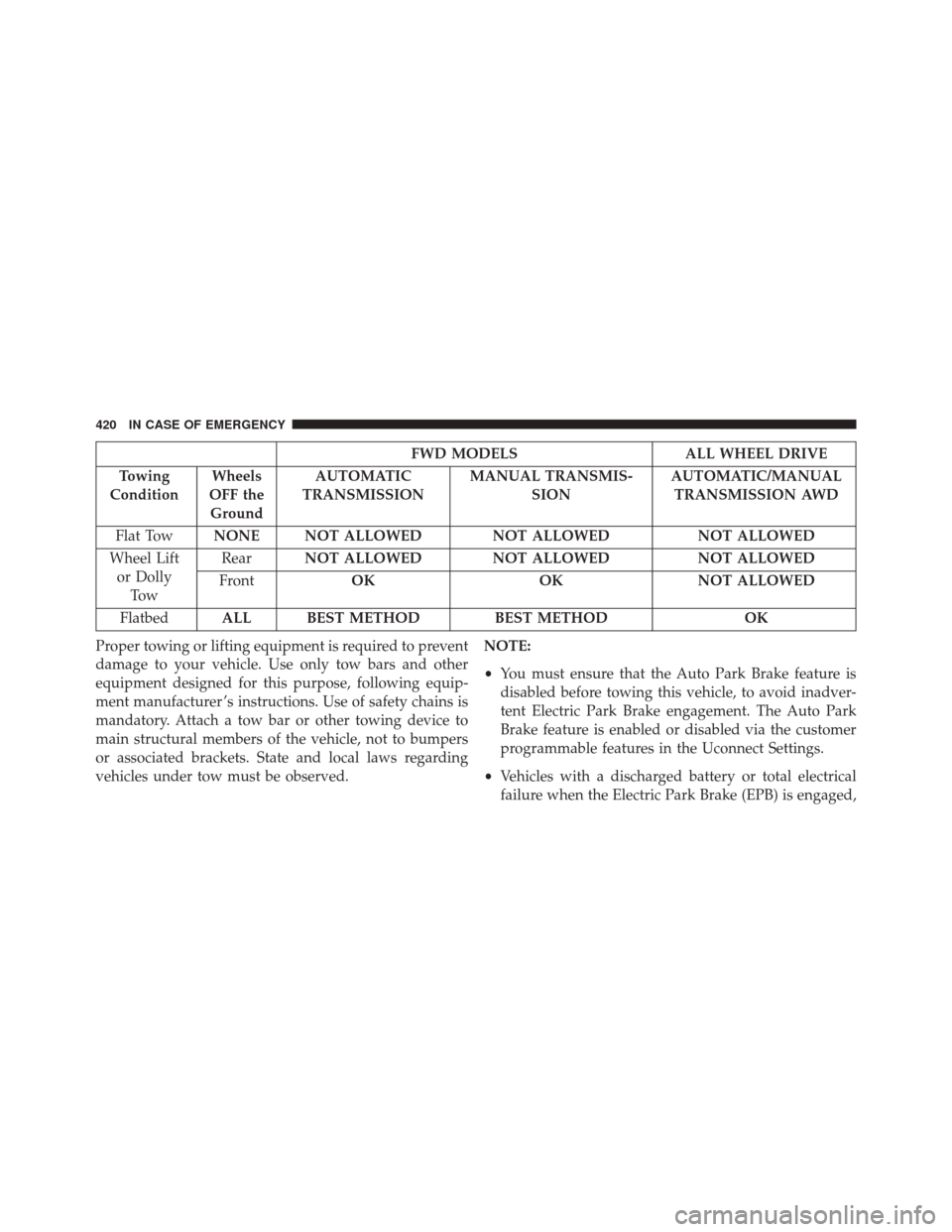
FWD MODELSALL WHEEL DRIVE
Towing
Condition Wheels
OFF the Ground AUTOMATIC
TRANSMISSION MANUAL TRANSMIS-
SION AUTOMATIC/MANUAL
TRANSMISSION AWD
Flat Tow NONE NOT ALLOWED NOT ALLOWED NOT ALLOWED
Wheel Lift or Dolly To w Rear
NOT ALLOWED NOT ALLOWED NOT ALLOWED
Front OK OKNOT ALLOWED
Flatbed ALL BEST METHOD BEST METHODOK
Proper towing or lifting equipment is required to prevent
damage to your vehicle. Use only tow bars and other
equipment designed for this purpose, following equip-
ment manufacturer ’s instructions. Use of safety chains is
mandatory. Attach a tow bar or other towing device to
main structural members of the vehicle, not to bumpers
or associated brackets. State and local laws regarding
vehicles under tow must be observed. NOTE:
•
You must ensure that the Auto Park Brake feature is
disabled before towing this vehicle, to avoid inadver-
tent Electric Park Brake engagement. The Auto Park
Brake feature is enabled or disabled via the customer
programmable features in the Uconnect Settings.
• Vehicles with a discharged battery or total electrical
failure when the Electric Park Brake (EPB) is engaged,
420 IN CASE OF EMERGENCY
Page 423 of 587
will need a wheel dolly or jack to raise the rear wheels
off the ground when moving the vehicle onto a flatbed.
If you must use the accessories (wipers, defrosters, etc.)
while being towed, the ignition must be in the MAR/
RUN position.
NOTE: The Safehold feature will engage the Electric Park
Brake whenever the driver’s door is opened (if the
ignition is ON, transmission is not in PARK, and brake
pedal is released). If you are towing this vehicle with the
ignition in the MAR/RUN position, you must manually
disable the Electric Park Brake each time the driver’s
door is opened, by pressing the brake pedal and then
releasing the EPB.
If the key fob is unavailable, or the vehicle’s battery is
discharged, refer to “Shift Lever Override” in this section
for instructions on shifting the transmission out of PARK
so that the vehicle can be moved.CAUTION!
• Do not use sling type equipment when towing.
Vehicle damage may occur.
• When securing the vehicle to a flat bed truck, do
not attach to front or rear suspension components.
Damage to your vehicle may result from improper
towing.
Front Wheel Drive (FWD) Models
The manufacturer recommends towing your vehicle with
all four wheels OFF the ground on a flatbed.
If flatbed equipment is not available, this vehicle must
towed with the front wheels OFF the ground (using a
towing dolly, or wheel lift equipment with the front
wheels raised).
8
IN CASE OF EMERGENCY 421
Page 432 of 587
▫Brake System ....................... .464
▫ Manual Transmission — If Equipped .......466
▫ Automatic Transmission — If Equipped .....467
▫ Appearance Care And Protection From
Corrosion .......................... .469
� RAISING THE VEHICLE .................476
� TIRE SAFETY INFORMATION .............478
▫ Tire Markings ....................... .478
▫ Tire Identification Number (TIN) ...........481
▫ Tire Terminology And Definitions ..........483
▫ Tire Loading And Tire Pressure ...........484
� TIRES — GENERAL INFORMATION ........489
▫ Tire Pressure ....................... .489▫
Tire Inflation Pressures .................490
▫ Tire Pressures For High Speed Operation . . . .492
▫ Radial Ply Tires ..................... .492
▫ Tire Types .......................... .493
▫ Run Flat Tires — If Equipped .............495
▫ Spare Tires — If Equipped ...............495
▫ Tire Spinning ....................... .496
▫ Tread Wear Indicators ..................496
▫ Life Of Tire ........................ .497
▫ Replacement Tires .....................497
� TIRE CHAINS (TRACTION DEVICES) .......499
� TIRE ROTATION RECOMMENDATIONS .....500
� STORING THE VEHICLE .................502
430 MAINTAINING AND CARING FOR YOUR VEHICLE
Page 467 of 587
Be sure to clean the top of the master cylinder area before
removing the cap. If necessary, add fluid to bring the
fluid level up to the requirements described on the brake
fluid reservoir. Fluid level can be expected to fall as the
brake pads wear. The brake fluid level should be checked
when the pads are replaced. However, low fluid level
may be caused by a leak and a checkup may be needed.
NOTE:If your vehicle is equipped with a manual
transmission, the brake fluid reservoir supplies fluid to
both the brake system and the clutch release system. The
two systems are separated in the reservoir, and a leak in
one system will not affect the other system. The manual
transmission clutch release system should not require
fluid replacement during the life of the vehicle. If the
brake fluid reservoir is low and the brake system does
not indicate any leaks or other problems, it may be a
result of a leak in the hydraulic clutch release system. See
your local authorized dealer for service. Use only manufacturer’s recommended brake fluid. Re-
fer to “Fluids, Lubricants, And Genuine Parts” in the
“Technical Data” section for further information.
WARNING!
•
Use only manufacturer ’s recommended brake
fluid. Refer to “Fluids, Lubricants, And Genuine
Parts” in the “Technical Data” section for further
information. Using the wrong type of brake fluid
can severely damage your brake system and/or
impair its performance. The proper type of brake
fluid for your vehicle is also identified on the
original factory installed hydraulic master cylinder
reservoir.
• To avoid contamination from foreign matter or
moisture, use only new brake fluid or fluid that has
been in a tightly closed container. Keep the master
(Continued)
9
MAINTAINING AND CARING FOR YOUR VEHICLE 465
Page 468 of 587
WARNING!(Continued)
cylinder reservoir cap secured at all times. Brake
fluid in a open container absorbs moisture from the
air resulting in a lower boiling point. This may
cause it to boil unexpectedly during hard or pro-
longed braking, resulting in sudden brake failure.
This could result in a collision.
• Overfilling the brake fluid reservoir can result in
spilling brake fluid on hot engine parts, causing
the brake fluid to catch fire. Brake fluid can also
damage painted and vinyl surfaces, care should be
taken to avoid its contact with these surfaces.
• Overfilling the brake fluid reservoir can result in
spilling brake fluid on hot engine parts, causing
the brake fluid to catch fire. Brake fluid can also
damage painted and vinyl surfaces, care should be
taken to avoid its contact with these surfaces.
CAUTION!
Use of improper brake fluids will affect overall
clutch system performance. Improper brake fluids
may damage the clutch system resulting in loss of
clutch function and the ability to shift the transmis-
sion.
Manual Transmission — If Equipped
Lubricant Selection
Use only the manufacturers recommended transmission
fluid. Refer to “Fluids, Lubricants, And Genuine Parts” in
“Maintaining And Caring For Your Vehicle” for further
information.
Please see your authorized dealer for service.
466 MAINTAINING AND CARING FOR YOUR VEHICLE
Page 513 of 587
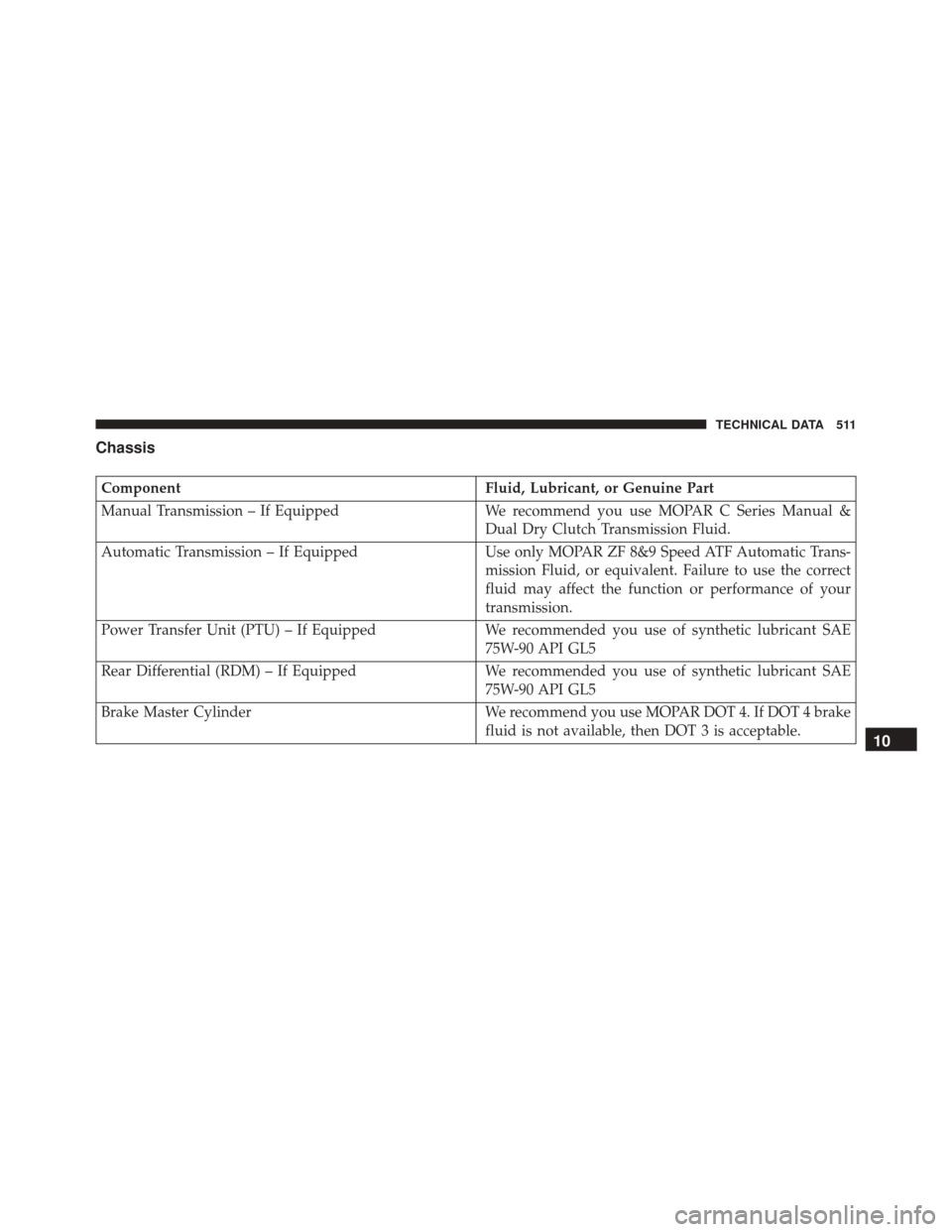
Chassis
ComponentFluid, Lubricant, or Genuine Part
Manual Transmission – If Equipped We recommend you use MOPAR C Series Manual &
Dual Dry Clutch Transmission Fluid.
Automatic Transmission – If Equipped Use only MOPAR ZF 8&9 Speed ATF Automatic Trans-
mission Fluid, or equivalent. Failure to use the correct
fluid may affect the function or performance of your
transmission.
Power Transfer Unit (PTU) – If Equipped We recommended you use of synthetic lubricant SAE
75W-90 API GL5
Rear Differential (RDM) – If Equipped We recommended you use of synthetic lubricant SAE
75W-90 API GL5
Brake Master Cylinder We recommend you use MOPAR DOT 4. If DOT 4 brake
fluid is not available, then DOT 3 is acceptable.
10
TECHNICAL DATA 511