Page 108 of 587
mode. Once the operator is in the vehicle and has placed
the ignition switch in the MAR/RUN position, rain
sensing wiper operation can resume, if it has been
selected, and no other inhibit conditions (mentioned
previously) exist.
Rear Window Wiper/Washer
The rear wiper/washer controls are located on the lever
on the right side of the steering column. The rear
wiper/washer is operated by rotating a switch, located at
the middle of the lever.Rotate the center portion of the lever upward to
the first detent for intermittent operation and to
the second detent for continuous rear wiper operation.
To use the washer, push the lever forward and
hold while spray is desired. If the lever is
pushed while in the intermittent setting, the
wiper will turn on and operate for several wipe cycles after the end of the lever is released, and then
resume the intermittent interval previously selected.
If the lever is pushed while the wiper is in the off
position, the wiper will operate for several wipe cycles,
then turn off.
NOTE:
As a protective measure, the pump will stop if
the switch is held for more than 30 seconds. Once the
lever is released, the pump will resume normal opera-
tion.
If the rear wiper is operating when the ignition is turned
to the STOP/OFF position, the wiper will automatically
return to the “park” position.
Rear Window Defroster
The rear window defroster button is located with
the Climate Controls on the instrument panel.
Push this button to turn on the rear window defroster. An
indicator in the button will illuminate when the rear
106 GETTING TO KNOW YOUR VEHICLE
Page 121 of 587

•Heated rear window
• System deactivation
NOTE: The Climate Control system detects the passenger
compartment temperature using a temperature sensor,
located in the lower instrument panel between the center
console and the steering wheel.
Turning On The Climate Control System
The Climate Control system can be turned on in different
ways: it is recommended to turn the Temperature Control
knobs to set the desired temperatures and then push the
AUTO button.
The system operates automatically to adjust the tempera-
ture, quantity and distribution of the air introduced into
the passenger compartment. It also manages the air
recirculation function and the activation of the air condi-
tioning compressor. During automatic operation, you can change the set
temperatures, air distribution and blower speed at any
time by using the relevant buttons or knobs: the system
will automatically change the settings to adjust to the
new requirements.
During automatic operation (AUTO), varying the air
flow and/or distribution or pushing the A/C control
button causes the AUTO function LED to turn off and the
system to operate in MANUAL mode.
Adjusting The Air Temperature
Rotate the Driver Temperature Control, or the Passenger
Temperature Control, dial clockwise or counter-
clockwise, to adjust the air temperature in the front left
(Driver Temperature Control) or right (Passenger Tem-
perature Control) zone of the passenger compartment.
The set temperatures are shown on the displays.
4
GETTING TO KNOW YOUR VEHICLE 119
Page 165 of 587
•Zone (5)
– Trip and Fuel Label (Left)
– Trip and Fuel Units (Left)
– Trip and Fuel Value (Right)
– Trip and Fuel Progress Bar (Centered)
– Text (Left)
• Zone (6)
– Odometer Digits (Left)
– Odometer Unit (Right)
– Cruise Control Speed Set (Center)
– Speed Buzzer (Right)
• Red Telltales (Left)
• Amber Telltales (Right)EVIC Control Buttons
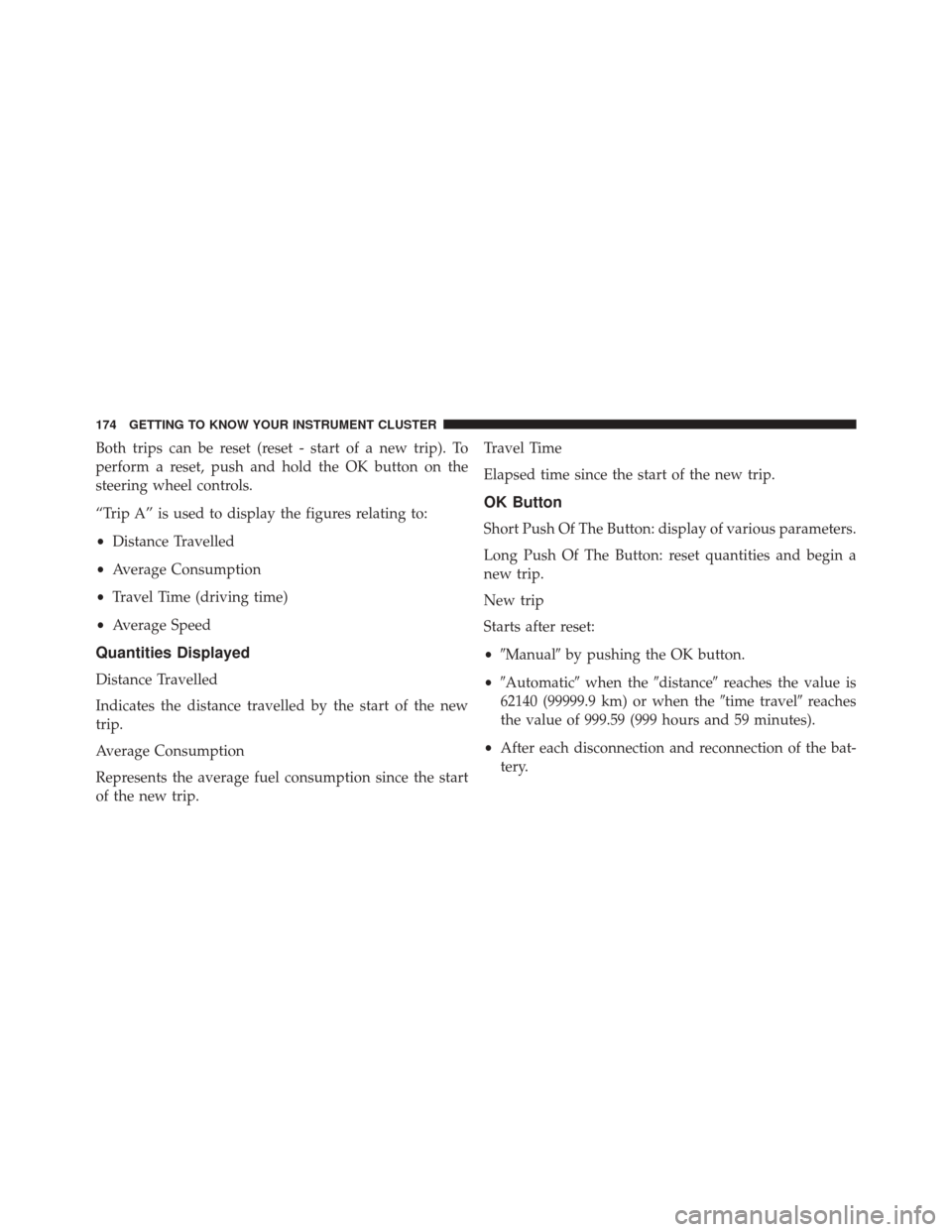
The system allows the driver to select information by
pushing the following buttons mounted on the steering
wheel:
EVIC Control Buttons1 — Arrow Up/Down Scroll Through Menus And Submenus
2 — Arrow Right/Left Access Information/Submenu Screens
3 — OK Button For Selecting And Resetting Information
5
GETTING TO KNOW YOUR INSTRUMENT CLUSTER 163
Page 170 of 587

Vehicle Info
Push and release the UP or DOWN arrow button until
�Vehicle Info�is highlighted in the EVIC. Push and
release the RIGHT arrow button and Coolant Temp will
be displayed. Push the RIGHT or LEFT arrow button to
scroll through the following information displays:
• Tire pressure
– View the information relating to the TPMS system (if equipped).
• Oil Temperature
– View the engine oil temperature.
• Battery Voltage
– View the voltage value (state of charge) of the battery.
Driver Assist
This menu item allows you to change the settings ( �No-
tice LaneSense� and�Intensity LaneSense�) relating to the
LaneSense system (if equipped).
• Notice LaneSense
• By selecting this function, you can select the �readi-
ness� of LaneSense, choosing between the options
�Near,�� Medium,� or�Far.�
• Intensity LaneSense
• Using this function, you can select the force applied to
the steering wheel to keep the car in the roadway
through the electrical drive system due to LaneSense.
Audio
This menu item allows you to view the instrument
cluster display and the information present on the dis-
play of the Uconnect system.
168 GETTING TO KNOW YOUR INSTRUMENT CLUSTER
Page 176 of 587
Both trips can be reset (reset - start of a new trip). To
perform a reset, push and hold the OK button on the
steering wheel controls.
“Trip A” is used to display the figures relating to:
•Distance Travelled
• Average Consumption
• Travel Time (driving time)
• Average Speed
Quantities Displayed
Distance Travelled
Indicates the distance travelled by the start of the new
trip.
Average Consumption
Represents the average fuel consumption since the start
of the new trip. Travel Time
Elapsed time since the start of the new trip.
OK Button
Short Push Of The Button: display of various parameters.
Long Push Of The Button: reset quantities and begin a
new trip.
New trip
Starts after reset:
•
�Manual� by pushing the OK button.
• �Automatic� when the�distance� reaches the value is
62140 (99999.9 km) or when the �time travel�reaches
the value of 999.59 (999 hours and 59 minutes).
• After each disconnection and reconnection of the bat-
tery.
174 GETTING TO KNOW YOUR INSTRUMENT CLUSTER
Page 186 of 587
LaneSense System•What Does It Mean
Electronic Vehicle Information Center
(EVIC) — If Equipped
The light comes on in the following ways:
Light illuminated (white): indicates that the system is
active and both of the lane markings have been
detected (the lines of the aisle are gray in color).
Light on as flashing light (amber): indicates that the
vehicle is going to cross over the lane marking.
Light illuminated (green): indicates that both lane
markings have been detected, and the system is
“armed.” The system will provide a torque warning
in the steering wheel if an unintentional lane depar-
ture occurs. Park/Headlight ON Indicator
•What Does It Mean
The light comes on by activating the park-
ing lights or headlights.
This feature allows you to maintain the
lights for a period of 30, 60, or 90 seconds
after placing the ignition in the STOP posi-
tion.
In some conditions, such as the poor quality of the
fuel, the light may come on only after starting the
engine.
Automatic High Beam Lights •What Does It Mean
The indicator light comes on by activating
the automatic high beam headlights.
Green
Warning Light
Green
Warning Light
184 GETTING TO KNOW YOUR INSTRUMENT CLUSTER
Page 195 of 587
Power Steering System Warning•What Does It Mean
This light will illuminate to indicate a fail-
ure in the Electronic Power Steering System
(EPS). Although it will still be possible to
steer the car, additional effort may be needed to
operate the steering wheel.
• What To Do
Please contact an authorized dealer as soon as pos-
sible.
5
GETTING TO KNOW YOUR INSTRUMENT CLUSTER 193
Page 197 of 587
SAFETY
CONTENTS
�BRAKE SYSTEM ...................... .197
� ELECTRONIC BRAKE CONTROL SYSTEM . . . .198
▫ Electronic Brake Force Distribution (EBD) . . . .198
▫ Brake System Warning Light ..............198
▫ Anti-Lock Brake System (ABS) ............198
▫ Anti-Lock Brake Warning Light ............200
▫ Brake Assist System (BAS) ...............200
▫ Hill Start Assist (HSA) .................201
▫ Traction Control System (TCS) ............203
▫ Electronic Stability Control (ESC) ..........204▫
Electronic Roll Mitigation (ERM) ..........205
▫ Dynamic Steering Torque (DST) ...........206
� OCCUPANT RESTRAINT SYSTEMS .........207
▫ Important Safety Precautions .............207
▫ Seat Belt Systems .....................209
▫ Supplemental Restraint System (SRS) .......224
▫ Child Restraints ..................... .241
▫ Transporting Pets .....................262
� SAFETY TIPS ........................ .262
▫ Transporting Passengers .................262
6