Page 280 of 476
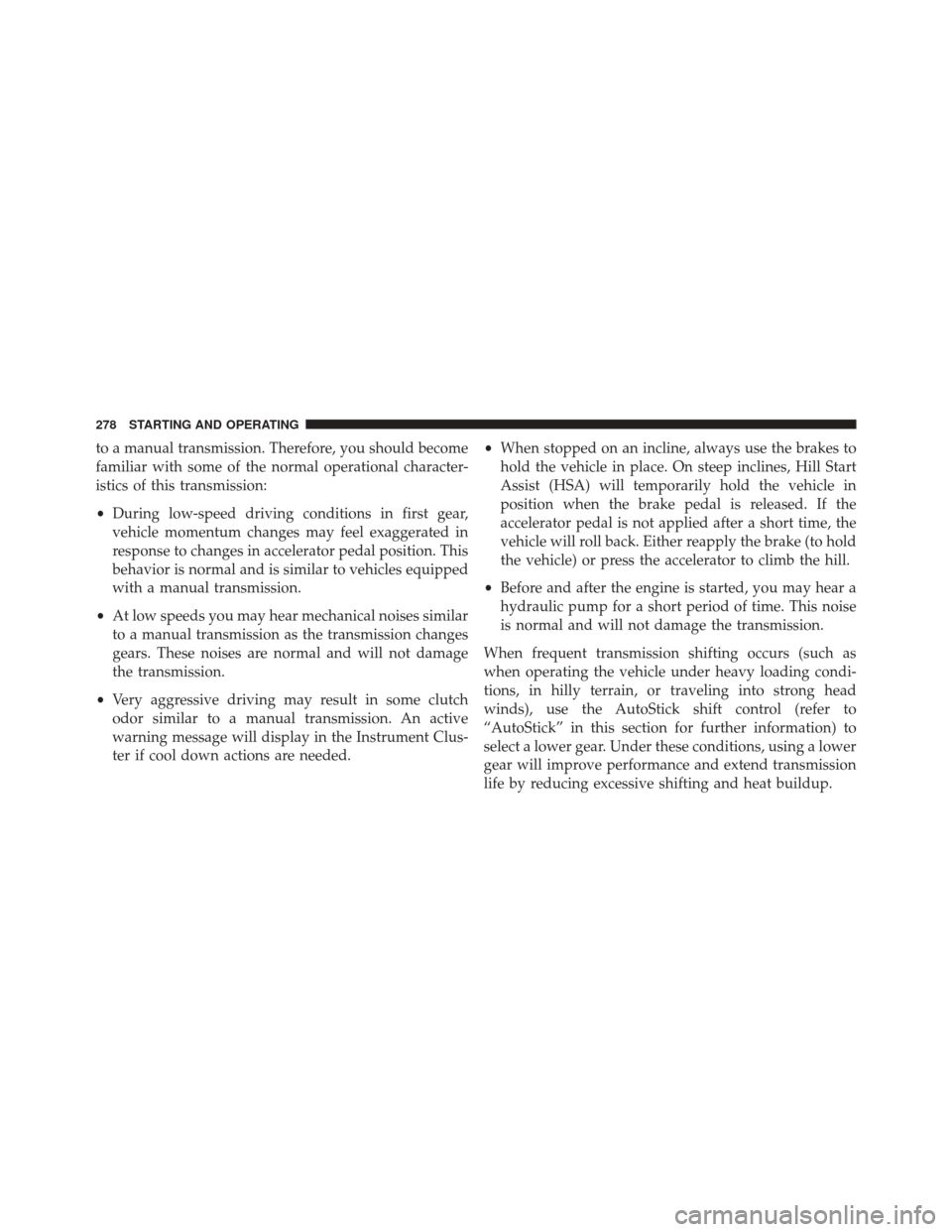
to a manual transmission. Therefore, you should become
familiar with some of the normal operational character-
istics of this transmission:
•During low-speed driving conditions in first gear,
vehicle momentum changes may feel exaggerated in
response to changes in accelerator pedal position. This
behavior is normal and is similar to vehicles equipped
with a manual transmission.
• At low speeds you may hear mechanical noises similar
to a manual transmission as the transmission changes
gears. These noises are normal and will not damage
the transmission.
• Very aggressive driving may result in some clutch
odor similar to a manual transmission. An active
warning message will display in the Instrument Clus-
ter if cool down actions are needed. •
When stopped on an incline, always use the brakes to
hold the vehicle in place. On steep inclines, Hill Start
Assist (HSA) will temporarily hold the vehicle in
position when the brake pedal is released. If the
accelerator pedal is not applied after a short time, the
vehicle will roll back. Either reapply the brake (to hold
the vehicle) or press the accelerator to climb the hill.
• Before and after the engine is started, you may hear a
hydraulic pump for a short period of time. This noise
is normal and will not damage the transmission.
When frequent transmission shifting occurs (such as
when operating the vehicle under heavy loading condi-
tions, in hilly terrain, or traveling into strong head
winds), use the AutoStick shift control (refer to
“AutoStick” in this section for further information) to
select a lower gear. Under these conditions, using a lower
gear will improve performance and extend transmission
life by reducing excessive shifting and heat buildup.
278 STARTING AND OPERATING
Page 283 of 476
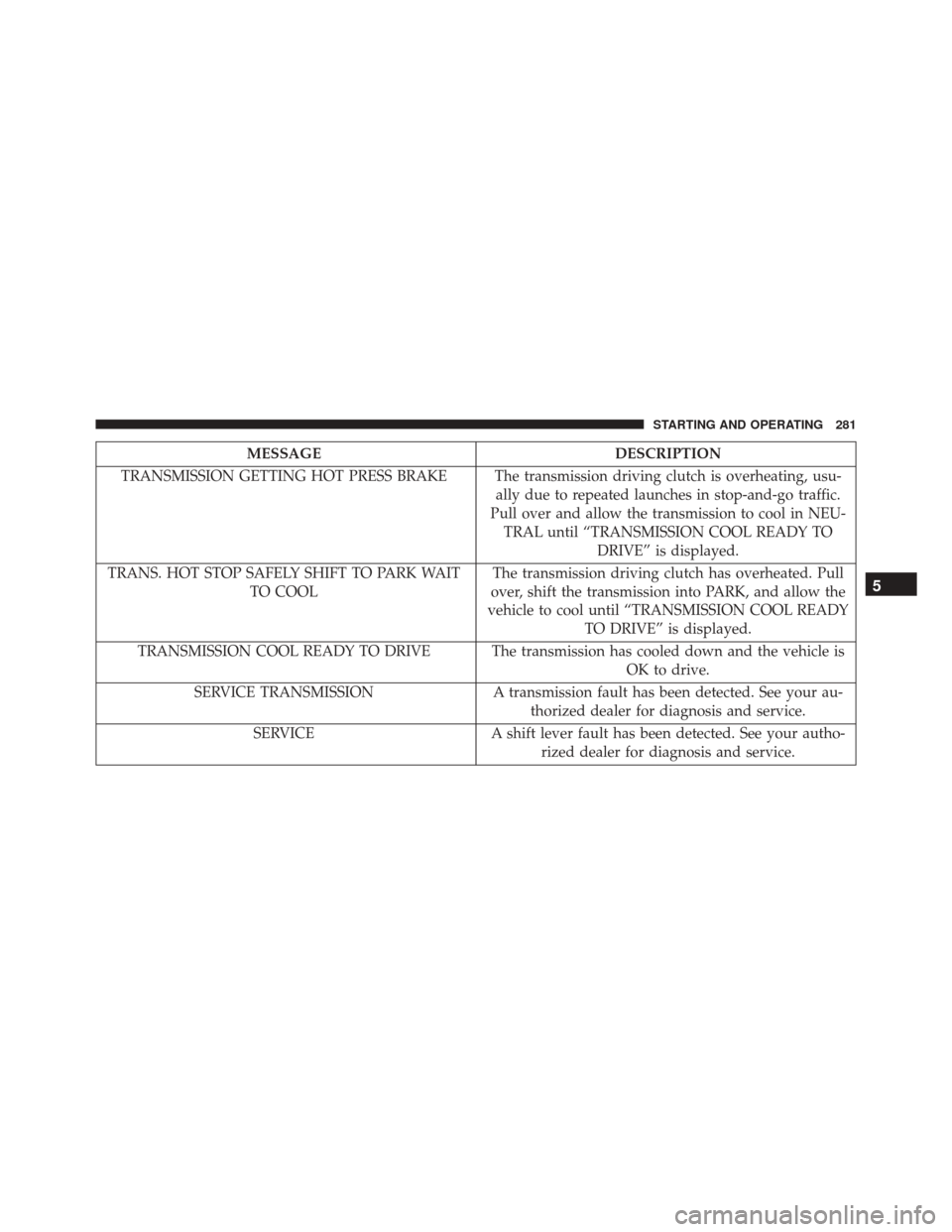
MESSAGEDESCRIPTION
TRANSMISSION GETTING HOT PRESS BRAKE The transmission driving clutch is overheating, usu- ally due to repeated launches in stop-and-go traffic.
Pull over and allow the transmission to cool in NEU- TRAL until “TRANSMISSION COOL READY TO DRIVE” is displayed.
TRANS. HOT STOP SAFELY SHIFT TO PARK WAIT TO COOL The transmission driving clutch has overheated. Pull
over, shift the transmission into PARK, and allow the
vehicle to cool until “TRANSMISSION COOL READY TO DRIVE” is displayed.
TRANSMISSION COOL READY TO DRIVE The transmission has cooled down and the vehicle is OK to drive.
SERVICE TRANSMISSION A transmission fault has been detected. See your au-
thorized dealer for diagnosis and service.
SERVICE A shift lever fault has been detected. See your autho-
rized dealer for diagnosis and service.
5
STARTING AND OPERATING 281
Page 290 of 476
DRIVE position provides optimum driving characteris-
tics under all normal operating conditions.
When frequent transmission shifting occurs (such as
when operating the vehicle under heavy loading condi-
tions, in hilly terrain, or traveling into strong head
winds), use the AutoStick shift control (refer to AutoStick
in this section for further information) to select a lower
gear. Under these conditions, using a lower gear will
improve performance and extend transmission life by
reducing excessive shifting and heat buildup.
If the transmission temperature exceeds normal operat-
ing limits, the transmission controller will expand the
range of torque converter clutch engagement. This is
done to prevent transmission damage due to overheat-
ing.During cold temperatures, transmission operation may
be modified depending on engine coolant temperature.
Normal operation will resume once the engine tempera-
ture has risen to a suitable level.
Transmission Limp Home Mode
Transmission function is monitored electronically for
abnormal conditions. If a condition is detected that could
result in transmission damage, Transmission Limp Home
Mode is activated. In this mode, the transmission remains
in third gear regardless of which forward gear is selected.
PARK, REVERSE, and NEUTRAL will continue to oper-
ate. The Malfunction Indicator Light (MIL) may be illu-
minated. Limp Home Mode allows the vehicle to be
driven to an authorized dealer for service without dam-
aging the transmission.
In the event of a momentary problem, the transmission
can be reset to regain all forward gears by performing the
following steps:
288 STARTING AND OPERATING
Page 347 of 476
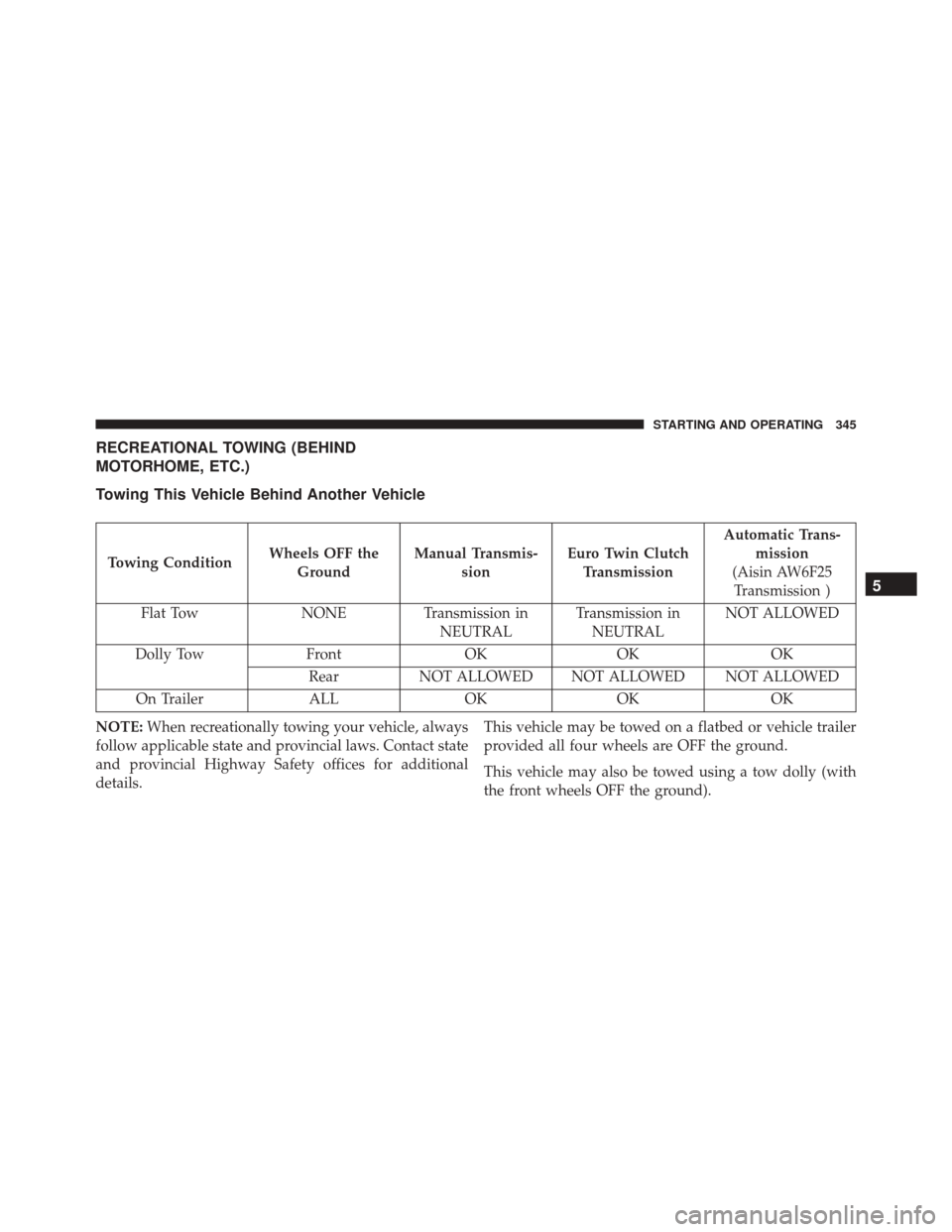
RECREATIONAL TOWING (BEHIND
MOTORHOME, ETC.)
Towing This Vehicle Behind Another Vehicle
Towing ConditionWheels OFF the
Ground Manual Transmis-
sion Euro Twin Clutch
Transmission Automatic Trans-
mission
(Aisin AW6F25 Transmission )
Flat Tow NONETransmission in
NEUTRAL Transmission in
NEUTRAL NOT ALLOWED
Dolly Tow FrontOKOK OK
Rear NOT ALLOWED NOT ALLOWED NOT ALLOWED
On Trailer ALLOKOK OK
NOTE: When recreationally towing your vehicle, always
follow applicable state and provincial laws. Contact state
and provincial Highway Safety offices for additional
details. This vehicle may be towed on a flatbed or vehicle trailer
provided all four wheels are OFF the ground.
This vehicle may also be towed using a tow dolly (with
the front wheels OFF the ground).
5
STARTING AND OPERATING 345
Page 348 of 476
Vehicles equipped with a manual transmission, or a Euro
Twin Clutch transmission, may be flat towed (with all
four wheels on the ground) at any legal highway speed,
for any distance, if the transmission is in NEUTRAL.
To place the Euro Twin Clutch transmission in NEU-
TRAL, follow the procedure below:
1. Turn the key to the ON/RUN position, without start-ing the engine.
2. Press the brake pedal and shift the transmission to NEUTRAL.
3. Turn the key to the OFF position. The key will remain in the ignition switch (it cannot be removed, since the
transmission is not in PARK). Leave the key in the OFF
position while being towed. 4. Release the brake pedal only when the parking brake
is applied, or the vehicle is securely connected to a tow
vehicle.
CAUTION!
•DO NOT flat tow any vehicle equipped with a
conventional automatic transmission. Damage to
the drivetrain will result. If these vehicles require
towing, make sure all drive wheels are OFF the
ground.
• Towing this vehicle in violation of the above re-
quirements can cause severe transmission damage.
Damage from improper towing is not covered un-
der the New Vehicle Limited Warranty.
(Continued)
346 STARTING AND OPERATING
Page 350 of 476
▫Euro Twin Clutch Transmission ............374
▫ Automatic Transmission .................375
� IGNITION KEY REMOVAL OVERRIDE .......376
� CAP-LESS FUEL FILL FUNNEL ............378
348 WHAT TO DO IN EMERGENCIES
Page 362 of 476
Preparations For Jacking
1. Park the vehicle on a firm level surface, avoiding ice orslippery areas.
WARNING!
Do not attempt to change a tire on the side of the
vehicle close to moving traffic, pull far enough off
the road to avoid the danger of being hit when
operating the jack or changing the wheel.
2. Turn on the Hazard Warning flashers.
3. Set the parking brake.
4. Place the shift lever in PARK (Euro Twin Clutch Transmission) or REVERSE (manual transmission).
5. Turn Off the ignition. 6. Block both the front and rear of the wheel diagonally
opposite of the jacking position. For ex-
ample, if changing the right front tire,
block the left rear wheel.
NOTE: Passengers should not remain in the vehicle
while the vehicle is being jacked.
Jacking Instructions
WARNING!
Carefully follow these tire changing warnings to
help prevent personal injury or damage to your
vehicle:
• Always park on a firm, level surface as far from the
edge of the roadway as possible before raising the
vehicle.
(Continued)
360 WHAT TO DO IN EMERGENCIES
Page 363 of 476
WARNING!(Continued)
•Turn on the Hazard Warning flasher.
• Block the wheel diagonally opposite the wheel to
be raised.
• Set the parking brake firmly and set an Euro Twin
Clutch Transmission in PARK; a manual transmis-
sion in REVERSE.
• Never start or run the engine with the vehicle on a
jack.
• Do not let anyone sit in the vehicle when it is on a
jack.
• Do not get under the vehicle when it is on a jack. If
you need to get under a raised vehicle, take it to a
service center where it can be raised on a lift.
• Only use the jack in the positions indicated and for
lifting this vehicle during a tire change.
• If working on or near a roadway, be extremely
careful of motor traffic.
CAUTION!
Do not attempt to raise the vehicle by jacking on
locations other than those indicated in the Jacking
Instructions for this vehicle.
1. Remove the spare tire, jack, and wheel bolt wrench.
2. If equipped with aluminum wheels where the center cap covers the wheel bolts, use the wheel bolt wrench
to pry the center cap off carefully before raising the
vehicle.
Jack Warning Label
6
WHAT TO DO IN EMERGENCIES 361