2016 FIAT 500L height
[x] Cancel search: heightPage 63 of 476
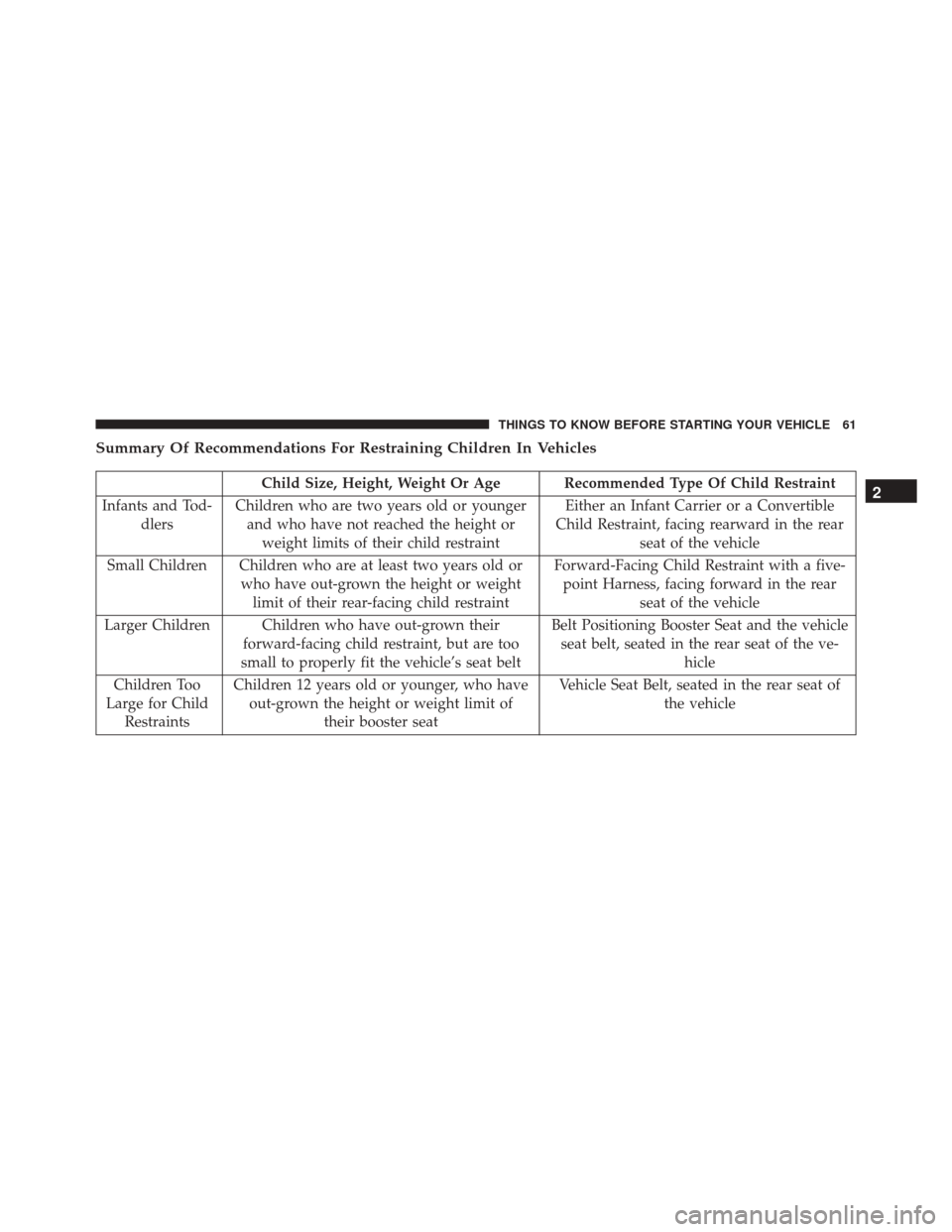
Summary Of Recommendations For Restraining Children In Vehicles
Child Size, Height, Weight Or Age Recommended Type Of Child Restraint
Infants and Tod- dlers Children who are two years old or younger
and who have not reached the height or weight limits of their child restraint Either an Infant Carrier or a Convertible
Child Restraint, facing rearward in the rear seat of the vehicle
Small Children Children who are at least two years old or who have out-grown the height or weightlimit of their rear-facing child restraint Forward-Facing Child Restraint with a five-
point Harness, facing forward in the rear seat of the vehicle
Larger Children Children who have out-grown their forward-facing child restraint, but are too
small to properly fit the vehicle’s seat belt Belt Positioning Booster Seat and the vehicle
seat belt, seated in the rear seat of the ve- hicle
Children Too
Large for Child Restraints Children 12 years old or younger, who have
out-grown the height or weight limit of their booster seat Vehicle Seat Belt, seated in the rear seat of
the vehicle2
THINGS TO KNOW BEFORE STARTING YOUR VEHICLE 61
Page 64 of 476
Infants And Child Restraints
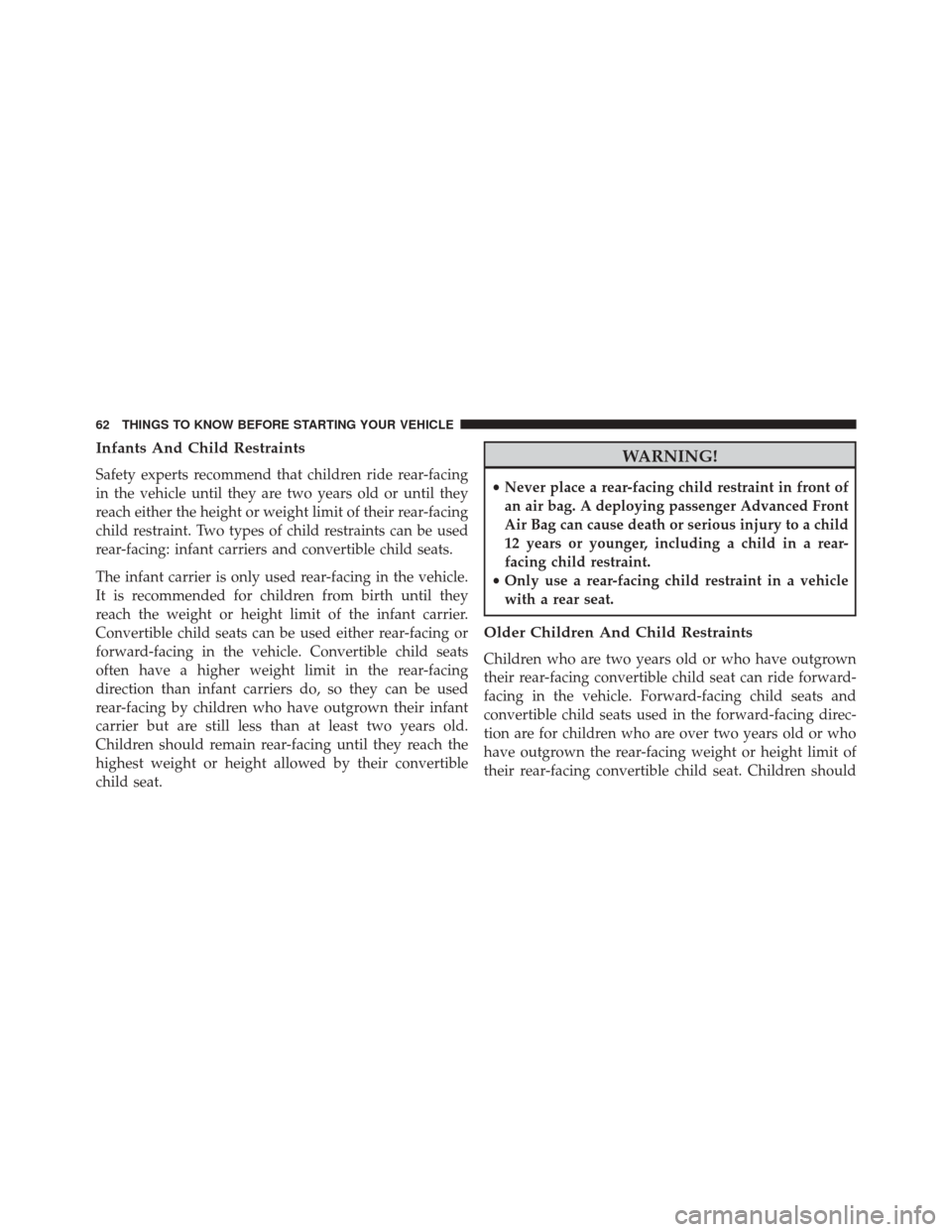
Safety experts recommend that children ride rear-facing
in the vehicle until they are two years old or until they
reach either the height or weight limit of their rear-facing
child restraint. Two types of child restraints can be used
rear-facing: infant carriers and convertible child seats.
The infant carrier is only used rear-facing in the vehicle.
It is recommended for children from birth until they
reach the weight or height limit of the infant carrier.
Convertible child seats can be used either rear-facing or
forward-facing in the vehicle. Convertible child seats
often have a higher weight limit in the rear-facing
direction than infant carriers do, so they can be used
rear-facing by children who have outgrown their infant
carrier but are still less than at least two years old.
Children should remain rear-facing until they reach the
highest weight or height allowed by their convertible
child seat.
WARNING!
•Never place a rear-facing child restraint in front of
an air bag. A deploying passenger Advanced Front
Air Bag can cause death or serious injury to a child
12 years or younger, including a child in a rear-
facing child restraint.
• Only use a rear-facing child restraint in a vehicle
with a rear seat.
Older Children And Child Restraints
Children who are two years old or who have outgrown
their rear-facing convertible child seat can ride forward-
facing in the vehicle. Forward-facing child seats and
convertible child seats used in the forward-facing direc-
tion are for children who are over two years old or who
have outgrown the rear-facing weight or height limit of
their rear-facing convertible child seat. Children should
62 THINGS TO KNOW BEFORE STARTING YOUR VEHICLE
Page 65 of 476
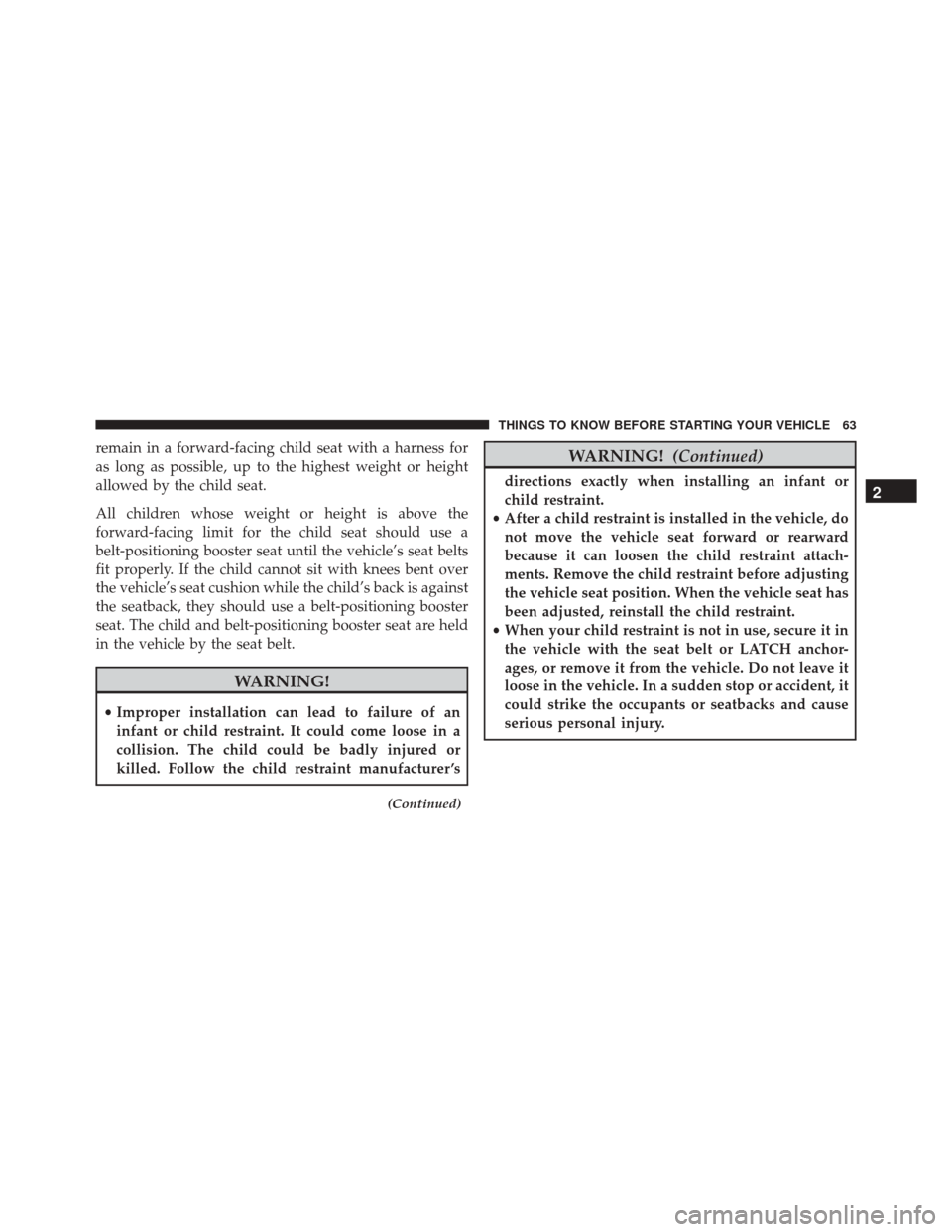
remain in a forward-facing child seat with a harness for
as long as possible, up to the highest weight or height
allowed by the child seat.
All children whose weight or height is above the
forward-facing limit for the child seat should use a
belt-positioning booster seat until the vehicle’s seat belts
fit properly. If the child cannot sit with knees bent over
the vehicle’s seat cushion while the child’s back is against
the seatback, they should use a belt-positioning booster
seat. The child and belt-positioning booster seat are held
in the vehicle by the seat belt.
WARNING!
•Improper installation can lead to failure of an
infant or child restraint. It could come loose in a
collision. The child could be badly injured or
killed. Follow the child restraint manufacturer ’s
(Continued)
WARNING! (Continued)
directions exactly when installing an infant or
child restraint.
• After a child restraint is installed in the vehicle, do
not move the vehicle seat forward or rearward
because it can loosen the child restraint attach-
ments. Remove the child restraint before adjusting
the vehicle seat position. When the vehicle seat has
been adjusted, reinstall the child restraint.
• When your child restraint is not in use, secure it in
the vehicle with the seat belt or LATCH anchor-
ages, or remove it from the vehicle. Do not leave it
loose in the vehicle. In a sudden stop or accident, it
could strike the occupants or seatbacks and cause
serious personal injury.2
THINGS TO KNOW BEFORE STARTING YOUR VEHICLE 63
Page 98 of 476
WARNING!
•Adjusting a seat while driving may be dangerous.
Moving a seat while driving could result in loss of
control which could cause a collision and serious
injury or death.
• Seats should be adjusted before fastening the seat
belts and while the vehicle is parked. Serious
injury or death could result from a poorly adjusted
seat belt.
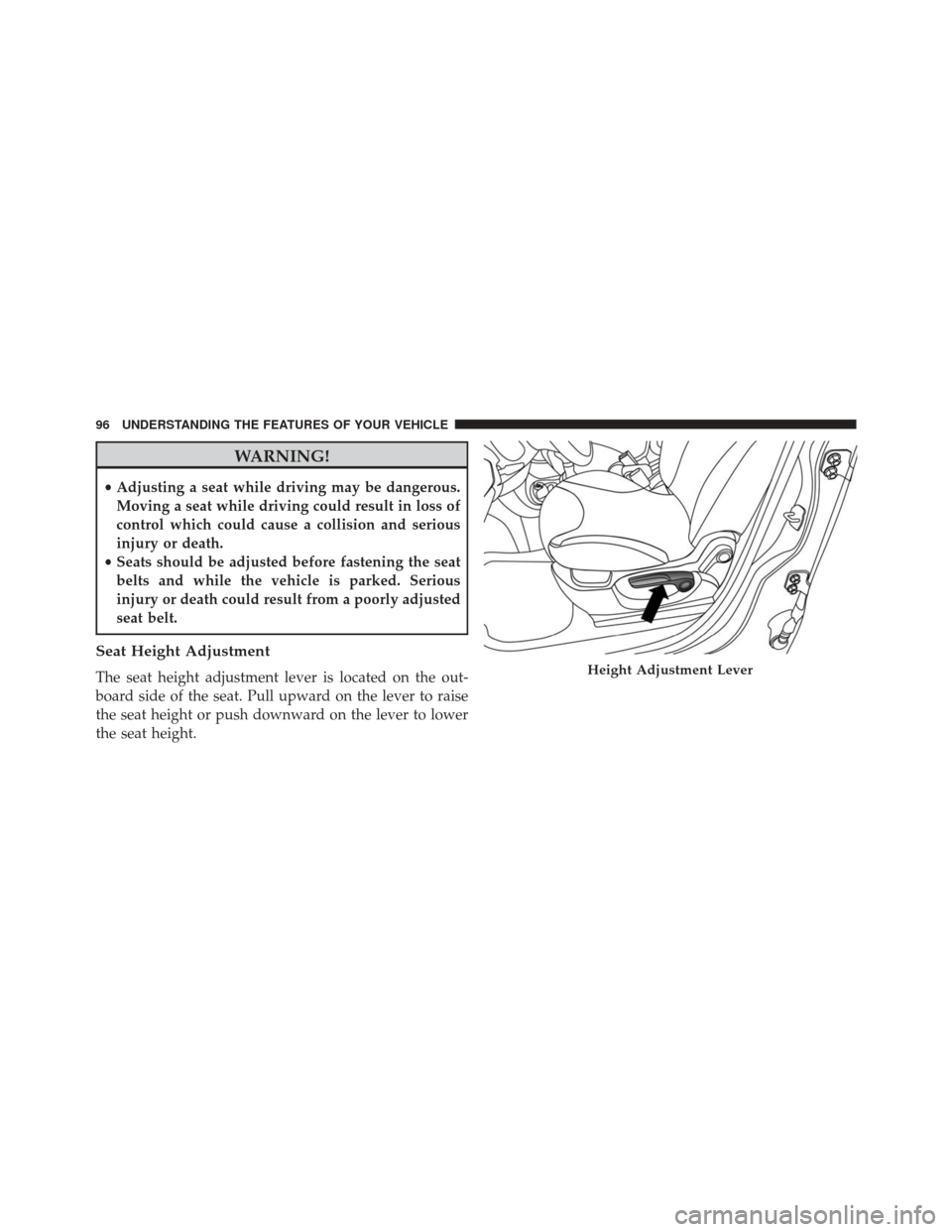
Seat Height Adjustment
The seat height adjustment lever is located on the out-
board side of the seat. Pull upward on the lever to raise
the seat height or push downward on the lever to lower
the seat height.Height Adjustment Lever
96 UNDERSTANDING THE FEATURES OF YOUR VEHICLE
Page 107 of 476
Head Restraints
Head restraints are designed to reduce the risk of injury
by restricting head movement in the event of a rear-
impact. Head restraints should be adjusted so that the top
of the head restraint is located above the top of your ear.
WARNING!
The head restraints for all occupants must be prop-
erly adjusted prior to operating the vehicle or occu-
pying a seat. Head restraints should never be ad-
justed while the vehicle is in motion. Driving a
vehicle with the head restraints improperly adjusted
or removed could cause serious injury or death in the
event of a collision.
NOTE: Do not reposition the head restraint 180 degrees
to the incorrect position in an attempt to gain additional
clearance to the back of the head.
Reactive Head Restraints — Front Seats
The front driver and passenger seats are equipped with
Reactive Head Restraints. In the event of a rear impact
the Reactive Head Restraints will automatically extend
forward minimizing the gap between the back of the
occupant’s head and the Reactive Head Restraint.
To raise the head restraint, pull upward on the head
restraint. To lower the head restraint, push the adjust-
ment button located at the base of the head restraint, and
push downward on the head restraint.
To remove the head restraint, raise it as far as it can go
then push the adjustment button, and the release button
at the base of each post while pulling the head restraint
up. To reinstall the head restraint, put the head restraint
posts into the holes and push downward. Then adjust it
to the appropriate height.
3
UNDERSTANDING THE FEATURES OF YOUR VEHICLE 105
Page 109 of 476
Rear Head Restraints
The rear seats are equipped with adjustable head re-
straints, the outboard head restraints have two comfort
positions, while the central head restraint have to use in
the raised position. When there are no occupants in the
center seat, the head restraint can be lowered for maxi-
mum visibility for the driver. When the center seat is
being occupied, the head restraint has to be in the raised
position.
NOTE:If the center rear head restraints requires removal,
see your authorized dealer.
To raise the outboard head restraints, pull upward on the
head restraint. To lower the head restraints, push the
adjustment button located at the base of the head re-
straint, and push downward on the head restraint.
To remove the outboard head restraints, raise it as far as
it can go then push the adjustment button, and the release button at the base of each post while pulling the head
restraint up. To reinstall the head restraint, put the head
restraint posts into the holes and push downward. Then
adjust it to the appropriate height.
WARNING!
A loose head restraint thrown forward in a collision
or hard stop could cause serious injury or death to
occupants of the vehicle. Always securely stow re-
moved head restraints in a location outside the occu-
pant compartment.
3
UNDERSTANDING THE FEATURES OF YOUR VEHICLE 107
Page 128 of 476

Rear Park Assist is automatically activated when the
transmission is placed into REVERSE. As the distance
from an obstacle behind the vehicle decreases, the au-
dible alert becomes more frequent.
Interaction With Trailer Towing
The Rear Park Assist system is automatically deactivated
when a trailer is hitched to the vehicle. The system will be
automatically activated as soon as the trailer is removed.
Rear Park Assist Sensors
The four Rear Park Assist sensors, located in the rear
fascia/bumper, monitor the area behind the vehicle that
is within the sensors’ field of view. The sensors can detect
obstacles, in the horizontal direction, from approximately
12 in (30 cm) up to 55 in (140 cm) from the center of the
rear fascia/bumper and up to 24 in (60 cm) from the
corners of the rear fascia/bumper, depending on the
location, type and orientation of the obstacle.If several obstacles are detected, the Rear Park Assist
system indicates the nearest obstacle.
The minimum height of a detectable obstacle corre-
sponds to the maximum height of an obstacle that would
clear the underside of the car during the parking maneu-
ver.
Rear Park Assist Audible Alerts
If an obstacle is behind the vehicle when the transmission
is placed into REVERSE, an audible alert is activated.
The tones emitted by the loudspeaker inform the driver
that the vehicle is approaching an obstacle. The pauses
between the tones are directly proportional to the dis-
tance from the obstacle. Pulses emitted in quick succes-
sion indicate the presence of a very close obstacle. A
continuous tone indicates that the obstacle is less than 12
in (30 cm) away.
126 UNDERSTANDING THE FEATURES OF YOUR VEHICLE
Page 151 of 476
REAR CARGO STORAGE FEATURES
The car features a load platform which can be adjusted to
three different heights, permitting modular luggage com-
partment volume:•
Position 1 (platform completely lowered) permits
maximum luggage compartment capacity.
• Position 2 (platform at threshold level) permits a level
load threshold to facilitate loading/unloading of ob-
jects in the luggage compartment. It also allows the
space underneath to be used as a additional compart-
ment for stowing objects which are more fragile or
small.
• Position 3 (platform completely raised) in conjunction
with the lowering of the rear seat and front passenger
side seat backrests, permits long objects to be loaded. It
is advisable to use this position only for the actual
period in which the objects are transported, then
return the platform to position 1 or 2.
Tilt of cargo floor
The cargo floor can also be arranged at an angle (tilted
toward the rear seat backs), in order to facilitate access to
Front Center Armrest Raised Position
3
UNDERSTANDING THE FEATURES OF YOUR VEHICLE 149