Page 444 of 707
4. Rear Temperature Control — If Equipped
Provides temperature control for the rear cabin. Turn left
for cooler or right for warmer temperature settings in the
rear cabin.
5. Right Front Temperature Control
Provides right front seat occupant with independent
temperature control. Turn left for cooler or right for
warmer temperature settings.
6. Mix ModeAir is directed through the floor, defrost and side
window demist outlets. This setting works best in
cold or snowy conditions that require extra heat at the
windshield. This setting is good for maintaining comfort,
while reducing moisture on the windshield. 7. Front Defrost Mode
Air is directed through the windshield and side
window demist outlets. Use Defrost mode with
maximum blower and temperature settings for best
windshield and side window defrosting.
NOTE: The air conditioning compressor may operate in
Mix and Defrost, even if the A/C button is not pushed.
This dehumidifies the air to help dry the windshield. To
improve fuel economy, use these modes only when
necessary.
8. Electronic Rear Window Defrost
Push this button to turn on the rear window
defroster and the heated outside mirrors (if
equipped). An indicator in the button will illuminate
when the rear window defroster is on. The rear window
defroster automatically turns off after approximately 10
minutes.
442 UNDERSTANDING YOUR INSTRUMENT PANEL
Page 463 of 707
STARTING AND OPERATING
CONTENTS
�STARTING PROCEDURES ................465
▫ Automatic Transmission ................465
▫ Normal Starting ...................... .465
▫ Extreme Cold Weather
(Below –20°F Or 29°C) ................466
▫ If The Engine Fails To Start ..............466
▫ After Starting ....................... .467
� ENGINE BLOCK HEATER — IF EQUIPPED . . .468
� AUTOMATIC TRANSMISSION ............468
▫ Key Ignition Park Interlock ...............470 ▫
Brake/Transmission Shift Interlock System . . .470
▫ Fuel Economy (ECON) Mode .............471
▫ Six-Speed Automatic Transmission .........472
▫ Gear Ranges ........................ .473
� DRIVING ON SLIPPERY SURFACES .........481
▫ Acceleration ........................ .481
▫ Traction ........................... .481
� DRIVING THROUGH WATER .............482
▫ Flowing/Rising Water ..................482
▫ Shallow Standing Water .................482
5
Page 465 of 707
▫Run Flat Tires — If Equipped .............518
▫ Spare Tires — If Equipped ...............518
▫ Tire Spinning ....................... .521
▫ Tread Wear Indicators ..................521
▫ Life Of Tire ........................ .522
▫ Replacement Tires .....................523
� TIRE CHAINS (TRACTION DEVICES) .......524
� TIRE ROTATION RECOMMENDATIONS .....526
� TIRE PRESSURE MONITOR SYSTEM (TPMS) . .527
▫ Base System ........................ .529
▫ Premium System — If Equipped ...........532
� FUEL REQUIREMENTS ..................536
▫ 3.6L Engine ......................... .536▫
Reformulated Gasoline .................536
▫ Gasoline/Oxygenate Blends ..............537
▫ E-85 Usage In Non-Flex Fuel Vehicles .......537
▫ MMT In Gasoline .....................538
▫ Materials Added To Fuel ................538
▫ Fuel System Cautions ...................539
▫ Carbon Monoxide Warnings .............540
� FLEXIBLE FUEL — IF EQUIPPED ...........540
▫ E-85 General Information ...............540
▫ Ethanol Fuel (E-85) ....................541
▫ Fuel Requirements ....................541
▫ Selection Of Engine Oil For Flexible Fuel Vehicles
(E-85) And Gasoline Vehicles .............542
5
STARTING AND OPERATING 463
Page 466 of 707
▫Starting ........................... .542
▫ Cruising Range ...................... .543
▫ Replacement Parts ....................543
▫ Maintenance ....................... .543
� ADDING FUEL ....................... .543
▫ Fuel Filler Cap (Gas Cap) ...............543
▫ Loose Fuel Filler Cap Message ............545
� VEHICLE LOADING ....................546 ▫
Vehicle Certification Label ...............546
� TRAILER TOWING .....................549
▫ Common Towing Definitions .............549
▫ Towing Tips ........................ .560
� RECREATIONAL TOWING (BEHIND
MOTORHOME, ETC.) ...................562
▫ Towing This Vehicle Behind Another Vehicle . .562
▫ Recreational Towing — All Models .........563
464 STARTING AND OPERATING
Page 468 of 707
2. Use the Fob with Integrated Key to briefly turn theignition switch to the START position and release it as
soon as the starter engages. The starter motor will
continue to run, and it will disengage automatically
when the engine is running.
3. If the engine fails to start, the starter will disengage automatically in 10 seconds. If this occurs, turn the
ignition switch to the OFF position, wait 10 to 15
seconds, then repeat the “Normal Starting” procedure
(Steps 1–3 above).
NOTE: This vehicle is equipped with a transmission
shift interlocking system. The brake pedal must be
pressed to shift out of PARK.
Extreme Cold Weather (Below –20°F Or 29°C)
To ensure reliable starting at these temperatures, use of
an externally powered electric engine block heater (avail-
able from your authorized dealer) is recommended.
If The Engine Fails To Start
WARNING!
• Never pour fuel or other flammable liquids into
the throttle body air inlet opening in an attempt to
start the vehicle. This could result in a flash fire
causing serious personal injury.
• Do not attempt to push or tow your vehicle to get it
started. Vehicles equipped with an automatic trans-
mission cannot be started this way. Unburned fuel
could enter the catalytic converter and once the
engine has started, ignite and damage the converter
and vehicle.
(Continued)
466 STARTING AND OPERATING
Page 469 of 707
WARNING!(Continued)
•If the vehicle has a discharged battery, booster
cables may be used to obtain a start from a booster
battery or the battery in another vehicle. This type
of start can be dangerous if done improperly. Refer
to “Jump-Starting” in “What To Do In Emergen-
cies” for further information.
If the engine fails to start after you have followed the
“Normal Starting” procedure, it may be flooded. Press
the accelerator pedal all the way to the floor and hold it
there while cranking the engine. This should clear any
excess fuel in case the engine is flooded.
CAUTION!
To prevent damage to the starter, DO NOT crank the
engine for more than 15 second intervals at one time.
Wait 10 to 15 seconds before trying again. If the engine has been flooded, it may start to run, but not
have enough power to continue running when the Key
Fob is released. If this occurs, continue cranking with the
accelerator pedal pressed all the way to the floor. Release
the accelerator pedal and the Key Fob once the engine is
running smoothly.
If the engine shows no sign of starting after two 15-
second intervals of cranking with the accelerator pedal
held to the floor, the “Normal Starting” procedure should
be repeated.
After Starting
The idle speed is controlled automatically and it will
decrease as the engine warms up.
5
STARTING AND OPERATING 467
Page 473 of 707
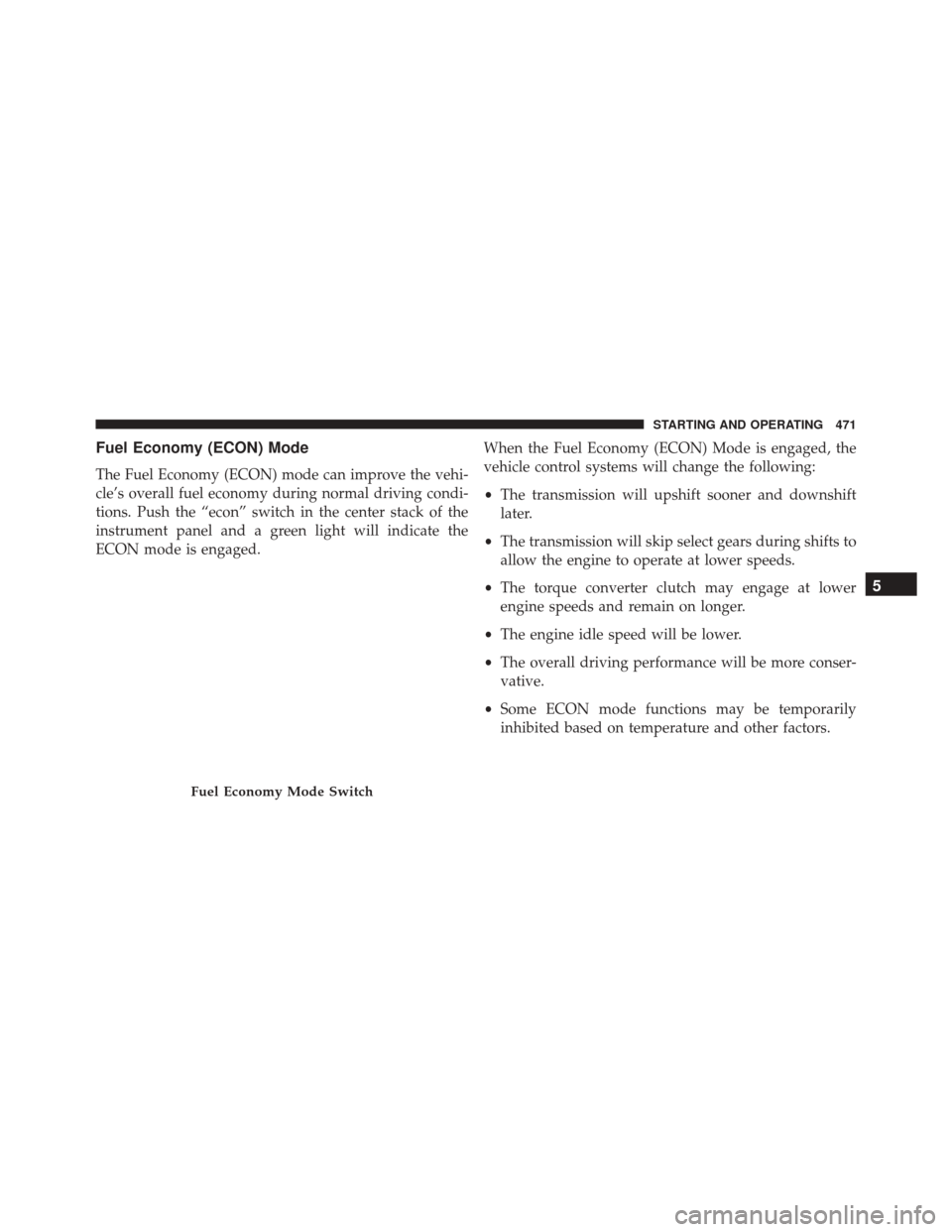
Fuel Economy (ECON) Mode
The Fuel Economy (ECON) mode can improve the vehi-
cle’s overall fuel economy during normal driving condi-
tions. Push the “econ” switch in the center stack of the
instrument panel and a green light will indicate the
ECON mode is engaged.When the Fuel Economy (ECON) Mode is engaged, the
vehicle control systems will change the following:
•
The transmission will upshift sooner and downshift
later.
• The transmission will skip select gears during shifts to
allow the engine to operate at lower speeds.
• The torque converter clutch may engage at lower
engine speeds and remain on longer.
• The engine idle speed will be lower.
• The overall driving performance will be more conser-
vative.
• Some ECON mode functions may be temporarily
inhibited based on temperature and other factors.
Fuel Economy Mode Switch
5
STARTING AND OPERATING 471
Page 479 of 707

DRIVE (D)
This range should be used for most city and highway
driving. It provides the smoothest upshifts and down-
shifts, and the best fuel economy. The transmission
automatically upshifts through all forward gears. The
DRIVE position provides optimum driving characteris-
tics under all normal operating conditions.
When frequent transmission shifting occurs (such as
when operating the vehicle under heavy loading condi-
tions, in hilly terrain, traveling into strong head winds, or
while towing heavy trailers), use the Electronic Range
Select (ERS) shift control (refer to�Electronic Range Select
(ERS) Operation� in this section for further information)
to select a lower gear range. Under these conditions,
using a lower gear range will improve performance and
extend transmission life by reducing excessive shifting
and heat buildup. During cold temperatures, transmission operation may
be modified depending on engine and transmission
temperature as well as vehicle speed. This feature im-
proves warm up time of the engine and transmission to
achieve maximum efficiency. Engagement of the torque
converter clutch is inhibited until the transmission fluid
is warm (refer to the “Note” under “Torque Converter
Clutch” in this section). During extremely cold tempera-
tures (-16°F [-27°C] or below), operation may briefly be
limited to third gear only. Normal operation will resume
once the transmission temperature has risen to a suitable
level.
Transmission Limp Home Mode
Transmission function is monitored electronically for
abnormal conditions. If a condition is detected that could
result in transmission damage, Transmission Limp Home
Mode is activated. In this mode, the transmission remains
in third gear regardless of which forward gear is selected.
5
STARTING AND OPERATING 477