Page 106 of 634
Fluid Leaks
Check area under vehicle after overnight parking for fuel,
engine coolant, oil, or other fluid leaks. Also, if gasoline
fumes are detected or if fuel, power steering fluid (if
equipped), or brake fluid leaks are suspected, the cause
should be located and corrected immediately.
104 THINGS TO KNOW BEFORE STARTING YOUR VEHICLE
Page 261 of 634
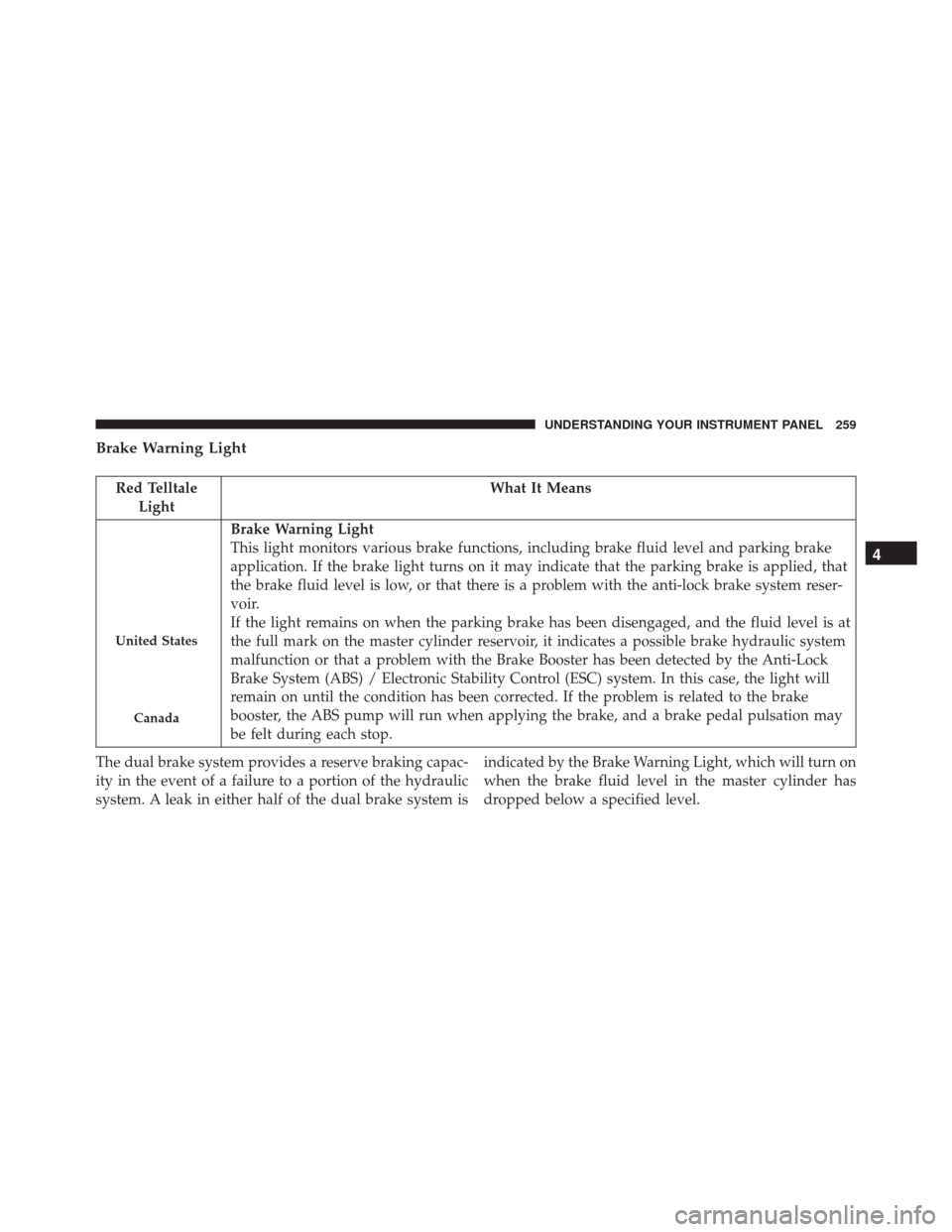
Brake Warning Light
Red TelltaleLight What It Means
United States
Canada
Brake Warning Light
This light monitors various brake functions, including brake fluid level and parking brake
application. If the brake light turns on it may indicate that the parking brake is applied, that
the brake fluid level is low, or that there is a problem with the anti-lock brake system reser-
voir.
If the light remains on when the parking brake has been disengaged, and the fluid level is at
the full mark on the master cylinder reservoir, it indicates a possible brake hydraulic system
malfunction or that a problem with the Brake Booster has been detected by the Anti-Lock
Brake System (ABS) / Electronic Stability Control (ESC) system. In this case, the light will
remain on until the condition has been corrected. If the problem is related to the brake
booster, the ABS pump will run when applying the brake, and a brake pedal pulsation may
be felt during each stop.
The dual brake system provides a reserve braking capac-
ity in the event of a failure to a portion of the hydraulic
system. A leak in either half of the dual brake system is indicated by the Brake Warning Light, which will turn on
when the brake fluid level in the master cylinder has
dropped below a specified level.
4
UNDERSTANDING YOUR INSTRUMENT PANEL 259
Page 262 of 634
The light will remain on until the cause is corrected.
NOTE:The light may flash momentarily during sharp
cornering maneuvers, which change fluid level condi-
tions. The vehicle should have service performed, and
the brake fluid level checked.
If brake failure is indicated, immediate repair is neces-
sary.
WARNING!
Driving a vehicle with the red brake light on is
dangerous. Part of the brake system may have failed.
It will take longer to stop the vehicle. You could have
a collision. Have the vehicle checked immediately.
Vehicles equipped with the Anti-Lock Brake System
(ABS) are also equipped with Electronic Brake Force
Distribution (EBD). In the event of an EBD failure, the Brake Warning Light will turn on along with the ABS
Light. Immediate repair to the ABS system is required.
Operation of the Brake Warning Light can be checked by
turning the ignition switch from the OFF position to the
ON/RUN position. The light should illuminate for ap-
proximately two seconds. The light should then turn off
unless the parking brake is applied or a brake fault is
detected. If the light does not illuminate, have the light
inspected by an authorized dealer.
The light also will turn on when the parking brake is
applied with the ignition switch in the ON/RUN posi-
tion.
NOTE:
This light shows only that the parking brake is
applied. It does not show the degree of brake application.
260 UNDERSTANDING YOUR INSTRUMENT PANEL
Page 426 of 634
Launch control will abort before launch completion,
display “Launch Aborted” in the cluster under any the
following conditions:
•The accelerator pedal is released during launch. ESC
system continues in ESC Full ON.
• The ESC system detects that the vehicle is no longer
moving in a straight line.
• The “ESC OFF” button is pushed to change the system
to another mode.
NOTE: After launch control has been aborted, ESC will
return to its current ESC mode.
CAUTION!
Do not attempt to shift when the drive wheels are
spinning and do not have traction. Damage to the
transmission may occur.
Guidelines For Track Use
NOTE: Because of the extreme conditions encountered
during track use, any damage or wear associated with
track use is not covered by warranty.
• If your SRT vehicle is equipped with Drive Modes,
they will alter the vehicle’s performance in various
driving situations. It is recommended that your vehicle
operates in SPORT or TRACK modes during the track
event.
• Prior to each track event/day, verify all fluids are at
the correct levels. Refer to “Fluid Capacities” in “Main-
taining Your Vehicle” for further information.
• Prior to each track event, verify the front and rear
brake pads have more than ½ pad thickness remain-
ing. If the brake pads require changing, please burnish
prior to track outing at full pace.
424 STARTING AND OPERATING
Page 431 of 634
WARNING!
•Driving through standing water limits your vehi-
cle’s traction capabilities. Do not exceed 5 mph
(8 km/h) when driving through standing water.
• Driving through standing water limits your vehi-
cle’s braking capabilities, which increases stopping
distances. Therefore, after driving through stand-
ing water, drive slowly and lightly press on the
brake pedal several times to dry the brakes.
• Failure to follow these warnings may result in
injuries that are serious or fatal to you, your pas-
sengers, and others around you.
CAUTION!
• Always check the depth of the standing water
before driving through it. Never drive through
(Continued)
CAUTION! (Continued)
standing water that is deeper than the bottom of
the tire rims mounted on the vehicle.
• Determine the condition of the road or the path
that is under water and if there are any obstacles in
the way before driving through the standing water.
• Do not exceed 5 mph (8 km/h) when driving
through standing water. This will minimize wave
effects.
• Driving through standing water may cause damage
to your vehicle’s drivetrain components. Always
inspect your vehicle’s fluids (i.e., engine oil, trans-
mission, axle, etc.) for signs of contamination (i.e.,
fluid that is milky or foamy in appearance) after
driving through standing water. Do not continue to
operate the vehicle if any fluid appears contami-
nated, as this may result in further damage. Such
(Continued)
5
STARTING AND OPERATING 429
Page 434 of 634
WARNING!
Continued operation with reduced power steering
assist could pose a safety risk to yourself and others.
Service should be obtained as soon as possible.
CAUTION!
Prolonged operation of the steering system at the end
of the steering wheel travel will increase the steering
fluid temperature and it should be avoided when
possible. Damage to the power steering pump may
occur.
FUEL SAVER TECHNOLOGY — IF EQUIPPED
This feature offers improved fuel economy by shutting
off four of the engine’s eight cylinders during light load
and cruise conditions. The system is automatic with no
driver inputs or additional driving skills required.NOTE:
This system may take some time to return to full
functionality after a battery disconnect.
PARKING BRAKE
Before leaving the vehicle, make sure that the parking
brake is fully applied and place the gear selector in the
PARK position.
The foot operated parking brake is located below the
lower left corner of the instrument panel. To apply the
park brake, firmly press the park brake pedal fully. To
release the parking brake, press the park brake pedal a
second time and let your foot up as you feel the brake
disengage.
432 STARTING AND OPERATING
Page 524 of 634

▫Brake System ....................... .550
▫ Automatic Transmission ................552
▫ Rear Axle .......................... .554
▫ Appearance Care And Protection From
Corrosion .......................... .554
� FUSES ............................. .561
▫ Front Power Distribution Center (Fuses) .....562
▫ Rear Power Distribution Center (Fuses) .....567
� VEHICLE STORAGE ....................576
� REPLACEMENT BULBS .................576
� BULB REPLACEMENT ..................578
▫
Front Low/High Beam Headlamp And Park/Turn
Lamp — Models With Halogen Headlamps . . . .578
▫ Front Low/High Beam Headlamp And Park/Turn
Lamp — Models With High Intensity Discharge
Headlamps (HID) .....................579
▫ Front/Rear Side Marker Lamp ............580
▫ Front Fog Lamp ..................... .580
▫ Backup Lamps ....................... .580
▫ Center High Mounted Stop Lamp (CHMSL) . . .580
▫ License Lamp ....................... .580
� FLUID CAPACITIES ....................581
▫ Fluid Capacities — SRT 6.2L ..............581
▫ Fluid Capacities — SRT 6.4L ..............582
� FLUIDS, LUBRICANTS, AND GENUINE
PARTS ............................. .583
▫ Important Information .................583
522 MAINTAINING YOUR VEHICLE
Page 526 of 634
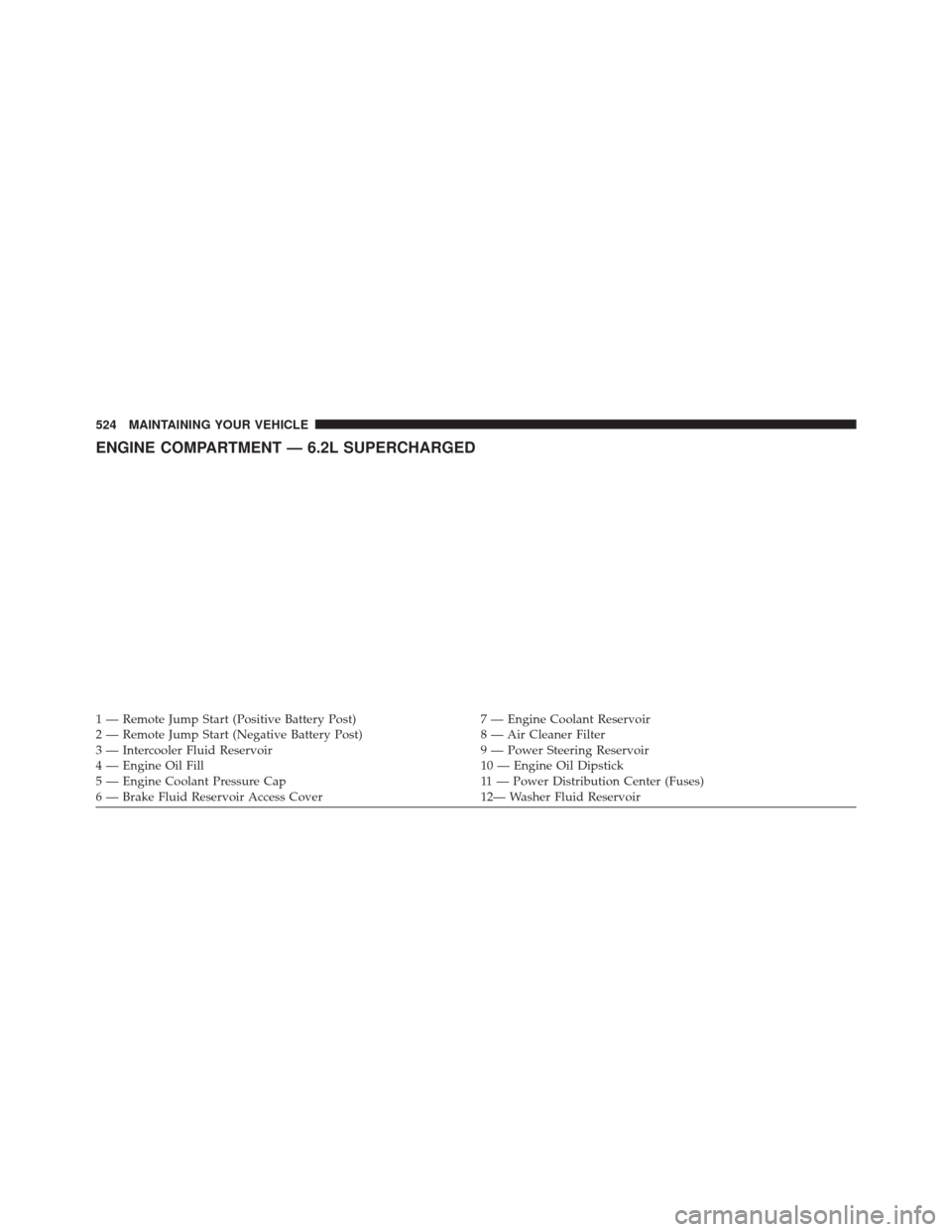
ENGINE COMPARTMENT — 6.2L SUPERCHARGED
1 — Remote Jump Start (Positive Battery Post)7 — Engine Coolant Reservoir
2 — Remote Jump Start (Negative Battery Post) 8 — Air Cleaner Filter
3 — Intercooler Fluid Reservoir 9 — Power Steering Reservoir
4 — Engine Oil Fill 10 — Engine Oil Dipstick
5 — Engine Coolant Pressure Cap 11 — Power Distribution Center (Fuses)
6 — Brake Fluid Reservoir Access Cover 12— Washer Fluid Reservoir
524 MAINTAINING YOUR VEHICLE