Page 515 of 634
FREEING A STUCK VEHICLE
If your vehicle becomes stuck in mud, sand, or snow, it
can often be moved using a rocking motion. Turn the
steering wheel right and left to clear the area around the
front wheels. Push and hold the lock button on the gear
selector. Then shift back and forth between DRIVE and
REVERSE while gently pressing the accelerator. Use the
least amount of accelerator pedal pressure that will
maintain the rocking motion, without spinning the
wheels or racing the engine.
NOTE:Shifts between DRIVE and REVERSE can only be
achieved at wheel speeds of 5 mph (8 km/h) or less.
Whenever the transmission remains in NEUTRAL for
more than 2 seconds, you must press the brake pedal to
engage DRIVE or REVERSE.
CAUTION!
Racing the engine or spinning the wheels may lead to
transmission overheating and failure. Allow the en-
gine to idle with the transmission in NEUTRAL for at
least one minute after every five rocking-motion
cycles. This will minimize overheating and reduce
the risk of transmission failure during prolonged
efforts to free a stuck vehicle.
NOTE: Push the �ESC Off� switch, to place the Electronic
Stability Control (ESC) system in �Partial Off�mode,
before rocking the vehicle. Refer to “Electronic Brake
Control” in “Starting And Operating” in your Owner’s
Manual on the DVD for further information. Once the
vehicle has been freed, push the �ESC Off�switch again to
restore �ESC On� mode.
6
WHAT TO DO IN EMERGENCIES 513
Page 516 of 634
CAUTION!
•When “rocking” a stuck vehicle by shifting be-
tween DRIVE and REVERSE, do not spin the
wheels faster than 15 mph (24 km/h), or drivetrain
damage may result.
• Revving the engine or spinning the wheels too fast
may lead to transmission overheating and failure.
It can also damage the tires. Do not spin the wheels
above 30 mph (48 km/h) while in gear (no trans-
mission shifting occurring).
WARNING!
Fast spinning tires can be dangerous. Forces gener-
ated by excessive wheel speeds may cause damage, or
even failure, of the axle and tires. A tire could
(Continued)
WARNING! (Continued)
explode and injure someone. Do not spin your vehi-
cle’s wheels faster than 30 mph (48 km/h) or for
longer than 30 seconds continuously without stop-
ping when you are stuck and do not let anyone near
a spinning wheel, no matter what the speed.
MANUAL PARK RELEASE — 8 SPEED
TRANSMISSION
WARNING!
Always secure your vehicle by fully applying the
parking brake, before activating the Manual Park
Release. Activating the Manual Park Release will
allow your vehicle to roll away if it is not secured by
the parking brake or by proper connection to a tow
(Continued)
514 WHAT TO DO IN EMERGENCIES
Page 521 of 634
•The transmission must be in NEUTRAL. Refer to
�Manual Park Release� in this section for instructions
on shifting the transmission to NEUTRAL when the
engine is off.
• The towing distance must not exceed 30 miles (48 km).
• The towing speed must not exceed 30 mph (48 km/h).
If the transmission is not operable, or the vehicle must be
towed faster than 30 mph (48 km/h) or farther than 30
miles (48 km), then the only acceptable method of towing
is with a flatbed truck.CAUTION!
• Towing this vehicle in violation of the above re-
quirements can cause severe transmission damage.
Damage from improper towing is not covered un-
der the New Vehicle Limited Warranty.
6
WHAT TO DO IN EMERGENCIES 519
Page 523 of 634
MAINTAINING YOUR VEHICLE
CONTENTS
�ENGINE COMPARTMENT — 6.2L
SUPERCHARGED ..................... .524
� ENGINE COMPARTMENT — 6.4L (392 HEMI) .525
� ONBOARD DIAGNOSTIC SYSTEM — OBD II . .526
▫ Onboard Diagnostic System (OBD II)
Cybersecurity ....................... .526
� EMISSIONS INSPECTION AND MAINTENANCE
PROGRAMS ......................... .527
� REPLACEMENT PARTS ..................529
� DEALER SERVICE ..................... .529
� MAINTENANCE PROCEDURES ...........530▫
Engine Oil ......................... .531
▫ Engine Oil Filter ..................... .533
▫ Engine Air Cleaner Filter ................534
▫ Maintenance-Free Battery ...............535
▫ Air Conditioner Maintenance .............536
▫ Body Lubrication .....................540
▫ Windshield Wiper Blades ...............540
▫ Adding Washer Fluid ..................541
▫ Exhaust System ..................... .541
▫ Cooling System ..................... .544
7
Page 525 of 634
▫Engine ............................ .584
▫ Chassis ........................... .585
7
MAINTAINING YOUR VEHICLE 523
Page 526 of 634
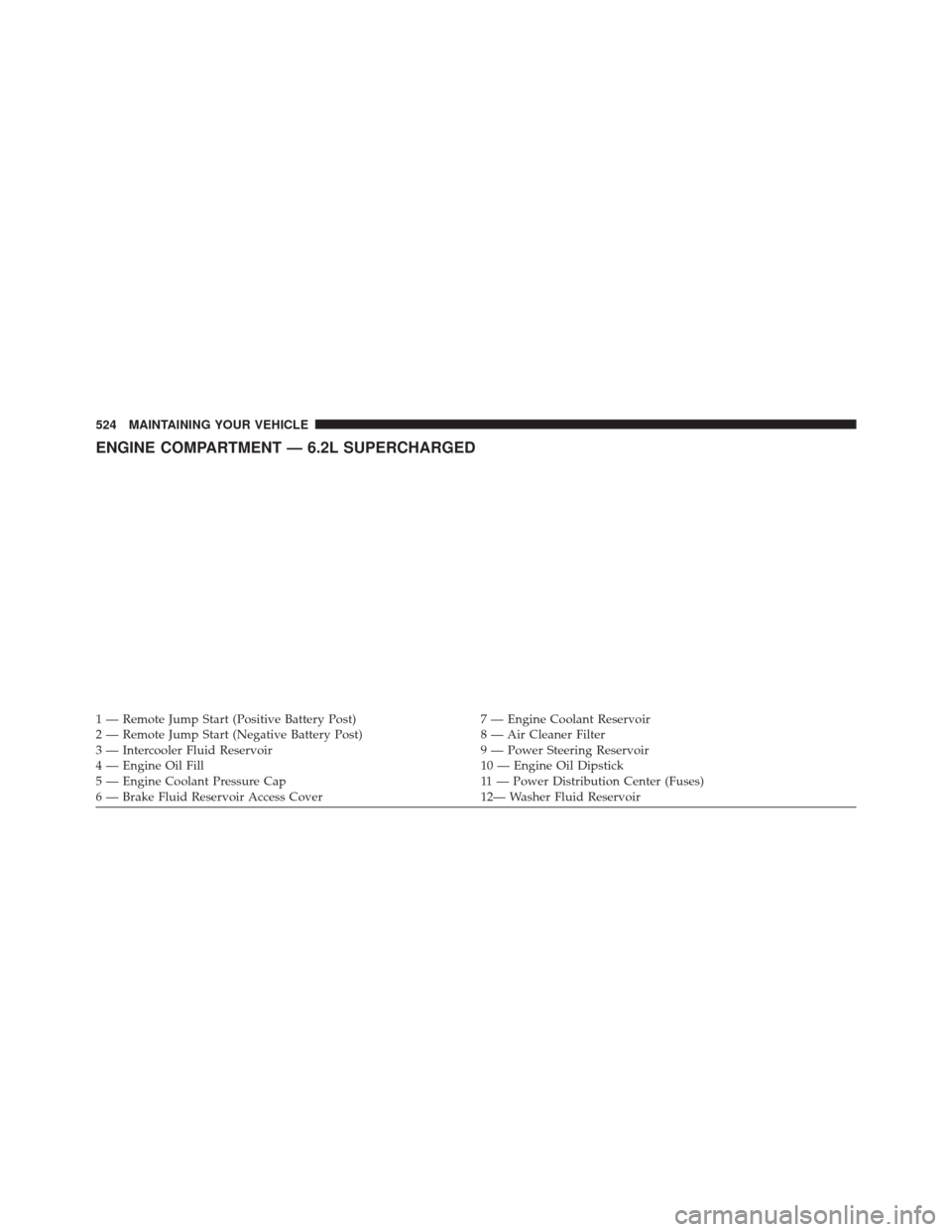
ENGINE COMPARTMENT — 6.2L SUPERCHARGED
1 — Remote Jump Start (Positive Battery Post)7 — Engine Coolant Reservoir
2 — Remote Jump Start (Negative Battery Post) 8 — Air Cleaner Filter
3 — Intercooler Fluid Reservoir 9 — Power Steering Reservoir
4 — Engine Oil Fill 10 — Engine Oil Dipstick
5 — Engine Coolant Pressure Cap 11 — Power Distribution Center (Fuses)
6 — Brake Fluid Reservoir Access Cover 12— Washer Fluid Reservoir
524 MAINTAINING YOUR VEHICLE
Page 527 of 634
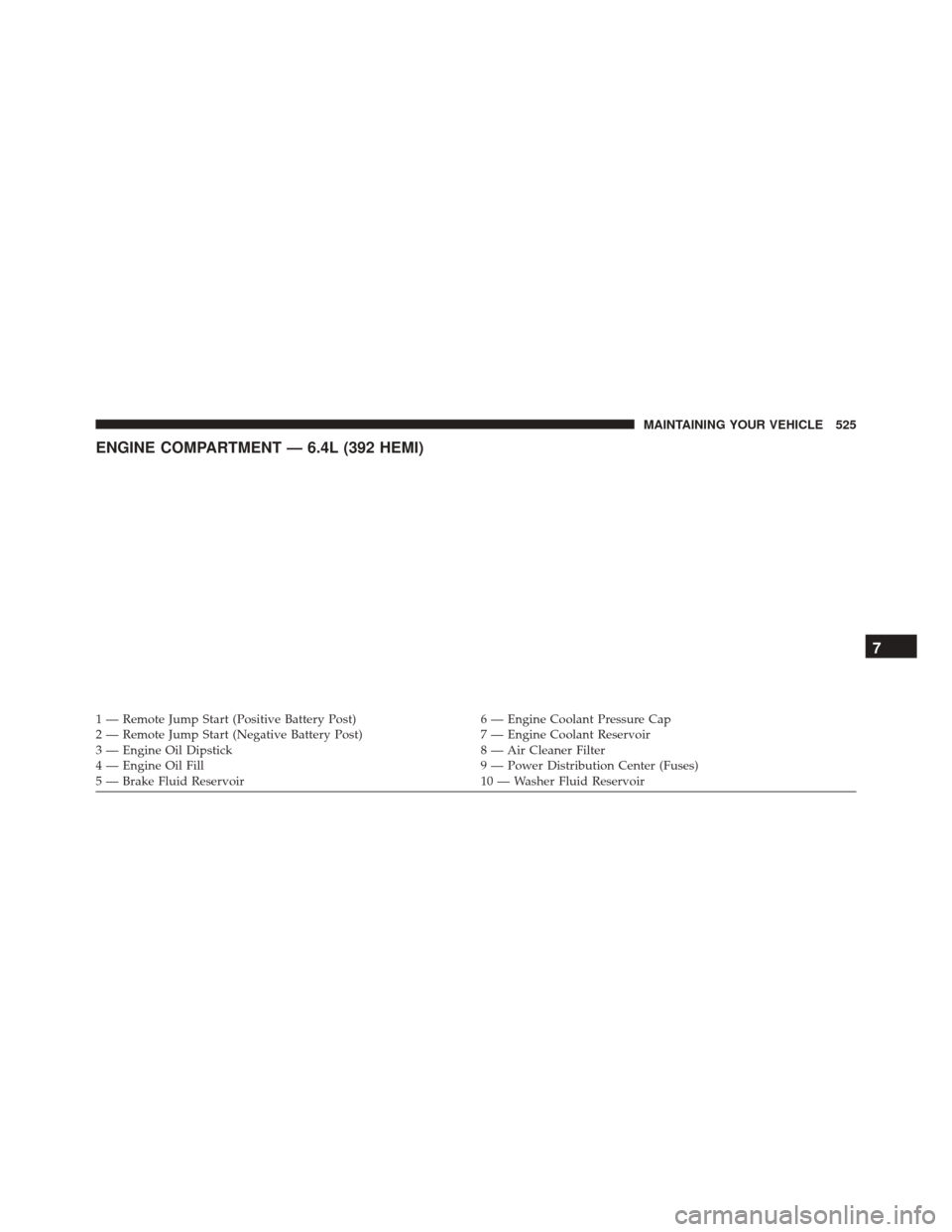
ENGINE COMPARTMENT — 6.4L (392 HEMI)
1 — Remote Jump Start (Positive Battery Post)6 — Engine Coolant Pressure Cap
2 — Remote Jump Start (Negative Battery Post) 7 — Engine Coolant Reservoir
3 — Engine Oil Dipstick 8 — Air Cleaner Filter
4 — Engine Oil Fill 9 — Power Distribution Center (Fuses)
5 — Brake Fluid Reservoir 10 — Washer Fluid Reservoir
7
MAINTAINING YOUR VEHICLE 525
Page 528 of 634
ONBOARD DIAGNOSTIC SYSTEM — OBD II
Your vehicle is equipped with a sophisticated onboard
diagnostic system called OBD II. This system monitors
the performance of the emissions, engine, and automatic
transmission control systems. When these systems are
operating properly, your vehicle will provide excellent
performance and fuel economy, as well as engine emis-
sions well within current government regulations.
If any of these systems require service, the OBD II system
will turn on the “Malfunction Indicator Light (MIL)”. It
will also store diagnostic codes and other information to
assist your service technician in making repairs. Al-
though your vehicle will usually be drivable and not
need towing, see your authorized dealer for service as
soon as possible.
CAUTION!
•Prolonged driving with the MIL on could cause
further damage to the emissions control system. It
could also affect fuel economy and driveability.
The vehicle must be serviced before any emissions
tests can be performed.
• If the MIL is flashing while the engine is running,
severe catalytic converter damage and power loss
will soon occur. Immediate service is required.
Onboard Diagnostic System (OBD II)
Cybersecurity
Your vehicle is required to have an Onboard Diagnostic
system (OBD II) and a connection port to allow access to
information related to the performance of your emissions
controls. Authorized service technicians may need to
526 MAINTAINING YOUR VEHICLE