2016 Citroen DS5 HYBRID RHD remove
[x] Cancel search: removePage 89 of 400
87
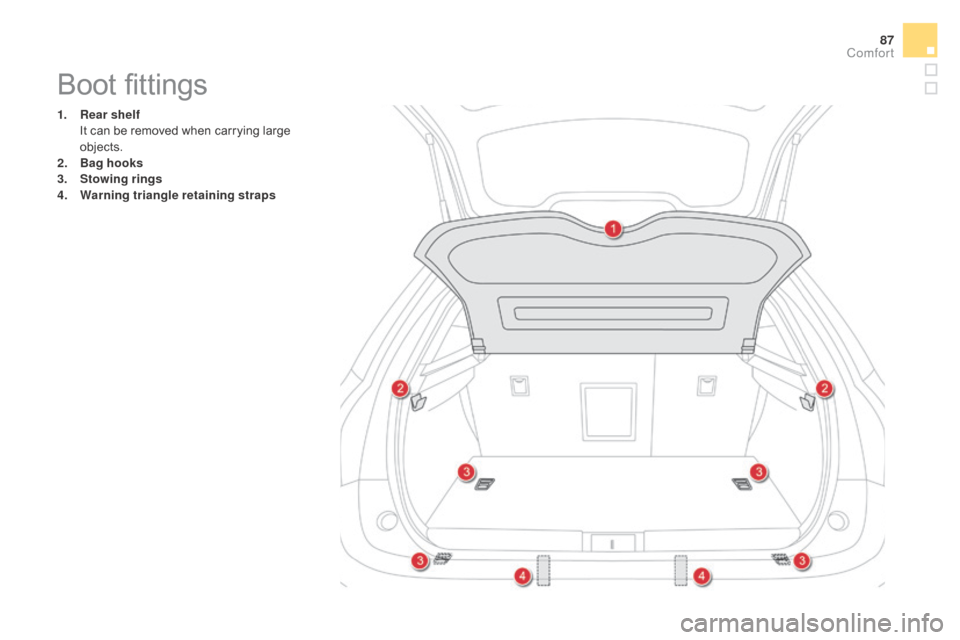
Boot fittings
1. Rear shelf I
t can be removed when carrying large
objects.
2.
Bag
hooks
3.
S
towing rings
4.
W
arning triangle retaining straps
comfort
Page 159 of 400

157
1. Front - rear cour tesy lamp
2. Front map reading lamp s
3.
R
ear map reading lamps
4.
I
nterior mood LE
ds
Courtesy lamps
In this position, the courtesy lamp
comes on gradually:
Front - rear courtesy lamps
Take care to avoid leaving anything in
contact with the courtesy lamps.
With the "permanent lighting" mode, the lighting
time varies according to the circumstances:
- with the ignition off, approximately
ten m inutes,
- in energy economy mode, approximately thirty seconds,
- with the engine running, unlimited.
- when the vehicle is unlocked,
- w hen the electronic key is removed from
the reader,
-
w
hen opening a door,
-
w
hen the remote control locking button is
activated, in order to locate your vehicle.
It switches off gradually:
-
w
hen the vehicle is locked,
-
w
hen the ignition is switched on,
-
3
0 seconds after the last door is closed.Permanently off.
Permanent lighting.
Front - rear map reading
lamps
F With the ignition on, press the corresponding switch.
Visibility
Page 171 of 400

169
Installing child seats attached using
the seat belt
In accordance with European regulations, this table indicates the options for installing child seats secured using a seat belt and universally approved (a)
according to the weight of the child and the seating position in the vehicle:
Weight of the child and indicative age
Seat Under 13 kg
(groups 0 (b) and 0+)
Up to approx 1 year From 9 to 18 kg
(group 1)
1 to 3 years approx From 15 to 25 kg
(group 2)
3 to 6 years approx From 22 to 36 kg
(group 3)
6 to 10 years approx
Front passenger seat (c) with
height adjustment U (R)
U (R)U (R)U (R)
Outer rear seats (d) UUUU
Centre rear seat XXXX
(a) Universal child seat: child seat that can be installed in all vehicles using a seat belt.
(b)
G
roup 0, from birth to 10 kg. Shells seats and baby carriers cannot be installed in the front
passenger seat.
W
hen installed in the 2
nd row, they prevent use of the other seats.
(c) Refer to the legislation in force in your country before installing your child on this seat.
(d)
T
o install a child seat at the rear, rear ward facing or for ward facing, move the front seat
for wards, then straighten the backrest to allow sufficient space for the child seat and the child's
legs.
U:
s
eat suitable for the installation of a child seat secured using a seat belt and universally
approved, rear ward facing and/or for ward facing.
U (R):
s
ame as U , with the passenger seat adjusted to the highest position and as far back as possible.
X: seat position not suitable for installation of a child seat for the weight class indicated. Remove and stow the head restraint
before installing a child seat with a
backrest on a passenger seat. Refit the
head restraint once the child seat has
been removed.
child safety
Page 172 of 400

Your vehicle has been approved in accordance with the latest ISOFIX regulations.
The seats, represented below, are fitted with regulation ISOFIX mountings:
"ISOFIX" mountings
- two rings A , located between the vehicle
seat back and cushion, indicated by
a
marking, This ISOFIX mounting system ensures fast,
reliable and safe fitting of the child seat in your
vehicle.
The ISOFIX child seats are fitted with
two latches which are secured easily on the
two rings A
.
Some also have an upper strap (or top tether)
which is attached to ring B . The incorrect installation of a child seat
in a vehicle compromises the child's
protection in the event of an accident.
Observe strictly the fitting instructions
provided with the child seat.
-
a r
ing B
, located under a cover on the back
of the top of the seat backrest, referred to as
the TOP TETHER for fixing the upper strap.
I
ts position is indicated by a marking.
To secure the child seat to the TOP TETHER
:
-
r
emove and stow the head restraint before
installing the child seat on this seat (refit it
after the child seat has been removed),
-
o
pen the TOP TETHER cover by pulling its
cut-out,
-
p
ass the child seat strap behind the seat
backrest, centred between the holes for the
head restraint rods,
-
s
ecure the upper strap fixing to the ring B,
-
t
ighten the upper strap.
The ISOFIX mountings are three rings for each seat:Located on the back of the seat backrest, the
top tether is used to secure the upper strap of
child seats that have one. This device limits
for ward tipping of the child seat, in the event of
a front impact.
For information on the possibilities
for fitting ISOFIX child seats to your
vehicle, refer to the table of seating
positions.
Page 176 of 400

I UF: seat suitable for the installation of an I sofix
U niversal seat, F or ward-facing secured
using the upper strap secured to the upper
ring on ISOFIX seating positions.
IL- SU:
s
eat suitable for the installation of an
I sofix S emi-Universal seat either:
-
r
ear ward facing fitted with an upper strap
or a support leg,
-
f
or ward facing fitted with a support leg,
-
a s
leeper cot fitted with an upper strap or a
support leg.
For advice on securing of the upper strap, refer
to the "Isofix mountings" section. Remove and stow the head restraint
before installing a child seat with a
backrest on a passenger seat. Refit the
head restraint once the child seat has
been removed.
X:
s eat not suitable for the installation of a child
seat or shell for the weight group indicated.
Page 177 of 400

175
The incorrect installation of a child seat in a
vehicle compromises the child's protection in
the event of an accident.
Ensure that there is no seat belt or seat belt
buckle under the child seat, as this could
destabilise it.
Remember to fasten the seat belts or the
child seat harnesses keeping the slack
relative to the child's body to a minimum,
even for short journeys.
When installing a child seat using the seat
belt, ensure that the seat belt is tightened
correctly on the child seat and that it secures
the child seat firmly on the seat of your
vehicle. If your passenger seat is adjustable,
move it for wards if necessary.
At rear seating positions, always leave
sufficient space between the front seat and:
-
a r
ear ward facing child seat,
-
t
he child's feet for a child seat fitted
forward facing.
To do this, move the front seat for wards
and, if necessary, move its backrest into the
upright position.
Advice
For optimum installation of the forward facing
child seat, ensure that the back of the child
seat is as close as possible to the backrest
of the vehicle's seat, in contact if possible.
You must remove the head restraint before
installing a child seat with backrest to a
passenger seat.
Ensure that the head restraint is stored or
attached securely to prevent it from being
thrown around the vehicle in the event of
sharp braking. Refit the head restraint when
the child seat is removed.
children at the front
The legislation on carrying children on the
front passenger seat is specific to each
country. Refer to the legislation in force in
your country.
Deactivate the passenger's front airbag
when a rear ward facing child seat is installed
on the front passenger seat.
Otherwise, the child risks being seriously
injured or killed if the airbag is deployed. As a safety precaution, do not leave:
-
a c
hild or children alone and
unsupervised in a vehicle,
-
a c
hild or an animal in a vehicle which
is exposed to the sun, with the windows
closed,
-
t
he keys within reach of children inside
the vehicle.
To prevent accidental opening of the doors
and rear windows, use the child lock.
Take care not to open the rear windows by
more than one third.
To protect young children from the rays of
the sun, fit side blinds on the rear windows.
Installing a booster seat
The chest part of the seat belt must be
positioned on the child's shoulder without
touching the neck.
Ensure that the lap part of the seat belt
passes correctly over the child's thighs.
CITROËN recommends the use of a booster
seat which has a back, fitted with a seat belt
guide at shoulder level.
child safety
Page 178 of 400

Electric child lock
Remote control system to prevent opening of the rear doors using their interior controls and use of the rear electric windows.
Switching onSwitching off
Any other status of the indicator lamp
indicates a fault with the electric child
lock.
Have it checked by a CITROËN dealer
or a qualified workshop.
This system is independent and in no
circumstances does it take the place of
the central locking control.
Check the state of the child lock each
time you switch on the ignition.
Always remove the key from the ignition
when leaving the vehicle, even for a
short time.
In the event of a serious impact, the
electric child lock is switched off
automatically to permit the exit of the
rear passengers.
F
W
ith the ignition on, press this
button. F
W
ith the ignition on, press this
button again.
The indicator lamp in the button comes on, accompanied
by a message to confirm that the child lock is on.
This indicator lamp remains on until the child lock is
switched off.The indicator lamp in the button goes off,
accompanied by a message to confirm that the
child lock is off.
This indicator lamp remains off while the child
lock is switched off.
It is still possible to open the doors from
the outside and operate the rear electric
windows from the driver's control panel.
Page 192 of 400

deactivation
Only the passenger's front airbag can be
deactivated:
F
i
nsert the key in the passenger airbag
deactivation switch,
F
t
urn it to the "OFF" position,
F
t
hen, remove the key keeping the switch in
the new position. According to version, this warning
lamp comes on either in the
instrument panel or in the seat belt
and passenger's front airbag warning
lamp display when the ignition is on
and until the airbag is reactivated.
To assure the safety of your child,
the passenger's front airbag must be
deactivated when you install a rear ward
facing child seat on the front passenger
seat.
Other wise, the child would risk being
seriously injured or killed if the airbag
were deployed.
Reactivation
When you remove the child seat, with
the ignition off , turn the switch to the
"O
n"
position to reactivate the airbag and so
assure the safety of your front passenger in the
event of an impact.
With the ignition on, this warning
lamp comes on in the seat belt and
passenger's front airbag warning
lamp display for approximately one
minute, if the passenger's front
airbag is activated.
Operating fault
If this warning lamp comes on in the
instrument panel, accompanied by
an audible warning and a message in
the instrument panel screen, contact
a CITROËN dealer or a qualified
workshop to have the system
checked. The airbags may no longer
be deployed in the event of a serious
impact.