Page 508 of 702
While studded tires improve performance on ice, skid
and traction capability on wet or dry surfaces may be
poorer than that of non-studded tires. Some states pro-
hibit studded tires; therefore, local laws should be
checked before using these tire types.
Run Flat Tires — If Equipped
Run Flat tires allow you the capability to drive 50 miles
(80 km) at 50 mph (80 km/h) after a rapid loss of inflation
pressure. This rapid loss of inflation is referred to as the
Run Flat mode. A Run Flat mode occurs when the tire
inflation pressure is of/or below 14 psi (96 kPa). Once a
Run Flat tire reaches the run flat mode it has limited
driving capabilities and needs to be replaced immedi-
ately. A Run Flat tire is not repairable.
It is not recommended driving a vehicle loaded at full
capacity or to tow a trailer while a tire is in the run flat mode.
See the tire pressure monitoring section for more infor-
mation.
Spare Tires — If Equipped
NOTE:For vehicles equipped with Tire Service Kit
instead of a spare tire, please refer to “Tire Service Kit” in
“What To Do In Emergencies” for further information.
CAUTION!
Because of the reduced ground clearance, do not take
your vehicle through an automatic car wash with a
compact or limited-use temporary spare installed.
Damage to the vehicle may result.
Spare Tire Matching Original Equipped Tire And
Wheel — If Equipped
Your vehicle may be equipped with a spare tire and
wheel equivalent in look and function to the original
equipment tire and wheel found on the front or rear axle
of your vehicle. This spare tire may be used in the tire
506 STARTING AND OPERATING
Page 540 of 702
The entire vehicle should first be weighed on a commer-
cial scale to insure that the GVWR has not been exceeded.
The weight on the front and rear of the vehicle should
then be determined separately to be sure that the load is
properly distributed over the front and rear axle. Weigh-
ing the vehicle may show that the GAWR of either the
front or rear axles has been exceeded but the total load is
within the specified GVWR. If so, weight must be shifted
from front to rear or rear to front as appropriate until the
specified weight limitations are met. Store the heavier
items down low and be sure that the weight is distributed
equally. Stow all loose items securely before driving.
Improper weight distributions can have an adverse effect
on the way your vehicle steers and handles and the way
the brakes operate.CAUTION!
Do not load your vehicle any heavier than the GVWR
or the maximum front and rear GAWR. If you do,
parts on your vehicle can break, or it can change the
way your vehicle handles. This could cause you to
lose control. Also overloading can shorten the life of
your vehicle.
TRAILER TOWING
Trailer towing with this vehicle is not recommended.
538 STARTING AND OPERATING
Page 541 of 702
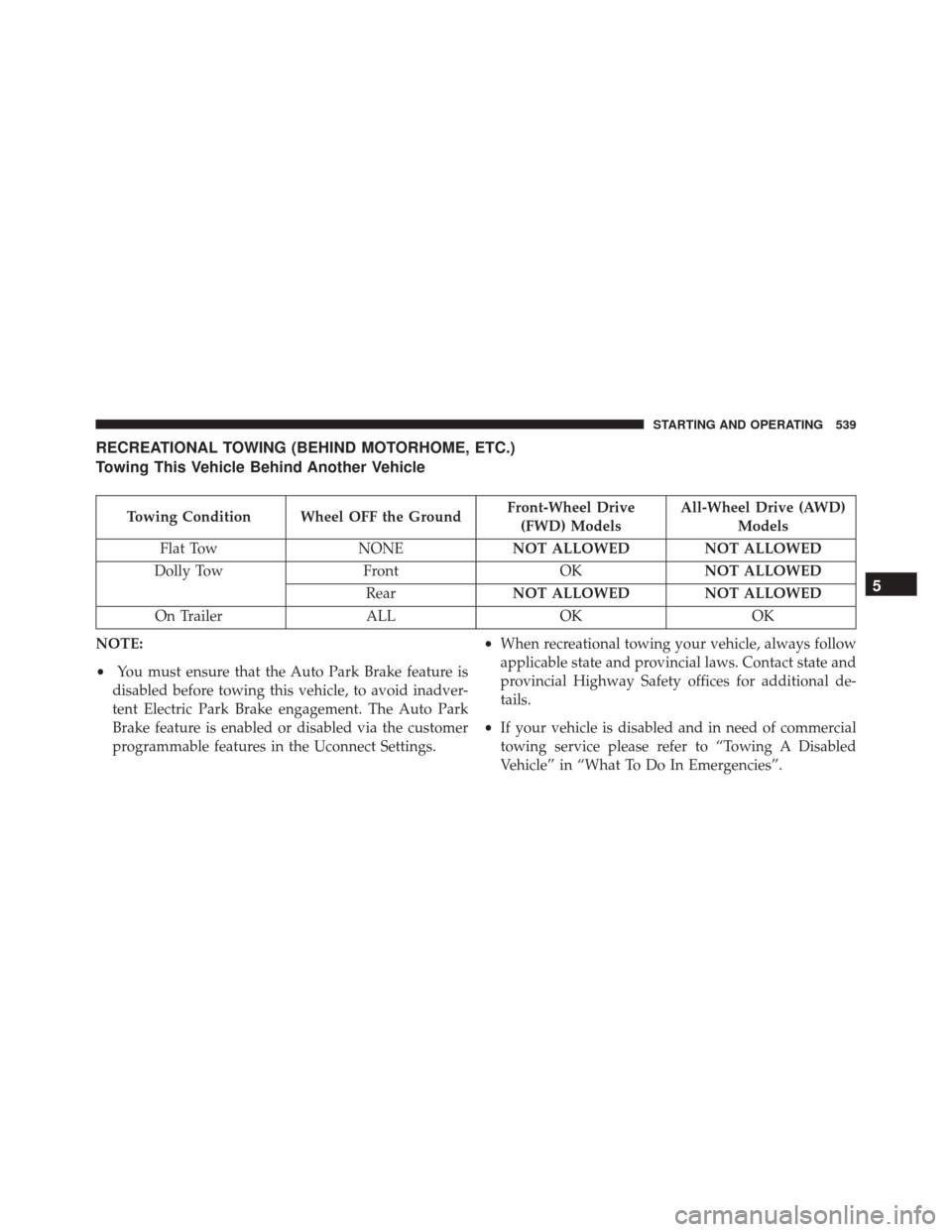
RECREATIONAL TOWING (BEHIND MOTORHOME, ETC.)
Towing This Vehicle Behind Another Vehicle
Towing Condition Wheel OFF the GroundFront-Wheel Drive
(FWD) Models All-Wheel Drive (AWD)
Models
Flat Tow NONENOT ALLOWED NOT ALLOWED
Dolly Tow FrontOKNOT ALLOWED
Rear NOT ALLOWED NOT ALLOWED
On Trailer ALLOKOK
NOTE:
• You must ensure that the Auto Park Brake feature is
disabled before towing this vehicle, to avoid inadver-
tent Electric Park Brake engagement. The Auto Park
Brake feature is enabled or disabled via the customer
programmable features in the Uconnect Settings. •
When recreational towing your vehicle, always follow
applicable state and provincial laws. Contact state and
provincial Highway Safety offices for additional de-
tails.
• If your vehicle is disabled and in need of commercial
towing service please refer to “Towing A Disabled
Vehicle” in “What To Do In Emergencies”.
5
STARTING AND OPERATING 539
Page 542 of 702
Recreational Towing — Front-Wheel Drive (FWD)
Models
DO NOTflat tow this vehicle. Damage to the drivetrain
will result.
Recreational towing for front-wheel drive models is
allowed ONLY if the front wheels are OFFthe ground.
This may be accomplished using a tow dolly or vehicle
trailer. If using a tow dolly, follow this procedure:
1. Properly secure the dolly to the tow vehicle, following the dolly manufacturer’s instructions.
2. Drive the front wheels onto the tow dolly.
3. Apply the parking brake.
4. Place the transmission in PARK.
5. Turn the engine OFF.
6. Properly secure the front wheels to the dolly, following the dolly manufacturer’s instructions. 7. Turn the ignition to the ON/RUN position, but do not
start the engine.
8. Press and hold the brake pedal.
9. Release the parking brake.
10. Turn the ignition OFF.
11. Remove the Key Fob.
12. Release the brake pedal.
CAUTION!
• DO NOT flat tow this vehicle. Damage to the
drivetrain will result. If this vehicle requires tow-
ing, make sure the drive wheels are OFF the
ground.
• Ensure that the Electric Park Brake is released, and
remains released, while being towed.
(Continued)
540 STARTING AND OPERATING
Page 543 of 702
CAUTION!(Continued)
•Towing this vehicle in violation of the above re-
quirements can cause severe transmission damage.
Damage from improper towing is not covered un-
der the New Vehicle Limited Warranty.
Recreational Towing — All-Wheel Drive (AWD)
Models
Recreational towing is not allowed. These models do
not have a NEUTRAL (N) position in the power transfer
unit.
NOTE: This vehicle may be towed on a flatbed or vehicle
trailer provided all four wheels are OFF the ground.
CAUTION!
Towing this vehicle with ANY of its wheels on the
ground can cause severe transmission and/or power
transfer unit damage. Damage from improper towing
is not covered under the New Vehicle Limited War-
ranty.
5
STARTING AND OPERATING 541
Page 545 of 702
WHAT TO DO IN EMERGENCIES
CONTENTS
�HAZARD WARNING FLASHERS ...........545
� IF YOUR ENGINE OVERHEATS ............545
� WHEEL AND TIRE TORQUE
SPECIFICATIONS ..................... .546
▫ Torque Specifications ...................546
� TIRE SERVICE KIT — IF EQUIPPED .........548
▫ Tire Service Kit Storage .................548
▫ Tire Service Kit Components And Operation . .550
▫ Tire Service Kit Usage Precautions .........550
▫ Sealing A Tire With Tire Service Kit .........553�
JACKING AND TIRE CHANGING ..........558
▫ Jack Location/Spare Tire Stowage .........559
▫ Preparations For Jacking ................560
▫ Jacking Instructions ...................561
▫ Road Tire Installation ...................569
� JUMP-STARTING PROCEDURES ...........572
▫ Preparations For Jump-Start ..............573
▫ Jump-Starting Procedure ................574
� FREEING A STUCK VEHICLE .............576
� MANUAL PARK RELEASE ................578
6
Page 546 of 702
�TOWING A DISABLED VEHICLE ...........581
▫ Front-Wheel Drive (FWD) Models .........584▫
All-Wheel Drive (AWD) Models ...........584
544 WHAT TO DO IN EMERGENCIES
Page 550 of 702
WARNING!
To avoid the risk of forcing the vehicle off the jack,
do not tighten the lug nuts fully until the vehicle has
been lowered. Failure to follow this warning may
result in personal injury.
TIRE SERVICE KIT — IF EQUIPPED
Small punctures up to ¼” (6 mm) in the tire tread can be
sealed with Tire Service Kit. Foreign objects (e.g., screws
or nails) should not be removed from the tire. Tire Service
Kit can be used in outside temperatures down to approxi-
mately -4°F (-20°C).
This kit will provide a temporary tire seal, allowing you
to drive your vehicle up to 100 miles (160 km) with a
maximum speed of 55 mph (90 km/h).
Tire Service Kit Storage
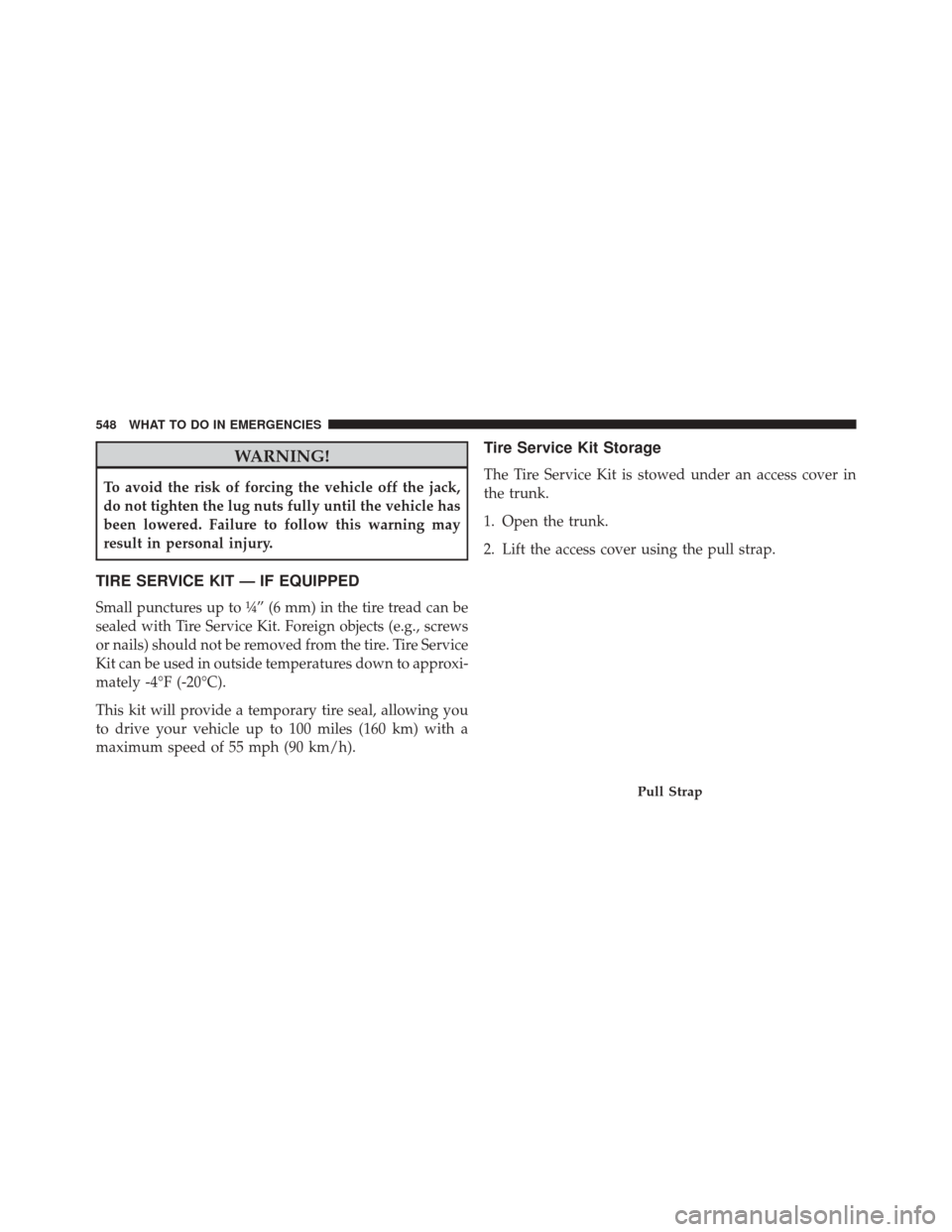
The Tire Service Kit is stowed under an access cover in
the trunk.
1. Open the trunk.
2. Lift the access cover using the pull strap.
Pull Strap
548 WHAT TO DO IN EMERGENCIES