Page 580 of 702
MANUAL PARK RELEASE
WARNING!
Always secure your vehicle by fully applying the
parking brake, before activating the Manual Park
Release. Activating the Manual Park Release will
allow your vehicle to roll away if it is not secured by
the parking brake or by proper connection to a tow
vehicle. Activating the Manual Park Release on an
unsecured vehicle could lead to serious injury or
death for those in or around the vehicle.
In order to move the vehicle in cases where the transmis-
sion will not shift out of PARK (such as a dead battery),
a Manual Park Release is available.
Follow these steps to activate the Manual Park Release:
1. Apply the parking brake. 2. Using a small screwdriver or similar tool, remove the
Manual Park Release access cover, which is under-
neath the rubber storage bin liner in the center console
pass-through.
Manual Park Release location
578 WHAT TO DO IN EMERGENCIES
Page 582 of 702
5. The vehicle is now out of PARK and can be moved.Release the parking brake only when the vehicle is
securely connected to a tow vehicle. To reset the Manual Park Release:
1. Pull the tether upwards to unlock the lever.
2. Rotate the Manual Park Release lever forward and
down to its original position.
3. Re-install the access cover and the rubber storage bin liner.
Locked Position
580 WHAT TO DO IN EMERGENCIES
Page 583 of 702
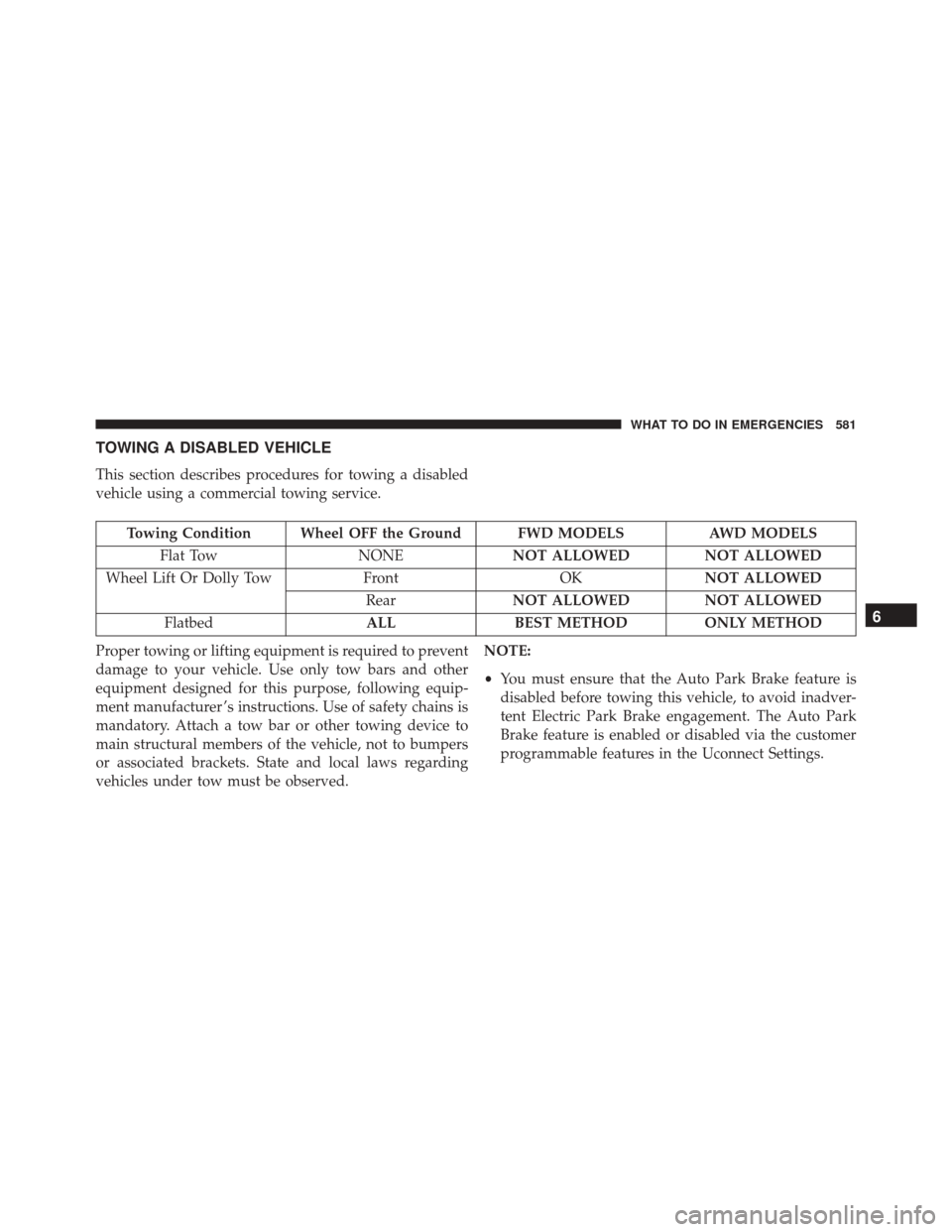
TOWING A DISABLED VEHICLE
This section describes procedures for towing a disabled
vehicle using a commercial towing service.
Towing Condition Wheel OFF the Ground FWD MODELSAWD MODELS
Flat Tow NONENOT ALLOWED NOT ALLOWED
Wheel Lift Or Dolly Tow FrontOKNOT ALLOWED
Rear NOT ALLOWED NOT ALLOWED
Flatbed ALLBEST METHOD ONLY METHOD
Proper towing or lifting equipment is required to prevent
damage to your vehicle. Use only tow bars and other
equipment designed for this purpose, following equip-
ment manufacturer ’s instructions. Use of safety chains is
mandatory. Attach a tow bar or other towing device to
main structural members of the vehicle, not to bumpers
or associated brackets. State and local laws regarding
vehicles under tow must be observed. NOTE:
•
You must ensure that the Auto Park Brake feature is
disabled before towing this vehicle, to avoid inadver-
tent Electric Park Brake engagement. The Auto Park
Brake feature is enabled or disabled via the customer
programmable features in the Uconnect Settings.
6
WHAT TO DO IN EMERGENCIES 581
Page 584 of 702
•Vehicles with a discharged battery or total electrical
failure when the electric parking brake (EPB) is en-
gaged, will need a wheel dolly or jack to raise the rear
wheels off the ground when moving the vehicle onto a
flatbed.
Vehicle Recovery Tow Points
Your vehicle is equipped with Vehicle Recovery Points
that can be used to recover a disabled vehicle, located on
the underbody of the vehicle.
NOTE:
• Ensure that the towing service tow hooks are properly
seated and secured in the attachment points.
• This recovery tow feature should be used by a trained
professional only. •
Use approved receptacle location to free the disabled
vehicle from its environment.
Front Of Vehicle Recovery Points
582 WHAT TO DO IN EMERGENCIES
Page 585 of 702
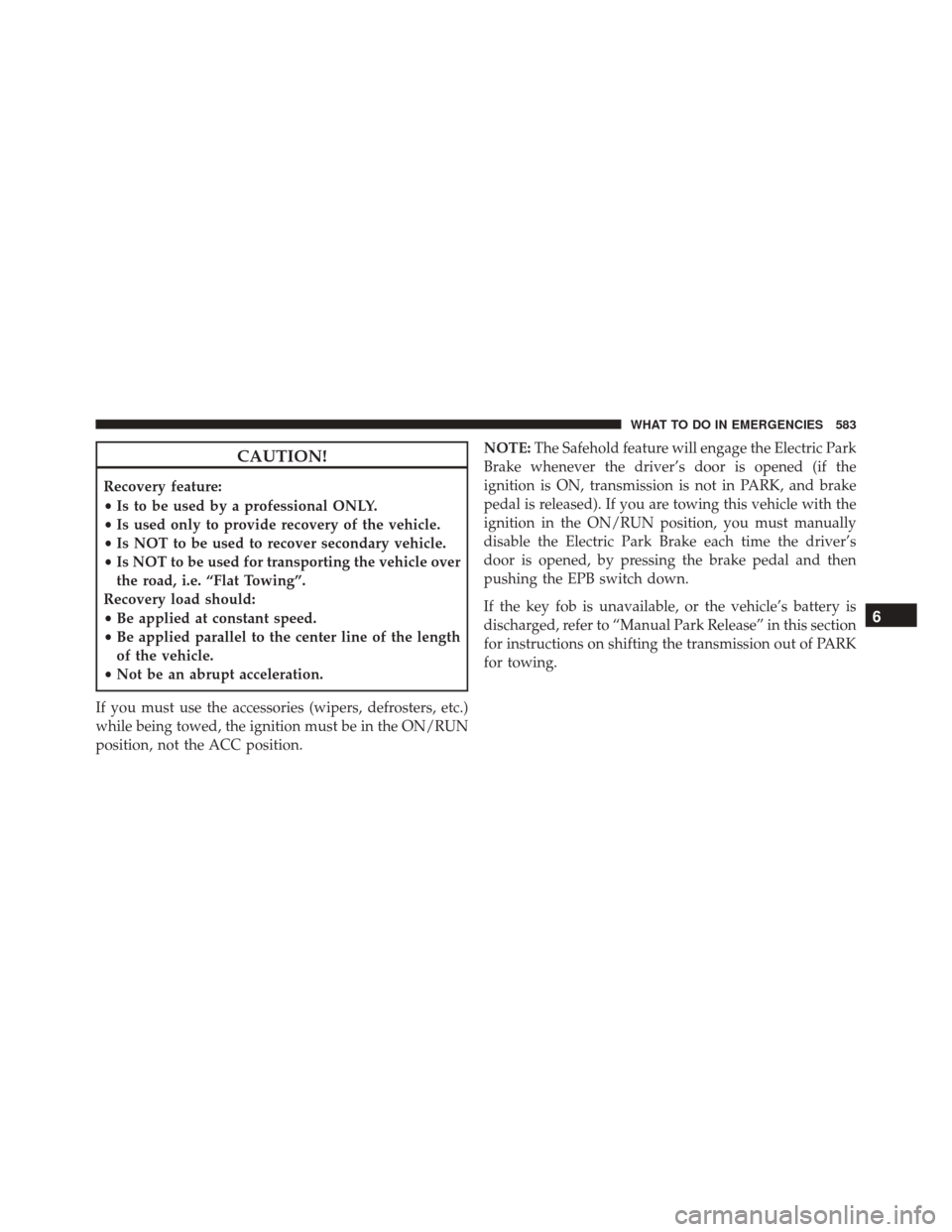
CAUTION!
Recovery feature:
•Is to be used by a professional ONLY.
• Is used only to provide recovery of the vehicle.
• Is NOT to be used to recover secondary vehicle.
• Is NOT to be used for transporting the vehicle over
the road, i.e. “Flat Towing”.
Recovery load should:
• Be applied at constant speed.
• Be applied parallel to the center line of the length
of the vehicle.
• Not be an abrupt acceleration.
If you must use the accessories (wipers, defrosters, etc.)
while being towed, the ignition must be in the ON/RUN
position, not the ACC position. NOTE:
The Safehold feature will engage the Electric Park
Brake whenever the driver’s door is opened (if the
ignition is ON, transmission is not in PARK, and brake
pedal is released). If you are towing this vehicle with the
ignition in the ON/RUN position, you must manually
disable the Electric Park Brake each time the driver’s
door is opened, by pressing the brake pedal and then
pushing the EPB switch down.
If the key fob is unavailable, or the vehicle’s battery is
discharged, refer to “Manual Park Release” in this section
for instructions on shifting the transmission out of PARK
for towing.
6
WHAT TO DO IN EMERGENCIES 583
Page 586 of 702
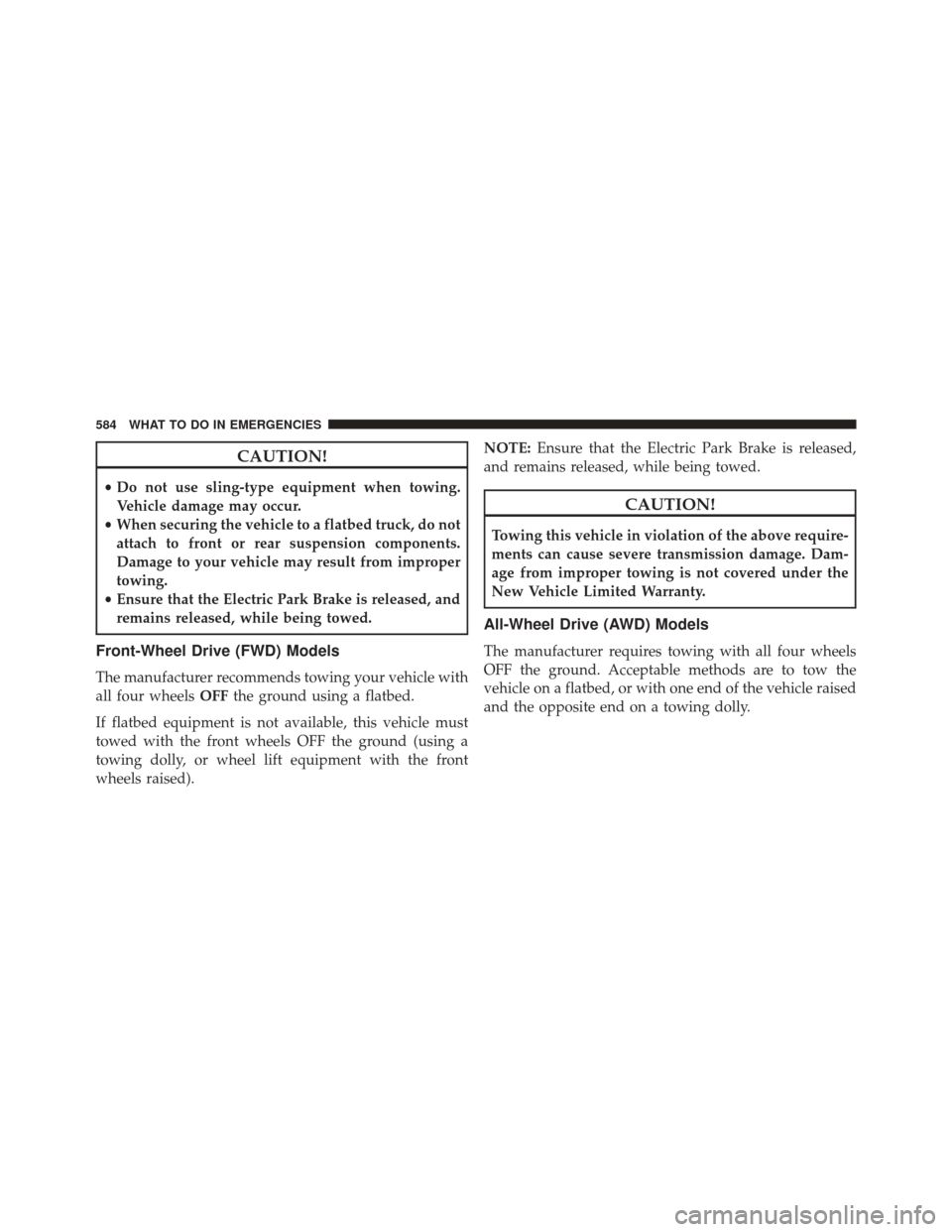
CAUTION!
•Do not use sling-type equipment when towing.
Vehicle damage may occur.
• When securing the vehicle to a flatbed truck, do not
attach to front or rear suspension components.
Damage to your vehicle may result from improper
towing.
• Ensure that the Electric Park Brake is released, and
remains released, while being towed.
Front-Wheel Drive (FWD) Models
The manufacturer recommends towing your vehicle with
all four wheels OFFthe ground using a flatbed.
If flatbed equipment is not available, this vehicle must
towed with the front wheels OFF the ground (using a
towing dolly, or wheel lift equipment with the front
wheels raised). NOTE:
Ensure that the Electric Park Brake is released,
and remains released, while being towed.
CAUTION!
Towing this vehicle in violation of the above require-
ments can cause severe transmission damage. Dam-
age from improper towing is not covered under the
New Vehicle Limited Warranty.
All-Wheel Drive (AWD) Models
The manufacturer requires towing with all four wheels
OFF the ground. Acceptable methods are to tow the
vehicle on a flatbed, or with one end of the vehicle raised
and the opposite end on a towing dolly.
584 WHAT TO DO IN EMERGENCIES
Page 587 of 702
CAUTION!
•DO NOT tow this vehicle with ANY of its wheels
on the ground. Damage to the drivetrain will result.
• Front or rear wheel lifts must not be used. Internal
damage to the transmission or power transfer unit
will occur if a front or rear wheel lift is used when
towing.
• Towing this vehicle in violation of the above re-
quirements can cause severe transmission and/or
power transfer unit damage. Damage from im-
proper towing is not covered under the New Ve-
hicle Limited Warranty.
6
WHAT TO DO IN EMERGENCIES 585
Page 593 of 702

ONBOARD DIAGNOSTIC SYSTEM — OBD II
Your vehicle is equipped with a sophisticated Onboard
Diagnostic system called OBD II. This system monitors
the performance of the emissions, engine, and automatic
transmission control systems. When these systems are
operating properly, your vehicle will provide excellent
performance and fuel economy, as well as engine emis-
sions well within current government regulations.
If any of these systems require service, the OBD II system
will turn on the Malfunction Indicator Light (MIL). It will
also store diagnostic codes and other information to
assist your service technician in making repairs. Al-
though your vehicle will usually be drivable and not
need towing, see your authorized dealer for service as
soon as possible.
CAUTION!
•Prolonged driving with the MIL on could cause
further damage to the emission control system. It
could also affect fuel economy and driveability.
The vehicle must be serviced before any emissions
tests can be performed.
• If the MIL is flashing while the engine is running,
severe catalytic converter damage and power loss
will soon occur. Immediate service is required.
Loose Fuel Filler Cap Message
If the vehicle diagnostic system determines that the fuel
filler cap is loose, improperly installed, or damaged, a
“CHECK GASCAP” message will be displayed in the
Electronic Vehicle Information Center (EVIC) or Driver
Information Display (DID). Refer to “Electronic Vehicle
Information (EVIC) or �Driver Information Display
(DID)” in “Understanding Your Instrument Panel” for
7
MAINTAINING YOUR VEHICLE 591