2016 CHEVROLET MALIBU stop start
[x] Cancel search: stop startPage 276 of 420
Chevrolet Malibu Owner Manual (GMNA-Localizing-U.S./Canada/Mexico-
9087641) - 2016 - crc - 9/3/15
Driving and Operating 275
When towing a trailer, the arrows on
the instrument cluster flash for turns
even if the bulbs on the trailer are
burned out. Check occasionally to
be sure the trailer bulbs are still
working.
Driving on Grades
Reduce speed and shift to a lower
gear before starting down a long or
steep downgrade. If the
transmission is not shifted down, the
brakes might have to be used so
much that they would get hot and no
longer work well.
The vehicle can tow in D (Drive).
Use a lower gear if the transmission
shifts too often.
When towing at high altitude on
steep uphill grades, engine coolant
boils at a lower temperature than at
normal altitudes. If the engine is
turned off immediately after towing
at high altitude on steep uphill
grades, the vehicle could show
signs similar to engine overheating.
To avoid this, let the engine run
while parked, preferably on level
ground, with the transmission in
P (Park) for a few minutes beforeturning the engine off. If the
overheat warning comes on, see
Engine Overheating
0298
ii.
Parking on Hills
{Warning
Parking the vehicle on a hill with
the trailer attached can be
dangerous. If something goes
wrong, the rig could start to move.
People can be injured, and both
the vehicle and the trailer can be
damaged. When possible, always
park the rig on a flat surface.
If parking the rig on a hill: 1. Press the brake pedal, but do not shift into P (Park) yet. Turn
the wheels into the curb if
facing downhill or into traffic if
facing uphill.
2. Have someone place chocks under the trailer wheels.
3. When the wheel chocks are in place, release the brake pedal
until the chocks absorb
the load. 4. Reapply the brake pedal. Then
apply the parking brake and
shift into P (Park).
5. Release the brake pedal.
Leaving After Parking on a Hill
1. Apply and hold the brake pedal while you:
1.1. Start the engine.
1.2. Shift into a gear.
1.3. Release the parking brake.
2. Let up on the brake pedal.
3. Drive slowly until the trailer is clear of the chocks.
4. Stop and have someone pick up and store the chocks.
Maintenance When Trailer
Towing
The vehicle needs service more
often when pulling a trailer. See the
Maintenance Schedule 0368
ii.
Things that are especially important
in trailer operation are automatic
transmission fluid, engine oil, axle
Page 280 of 420
Chevrolet Malibu Owner Manual (GMNA-Localizing-U.S./Canada/Mexico-
9087641) - 2016 - crc - 9/3/15
Vehicle Care 279
Vehicle Care
General Information
General Information . . . . . . . . . . 280
California Proposition65 Warning . . . . . . . . . . . . . . . . . 280
California Perchlorate Materials Requirements . . . . . 280
Accessories and Modifications . . . . . . . . . . . . . . . . 280
Vehicle Checks
Doing Your OwnService Work . . . . . . . . . . . . . . . 281
Hood . . . . . . . . . . . . . . . . . . . . . . . . . 282
Engine Compartment Overview . . . . . . . . . . . . . . . . . . . . 284
Engine Oil . . . . . . . . . . . . . . . . . . . . 289
Engine Oil Life System . . . . . . . 291
Automatic Transmission Fluid . . . . . . . . . . . . . . . . . . . . . . . . 293
Engine Air Cleaner/Filter . . . . . . 293
Cooling System (Engine) . . . . . 294
Cooling System (Power Electronics) . . . . . . . . . . . . . . . . . 295
Engine Coolant . . . . . . . . . . . . . . . 296
Engine Overheating . . . . . . . . . . 298
Washer Fluid . . . . . . . . . . . . . . . . . 300
Brakes . . . . . . . . . . . . . . . . . . . . . . . 300
Brake Fluid . . . . . . . . . . . . . . . . . . . 301 Battery - North America . . . . . . 302
Starter Switch Check . . . . . . . . . 304
Automatic Transmission Shift
Lock Control Function
Check . . . . . . . . . . . . . . . . . . . . . . . 304
Park Brake and P (Park) Mechanism Check . . . . . . . . . . 304
Wiper Blade Replacement . . . . 305
Headlamp Aiming
Headlamp Aiming . . . . . . . . . . . . 306
Bulb Replacement
Bulb Replacement . . . . . . . . . . . . 306
Halogen Bulbs . . . . . . . . . . . . . . . . 306
LED Lighting . . . . . . . . . . . . . . . . . 306
Headlamps, Front Turn Signal, Sidemarker, and Parking
Lamps . . . . . . . . . . . . . . . . . . . . . . 306
Taillamps, Turn Signal, Stoplamps, and Back-Up
Lamps (LS and LT) . . . . . . . . . . 307
Taillamps, Turn Signal, Stoplamps, and Back-Up
Lamps (LTZ) . . . . . . . . . . . . . . . . 308
License Plate Lamp . . . . . . . . . . 309
Replacement Bulbs . . . . . . . . . . . 310
Electrical System
High Voltage Devices and Wiring . . . . . . . . . . . . . . . . . . . . . . . 310
Electrical System Overload . . . 310 Fuses . . . . . . . . . . . . . . . . . . . . . . . . . 311
Engine Compartment Fuse
Block . . . . . . . . . . . . . . . . . . . . . . . . 312
Instrument Panel Fuse Block . . . . . . . . . . . . . . . . . . . . . . . . 316
Wheels and Tires
Tires . . . . . . . . . . . . . . . . . . . . . . . . . . 318
All-Season Tires . . . . . . . . . . . . . . 319
Winter Tires . . . . . . . . . . . . . . . . . . 319
Summer Tires . . . . . . . . . . . . . . . . 320
Tire Sidewall Labeling . . . . . . . . 320
Tire Designations . . . . . . . . . . . . . 322
Tire Terminology and
Definitions . . . . . . . . . . . . . . . . . . 323
Tire Pressure . . . . . . . . . . . . . . . . . 325
Tire Pressure for High-Speed Operation . . . . . . . . . . . . . . . . . . . 326
Tire Pressure Monitor System . . . . . . . . . . . . . . . . . . . . . . 327
Tire Pressure Monitor Operation . . . . . . . . . . . . . . . . . . . 328
Tire Inspection . . . . . . . . . . . . . . . . 331
Tire Rotation . . . . . . . . . . . . . . . . . 331
When It Is Time for New Tires . . . . . . . . . . . . . . . . . . . . . . . . 332
Buying New Tires . . . . . . . . . . . . . 333
Different Size Tires and Wheels . . . . . . . . . . . . . . . . . . . . . . 334
Uniform Tire Quality Grading . . . . . . . . . . . . . . . . . . . . . 335
Page 299 of 420
Chevrolet Malibu Owner Manual (GMNA-Localizing-U.S./Canada/Mexico-
9087641) - 2016 - crc - 9/3/15
298 Vehicle Care
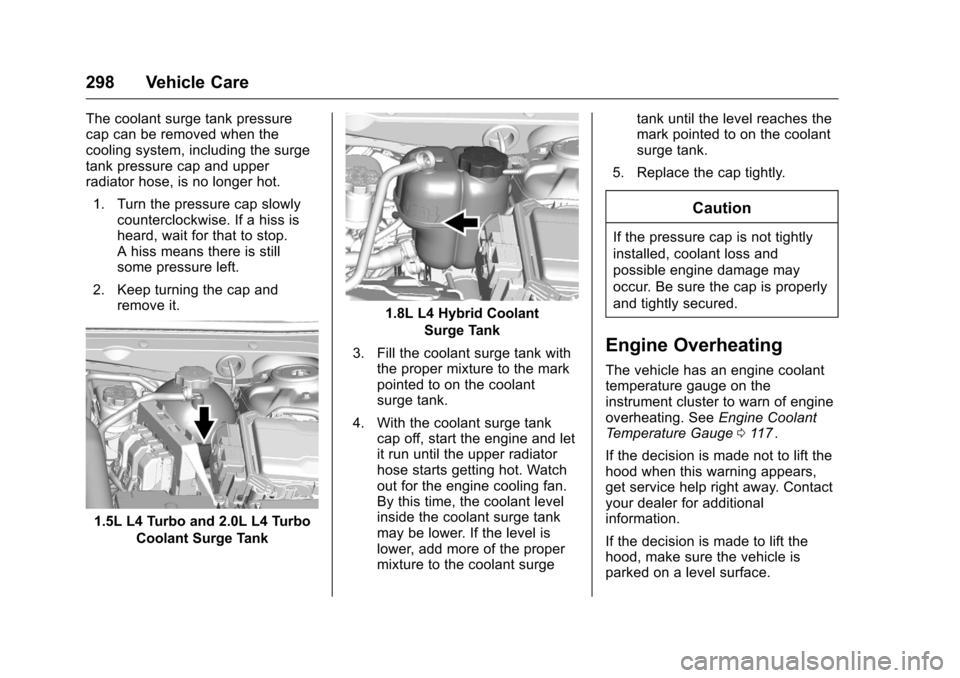
The coolant surge tank pressure
cap can be removed when the
cooling system, including the surge
tank pressure cap and upper
radiator hose, is no longer hot.1. Turn the pressure cap slowly counterclockwise. If a hiss is
heard, wait for that to stop.
A hiss means there is still
some pressure left.
2. Keep turning the cap and remove it.
1.5L L4 Turbo and 2.0L L4 Turbo
Coolant Surge Tank
1.8L L4 Hybrid CoolantSurge Tank
3. Fill the coolant surge tank with the proper mixture to the mark
pointed to on the coolant
surge tank.
4. With the coolant surge tank cap off, start the engine and let
it run until the upper radiator
hose starts getting hot. Watch
out for the engine cooling fan.
By this time, the coolant level
inside the coolant surge tank
may be lower. If the level is
lower, add more of the proper
mixture to the coolant surge tank until the level reaches the
mark pointed to on the coolant
surge tank.
5. Replace the cap tightly.
Caution
If the pressure cap is not tightly
installed, coolant loss and
possible engine damage may
occur. Be sure the cap is properly
and tightly secured.
Engine Overheating
The vehicle has an engine coolant
temperature gauge on the
instrument cluster to warn of engine
overheating. See Engine Coolant
Temperature Gauge 0117
ii.
If the decision is made not to lift the
hood when this warning appears,
get service help right away. Contact
your dealer for additional
information.
If the decision is made to lift the
hood, make sure the vehicle is
parked on a level surface.
Page 304 of 420
Chevrolet Malibu Owner Manual (GMNA-Localizing-U.S./Canada/Mexico-
9087641) - 2016 - crc - 9/3/15
Vehicle Care 303
{Warning
Damage to the high voltage
battery or high voltage system
can create a risk of electric shock,
overheating, or fire.
If the vehicle is damaged from a
moderate to severe crash, flood,
fire, or other event, the vehicle
should be inspected as soon as
possible. Until the vehicle has
been inspected, store it outside at
least 15 m (50 ft) from any
structure or anything that can
burn. Ventilate the vehicle by
opening a window or a door.
Contact Customer Assistance as
soon as possible to determine
whether an inspection is needed.
SeeCustomer Assistance Offices
0 386
ii. Stop/Start System
If equipped with the 1.5L L4 engine,
the vehicle has a stop/start system
to shut off the engine to help
conserve fuel. See
Starting the
Engine 0228
ii.
Vehicles with a 1.5L engine have an
Absorbed Glass Mat (AGM) 12-volt
battery. Installation of a standard
12-volt battery will result in reduced
12-volt battery life.
When using a 12-volt battery
charger on the 12-volt AGM battery,
some chargers have an AGM
battery setting on the charger.
If available, use the AGM setting on
the charger, to limit charge voltage
to 14.8 volts.
{Warning
WARNING: Battery posts,
terminals, and related
accessories contain lead and lead
compounds, chemicals known to
the State of California to cause
cancer and birth defects or other
(Continued)
Warning (Continued)
reproductive harm. Batteries also
contain other chemicals known to
the State of California to cause
cancer.WASH HANDS AFTER
HANDLING. SeeCalifornia
Proposition 65 Warning 0280
ii.
Vehicle Storage
{Warning
Batteries have acid that can burn
you and gas that can explode.
You can be badly hurt if you are
not careful. See Jump Starting -
North America 0352
iifor tips on
working around a battery without
getting hurt.
Infrequent Usage: Remove the
12-volt battery black, negative (−)
cable from the battery to keep the
battery from running down.
Page 312 of 420
Chevrolet Malibu Owner Manual (GMNA-Localizing-U.S./Canada/Mexico-
9087641) - 2016 - crc - 9/3/15
Vehicle Care 311
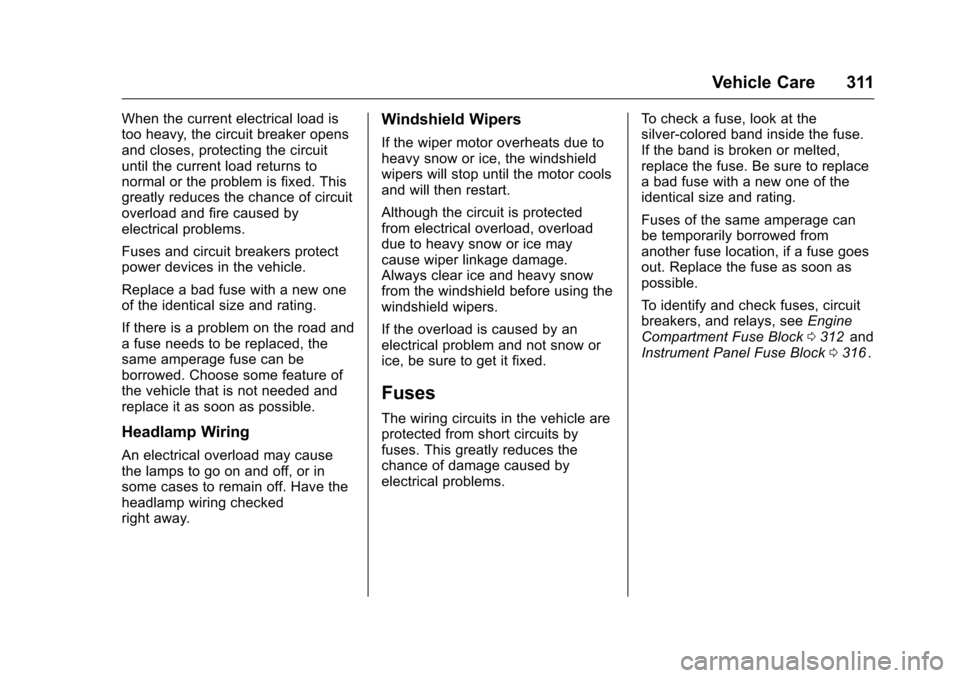
When the current electrical load is
too heavy, the circuit breaker opens
and closes, protecting the circuit
until the current load returns to
normal or the problem is fixed. This
greatly reduces the chance of circuit
overload and fire caused by
electrical problems.
Fuses and circuit breakers protect
power devices in the vehicle.
Replace a bad fuse with a new one
of the identical size and rating.
If there is a problem on the road and
a fuse needs to be replaced, the
same amperage fuse can be
borrowed. Choose some feature of
the vehicle that is not needed and
replace it as soon as possible.
Headlamp Wiring
An electrical overload may cause
the lamps to go on and off, or in
some cases to remain off. Have the
headlamp wiring checked
right away.
Windshield Wipers
If the wiper motor overheats due to
heavy snow or ice, the windshield
wipers will stop until the motor cools
and will then restart.
Although the circuit is protected
from electrical overload, overload
due to heavy snow or ice may
cause wiper linkage damage.
Always clear ice and heavy snow
from the windshield before using the
windshield wipers.
If the overload is caused by an
electrical problem and not snow or
ice, be sure to get it fixed.
Fuses
The wiring circuits in the vehicle are
protected from short circuits by
fuses. This greatly reduces the
chance of damage caused by
electrical problems.To check a fuse, look at the
silver-colored band inside the fuse.
If the band is broken or melted,
replace the fuse. Be sure to replace
a bad fuse with a new one of the
identical size and rating.
Fuses of the same amperage can
be temporarily borrowed from
another fuse location, if a fuse goes
out. Replace the fuse as soon as
possible.
To identify and check fuses, circuit
breakers, and relays, see
Engine
Compartment Fuse Block 0312
iiand
Instrument Panel Fuse Block 0316ii.
Page 318 of 420
Chevrolet Malibu Owner Manual (GMNA-Localizing-U.S./Canada/Mexico-
9087641) - 2016 - crc - 9/3/15
Vehicle Care 317
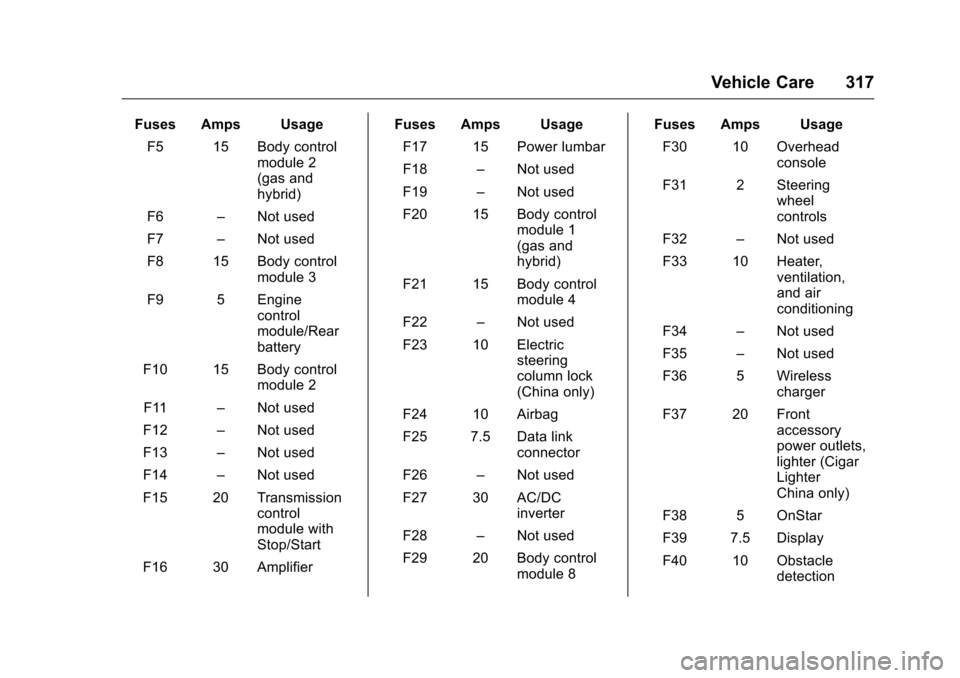
Fuses Amps UsageF5 15 Body control module 2
(gas and
hybrid)
F6 –Not used
F7 –Not used
F8 15 Body control module 3
F9 5 Engine control
module/Rear
battery
F10 15 Body control module 2
F11 –Not used
F12 –Not used
F13 –Not used
F14 –Not used
F15 20 Transmission control
module with
Stop/Start
F16 30 Amplifier Fuses Amps Usage
F17 15 Power lumbar
F18 –Not used
F19 –Not used
F20 15 Body control module 1
(gas and
hybrid)
F21 15 Body control module 4
F22 –Not used
F23 10 Electric steering
column lock
(China only)
F24 10 Airbag
F25 7.5 Data link connector
F26 –Not used
F27 30 AC/DC inverter
F28 –Not used
F29 20 Body control module 8 Fuses Amps Usage
F30 10 Overhead console
F31 2 Steering wheel
controls
F32 –Not used
F33 10 Heater, ventilation,
and air
conditioning
F34 –Not used
F35 –Not used
F36 5 Wireless charger
F37 20 Front accessory
power outlets,
lighter (Cigar
Lighter
China only)
F38 5 OnStar
F39 7.5 Display
F40 10 Obstacle detection
Page 319 of 420
Chevrolet Malibu Owner Manual (GMNA-Localizing-U.S./Canada/Mexico-
9087641) - 2016 - crc - 9/3/15
318 Vehicle Care
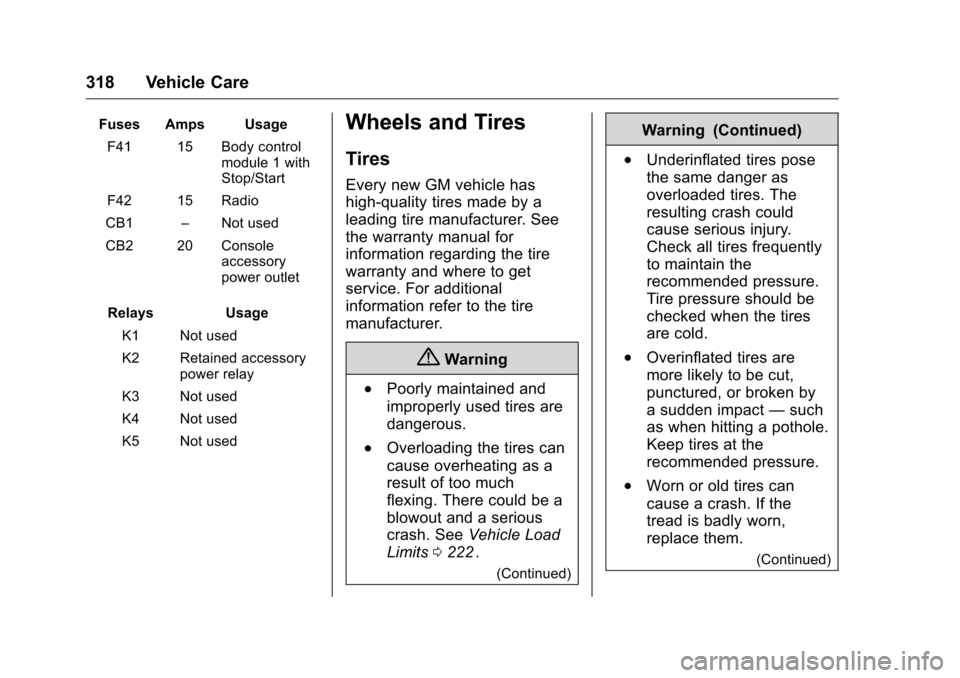
Fuses Amps UsageF41 15 Body control module 1 with
Stop/Start
F42 15 Radio
CB1 –Not used
CB2 20 Console accessory
power outlet
Relays Usage K1 Not used
K2 Retained accessory power relay
K3 Not used
K4 Not used
K5 Not usedWheels and Tires
Tires
Every new GM vehicle has
high-quality tires made by a
leading tire manufacturer. See
the warranty manual for
information regarding the tire
warranty and where to get
service. For additional
information refer to the tire
manufacturer.
{Warning
.Poorly maintained and
improperly used tires are
dangerous.
.Overloading the tires can
cause overheating as a
result of too much
flexing. There could be a
blowout and a serious
crash. See Vehicle Load
Limits 0222
ii.
(Continued)
Warning (Continued)
.Underinflated tires pose
the same danger as
overloaded tires. The
resulting crash could
cause serious injury.
Check all tires frequently
to maintain the
recommended pressure.
Tire pressure should be
checked when the tires
are cold.
.Overinflated tires are
more likely to be cut,
punctured, or broken by
a sudden impact —such
as when hitting a pothole.
Keep tires at the
recommended pressure.
.Worn or old tires can
cause a crash. If the
tread is badly worn,
replace them.
(Continued)
Page 329 of 420
Chevrolet Malibu Owner Manual (GMNA-Localizing-U.S./Canada/Mexico-
9087641) - 2016 - crc - 9/3/15
328 Vehicle Care
Your vehicle has also been
equipped with a TPMS malfunction
indicator to indicate when the
system is not operating properly.
The TPMS malfunction indicator is
combined with the low tire pressure
telltale. When the system detects a
malfunction, the telltale will flash for
approximately one minute and then
remain continuously illuminated.
This sequence will continue upon
subsequent vehicle start-ups as
long as the malfunction exists.
When the malfunction indicator is
illuminated, the system may not be
able to detect or signal low tire
pressure as intended. TPMS
malfunctions may occur for a variety
of reasons, including the installation
of replacement or alternate tires or
wheels on the vehicle that prevent
the TPMS from functioning properly.
Always check the TPMS malfunction
telltale after replacing one or more
tires or wheels on your vehicle to
ensure that the replacement or
alternate tires and wheels allow the
TPMS to continue to function
properly.See
Tire Pressure Monitor
Operation 0328ii.
See Radio Frequency Statement
0 394
ii.
Tire Pressure Monitor
Operation
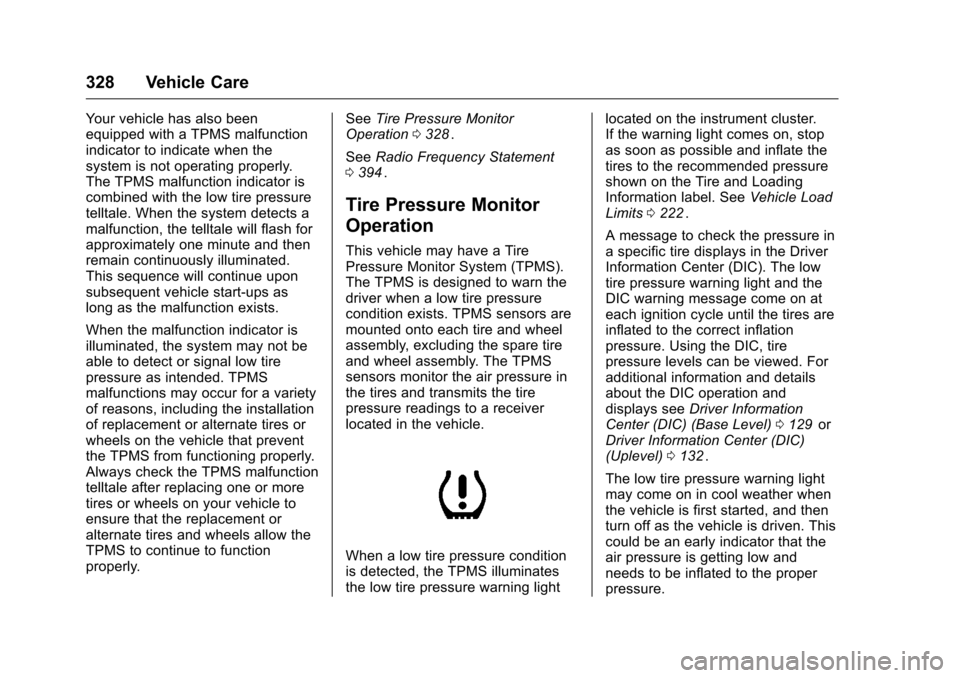
This vehicle may have a Tire
Pressure Monitor System (TPMS).
The TPMS is designed to warn the
driver when a low tire pressure
condition exists. TPMS sensors are
mounted onto each tire and wheel
assembly, excluding the spare tire
and wheel assembly. The TPMS
sensors monitor the air pressure in
the tires and transmits the tire
pressure readings to a receiver
located in the vehicle.
When a low tire pressure condition
is detected, the TPMS illuminates
the low tire pressure warning light located on the instrument cluster.
If the warning light comes on, stop
as soon as possible and inflate the
tires to the recommended pressure
shown on the Tire and Loading
Information label. See
Vehicle Load
Limits 0222
ii.
A message to check the pressure in
a specific tire displays in the Driver
Information Center (DIC). The low
tire pressure warning light and the
DIC warning message come on at
each ignition cycle until the tires are
inflated to the correct inflation
pressure. Using the DIC, tire
pressure levels can be viewed. For
additional information and details
about the DIC operation and
displays see Driver Information
Center (DIC) (Base Level) 0129
iior
Driver Information Center (DIC)
(Uplevel) 0132
ii.
The low tire pressure warning light
may come on in cool weather when
the vehicle is first started, and then
turn off as the vehicle is driven. This
could be an early indicator that the
air pressure is getting low and
needs to be inflated to the proper
pressure.