2016 AUDI RS7 SPORTBACK ECU
[x] Cancel search: ECUPage 176 of 282

Child safety
Please remember that the lower anchorage
points are only intended for installation and at
tachment of child restraints specifically certified
for use with
LATCH lower anchorages. Child re
straints that are not equipped with the lower an
chorage attachments can still be installed in
compliance with the child restraint manufactur
er's instructions on using vehicle safety belts .
A WARNING
Improper use of LATCH lower anchorages can
cause serious personal injury in an accident.
- Always carefully follow the child restraints
manufacturer's instructions for proper in
stallation of the child restraint and proper
use of the lower anchorages or safety belts
in your vehicle.
- Never secure or attach any luggage or other
items to the
LATCH lower anchorages.
- Always read and heed the important infor
mation about child restraints in this chapter
and WARNINGS
¢ page 159, Child safety.
Installing a child restraint with LATCH
lower anchorages
Whenever you install a child restraint always fol
low the child restraint manufacturer 's instruc
tions.
Fig. 172 Lowe r an ch orages : proper mou nting
Mounting
.,. Make sure the seatback of the rear seat bench
is in the upright position and securely latched
in place .
.. Attach both hook-on connectors with the spring
catch release on the child safety seat onto the
174
LATCH lower anchorage so that the connectors
lock into place
¢ fig. 172.
.. Pull on the connector attachments to make
sure they are properly attached to the LATCH
lower anchorage.
.. Pull straps tight following the child restraint
manufacturer's instructions.
Releasing
.. Loosen the tension on the straps following the
child restraint manufacturer's instructions.
.. Depress the spring catches to release the an
chorage hooks from the lower anchorages .
Remember: Use tether straps to help keep the
child restraint firmly in place.
A WARNING
-
Improper use of the LATCH system can in
crease the risk of serious personal injury and
death in an accident .
- These anchors were developed only for child safety seats using the "LATCH" system.
- Never attach other child safety seats, belts
or other objects to these anchors .
- Always make sure that you hear a click when
latching the seat in place. If you do not hear
a click the seat is not secure and could fly
forward and hit the interior of the vehicle,
or be ejected from the vehicle.
A WARNING
Improper installation of child restraints will
increase the risk of injury in an accident.
- Always follow the child restraint system
manufacturer's instructions for proper in
stallation of the child restraint system and
proper use of tether straps as well as the lower anchorages or safety belts in your ve
hicle.
- Always read and heed the important infor
mation and WARNINGS about child safety
and the installation of child restraint sys
tems
¢ page 159, Child safety.
-
Page 177 of 282
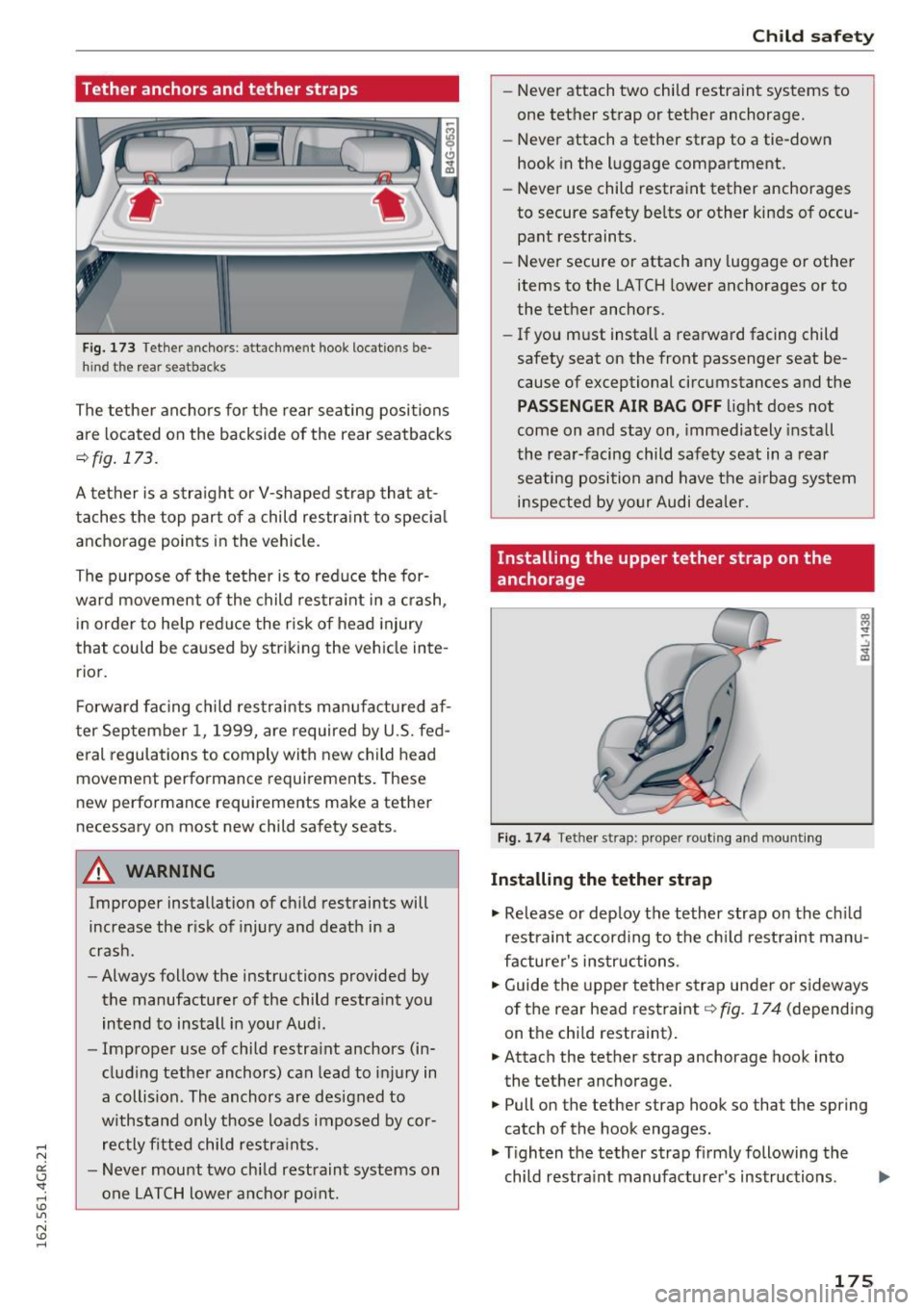
Tether anchors and tether straps
Fig. 173 Te the r ancho rs: att achm ent hook locatio ns be
hi nd the rea r seatbacks
The tether anchors for the rear seating positions
are located on the backside of the rear seatbacks
¢ fig. 173.
A tether is a stra ight or V-shaped strap that at
taches the top part of a child restra int to special
anchorage points in the vehicle .
The purpose of the tether is to reduce the for
ward movement of the child restra int in a crash,
in order to he lp red uce the risk of head injury
that could be caused by striking the veh icle inte
rio r.
F orwa rd facing ch ild restraints manufactured af
ter September 1, 1999, are required by U.S. fed
eral regulations to comply with new child head movement performance requirements. These
new perfo rmance requirements make a tether
necessary on most new child safety seats .
A WARNING
Improper installation of child restraints will
increase the r isk of injury and death in a
crash .
- Always follow the instructions provided by
the manufacturer of the child restra int you
intend to install in your Aud i.
- Improper use of child restra int anchors (in
cluding tether anchors) can lead to injury in
a collision . The anchors are designed to
withstand only those lo ads imposed by cor
rectly fitted child restra ints.
- Never mou nt two chi ld restraint systems on
one LATCH lower a nchor po int.
Ch ild sa fety
- Never attach two child restraint systems to
one tether strap or tether anchorage.
- Never attach a tether strap to a tie-down
hook in the luggage compartment.
- Never use child restraint tether anchorages
to secure safety be lts or other kinds of occu
pant restraints.
- Never secure or attach any luggage or other
items to the LATCH lower anchorages or to
the tether anchors.
- If you must install a rearward facing child
safety seat on the front passenger seat be
cause of exceptional circumstances and the
PAS SEN GER AIR BAG OFF light does not
come on and stay on, immediately install
the rear-facing child safety seat in a rear seating position and have the a irbag system
inspected by your Audi dealer.
Installing the upper tether strap on the
anchorage
Fig . 1 74 Tet her strap : p roper rout ing and mount ing
Installing the tether st rap
... Re lease or dep loy t he tether strap on the ch ild
restraint according to the ch ild restraint manu
facture r's ins tructions .
... Guide the upper tether strap under or s ideways
of the rear head rest raint
q fig . 174 (dependi ng
on the chi ld restraint) .
... Attach the tether strap ancho rage hook into
the tether anchorage.
... Pull on the tether strap hook so that the spring
catch of the hook engages .
.,. Tighten the tether strap fi rm ly following the
child restra int manufacture r's instructions.
175
Page 206 of 282

Checking and Filling
-Do not remove the engine cover under any
circumstances . This increases the risk of
burns.
- If work on the fuel system or the electrical
system is necessary:
- Always disconnect the battery.
- Never smoke or work near heaters or open
flames . Fluids in the engine compartment
could start a fire.
- Keep an approved fire extinguisher imme
diately available .
- To avoid electrical shock and personal injury
while the engine is running or being started,
never touch:
- Ignition cables
- Other components of the high voltage
electronic ignition system.
- If you must perform a check or repair with
the engine running:
- First, fully apply the parking brake, move
selector lever to P (Park) .
- Always use extreme caution to prevent
clothing, jewelry, or long hair from get
ting caught in the radiator fan, V -belts or
other moving parts, or from contacting
hot parts. Tie back hair before starting,
and do not wear clothing that will hang or
droop into the engine.
- Minimize exposure to emission and chemi
cal hazards
,=:, .&. -
A WARNING
California Proposition 65 Warning:
- Engine exhaust, some of its constituents,
and certain vehicle components contain or
emit chemicals known to the State of Cali
fornia to cause cancer and birth defects and
reproductive harm. In addition, certain flu
ids contained in vehicles and certain prod
ucts of component wear contain or emit
204
chemicals known to the State of California
to cause cancer and birth defects or other
reproductive harm .
- Battery posts, terminals and related acces
sories contain lead and lead compounds,
chemicals known to the State of California
to cause cancer and reproductive harms .
Wash hands after handling.
(D Note
When adding fluids, always make sure that
they are poured into the proper container or
filler opening, otherwise serious damage to
vehicle systems will occur.
@ For the sake of the environment
To detect leaks in time, inspect the vehicle
floor pan from underneath regularly . If you
see spots from oil or other vehicle fluids, have
your vehicle inspected by an authorized Audi
dealer.
Closing the engine hood
.,. Pull the hood down until the pressure from the
struts is reduced.
.,. Let the hood
drop down and latch in place. Do
not try to push it shut;
it may fail to engage
¢ _& .
A WARNING
A hood that is not completely latched could
fly up and block your view while driving .
- When you close the engine hood, check it to
make sure the safety catch has properly en
gaged . The hood should be flush with the
surrounding vehicle body parts.
- If you notice while driving that the hood is
not secured properly, stop at once and close it .
-
Page 209 of 282

diagnosed. Keep in mind that the accurate
measurement of oil consumption requires
great care and may take some time. Your
Audi dealer has instructions about how to measure oil consumption accurately.
Checking the engine oil level
The engine oil level con be checked in the Info
tainment system
Fig. 184 Infotainment: oil level indicator
~ Park your vehicle on a level surface .
~ Shut the engine off when it is warm .
~ Switch only the ignition back on.
~ Wait approximately two minutes.
~ Select: the ICARI function button > (Ca r)* Sys
tems
control button > Service & control > Oil
level.
~ Check the oil level in the Infotainment system
display ¢
fig. 184. Add engine oil if the bar of
the oil level indicator is near "min"
¢page 207.
Depending on the way the vehicle is driven and
the operating conditions, oil consumption can be
up to 1 quart per 600 miles (0.8 liter per 1,000
km) . Consumpt ion may be higher within the first
3,000 miles (5,000 km).
Because of this, the engine oil level must be
checked regularly . It would be best to check each
time you refuel your veh icle and before long
drives .
(D Tips
The oil level indicator in the instrument clus
ter display is only an informational display. If
the oil level is too low, a minimum oil warn ing
Checking and Filling
appears in the instrument cluster. Add oil. If
the hood was opened, the current oil level is
shown in the instrument cluster the next t ime
the ignition is switched on.
Adding engine oil 9:::7:
Fig. 185 E ngine compar tmen t: cover on the engine oil fill
er neck
Before you check anything in the engine compart
ment,
always read and heed all WARNINGS
¢.,&. in Working in the engine compartment on
page 203 .
~ Shut the engine off .
~ Unscrew the cap~ to the engine oil filling
hole
q fig . 185, ¢page 205, fig. 183 .
~ Carefully top off with 0.5 quarts (0.5 liters) of
the appropriate oil
q page 205.
~ Check the oil level again after two minutes
q page 207, Checking the engine oil level.
~ Top off the oil again, if necessary.
~ Screw the cap back on the filling hole.
A WARNING
--While topping off, the o il must not come in
contact with hot engine parts - fire hazard!
- The oil filler cap must be properly secured
to prevent oil from being sprayed on the hot
engine and exhaust system when the engine
is running -fire hazard!
- If your skin has come in contact with the en
g in e oil, you must subsequently cleanse it
thoroughly.
(D Note
- Check the oil level using the M MI. If the
message
Please reduce oil level appears,
contact your authorized Aud i dea ler or other .,.
207
Page 241 of 282
Emergency assistance
Equipment
Warning triangle
Applies to: ve hicles with warning triangle
D
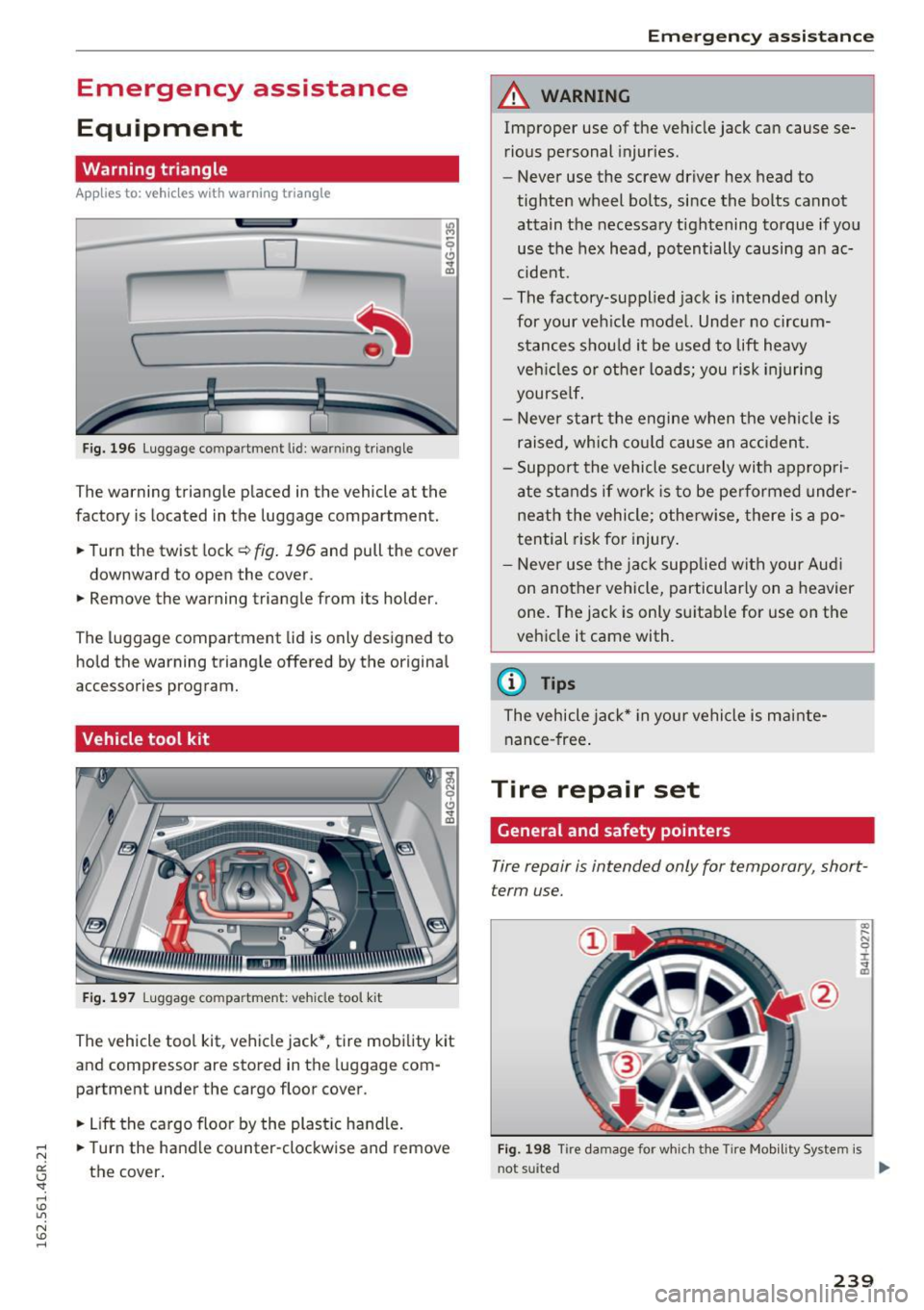
Fig. 196 Luggage co mpa rtment lid : w arnin g tria ngle
The warning triangle placed in the vehicle at the
factory is located in the luggage compartment.
• Turn the twist lock ¢
fig. 196 and pull the cover
downward to open the cover .
• Remove the warning triangle from its holder.
The luggage compartment lid is only designed to hold the warning triang le offered by the original
accessories program.
Vehicle tool kit
F ig. 197 Luggage co mpa rtment : veh icle tool kit
The vehicle tool kit , vehicle jack*, tire mobi lity kit
and compressor are stored in the luggage com
partment under the cargo floor cover .
• Lift the cargo floor by the plastic handle.
• Turn the handle counter-clockwise and remove
the cover .
Emergen cy a ssis tanc e
A WARNING
-Improper use of the veh icle jack can cause se-
rious pe rsonal injuries.
- Never use the screw driver hex head to
tighten wheel bolts, since the bolts cannot
attain the necessary tightening torque if you
use the hex head, potentially causing an ac
cident.
- The factory-supplied jack is intended only
for your veh icle model. Under no circum
stances s hou ld it be used to lift heavy
veh icles o r othe r loads; you risk in juring
yourse lf .
- Neve r start the engine when the ve hicle is
raised, which co uld cause an acciden t.
- Support the vehicle securely with appropri
ate stands if work is to be pe rformed under
neath the vehicle; otherwise, there is a po
t ential risk for injury .
- Neve r use the ja ck supplied w ith your Aud i
on anot her vehicle, particularly on a heavier
one. The jack is only s uitable for use on the
vehicle it came with.
(D Tips
The vehicle jack* in your vehicle is m ainte
nance -free .
Tire repair set
General and safety pointers
Tire repair is intended only for temporary, short
term use.
F ig. 198 Tire damage for wh ich the Tire Mob ility Sys tem is
not s uited
IIJI,
239
Page 247 of 282
@ Tips
-Never use the hexagonal socket in the han
dle of the screwdriver to loosen or tighten
the wheel bo lts .
- If a whee l bolt is very tight, you may find it
easier to loosen by carefully pushing down
on the end of the wheel bolt wrench with
one foot only . As you do so, hold on to the
car to keep your balance and take care not
to s lip.
Raising the vehicle
The vehicle must be li~ed with the jack first be
fore the wheel can be removed .
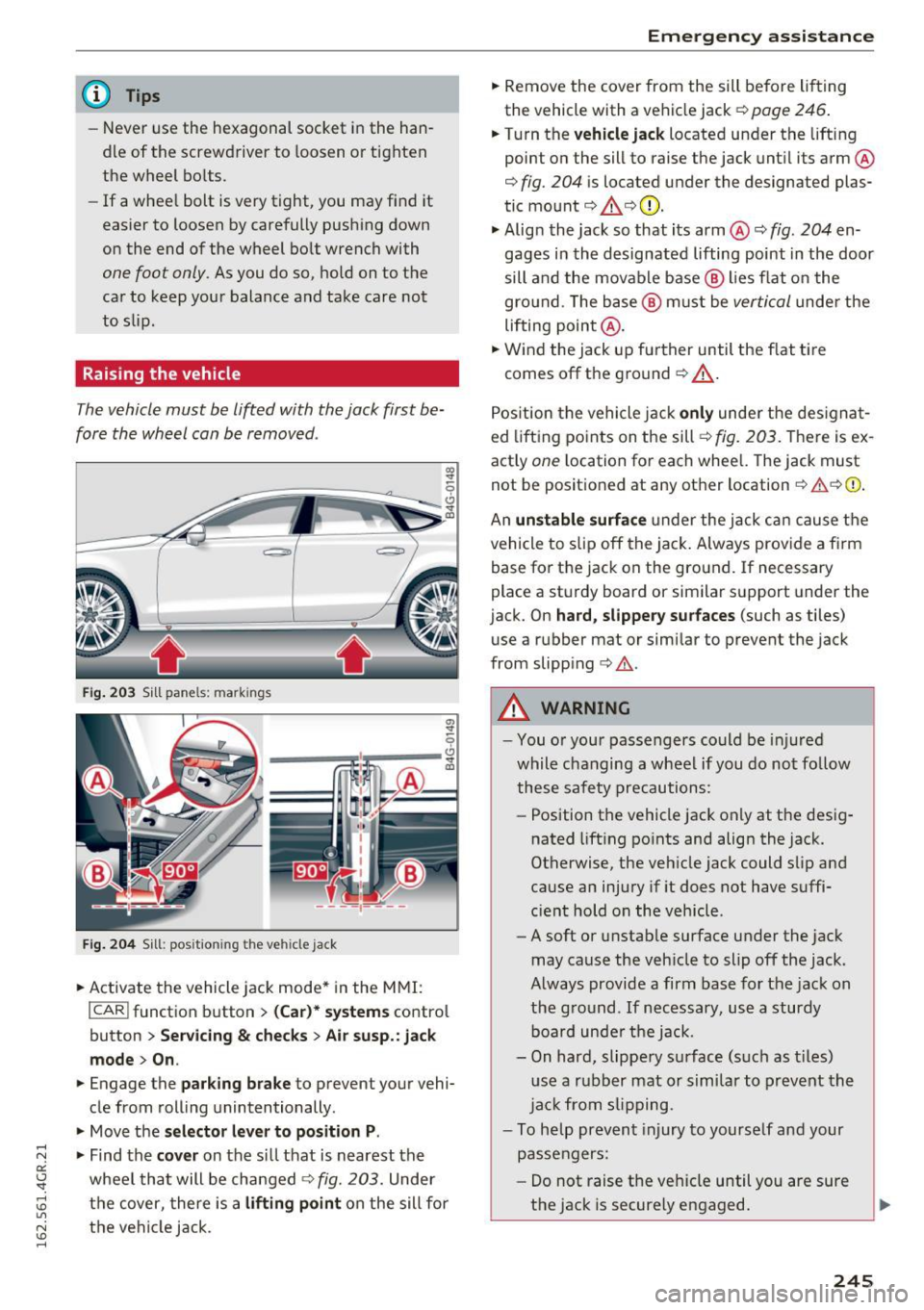
Fig. 203 S ill pane ls: markin gs
a,
"' ~ 9
---~,.----~ a,
Fig . 204 S ill : posit io ning th e vehi cle ja ck
.. Activate the vehicle jack mode* in the MMI:
I CAR ! function button > (C ar)* sys tems contro l
button
> Serv icing & checks> Air s usp. : jac k
mod e> On.
.. Engage the par king br ake to preven t your vehi
cle from roll ing unintentionally .
.. Move the
selector lever t o position P .
.... N .,. Find the cover on the si ll that is nearest the a::
~ wheel that will be changed¢ fig. 203. Under
~ the cover, there is a liftin g point on the sill for U"I
~ the vehicle jack .
......
Em ergen cy a ssis tanc e
.. Remove the cover from the sill before lift ing
the vehicle with a vehicle jack¢
page 246 .
.. Turn the vehicle ja ck located under the lifting
point on the sill to raise the jack unt il its arm ®
¢
fig. 204 is located under the designated plas
tic mount ¢
.&,¢(D .
.. Alig n the jack so that its arm@¢ fig. 204 en
gages in the designated lifting point in the door
sill and the movable base @ lies flat o n the
gro und . The base @ must be
vertical unde r the
lifting point @ .
.. Wind the jack up further until the f lat tire
comes off the ground¢_&. .
Pos ition the vehicle jack
only under the des igna t
ed lift ing points on the sill
¢ fig. 203. There is ex
actly
one l ocation for each whee l. The jack must
not be posit ioned at any other location¢ & ¢0 .
An
un stable surfa ce under the jack can cause the
vehicle to slip off the jack . Always provide a f irm
base for the jack on the ground. If necessary
place a sturdy board o r similar support under the
jack. On
ha rd, slipper y surfa ce s (such as tiles)
use a rubbe r mat or similar to prevent the jack
from slipping ¢& .
A WARNING
-You o r your passengers could be inj ured
while changing a wheel if you do not fo llow
these safety precautions :
- Position the vehicle jack only at the des ig
nated lift ing po ints and align the jack.
Otherwise, the vehicle jack could slip and
cause an injury if it does not have suffi
c ient hold on the vehicle .
- A soft or unstable surface under the jack
may cause the veh icle to slip off the jack .
Always provide a firm base for the jack on
the g round . If necessary, use a sturdy
boa rd unde r the jack.
- On hard, slippery surface (s uch as t iles)
u se a rubber mat or sim ilar to prevent the
ja ck from s lipping.
- To help prevent injury to yourse lf and your
passengers:
- Do not raise the vehicle until you are sure
the jack is securely engaged.
245
Page 250 of 282
Emerg enc y assis ta nc e
-Repl ace th e flat tire with a ne w one and have
it in st a lled on you r vehicl e as s oon as poss i
ble . R emount the wheel co ve r.
Until th en, driv e with extr a care and at r educe d
s peeds .
A WARNING
-If you are going to equip your vehicle w ith
t ires or rims which differ from those which
were factory installed, then be sure to read
the informat ion¢
page 225, New tires or
wheels.
- Always make sure the damaged wheel or
even a flat tire and the jack and tool kit are
properly secured in the luggage compart
ment and are not loose in the passenger
compartment.
- In an accident or sudden ma neuver they
could fly forward, injuring anyone in the ve
hicle.
- Always store damaged wheel, jack and too ls
sec urely in the luggage compartment. Oth
erwise, in an accident or s udden maneuver
they could fly forward, causing injury to pas
sengers in the vehicle.
(D Note
Do not use commercia lly available t ire seal
ants . Otherwise , the electrical components of
the t ire pressure monito ring sys tem wi ll no
longer work properly and the sensor for the
tire press ure monitoring system will have to
be replaced by qualified workshop .
248
-
Page 257 of 282
(D Note
Im pro per hook-u p of jum per cables can ru in
the gene ra tor.
- Always connect P OSITI VE( +) to POS ITI VE
( + ), and NEGATIVE( -) to NEGATIVE( -)
ground post of t he battery manager contro l
u nit .
- Check that a ll sc rew p lugs on the battery
ce lls a re sc rewed in firmly . If not, t igh ten
pl ugs p rio r to connecting clamp on negative
batte ry te rminal.
- Please note t hat the procedure fo r con nect
i ng a jumper cab le as desc ribe d above ap
p lies specifica lly to the case of yo ur vehicle
being jump s tarte d. W hen you are giv ing a
ju mp s ta rt to an othe r vehicl e, do
not con
n ect t he nega tive (- ) ca b le t o t he nega tive
(-) t ermin al on the di scharged battery @
c::> fig . 2 13 . Instead, securely connec t the
negative (-) cable to either a solid metal
com ponent that is f irm ly bolted t o the e n
gine block o r to t he engine bloc k itsel f. If
the battery that is be ing c ha rge d d oes not
vent to the outs ide, escap ing batte ry gas
could ignite and e xplode!
Towing with a tow truck
General hints
Your Audi require s speci al handling f or towing.
Th e follow ing informat ion is to be used by com
mercia l tow tr uck o pera tors who know how to op
e rat e the ir equip men t sa fely.
- Never tow your Audi. Towing will cause dam
age to the engine and transmission .
- Never wrap the safety chains or winch cables
around the brake lines.
- To prevent unnecessary damage, your Audi
must be transported with a flat bed truck.
- To load the vehicle on to the flat bed, use the
towing loop found in the vehicle tools and at
tach to the front or rear anchorage
c::> page 255 and c::> pag e 256 .
Emergency situations
A WARNING
-A vehicle being towe d is not safe for passen-
ge rs. Neve r allow a nyo ne to ride in a vehicle
b eing towed, for any reason.
Front towing loop
Fi g. 214 Fron t bumper: cover
Fig. 215 Fron t bumper: installing the tow ing loop
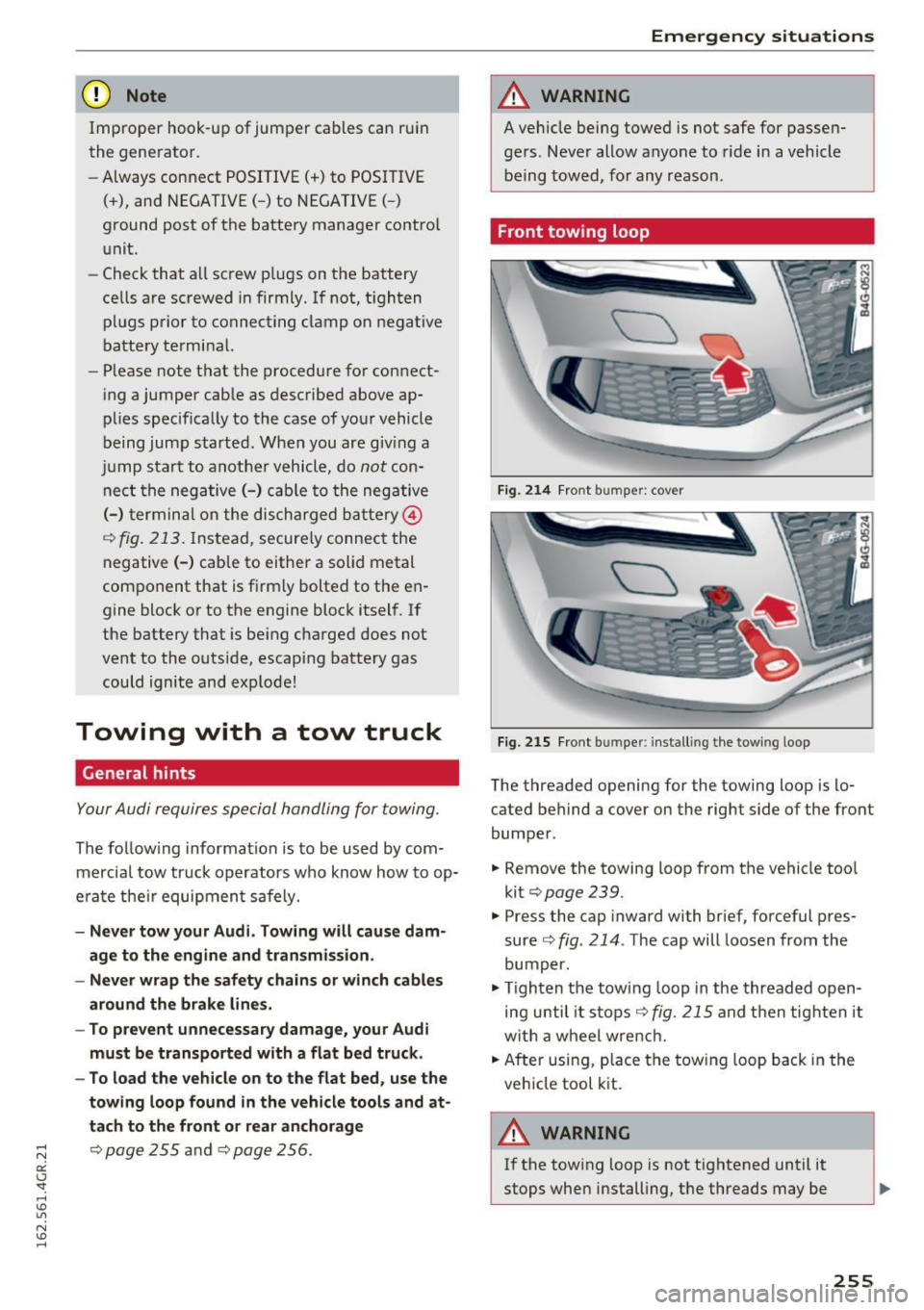
The threaded opening for the towing loop is lo
cated behind a cover on the rig ht side of the front
bumper .
.,. Remove the towing loop from the vehicle too l
kit<=>
page 239.
.,. Press the cap inward with brief, forceful pres
sure <=>
fig. 214 . The cap will loosen from the
bumper.
.,. Tigh ten t he towing loop in the threaded o pen
ing until it sto ps
c::> fig. 215 and t hen tig hten it
w it h a wheel wre nc h .
.,. After usi ng, p lace the tow ing loop ba ck in t he
ve hicle tool kit.
A WARNING
--
If t he tow ing loop is not tig htened until it
stops when installing, t he threads may be
255