2016 AUDI RS7 SPORTBACK weight
[x] Cancel search: weightPage 143 of 282

restrained, not just because the law requires you
to be.
The Advanced Airbag System in your ve hicle has
been certified to meet the " low r isk" require
ments for 3 and 6 yea r-o ld children on the pas
senger side and very sma ll adults on the driver
side . The low r isk dep loyment cr iteria are intend
ed to help reduce the risk of injury through inter
action with the front a irbag that can occur, for
examp le, by being too close to the steering wheel
and instrument panel when the airbag inflates .
In addition, the system has been certified to
comply w ith the "suppression" requirements of
the Safety Standard, to turn off the front a irbag
for infants 12 months old and younger who are
restrained on the front passenger seat in child re
stra ints that a re listed in the Standard
¢ page 161, Child restraints and Advanced front
airbag system .
"Suppression" requ ires the front a irbag on the
passenger side to be turned off if:
- a ch ild up to about one year of age is restra ined
on the fro nt passenger seat i n one of the rear
facing or forward-fac ing infant restra ints listed
in Federal Motor Vehicle Safety Standard 208
with wh ich the Advanced Airbag System in your
vehicle was certified . For a listing of the ch ild
restraints that were used to certify your vehi
cle's compliance with the US Safety Standard
¢ page 161,
-When a person is detected on the front passen
ger seat that has an electrical capacitance that
is more than the tota l electrical capac itance of
a ch ild that is about 1 year old restra ined in one
of the rear-facing or forward-facing infant re
straints (listed in Federal Motor Veh icle Safety
Standard 208 w ith which the Advanced A irbag
System i n your veh icle was certified), the front
airbag o n the passenge r side may o r may not
deploy.
The
P A SSENGER AIR B AG OFF light comes on
when the electron ic cont rol un it detects a total
e lectrical capacitan ce on the front passenge r seat
that requ ires the front a irbag to be turned off. If
the
PAS SENGER AIR BAG OFF light does not
come on, the front airbag on the passenger side
Airb ag sys tem
has not been turned off by the contro l unit and
can deploy if the contro l unit senses an impact
that meets the cond itions stored in its memory.
If the total e lectr ica l capaci tance reg istered on
the front passenger seat is mo re than that of a
typica l 1 year -old, but less than the weight of a
small adult, the front a irbag on the passenger
s ide may deploy (the
PA SS ENGER AIR BA G OFF
light does not come on).
For example , the ai rbag ma y deplo y if:
- a small ch ild that is heav ier than a typ ica l 1
yea r-o ld child is on the front passenger seat
(regardless o f whether the child is in one of the
child seats listed
¢ page 161),
-a child who has outgrown c hild restraints is on
the front passenge r seat .
If the front passenge r a irbag is t urned off, the
PASSENGER AIR BAG OFF light in the center of
the instrument pane l wi ll come on and stay on .
If the front passenger a ir bag deploys, the Feder
al Standa rd requi res the ai rbag to meet the "low
risk" deployment criteri a to he lp redu ce the r isk
of inj ury th rough interaction with the airbag .
" Low risk" deployment occurs in those crashes
that take p lace at lower decelerations as defined
in the electronic contro l unit ¢
page 146.
Alwa ys remember : Even though your vehicle is
equipped with Advanced Airbags, the safest place
for children is properly restrained on the back
seat. Please be sure to read the important infor
mation in the sections that fo llow and be sure to
heed all of the WARNINGS.
A WARNING
To reduce the risk of injury when an airbag in
flates, always wea r safety belts properly.
- If you are u nrestra ined, leaning forward, sit
ting sideways or out of position in any way,
your r is k of injury is much highe r.
- You will also receive ser ious injuries and
could even be killed if yo u are up against the
ai rbag or too close to it when it inflates -
even with an A dvanced Airbag
¢page 135.
141
Page 151 of 282

-the adult on the front passenger seat is proper
l y seated on the center of the seat cushion with
his or her back up aga inst the backrest and the
backrest is not reclined ,
- the adult is not taking weight off the seat by
holding on to the passenger assist handle
above the front passenger door or supporting
their we ight on the armrest,
- the safety be lt is be ing properly worn and that
there is not a lo t of slack in the safety belt web
bing,
- there are no aftermarket seat covers or cush
ions or other things (such as blankets) on the
front passenger seat that might cause the ca
pacit ive passenger detection system to miscal
cu late elect rical capac itance.
Important safety instructions on
monitoring the Advanced Airbag System
A WARNING
- If the status of the Adva need A irbag System
has changed while the vehicle is moving, the
PASSENGER AIR BAG OFF light blinks fo r
about 5 se conds to cat ch the driver's atten
t ion. If th is happens , al ways stop as soon as
it is safe to do so and check the steps descri
bed above.
- If the
PASSENGER AIR BAG OFF light does
not go of f when an adult who is not very
small is sitting on the front passenger seat
after taking the steps descri bed above,
make sure the adult is properly seated and
restra ined at one of the rear seating posi
t ions. Have the airbag system inspected by
yo ur authorized Aud i dealer before trans
porting anyone on the front passenger seat .
A WARNING
An airbag system that is not functioning prop
e rl y cannot provide supplemental p rotection
in a frontal cra sh .
-If the airbag indicato r light ¢ page 17
comes when the vehicle is be ing use d, have
the system inspected immed iate ly by yo ur
authorized Au di dealer. It is possible that
Airb ag sys tem
the airbag will in flate when it is not sup
posed to, or w ill not inf late when it should.
A WARNING
-
If the front a irbag inflates, a ch ild witho ut a
chi ld restraint, or in a rea rward-facing child
safety seat, or in a forward-fac ing child re
stra int that has not been properly insta lled
will be serious ly injured and can be killed .
- Even tho ugh your vehicle is equipped with
an Advanced A irbag System, make certain
that all children, espec ially 12 years a nd
younge r, always ride on t he bac k sea t prop
erly rest raine d for the ir age and s ize.
- Always install fo rwa rd o r rea r-fa cing child
seats on the rea r seat -even w ith an Ad
van ce d Ai rbag System.
- If you must install a rea rw ar d-facing child
se at o n the fron t passenge r seat because of
except ional circumstances an d the
PASSEN
GER AIR BAG OFF
light does not appear an d
stay on, immed iate ly install the rea r-facing
child seat in a rear seat ing pos ition and have
the airbag system inspected by your Audi
deale r.
- If, in exceptional circ umstances, you must
install a forward-facing child restraint on
the front passenger seat, always move the
seat into i ts rearmost posi tion in the seat 's
fore and aft a djustment range, as far away
fr om the a irbag as poss ible. The back res t
m ust be adjus ted to an upr igh t position .
Make sure that the
PASSENGER AIR BAG
OFF
li ght comes on and stays on all the time
wheneve r the ignit ion is switched on .
A WARNING
-If the PASSENGER AIR BAG OFF light does
not go out when an adult is sitting on the
front passenger seat after tak ing the steps
described above, make sure the adult is
proper ly seated and restra ined a t one of the
rear seating posit ions .
- Have the airbag system inspected by your
Aud i deale r before transporting anyone on
the front passenge r seat .
149
Page 158 of 282

Airbag syste m
by being pushed into you as the airbag in
flates.
- Never p lace or attach accessories or other
objects (such as cup holders, telephone brackets, or even large, bulky objects) on
the doors, over or near the area marked
"AIRBAG" on the seat backrests.
- Such objects and accessories can become
dangerous projectiles and cause in ju ry
when the supplemental side airbag de ploys.
- Never carry any objects or pets in the de ployment space between them and the
airbags or allow children or other passen
gers to travel in this position.
- Always use the built-in coat hooks only for
lightweight clothing. Never leave any heavy
or sharp-edged objects in the pockets that
may interfere w ith side airbag deployment
and can cause personal i njury in an accident.
- Always prevent the side airbags from being
damaged by heavy objects knocking against
or hitting the sides of the seatbacks.
- The airbag system can only be triggered
once. If the airbag has been triggered, the
system must be replaced by an author ized
Audi dealership.
- Damage (cracks, deep scratches etc.) to the
orig inal seat covers or to the seam in the
area of the side a irbag mod ule m ust always
be repa ired immed iate ly by an authorized
Audi dealer .
- If children are sea ted improperly, their r is k
of injury increases in the ca se of an ac ciden t
~ page 159, Child safety .
-Never attempt to modify any components of
the a irbag sys tem in any way.
- In a side collision, side a irbags w il l not fu nc
t ion properly if sensors cannot correct ly
measure increasi ng air pressure ins ide the
doo rs when air escapes through larger, un
closed openings in the door panel.
- Never drive w ith inter io r door tr im panels
removed .
- Never drive when parts have been re
moved from the inside doo r panel and the
open ings they leave have not been proper
ly closed.
156
- Never drive when loudspeakers in the
doors have been removed unless the
speaker holes have been properly closed.
- Always make certain that openings are
covered or filled if additional speakers or
other equipment is installed i n the inside
door panels.
- Always have work on the doors done by an
authorized Aud i dealer or q ualified work
shop.
Side curtain airbags
Description of side curtain airbags
The side curtain airbag system can provide sup
plemental protection to properly restrained oc
cupants.
Fig. 162 S id e curt ain airbags, driver's sid e: side curtain a ir
bag locatio n
The side curtain airbags are located on both sides
of the inter ior above the fro nt and rear side win
dows~
fig. 162. T hey are identified by the word
"AIRBAG" on the windshie ld frame .
The side curtain airbags contain features that
provide ejection mitigation to help prevent veh i
cle occupants or parts of their bodies from being
completely or partially ejected from the vehicle i nterior in certain side impacts and vehicle roll
overs .
The side c urtain airbag system supplements the
safety belts and can help to reduce the risk of in
j ury for occupants' heads and upper torso . The
s ide curtain airbag inflates in side impacts and
only when the vehicle acceleration registered by
the control unit is high enough. If th is rate is be-
low the reference va lue programmed into the .,.
Page 160 of 282
Airbag syste m
side curtain airbag must inflate within the blink
of an eye at very high speed and with great force .
The s ide curta in a irbag could injure you if your
seating position is not proper or upright or if
items are located in the area where the supp le
mental side curtain airbag inflates . This applies
especially to children
c:> page 159.
Although they are not a soft pi llow, side curtain
airbags can "cushion" the impact and in this way
they can help to reduce the risk of injury to the head and the upper part of the body .
A fine dust may develop when the airbag deploys.
This is quite normal and does not mean there is a
fire in the veh icle.
Important safety instructions on the side
curtain airbag system
Airbags are only supplemental restraints . Always
properly wear safety belts and ride in a proper
seating position.
There is a lot that you and your passengers must
know and do to help the safety be lts and airbags
do their job to provide supp lemental protect ion.
_& WARNING
Improperly wea ring safety belts and imprope r
seating pos it ions increase the ris k of serious
persona l injury and death whenever a vehicle
is being used.
- Never let occupan ts p lace any parts of their
bodies in the area from which the side cur
tain airbag inflate .
- Always make sure that the side curtain air
bags can inflate witho ut interference .
- U se the buil t- in coat hooks on ly for light
weight clothing. Never leave any heavy or
sharp-edged objects in the pockets that may
interfere w ith airbag deployment and can
cause personal injury in a collision.
- Never use hangers to hang clothes on the
hooks.
- Only use factory-installed s un shades or, if
shades installed after the veh icle leaves the
factory, use only genuine Aud i sun shades.
- Never swing the sun visors over to the side
windows if things such as pens, garage door
158
opene rs, hands-free speakers, etc. are at
tached to the sun visors. They could come
loose and cause serious injury if the side cur
tain airbag inflates.
- A deploying airbag inflates in a fract ion of a
second and with great force.
- Never attach objects to the cover or in the
deployment zone of a s ide curtain airbag.
- The airbag deployment zones must be kept
clear at all times. Make sure there are no
objects, pets, or other persons in the space
between any vehicle occupant and any air
bag at any time .
- Do not attach any accessories to the doors.
_& WARNING
-The airbag system can deploy on ly once. If
the airbag has been triggered, the system
must be rep laced by an author ized A udi
dea le r o r qualified wor ksh op.
- Always have wo rk involv ing the side curtain
airbag system, remova l and installat ion of
the airbag componen ts, or other repairs
pe rformed by a q ualified dea lership. Other
w ise the airbag system may not work cor
rectly.
- Never attempt to mod ify any componen ts of
the airbag system in any way .
Page 161 of 282

Child safety
Important information
Introduction
The rear seat is generally the safest place in a
collision .
The physical principles of what happens when
your vehicle is in a crash apply also to children
c:> page 128, What happens to occupants not
wearing safety belts? .
But unlike adults and
teenagers, their muscles and bones are not fully
developed. In many respects children are at
greater r isk of serious injury in crashes than
adults .
Because children's bodies are not fu lly devel
oped, they requ ire restraint systems especially
des igned for their size, we ight , and body struc
ture. Many countr ies and all states of the United
States and provinces of Canada have laws requir
ing the use of approved child restraint systems
for infants and small children .
In a frontal crash at a speed of 20-3 5 mph
(30-56 km/h) the forces acting on a 13-pound
(6 kg) infant will be more than 20 times the
weight of the child . This means the weight of the
child would suddenly be more than 260 pounds
(120 kg) . Under these conditions, only an appro
priate child restraint properly used can reduce
the risk of serious injury . Child restra ints, like
adult safety belts, must be used properly to be
effect ive. Used improperly, they can increase the
risk of serious injury in an accident .
Consult the child safety seat manufacturer's in
structions in order to be sure the seat is right for
your child's size
c:> page 162, Important safety
instructions for using child safety seats .
Please
be sure to read and heed all of the important in
formation and WARNINGS about child safety,
Advanced Airbags, and the installation of child restraints in this chapter.
There is a lot you need to know about the Ad
vanced Airbags in your vehicle and how they work
when infants and children in chi ld restraints are
on the front passenger seat . Because of the large
amount of important information, we cannot re-
Ch ild safety
peat it all here. We urge you to read the detailed
information in this owner's manual about airbags
and the Advanced Airbag System in your vehicle
and the very important information about trans
porting children on the front passenger seat.
Please be sure to heed the WARNINGS -they are
extremely important for your safety and the safe
ty of your passengers, especia lly infants and
small chi ldren.
_& WARNING
- Accident statistics have shown that children
are generally safer in the rear seat area than in the front seating position . Always restrain
any child age 12 and under in the rear.
- All vehicle occupants and especially children must be restrained properly whenever riding
in a vehicle. An unrestrained or improperly restrained child cou ld be injured by striking
the inter ior or by being ejected from the ve
h icle during a sudden maneuver or impact .
An unrestrained or improperly restrained
child is a lso at greater risk of injury or death
through contact w ith an inflating a irbag.
-A suitable ch ild restraint properly installed
and used at one of the rear seating positions
provides the h ighest degree of protect ion
for infants and small children in most acci
dent situat ions .
_& WARNING
f"-"----
Children on the front seat of any car even with
Advanced Airbags can be seriously injured or
even killed when an airbag inflates . A child in
a rearward-facing chi ld safety seat installed
on the front passenger seat will be seriously i njured and can be killed if the front airbag in
flates .
- The inflating airbag will h it the ch ild safety
seat or infant carr ier with great force and
will smash the child safety seat and child aga inst the backrest, center armrest, or
door.
- Always install rear-fac ing child safety seats
on the rear seat .
- If you must install a rearward facing child
safety seat on the front passenger seat in
159
Page 163 of 282

Advanced front airbag system and children
Your vehicle is equipped with a front "Advanced
Airbag System" in compliance with United States
F edera l Motor Vehicle Safety Standard ( FMVSS)
208, as well as Canada Motor Vehicle Safety
Standard (CMVSS) 208 as applicable at the time
your veh icle was manufactured.
The Advanced Airbag system in your vehicle has
been certified to meet the "low-risk" require
ments for 3- and 6-year old children on the pas
senger side and small adults on the driver side.
The low risk deployment criteria are intended to
reduce the risk of injury through interaction with
the airbag that can occur, for example, by being
too close to the steering wheel and instrument
panel when the airbag inflates. In addition, the
system has been certified to comply with the
"s uppress ion " req uirements of the Safety Stand
ard, to turn off the front airbag for infants up to
12 months who are restrained on the front pas
senger seat in child restraints that are listed in
the Standard.
E ven though your vehicle is equipped with an Ad ·
vanced Airbag system, all children, especially
those 12 years and younger, should always ride
in the back seat properly restrained for their age
and size. The airbag on the passenger side makes
the front seat a potentially dangerous place for a
child to r ide. The front seat is not the safest place
for a child in a forward-facing child safety seat .
It
can be a very dangerous place for an infant or a
la rger child in a rearward-facing seat.
The vehicle's Advanced A irbag System has a ca
pac itive passenger detect io n system in the front
passenger seat cush ion that can detect the pres
ence of a baby or a child in a child restraint sys
tem on this seat .
The capacit ive passenger detection system regis
ters the changes that result in an electrical field
when a child, a child restraint, and a baby blanket
are on the front passenge r seat. The change in
the measured capacitance due to the presence of
a child, a child restraint, and a baby blanket on
the front passenger seat is related to the child restraint system resting on the seat. The meas
ured capacitance of a child restraint system var-
Child safety
ies depending on the type of system and specific
make and mode l.
T he elect rical capacitance of the various types,
makes, and models of child restra ints specified
by the U.S .National Highway Traff ic Safety Ad
ministration (NHTSA) in the relevant safety
standard are stored in the Advanced Airbag Sys
tem control unit together with the capacitances
typ ical of infants and a 1-year old child. When a
child restraint is used on the front passenger
seat w it h a typical 1 year-old infant, the Ad
vanced Airbag System compares the capacitance measured by the capacitive passenge r detection
system with the data stored in the electronic con
t rol unit.
Child restraints and Advanced front airbag
system
Regardless of the ch ild restraint that you use,
make sure that it has been certified to meet Safe
ty Standards and has been cert ified by its manu
facturer for use w ith an airbag . Always be sure
that the child restraint is properly installed at
one of the rear seating positions. If in exception
al circumstances you must use it on the front
passenger seat, carefully read all of the informa
tion on child safety and Advanced Airbags and heed all of the applicable WARNINGS . Make cer
tain that the chi ld and child restraint are correct
ly recognized by the capac itive passenger detec
t ion system in the front passenger seat, that the
front passenger a irbag is turned off, and that the
airbag status is always correctly s ignaled by the
PASSENGER AIR BAG OFF light .
Many types and models of child restra ints have
been available over the years, new models are in
troduced regularly incorporating new and im
proved designs and older models are taken out of
production. Child restra ints are no t standardized.
Child restraints of the same type typically have
different weights and sizes and different "foot
prints", the size and shape of the bottom of the
chi ld restraint that sits on the seat, when they
are installed on a vehicle seat. These differences
make it virtually impossib le to certify compliance
with the requirements for advanced a irbags w ith
each and every child restra int that has ever been ..,.
161
Page 165 of 282
to prevent the child safety seat from moving
¢page 169.
~ Push the child safety seat down with your full
weight to get the safety belt really tight so that
the seat cannot move forward or sideways
more than one inch (2.5 cm).
~ Secure unused safety belts on the rear seat
¢ page 164.
Always remember: Even though your vehicle is
equipped with an Advanced Airbag system, all
children, especially those 12 years and younger,
should always ride in the back seat properly re
strained for their age and size.
_& WARNING
Not using a child safety seat, using the wrong
child safety seat or improperly installing a
child restraint increases the risk of serious
personal injury and death.
-All vehicle occupants and especially children must be restrained properly whenever riding
in a vehicle. An unrestrained or improperly
restrained child could be injured by striking
the interior or by being ejected from the ve
hicle during a sudden maneuver or impact.
An unrestrained or improperly restrained
child is also at greater risk of injury or death
through contact with an inflating airbag.
- Commercially available child safety seats
are required to comply with U.S. Federal
Motor Vehicle Safety Standard (FMVSS) 213
(in Canada CMVSS 213).
- When buying a child restraint, select one
that fits your child and the vehicle.
- Only use child restraint systems that fully
contact the flat portion of the seat cush
ion. The child restraint must not tip or
lean to either side. Audi does not recom
mend using child safety seats that rest on
legs or tube-like frames. They do not pro
vide adequate contact with the seat.
-Always heed all legal requirements per
taining to the installation and use of child
safety seats and carefully follow the in
structions provided by the manufacturer
of the seat you are using.
Child safety
- Never allow children under 57 inches
(1.45 meters) to wear a normal safety belt.
They must always be restrained by a proper child restraint system. Otherwise, they
could sustain injuries to the abdomen and
neck areas during sudden braking maneu
vers or accidents.
- Never let more than one child occupy a child
safety seat.
- Never let babies or older children ride in a
vehicle while sitting on the lap of another passenger.
- Holding a child in your arms is never a sub
stitute for a child restraint system.
- The strongest person could not hold the
child with the forces that exist in an acci
dent. The child will strike the interior of
the vehicle and can also be struck by the
passenger.
- The child and the passenger can also in
jure each other in an accident.
- Never install rear-facing child safety seats
or infant carriers on the front passenger
seat. A child will be seriously injured and
can be killed when the passenger airbag in
flates -even with an Advanced Airbag Sys
tem.
- The inflating airbag will hit the child safety
seat or infant carrier with great force and
will smash the child safety seat and child
against the backrest, center armrest, door
or roof.
- Always install rear-facing child safety seats
or infant carriers on the rear seat.
- Forward-facing child safety seats installed
on the front passenger's seat can interfere
with the airbag when it inflates and cause serious injury to the child. Always install for
ward-facing child safety seats on the rear
seat.
- If exceptional circumstances require the use
of a forward-facing child restraint on the
front passenger's seat, the child's safety and well-being require that the following
special precautions be taken: ..,.
163
Page 167 of 282
_& WARNING
A child in a child safety seat installed with the
LATCH lower anchorages or with the standard
safety belt or a child in a booster seat on the
rear seat could play with unused rear seat
safety belts and become entangled. This
could cause the child serious personal injury
and even death.
- Always secure unused rear seat safety belts
out of reach of children in child seats such
as by properly routing them around the head restraint of the seat where the child
restraint is installed .
- Never activate the convertible locking re tractor when routing the safety belts around
the head restraints.
Child seats
Infant seats
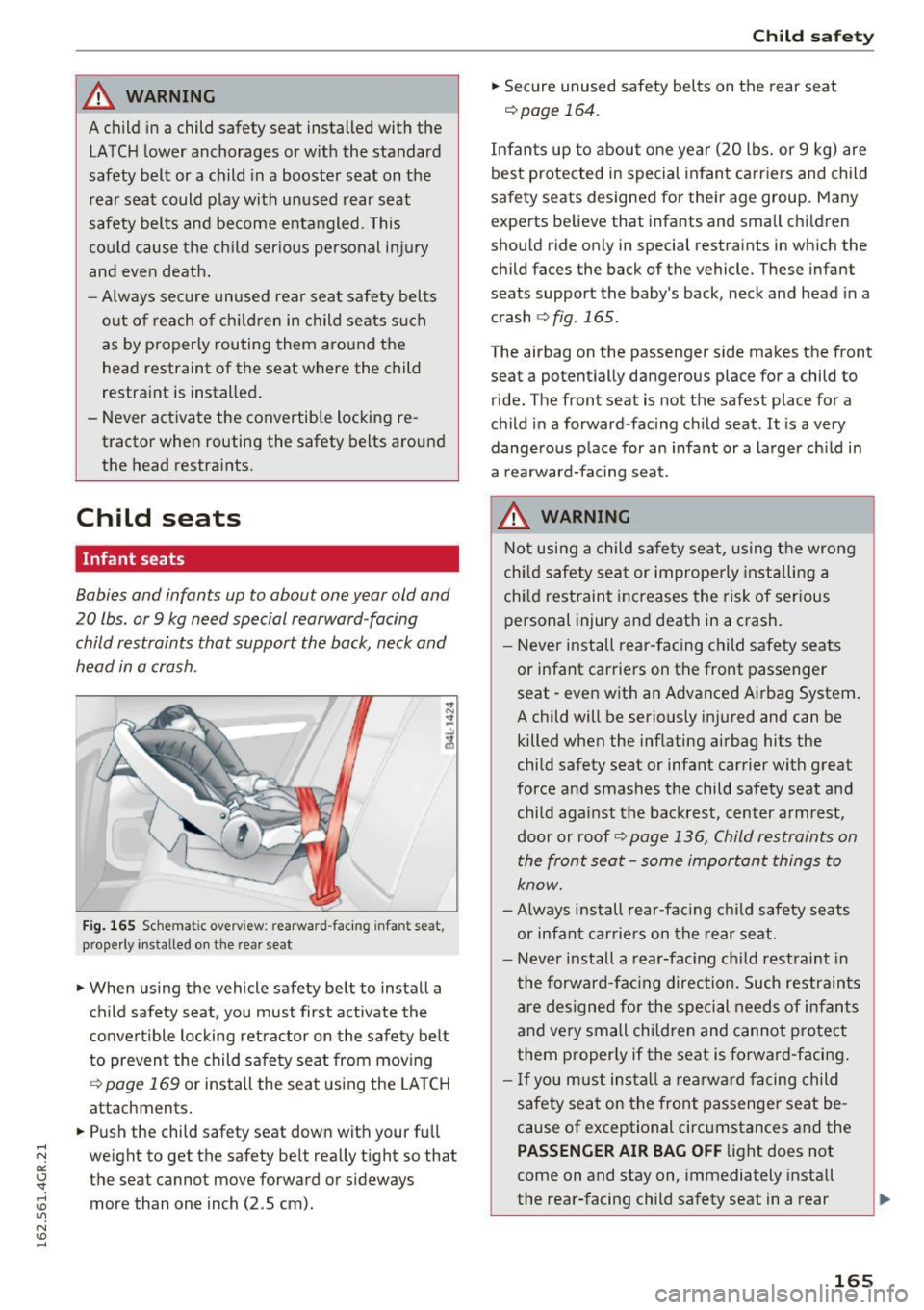
Babies and infants up to about one year old and
20 lbs. or 9 kg need special rearward-facing
child restraints that support the bock, neck and
head in a crash .
Fig. 165 Schemat ic overview: rearwa rd-facing infant seat,
properly installed on the rear seat
"'When using the vehicle safety belt to install a
child safety seat, you must first activate the
convertible locking retractor on the safety belt
to prevent the child safety seat from moving
~ page 169 or install the seat using the LATCH
attachments.
"'Push the child safety seat down with your full
weight to get the safety belt really tight so that
the seat cannot move forward or sideways
more than one inch (2.S cm).
Child safety
"' Secure unused safety belts on the rear seat
¢page 164.
Infants up to about one year (20 lbs. or 9 kg) are
best protected in special infant carriers and child
safety seats designed for their age group. Many
experts believe that infants and small children
should ride only in special restraints in which the
child faces the back of the vehicle. These infant
seats support the baby's back, neck and head in a
crash
¢fi g. 165.
The airbag on the passenger side makes the front
seat a potentially dangerous place for a child to
ride. The front seat is not the safest place for a
child in a forward -facing child seat . It is a very
dangerous place for an infant or a larger child in
a rearward-facin g seat.
_& WARNING
Not using a child safety seat, using the wrong
child safety seat or improperly installing a
child restraint increases the risk of serious
personal injury and death in a crash.
- Never install rear-facing child safety seats
or infant carriers on the front passenger
seat -even with an Advanced Airbag System.
A child will be seriously injured and can be
killed when the inflating airbag hits the
child safety seat or infant carrier with great
force and smashes the child safety seat and child against the backrest, center armrest,
door or roof¢
page 136, Child restraints on
the front seat -some important things to
know.
- Always install rear-fac ing child safety seats
or infant carriers on the rear seat.
- Never install a rear-facing child restraint in
the forward -facing direction. Such restraints
are designed for the special needs of infants
and very small children and cannot protect
them properly if the seat is forward-facing.
- If you must install a rearward facing child
safety seat on the front passenger seat be
cause of exceptional circumstances and the
PASSENGER AIR BAG OFF light does not
come on and stay on, immedia tely install
the rear-facing child safety seat in a rear
165