2016 AUDI RS7 SPORTBACK warning light
[x] Cancel search: warning lightPage 196 of 282

Care and cleaning
Rinse the vehicle thoroughly again and let it air
dry. Remove any water residue using a leather
cloth .
_& WARNING
- Only wash the vehicle when the ignition is
off and follow the instructions from the car
wash operator to reduce the risk of acci
dents .
- To reduce the risk of cuts, protect yourself
from sharp metal components when wash
ing the underbody or the inside of the wheel
housings .
- After was hing the vehicle, the bra kin g effect
may be delayed due to mo isture on the
bra ke rotors or ice in the winte r. The bra kes
must be d ried first w ith a few careful b rake
applica tions .
(D Note
-If you wash t he ve hicle in an automatic car
wash, you m ust retract the rear spoiler if
ne cessary, and fold the e xte rior mi rrors in
to reduce the risk of damage. Power fo ld ing
-
exterior mirrors* must only be fo lded in and
o ut using the power folding f unction .
- T o prevent pa int damage, do not wash the
vehicle in direct sunlight .
- T o red uce the risk of damage to the s urf ac e,
do not use insect removing sponges, k itchen
sponges o r similar items .
- Mat te finish painted vehicle components:
- To reduce the r isk of damage to the sur-
face, do not use polis hing agents or hard
wax.
- Never use protective wax. It can destroy
the matte finish effect.
- Do not place any stickers or magnetic
signs on vehicle parts painted with matte
finish paint. The paint could be damaged
when the stickers or magne ts are re
moved .
@) For the sake of the environment
Only wash the ve hicle in facilities spec ially de
signed for that pu rpose . This will reduce the
r isk of dirty wate r contaminated with o il from
entering the sewe r system.
Cleaning and care information
When clean ing and caring for individua l vehicle
components, refer to the following tables . The
i n formation contained there is simply recom
mendations. Fo r questions or for components that are
not listed, cons ult an autho rized Aud i
dealer or au thori zed A udi Se rvice Fac ility. Also
f o llow the information fo und in¢&. .
Ext eri or cleaning
Component Situation Solution
Windshield wiper
Deposits ¢ page 50, Cleaning windshield wiper blades
blades
Headlights /
Deposits Soft sponge with a m ild soap solution3
)
Tail light s
S en sors /
Deposits Sensors: soft cloth with solvent-free cleaning solut ion
cam era lens es Camera lenses: soft cloth w ith alcohol -free cleaning solu -
tion
Snow/ice Hand brush/solvent-free de-icing spray
Wheels Road salt Water
Bra ke dust Acid-free special cleaning solution
Exhaust tail pipes Road salt
Water, clean ing solution su itab le for stainless stee l, if nee-
essa ry
194
...
Page 198 of 282

Care and cleaning
Component Situation Solution
Te xtil es
Deposits adhering to Vacuum cleaner
a rt ifici al le ather , the surface
Alcant ara Water-based deposits Absorben
t cloth and mild soap solutiona>
such as coffee, tea,
blood, etc.
O il-based deposits Apply a m ild soap solution a), blot away the dissolved oil or
such as oil, make-up, dye, treat afterward with water, if necessary
etc.
Special deposits such Special stain remover, b lot with absorbent material, treat
as ink, na il polish, la- afterward with mild soap solution, if necessary a)
tex paint, shoe pol-
ish, etc.
Natural leather Fresh stains Wool cloth with a mild soap so
lutiona)
Water-based deposits fresh sta ins: absorbent cloth
such as coffee, tea, Dried sta ins: stain remover suitable fo r leather
blood, etc.
Oil-based deposits Fresh staiins: absorbent cloth and stain remover suitable
such as oil, make-up, for leather
etc. Dried sta ins : grease dissolv ing spray
Special deposits such Spot remover suitab le for leather
as ink, nai l polish, la -
tex paint, shoe pol-
ish, etc.
Ca re Regularly apply cond ition ing cream that protects from
light and penet rates into the materia l. Use specia lly-co l-
ored conditioning cream, if necessary.
Carbon parts Deposits clean the same way as plastic parts
a) Mild soap solution: maximum two tablespoons of neutral soap in 1 quart (l liter) of water
_& WARNING
The windshie ld may not be trea ted with wa
ter-repelling windshield coating agents. Un
favorable conditions s uch as wetness, dark
ness, or low sun can result in increased glare .
Wiper blade chatter is also possible.
(D Note
- Headlights/tail light s
-Never clean headlights or tail lights with a
dry cloth or sponge.
- Do not use any cleaning product that con
tains alcohol, because they could cause
cracks to form.
- Wheels
196
-
- Never use any paint polish or other abra
sive materials.
- Damage to the protect ive layer on the
rims such as stone chips or scratches must
be repaired immediately.
- Sensors /camera lenses
- Neve r use wa rm or ho t wa ter to remove
snow or ice from the camera lens . This
could cause the lens to crack .
- N eve r use ab rasive cleaning materials or
a lcohol to clea n the camera lens . This
could cause scratches and cracks .
-Doo r window s
-Remove snow and ice on windows and ex-
terior mirrors with a plast ic scraper. To
Page 207 of 282
Checking and Filling
Engine compartment
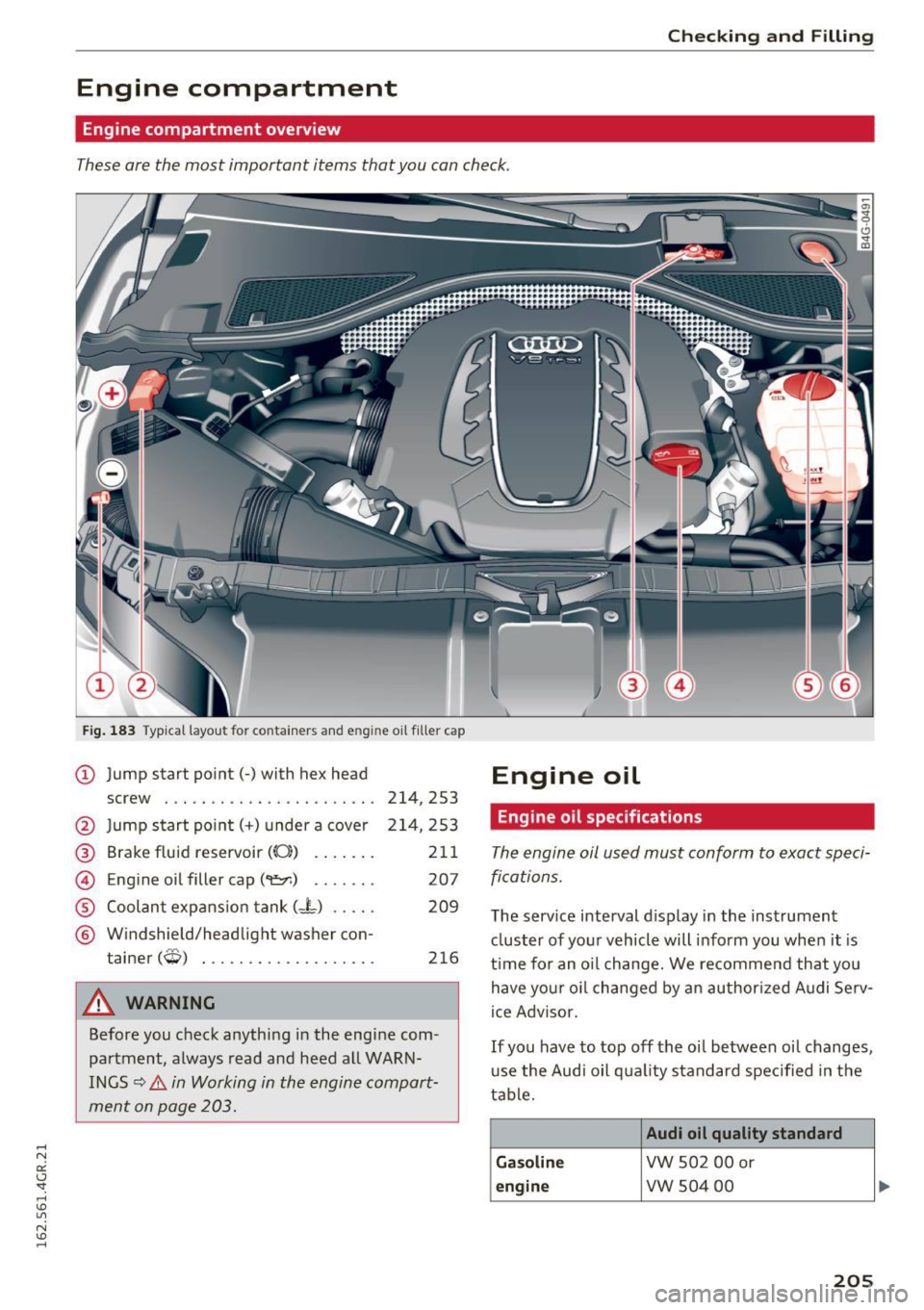
Engine compartment overview
These are the most important items that you can check.
Fig. 183 Typical layout for containers and e ngine oil fille r cap
(D Jump start point(-) with hex head Engine oil
screw . .. .... .... .... ..... .. . 214, 253
@ Jump start po int( +) under a cover 214 ,253
@ Brake fluid reservoir (0:) . . . . . . . 211
@ Eng ine oil filler cap(~) . . . . . . . 207
® Coolant expans ion tank (- L) . . . . . 209
® Windshield/headlight washer con-
tainer
(W) . . . . . . . . . . . . . . . . . . . 216
A WARNING
Before you check anything in the engine com
partment, always read and heed all WARN
INGS
¢ .&. in Working in the engine compart
ment on page 203.
Engine oil specifications
The engine oil used must conform to exact speci
fications.
The service interval display in the instrument
cluster of your vehicle will inform you when it is
t ime for an o il change. We recommend that you
have your oil changed by an authorized Audi Serv-
ice Adv isor.
If you have to top off the oi l between oil changes,
use the Audi oil quality standard specified in the
table.
Audi oil quality standard
Gasoline
VW 502 00 or
engine VW S04 00
205
Page 208 of 282
Check ing and F illing
Using the proper engine oil is impo rtant for the
functionality and service life of the engine. Your engine was facto ry-filled with a h igh-quality oi l
which can usually be used throughout the entire
year.
@) Note
Your Limited New Vehicle War ranty does not
cover damage or malfunctions due to failure
to follow recommended maintenance and use
requirements as set forth in the Audi Owner's
Manual and Warran ty
& Maintenance booklet.
- Use only a high quality eng ine oil t hat ex-
p ressly complies with the Audi oil qua lity
standard specified for your vehicle's engine .
Using a ny o ther oil can cause serious engine
d am age.
- D o not mix any lubricants o r other addit ives
i nto the engine oil. Doing so ca n cause en
g ine damage.
(D Tips
I f you need to add oil and there is none availa
ble t hat meets the Audi o il quality standard
your eng ine requi res , you m ay ad d a tot al of
no more than 0.5 qu art /li ter o f a h igh-quality
"synthe tic"oil that meets t he following speci
fications.
- AC EA A3 o r API SM wi th a viscosity grade o f
SAE 0W-30, SAE SW-30 or SAE SW-40.
- F or more inform ation about engine o il that
has been approve d for your ve hicl e, please
contact eithe r you r a uthorized Audi dea le r
or A udi C ustome r Relat ions at
1 (800) 822-2834 or visit o ur web site at
www.audiusa.com or www.aud icanada.ca.
Engine oil consumption
T he engine in your vehicle depends on an ade
quate amoun t of oil to lubricate and cool all of
its moving par ts.
In order to p rovide effective lubr ication and cool
ing of internal engine components, all interna l
combustion engines consume a cer tain amount
of oil. Oi l co nsumption varies from engine to en
g ine and may change significant ly over the life of
the eng ine . Typically, eng ines with a specified
206
b reak -in period (see q page 188) consume more
oi l during the break-in period than they consume
after o il consumption has stab ilized.
U nder normal cond itions, the ra te of oil con
s u mption depends on the q ua lity and viscos ity o f
the oil , the RPM (revo lutions per minute) at
which the engine is operated, the amb ient tem
perature and road condit ions. Further facto rs a re
the amount of o il di lution from wate r condensa
tion or fue l resid ue a nd the oxidation level of the
o il. As any engine is subject to wear as mileage
builds up, the o il consumption may increase ove r
ti me until replacement o f wo rn components may
become ne cessary.
With a ll these va riables coming into p lay, no
standard rate of o il consumption can be estab
li sh ed or spec ified . T he re is no alte rnative to reg
u lar and freq uen t che cki ng of the oil level , see
Note .
If the yellow engine oil level warning symbo l in
the instr ument cluster
II lights up, yo u should
c h eck t he o il level as soon as poss ible
q page 207 . Top off the o il at your earlies t con
venience
q page 207.
_& WARNING
Before you check a nyt hing in the en gine com
partment, always read and heed all WARN
INGS
9 .&. in Working in the engine compart
ment on page 203.
((I) Note
D riving w it h an insuffic ient oil level is li ke ly to
cause severe damage to the engine.
(D Tips
- The oil pressure warning d isplay. is not
an indicator of the oil level. Do not rely on
it. Instead, check the oil level in your en
g ine at regular intervals, preferably each
time you refuel, and always befo re going
on a long trip .
-If you have the impress ion your engine con
sumes excessive amou nts of oil, we recom
mend that yo u consult your Aud i dea le r to
have the cause of yo ur conce rn prope rly .,.
Page 212 of 282

Checking and Filling
should be between the "min " and "max" mark
ings. When the engine is warm, the level may
be slightly above the "max" marking.
The location of the coolant expansion tank can be
seen in the engine compartment illustration
<::> page 205.
To obtain an accurate reading, the engine must
be switched off.
The expansion tank in your vehicle is equipped
with an electric coolant level sensor.
When the coolant level is too low, the warning
light in the Auto-Check System <::>
page 15 will il
luminate until you add coolant and the level has
been restored to normal. Even though there is an
electric coolant level sensor, we still recommend
you check the coolant level from time to time.
Coolant loss
Coolant loss may indicate a leak in the cooling
system. In the event of coolant loss, the cooling
system should be inspected immediately by your
authorized Audi dealer. It is not enough merely
to add coolant.
In a
sealed system, losses can occur only if the
boiling point of the coolant is exceeded as a re
sult of overheating.
A WARNING
The cooling system is under pressure and can
get very hot. Reduce the risk of scalding from
hot coolant by following these steps.
-Turn off the engine and allow itto cool down.
- Protect your face, hands and arms from es caping fluid and steam by covering the cap
with a large, thick rag.
- Turn the cap slowly and very carefully in a counter-clockwise direction while applying
light, downward pressure on the top of the
cap.
- To avoid being burned, do not spill anti
freeze or coolant on the exhaust system or
hot engine parts . Under certain conditions,
the ethylene glycol in engine coolant can
catch fire .
210
(D Note
Do not add any type of radiator leak sealant
to your vehicle's engine coolant. Adding radia
tor repair fluid may adversely affect the func
tion and performance of your cooling system
and could result in damage not covered by
your New Vehicle Limited Warranty .
Adding coolant
Be very careful when adding engine coolant.
Before you check anything in the engine compart
ment,
always read and heed all WARNINGS
<::>.& in Working in the engine compartment on
page 203 .
.. Requirement: There must be a residual amount
of coolant in the expansion tank
i:::>Q) .
.. Turn off the engine .
.. Let the engine cool down .
.. Place a thick rag over the coolant expansion
tank <::>
page 209, fig. 186 and carefully twist
the cap counter-clockwise
c::> &,.
.. Add coolant mixed in the correct ratio
<::> page 209, Coolant up to the MAX marking.
.. Make sure that the fluid level remains stable.
Add more coolant if necessary.
.. Twist the cap on again
tightly.
Replacement engine coolant must conform to ex
act specifications <::>
page 209, Coolant.
We recommend using only coolant additive G12+
+, G13 or in an emergency G12+ . Do
not use a
different additive. In an emergency use plain wa
ter until you can get the correct additive and can
restore the correct ratio. This should be done as
soon as possible.
If you have lost a considerable amount of cool
ant, then you should add cold antifreeze and cold
water only when the engine is cold.
Always use
new engine coolant when refilling.
Do not fill coolant above the "MAX" mark . Excess
coolant will be forced out through the pressure
relief valve in the cap when the engine becomes
hot.
~
Page 213 of 282
,&_ WARNING
-The cooling system is under pressure and
can get very hot. Reduce the risk of scalding
from hot coolant by following these steps.
- Turn off the engine and allow it to cool
down.
- Protect your face, hands and arms from
escaping fluid and steam by covering the
cap with a large, thick rag.
- Turn the cap slowly and very carefully in a
counter-clockwise direction while applying light, downward pressure on the top of
the cap.
- To avoid being burned, do not spill ant i
freeze or coolant on the exhaust system or
hot engine parts. Under certa in condi
tions, the ethylene glycol in engine cool
ant can catch fire.
- Antifreeze is poisonous. Always store anti
freeze in its original container and well out
of the reach of children.
- If you drain the coolant, it must be caught
and safely stored in a proper container
clearly marked "poison" .
(D Note
-Do not add coolant if the expansion tank is
empty. Air could enter the cooling system
and damage the eng ine. If this is the case,
do not continue driving. Seek professional
assistance.
- Coolant pollutes the environment and could
cause an engine fire. Excess coolant will be
forced out through the pressure relief valve
i n the cap when the engine becomes hot .
- If, in an emergency, only water can be add ed, the correct ratio between water and an
tifreeze
¢ page 209 must be restored as
soon as possible.
@ For the sake of the environment
Drained coolant should not be reused. Always
dispose of used coolant while observing all
environmental regulat ions.
-
Checking and Filling
Radiator fan
The radiator fan switches on automatically by it
self .
An auxiliary electric radiator fan switches on and
off depending on coolant temperature and other
vehicle operating conditions.
After you switch the engine off, the auxiliary fan
can continue running for up to 10 minutes -even
with the ignition off. It can even switch on again later by itself ¢&. , if
- the temperature of the engine coolant rises due
to the heat build-up from the engine in the en gine compartment, or
- the engine compartment heats up because the
vehicle is parked in intense sunlight.
A WARNING
--
- To reduce the risk of personal injury never
touch the radiator fan .
- The auxiliary electric fan is temperature
controlled and can switch on suddenly even
when the engine is not running .
- The auxiliary radiator fan switches on auto
matically when the engine coolant reaches a
certa in temperature and will continue to run
until the coolant temperature drops.
Brake fluid
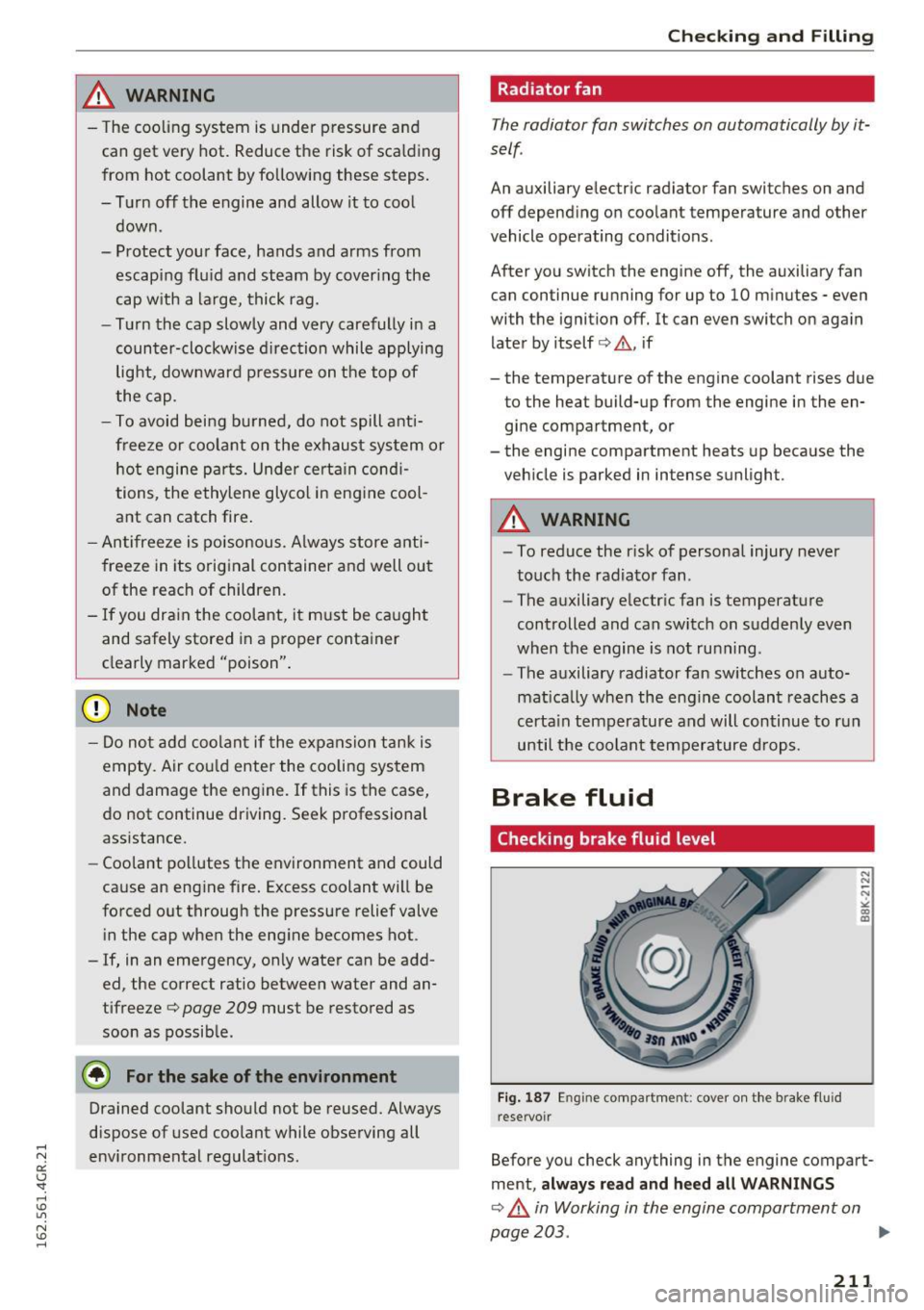
Checking brake fluid level
Fig. 187 En g in e compar tment: cover on the b rake fluid
rese rvoir
Before you check anything in the engine compart
ment,
always read and heed all WARNINGS
¢ & in Working in the engine compartment on
page 203 . .,.
211
Page 214 of 282

Checking and Filling
"' Read the brake fluid level from the brake fluid
reservoir
¢ fig. 187, ¢page 205, fig. 183. The
brake fluid level must be between the "MIN"
and "MAX" markings.
The location of the brake fluid reservoir can be
seen in the engine compartment illustration
c>page205.
The fluid level may drop slightly after some time
due to the automatic adjustment of the brake
pads. This is not cause for alarm.
If the brake fluid level falls considerably below
the "MIN" mark, the brake warning/indicator
light
1111 (U.S. models)/ . (Canadian models)
will come on¢
page 14. Do not continue to oper
ate the vehicle. The complete brake system
should be thoroughly checked by an authorized
Audi dealer or other qualified facility and the
cause corrected . If the brake fluid level is too
low, the brake warning/indicator light will illumi
nate. Contact an authorized Audi dealer
immedi
ately.
Changing brake fluid
Have the brake fluid changed by an experienced
technician.
Brake fluid absorbs moisture from the air . If the
water content in the brake fluid is too high , cor
rosion in the brake system may result after a pe
riod of time. The boiling point of the brake fluid
will also decrease considerably and decrease
braking performance.
Therefore, the brake fluid must be changed
every
two years.
Always use new brake fluid which con
forms to Federal Motor Vehicle Standard "FMVSS
116 DOT 4".
The brake fluid reservoir can be difficult to reach,
therefore, we recommend that you have the
brake fluid changed by your authorized
Audi
dealer.
Your dealer has the correct tools, the
right brake fluid and the know-how to do this for
you.
212
A WARNING
-
- Brake fluid is poisonous. It must be stored
only in the closed original container out of
the reach of children!
- Brake failure can result from old or inappro
priate brake fluid. Observe these precau
tions:
- Use only brake fluid that meets SAE speci
fication
J 1703 and conforms to Federal
Motor Vehicle Standard 116. Always check
with your authorized Audi dealer to make
sure you are using the correct brake fluid.
The correct type of brake fluid is also indi
cated on the brake fluid reservoir .
- The brake fluid must be new. Heavy use of
the brakes can cause a vapor lock if the
brake fluid is left in the system too long .
This can seriously affect the efficiency of
the brakes as well as your safety. This
could result in an accident.
(D Note
Brake fluid will damage the paint of your vehi
cle.
@ For the sake of the environment
Because of the problem of proper disposal of
brake fluid as well as the special tools re
quired and the necessary expertise, we rec
ommend that you have the brake fluid
changed by your authorized Audi dealer .
Battery
General information
Under normal operating conditions, the battery
in your Audi does not need any maintenance.
With
high outside temperatures or long daily
drives we recommend that you have the electro
lyte level checked by a service facility. The elec
trolyte level should also be checked each time
the battery is charged ¢
page 214.
Have the battery checked when you take your ve
hicle in for service. You are well advised to re
place a battery that is older than S years.
Page 215 of 282

With certain types o f air bag dep loyment, the
battery is disconnected from the vehicle electri
cal system for safety reasons¢&.
in Repair, care
and disposal of the airbags on page 150 .
Disconnecting the battery terminals
Some vehicle func tions (power w indow re gula
t ors, for example) are lost i f th e battery termi
na ls are d isconnected . These functions have to be
relearned a fter the battery termina ls are con
nected aga in. To prevent th is, the batte ry s hou ld
only be disco nnected from the vehicle e lectr ica l
system w hen abso lut ely necessa ry for repairs.
Veh icles not driven for long periods
If yo u do not drive you r vehicle over a period of
seve ral days or weeks, e lectrical components a re
g radually c ut back or sw itched off. This reduces
e n ergy consumption and ma inta ins starting ca
pability over a longer period ¢
page 186. Some
of the co nvenience funct io ns m ay not o perate,
such as the i nter io r li ghts or powe r seat adjust
men t. T he conve nie nce func tions w ill be av aila ble
ag ain whe n you swi tch on the igni tion and start
the eng ine .
Winter operation
During the win ter mo nth s, ba ttery capaci ty te nds
to decr ease as temperatu res drop . T his is be
c a use more power i s als o c ons umed w hile s tar t
i ng, and t he he adlights, rear w indow de fogge r,
etc., a re used more o ften .
Avoi d unn ecess ary power consu mption, part icu
larl y in cit y tr affic or when traveling on ly sho rt
d is tan ces. Let yo ur au thori ze d Aud i d ealer che ck
the cap aci ty of the vehicle battery before w inte r
sets in ¢
pa ge 214 . A well charge d battery w ill
n ot on ly prevent start ing p roblems w hen the
weather is cold, but will also last longer .
(D Tips
If your ve hicle is left stand ing fo r severa l
weeks at extremely low tem peratures, the ve
hicle batte ry s hould be removed an d sto red
where it will not freeze. This will preve nt it
fro m being damaged an d hav ing to be re
placed.
Checking and Filling
Working on the battery
Be especially careful when working on or near
th e battery.
The battery is located in the luggage compart
ment under the floor. Befo re yo u check anything
i n the luggage compart ment ,
read and heed all
WARNINGS ¢&_ .
Always heed the safety warnings , when wor king
o n the veh icle batte ry or t he ve hicle elec trical
system to prevent in ju ry .
The following WARNINGS are very important
when working on the battery :
Always heed the following WARNING SYM-
BOLS and safety precautions when working on the battery.
®
Always wear eye protection .
~
Battery acid contains sulfuric acid . Al-
ways wear gloves and eye protection .
@
No
- sparks
- flames
· smoking .
~
When a battery is charged, it produces
hydrogen gas which is explosive and
could cause personal injury.
®
Always keep the battery well out of
reach of children .
A WARNING
=
Whenever working on t he battery or on the
e lectr ica l system, the re is the r isk of injury,
accide nt a nd eve n fire. Read and he ed the fol
l ow ing W AR NIN GS:
- Always wear eye prot ection. Do not let bat·
tery acid or any l ead particles g et on you r
skin o r clothing. Shield yo ur ey es. E xplosiv e
g ases can ca use b lindne ss or o ther in jury.
- Ba tte ry acid contai ns sulfur ic acid . Su lfu ric
acid can ca u se blindness and s evere burns.
- Always wea r gloves and eye protection . Do
n ot tilt t he batte ry because aci d could lea k
-
out of the ventilation openings. ""
213