2016 AUDI Q5 service
[x] Cancel search: servicePage 167 of 300

..... N
co ~ CX)
..... I.Cl U"I
..... I.Cl .....
@ For the sake of the environment
Undep loyed airbag modu les and pretension
ers might be classified as Perchlorate Materi
al -special handling may apply, see
www.dtsc .ca.gov/hazardouswaste/perchlo
rate . When the veh icle or parts of the re
straint system including airbag modules safe
ty belts with pretensioners are scrapped, all
app licable laws and regulations must be ob
served. Your authorized Audi dealer is familiar
w ith these req uirements and we recommend
that you have your dealer perform this service
for you.
Other things that can affect Advanced
Airbag performance
Changing the vehicle's suspension system can
change the way that the Advanced Airbag System
pe rforms in a crash. For examp le, using tire-r im
comb inat ions not approved by Audi, lowering the
veh icle, chang ing the stiffness of the suspens ion,
including the springs, suspension struts, shock
absorbers etc . can change the forces that are
measured by the airbag sensors and sent to the
e lectronic control unit . Some suspension changes
can, for example, increase the force levels meas
ured by the sensors and make the airbag system
deploy in crashes in wh ich it would not deploy if
the changes had not been made . Other kinds of
changes may reduce the fo rce levels measured by
the sensors and prevent the airbag from deploy ing when it should.
A WARNING
Changing the vehicle's suspension including
use of unapproved tire-rim combinations can
change Advanced Airbag performance and in
crease the risk of serious personal injury in a
crash.
- Never install suspens ion components that
do not have the same performance charac
teristics as the components or iginally instal
led on your veh icle.
- Never use tire-rim combinations that have
not been approved by Audi.
Airb ag sys tem
A WARNING
-Items stored between the safety belt buckle
and the center console can cause the sensors
i n the buckle to send the w rong information
to the electronic contro l modu le and prevent
the Advanced A irbag System from wo rking
p roperly.
- Always make sure that nothing can interfe re
with the safety belt buckles and that they
are not obstructed.
Side airbags
Description of side airbags
The airbag system con provide supplemental
protection to properly restrained occupants.
Fig. 1 69 Side a irbag locatio n in the driver 's seat
T he side airbags are located in the s ides of the
front seat backrests
r='.> fig . 169 and the rear back
rest* facing the doo rs. They are ident ified by t he
word "AIRBAG".
The si de airbag system ba sic ally con sis t s of:
- the electronic control module and external side
impact sensors
- the two a irbags located in the s ides of the front
backrests and the two airbags* located in the
rear backrest
- the airbag warning light in the instrument clus-
ter.
The airbag system is monitored electronica lly to
make certain that it is functioning proper ly at all
t imes . Each time you turn on the ignition, the a ir
bag system indicator light w ill come on for a few
seconds (self diagnostics) .
Ill-
165
Page 200 of 300
Driving and th e en vironm ent
- Do not apply additional undercoating or
rustproofing on or near the exhaust mani
fold, exhaust pipes, catalytic converter or heat sh ields . During dr iv ing, the substance
used for undercoating could overheat and
cause a fire .
{U) Note
-Be aware that just one tank filling with
leaded fuel will already seriously degrade
the performance of the catalytic co nverter .
- Do not exceed the correct engine oil level
c:>page224 .
-Do not drive until the fuel tank becomes
completely empty . The engine could mis
fire. Unburned fuel could also get into the
exhaust system and this could cause the
catalytic converte r to overheat.
- Do not turn off the ignition while the vehicle
. . 1s moving.
- Do not continue to operate your vehicle un
der these cond itions, as otherwise fuel can
r each the catalytic converte r. This could re
su lt in overheating of the converter, requir
i ng its replacement .
- To assure efficient operation of the Emis
s ion Control System:
- Have your vehicle maintained properly and in accordance with the service recommen
dations in your Warranty
& Maintenance
booklet .
- Lack of proper maintenance as well as im
proper use of the vehicle will impair the
function of the em ission control system
and could lead to damage.
@ For the sake of the environment
Even when the Emission Control System is op
erat ing properly, the exhaust gas can have a
sulfur-like exhaust gas smell under some op
erat ing states . This depends on the su lfur
content of the fuel be ing used. Using a differ
ent brand of fue l may he lp, or filling the tank
with lead-free super grade gasoline.
198
Diesel particulate filter
Applies to vehicles: with diesel engine
The diese l particulate filter filters near ly all of
the soot particles out of th e exhaust. The filter
cleans itself automat ically under normal d riving
conditions. If the filter cannot clean itself (for ex
ample, because you are only driving shor t distan
ces), the filter becomes clogged with soot and
the
II symbol for the diesel part iculate filter il
luminates
c:> page 34 .
&_ WARNING
-Do not park your vehicle over flammable
materials such as grass or leaves because
the high temperature of the diesel particu
late filter could start a fire.
-
- Do not apply an underbody protectant in the
exhaust system area or a fire could start.
Avoid damaging the
vehicle
When you are driving on poor roads, or over
curbs, steep ramps, etc., make certain that low
lying parts such as spoilers and exhaust system
parts do no t bottom out and ge t damaged.
This is espec ially true for vehicles with low-s lung
chassis (sports chassis)* and fully loaded
vehicles.
Economical and environ
mentally-friendly driving
General
Your personal style of driving will determine the
economy of your vehicle, as well as exhaust and
noise levels.
Fuel economy, environmental impact, and wear
on your engine, brakes and tires largely depend
on three factors:
- your personal driving style
- operating conditions
- technical limitations
If you anticipate what you need to do next and
drive economically, you can easily cu t your fuel
Page 201 of 300

..... N
co
er::
co
.....
give you some tips on how you can he lp the envi
ronment and your pocketbook.
(D Tips
T he consumpt ion estimates as published by
ENVIRONMENTAL PROTECTION AGENCY
(EPA) and Transport Canada may not corre
spond to your act ual consumption on the
road, which will vary depending upon vehicle
load and speed, road and weather conditions,
trip length, etc.
Drive smoothly and keep a lookout ahead
Vehicles use the most fuel when they are acceler
ating .
.. Avoid unnecessary accelerating and braking.
Vehicles use the most fuel when they are acceler
ating . If you anticipate what is going to happen
next, you will need to brake less and, thus, accel
erate less . Let the vehicle coast whenever possi
b le -for example when you see that the next traf
fic light is red .
Avoid full throttle
Driving a t moderate speeds saves fuel and im
proves your mileage .
.. Try and keep well be low your car's max imum
speed.
Accelerating gent ly reduces f uel consumption,
engine wear, and does not disturb the environ
ment.
F ue l cons umption, exha ust emissions and engine
noise increase d isproportionately at high speeds.
If yo u drive at approximately three quarters of
top speed, fuel consumpt ion w ill be reduced by
one ha lf. Never drive faster than the posted
speed limit and weather conditions perm it .
Driving and the envir onment
Reducing unnecessary idling
Even when your car is just idling it burns up fuel .
.. Shut the eng ine off when you are not driving
the vehicle.
.. Do not warm up t he vehicle by lett ing the en-
gine run at idle .
The idling phase is automatically reduced for
vehicles with the Start-Stop-System*. It is effi c ient to sw itch off the engine in veh icles without
the Start-Stop-System* when stopped at ra ilroad
c ross ings and long red lights . T urning the engine
off fo r just 30-40 seconds saves mo re fue l th an is
bur ned by s tarti ng the eng ine again .
It takes a long time for the eng ine to warm up
fully when it is ru nning at id le. However, wea r
and noxious emissions are especially high w hen
t h e engine is war ming up. So yo u should dr ive
aw ay as soon as you star t the eng ine and avoid
runn ing at high rpms w hile the engine is sti ll
warming up .
(D Note
Do not leave eng ine idling unatt ended after
start ing. If wa rning lights sho uld come on to
i ndicate impro per operation, they would go
u nheeded. Extended idling also prod uces
heat, which could result in overheating or
other damage to the vehicle o r othe r proper
ty .
Regular maintenance
A badly tuned engine unnecessarily wastes a lot
of fuel .
.. Have your vehicle serviced at regular interva ls.
By hav ing your vehicle regular ly serv ice d by an
authorized Aud i dea ler helps to ensure that it
runs properly and economically . T he cond ition o f
yo ur vehicle not on ly affects its safety and ability
to hold its value , it also affects
fuel consump
tion .
Check your oil each time you fill your tank.
T he amou nt o f oil used is related to engine load
and speed. .,,.
199
Page 209 of 300

..... N
co
er::
co
.....
General information
Regular, proper care helps to maintain your vehi
cle's value.
It can a lso be a requirement when
submitting warranty claims for corrosion damage
and paint defects on the body.
The necessary care products can be obtained
from your authorized Audi dealer or authorized
Audi Service Facility . Read and follow the instruc
tions for use on the packaging.
A WARNING
- Us ing clean ing and care products incorrectly
can be dangerous to your health.
- Always store clean ing and care products out
of reach of children to reduce the r isk of po i
soning .
@ For the sake of the environment
- Preferably use environmentally-friendly
products when buying cleaning agents.
- Do not dispose of leftover cleaning and care
products with household trash.
Car washes
The longer that deposits such as insects, bird
droppings, tree sap or road salt remain on the ve
h icle, the more the surface can be damaged. High
temperatures such as those caused by sunlight
i ncrease the damag ing effect .
Before washing, r inse off heavy depos its with
p lenty of water.
Stubborn deposits such as bird droppings or tree
sap are best removed with plenty of wate r and a
microfiber cloth.
Also, wash the underside of your vehicle once road sa lt stops being used for the season .
Pressure washers
When washing your ve hicles w ith a pressure
washer, always follow the ope ra ting inst ructions
p rovided w ith the pressure washe r. This is espe
cially important in regard to the pressure and
spraying distance. Do not aim the spray directly
Ca re and cleaning
at seals on side w indows, doo rs, the hood, the
lu ggage compartment lid or the sunroof* or at
t ires, rubber hoses, insulating material, sensors *
or camera lenses*. Keep a distance of at least 16 inches (40 cm) .
Do not remove snow and ice with a pressure
washer.
Never use rota ry nozzles or high pressure noz
zles .
T he wate r temperatu re must not be above 140 °F
(60 °() .
Automat ic car washes
Spray off the vehicle before washing .
Make s ure that the windows and roof * are closed
and the windsh ield wipers are off. Follow instruc
t ions from the car wash operator, especially if
there are accessories attached to your vehicle.
If possible, use car washes that do not have
brushes.
Washing by hand
Clean the ve hicle starting from the top and work
ing down using a soft sponge or cleaning br ush .
U se solvent-free cleaning products.
Washing vehicles with matte finish paint by
hand
To avoid damaging the paint when washing, first
remove d ust and large particles from your vehi
cle. Insects, grease spots and f ingerprints are
best removed w ith a special cleaner for matte
finish paint.
Apply the product using a microfiber cloth . To
avo id damag ing the pa int surface, do not use too
much pressure .
Rinse the vehicle thorough ly with water. Then
clean using a neutra l shampoo and a soft mic ro
fiber cloth.
Rinse the ve hicl e thorough ly agai n an d let it air
dry. Remove any water residue using a sham my.
IIIJ,,
207
Page 210 of 300

Care and cleaning
& WARNING
-Only wash the vehicle when the ignition is
off and follow the instructions from the car
wash operator to reduce the risk of acci dents.
- To reduce the risk of cuts, protect yourself from sha rp metal components when wash
ing the underbody or the inside of t he wheel
hous ings.
- After was hing the vehicle, the braking effect
may be delayed due to mo isture on the
bra ke rotors o r ice i n the winte r. The bra kes
mus t be d ried first w ith a few care ful brake
applications .
@ Note
-If you wash the ve hicle in an automa tic car
wash, you m ust fold the exte rior m irrors i n
to reduce the risk of damage to the mirrors.
Power folding exterior m irrors * must on ly
be fo lded in and out using the power folding
funct ion.
- To reduce the risk of damage to the rims
and tires, compare the width between the
whee ls on your ve hicle w ith the distance be
tween the gu ide rails in the car wash. -
To red uce the risk of damage, compare the
heig ht and width of your vehicle with the
heig ht and w idth of the inside of the car
wash.
- To prevent paint damage, do not wash the
vehicle in direct sunlight.
- To reduce the risk of damage to the surface,
do not use insect removing sponges, k itchen
sponges or s imilar items.
- Matte finish painted vehicle components:
- To reduce the r isk of damage to the sur-
face, do not use polish ing agents or hard
wax.
- Never use protective wax. It can destroy
the matte finish effect.
- Do not place any stickers or magnetic signs on vehicle parts pain ted with matte
finish paint. The paint could be damaged
when the stickers or magne ts are re
moved.
@ For the sake of the environment
Only wash the veh icle in facilities spe cially de
signed for that pu rpose. This will reduce the
r isk of dirty wate r contamina ted with o il from
entering the sewer system .
Cleaning and care information
When cleaning and caring for individua l vehicle
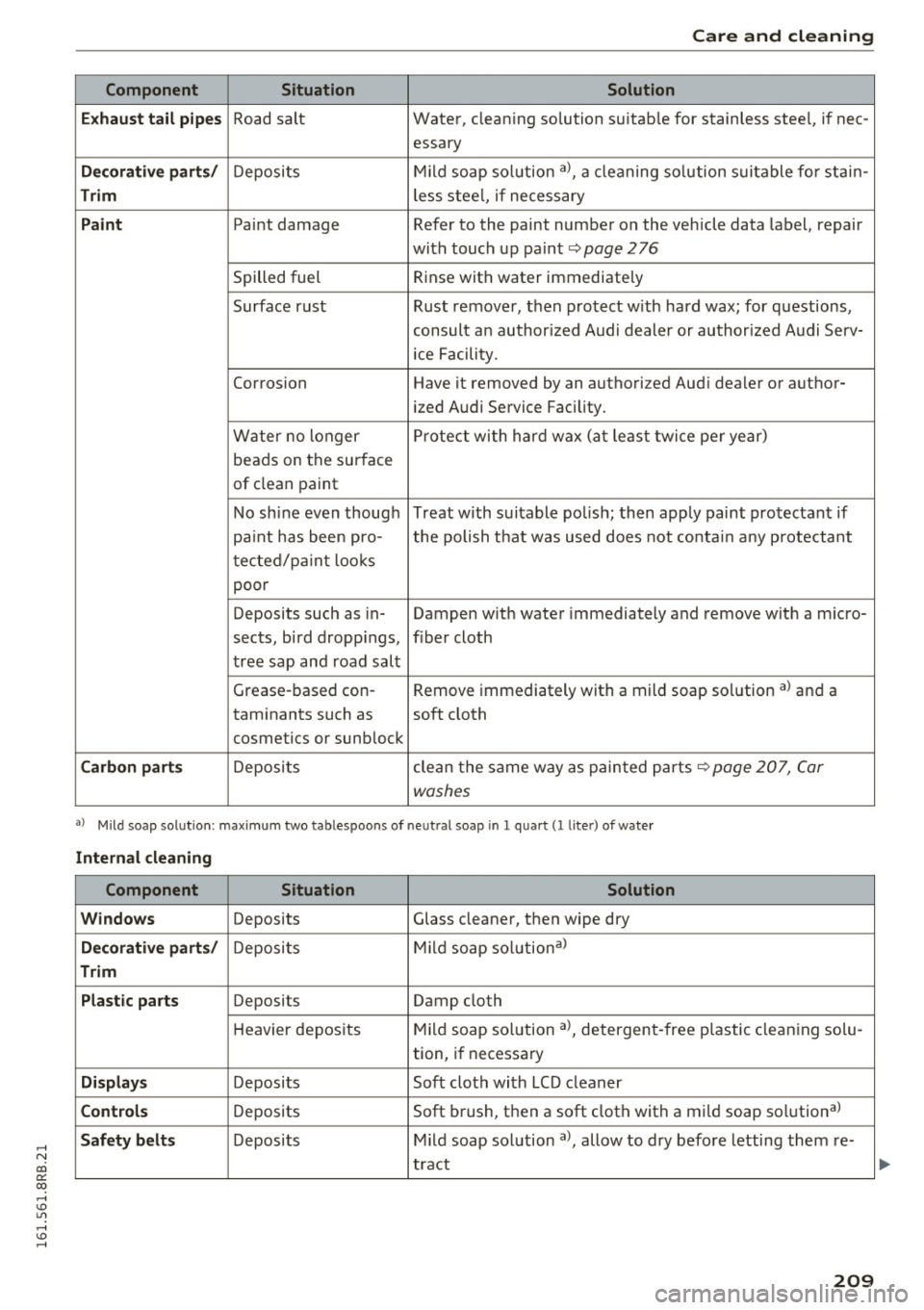
components, refer to the following tables. The information conta ined there is s imply recom
mendations . Fo r quest ions or for components that are not
listed, consult an authorized Aud i
dealer or authorized Audi Service Fac ility. Also
fo llow the information found in c::> & .
Ex ter io r cleaning
Component S ituation Solution
Wind shield wiper
Deposits c::> page 58, Cleaning windshield wiper blades
blades
Headlights /
Deposits Soft sponge with a mild soap solution a)
Tail lights
Sen sor s/
Deposits Sensors: soft cloth with solvent-free cleaning sol utio n
camera len ses Camera lenses: soft cloth w ith alcoho l-free cleaning so lu-
tion
Snow/ice Hand brush/solvent -free de -icing spray
Wheels Road salt Water
Brake dust Acid-free special cleaning solution
208
Page 211 of 300
,....,
N
co
er::
co
,....,
Component Situation Solution
Ex haust t ail p ip es
Road salt Water, cleaning solution suitab le for stainless steel, if nee-
essary
D eco rative p art s/ Deposits Mild soap solution
al, a cleaning so lution suitable for stain-
Trim less stee l, if necessary
Paint Paint damage Refer to the paint number on the vehicle data label, repair
with touch up paint
c:::;, page 276
Spilled fuel R
inse with water immediately
Surface rust Rust remover, then protect w ith hard wax; for questions,
consult an author ized Audi dealer or author ized Audi Serv-
ice Facility.
Corrosion Have it removed by an authorized Audi dealer or author-
ized Audi Service Facility.
Water no longer P
rotect with hard wax (at least twice per year)
beads on the surface
of clean paint
No sh ine even though Treat with suitable po lish; then apply paint protectant if
pa int has been pro- the polish that was used does not contain any protectant
tected/pa int loo ks
poor
Deposits such as in- Dampen w ith water immediately and remove wit h a m icro-
sects, bird dropp ings, fiber cloth
tree sap and road salt
Grease-based con- Remove immediately with a mild soap solution al and a
taminants such as
soft cloth
cosmetics or sunb lock
C arbon p art s Deposits clean the same way as painted parts c:::;, page 207, Car
washes
a) Mil d soap solution: maximum two tables po ons of neu tral soap in 1 quar t (l lite r) of wate r
Internal cl ea ning
Component Situation Solution
Windows
Deposits Glass cleaner, then wipe dry
Decorativ e part s/ Deposits M
ild soap solutional
Trim
Pla st ic par ts
Deposits Damp doth
H eavier deposits M
ild soap solution al, detergent-free p lastic clea ning so lu -
tion, if necessary
D ispla ys Deposits Soft cloth with LCD cleaner
Cont ro ls Deposits Soft brush,
then a soft cloth with a mild soap solution al
Safety bel ts Deposits Mild soap solution al, allow to dry before letting them re-
tract
209
Page 213 of 300

,....,
N
co
er::
co
,....,
one direction and not back and forth.
- Never remove snow or ice from door win
dows and mirrors using warm or hot water
because this could cause cracks to form.
- To avoid damage to the rear window de
fogger, do not apply any stickers on the
heating wires on the inside of the window.
- Decorative parts/trim
- Never use chrome care or cleaning prod-
ucts.
-Paint
- To reduce the risk of scratches, the vehicle
must be free of dirt and dust before pol
ishing or waxing.
- To prevent paint damage, do not polish or
wax the vehicle in direct sunlight.
- To reduce the risk of paint damage, do not
polish away rust spots.
- Remove cosmetics and sunscreen immedi
ately- these could damage the paint.
-Displays
-To avoid scratches, do not use dry cleaning
methods on displays.
-Controls
- Make sure that no fluids enter the con-
trols, because this could cause damage.
- Safety belts
- Do not remove the safety belts to clean
them.
- Never clean safety belts or their compo
nents chemically or with corrosive fluids
or solvents and never allow sharp objects
to come into contact with the safety belts.
This could cause damage to the belt web
bing.
- If there is damage to the webbing, the
connections, the retractors or the buckles,
have them replaced by an authorized Audi
dealer or authorized Audi Service Facility.
- Textiles/artificial leather/ Alcantara
- Never treat artificial leather/ Alcantara
with leather care products, solvents, floor
polish, shoe polish, spot remove or similar
products.
- Have a specialist remove stubborn stains
to prevent damage.
Care and cleaning
-Never use steam cleaners, brushes, hard
sponges, etc. when cleaning.
- Do not turn on the seat heating* to dry the
seat.
- Objects with sharp edges such as zippers,
rivets on clothing or belts can cause dam
age to the surface.
- Open hook and loop fasteners, for exam
ple on clothing, can damage seat covers.
Make sure hook and loop fasteners are
closed.
- Natural leather
- Never treat leather with solvents, floor
polish, shoe polish, spot remover or simi
lar products.
- Objects with sharp edges such as zippers, rivets on clothing or belts can cause dam
age to the surface.
- Never use steam cleaners, brushes, hard
sponges, etc. when cleaning.
- Do not turn on the seat heating* to dry the
seat.
- To help prevent the leather from fading,
do not leave the vehicle in direct sunlight
for long periods of time. If leaving the ve
hicle parked for long periods of time, you
should cover the leather to protect it from
direct sunlight.
(D Tips
-Insects are easier to remove from paint that
has been freshly waxed.
- Regular waxing can prevent rust spots from
forming.
Placing your vehicle out
of service
If you would like to take your vehicle out of serv
ice for a longer time, contact your authorized
Audi dealer or authorized Audi Service Facility.
They will advise you of important measures, such
as corros ion protection, maintenance and stor
age procedures . Also follow the information
about the battery ¢
page 229.
211
Page 215 of 300

,....,
N
co
er::
co
,....,
pecia lly we ll for winter or summer driving. Dur
ing seasona l change-over, we suggest that you
f ill up at busy gas stations where the seasonal
adjustment is more likely to be made in time.
- Fuels containing a high percentage of etha
no l such as ESO and E85 may only be used in
vehicles with flexible fuel* eng ines. Using
high ethanol fuel in veh icles not equ ipped
with flexible fuel* engines can cause severe
engine damage .
- Methanol fuels which do not meet these re quirements may ca use corros io n and dam
age to plast ic and r ubber components in the
fuel system.
- Do not use fuels that fail to meet the spec i
fied c rit er ia i n this c hapter.
- If you a re unable to determine whether or
not a particular fue l blend meets the spec i
fi cat ions, ask your service station o r its fuel
su pplier.
- Do not use fue l fo r w hich the contents can
not be identified.
- Fuel sys tem damage and performance prob
l ems result ing from the use of fue ls diffe r
ent from those specified are not the respon
s ibility o f Audi and are no t covered under
the New Vehicle or the Emissio n Contro l
System Wa rranties .
- If you experience a loss of fue l economy o r
driveability an d performance prob lems d ue
to the use o f one of these fuel b lends, we
r ecommend that you switch to unblended
fuel.
Ethanol fuel (Bio-ethanol)
App lies to vehicles: with flexib le fuel engine
You con recognize vehicles with a flexible fuel
engine by looking a t the label on the inside of
the fuel filler flop.
Veh icles with flexibl e fu el engines may be op er
ated w ith bio -ethanol fuels such as E85 (85%
ethano l and 15% gasoline) or with un leaded gas
oline (9 1 AKI/RO Z 95). The ve hicle may a lso be
ope rated with a mixture of these fuels.
Fuel and R efueling
Your fuel consumpt ion w ill increase when using
bio-ethano l fue ls due to th e lower amount of en
ergy conta ined per un it vol ume in ethanol.
Warming up the flexible fuel engine in low
temperature s
Due to the chemica l composition of b io -ethanol ,
a certa in amount of fue l ends up in the engine o il
when driving short distances in very low temper
atures . This fuel evaporates again when the en
gine is warmed up.
II Please warm up eng ine .
If the drive r message appears in the instr ume nt
cluster disp lay, drive with a warm engine to re
duce the oil leve l.
(D Note
- N ever fill wi th metha nol o r with a higher
percentage of b io -ethanol than 85% (E85).
A highe r percentage of bio-ethanol in the
fuel can cause damage to the engine or to the fuel system.
- If you use on ly E85, it is recommended to
fill the fue l tank complete ly w ith unleaded
premium grade gasoline every 5,000 mi les.
- If you expe rience starting, rough id le or hes
itat ion d riveab ility prob lems, f ill the fuel
tank complete ly w ith unleaded p remium
grade gaso line and drive it norma lly until
the gaso line is used. See your author ized
Audi dea ler if the problem persists.
- Inform your author ized Audi dealer that you
are operating o r have operate d the vehicle
w ith E8S.
- Read and follow the i nformat ion and tips
abou t gasoli ne <=:>
page 212 .
(D Tips
It may take longer to start the engine when
the outs ide temperatu re is very cold . If possi
ble, use w inte rized fue l if tempe ratures are
below free zing .
213