2016 AUDI A4 low fuel
[x] Cancel search: low fuelPage 219 of 278

Wheels
Wheels and Tires
General information
.,.Check your tires regularly for
damage (punctures, cuts, cracks
and bulges). Remove foreign ob
jects from the tire tread.
.,. If driving over curbs or similar
obstacles, drive slowly and ap
proach the curb at an angle.
.,.Have faulty tires or rims re
placed immediately.
"'Protect your tires from oil,
grease and fuel.
.,.M ark tires before removing
them so that the same running
direction can be maintained if
they are reinstalled.
"'Lay tires flat when storing and
store them in a cool, dry location
with as little exposure to light as
possible.
(D Note
-Please note that summer and
winter tires are designed for
the conditions that are typical in those seasons. Audi recom
mends using winter tires dur
ing the winter months. Low
temperatures significantly de crease the elasticity of summ
er tires, which affects traction
Wheels
and braking ability. If summer
tires are used in very cold
temperatures, cracks can form
on the tread bars, resulting in
permanent tire damage that
can cause loud driving noise
and unbalanced tires.
-Burnished, polished or
chromed rims must not be
used in winter driving condi
tions. The surface of the rims
does not have sufficient corro
sion protection for this and
could be permanently dam aged by road salt or similar
substances.
Tire designations
Fig. 188 T ir e designations on the side -
wall Ill>
217
Page 222 of 278

Wheels
Bead
means the part of the tire that is
made of steel wires, wrapped or
reinforced by ply cords and that is
shaped to fit the rim .
Bead separation
means a breakdown of the bond
between components in the bead.
Cord
means the strands forming the
plies in the tire.
Cold tire inflation pressure
means the tire pressure recom
mended by the vehic le manufac
turer for a tire of a des ignated
size that has not been driven for more than a couple of miles (kilo
meters) at low speeds in the
three hour period before the tire pressure is measured or adj usted.
Curb weight
means the weight of a motor ve
hicle w ith standard equipment in
cluding the maximum capacity of
fuel, oil, and coolant, air condi
tioning and additiona l weight of
op tional equipment.
E x tra load tire
means a tire des igned to operate
at higher loads and at h igher in -
220
flation pressures than t he corre
spond ing standa rd tire. Extra load
tires may be identified as "XL",
"xl" , "EXTRA LOAD" , or "RF" on
the sidewall.
Gross A xle Weight Rating
("GAWR ")
means the load-carrying capacity
of a single axle system , measured
at the ti re-gro und interfaces.
Gross Vehicle Weight Rating
("GVWR")
means the max imum total loaded
weight of the vehicle .
Groove
means the space between two ad
jacent tread ribs .
Load rating (code)
means the maximum load tha t a
tire is rated to carry for a given in
flation pressure. You may not find
this informat ion on all ti res be
cause it is not required by law .
Maximum load rating
means the load rating for a tire at
the maximum permissible infla
tion p ressure for that ti re .
Maximum loaded vehicle
weight
means the sum of:
Page 230 of 278

Wheels
the risk of an accident. Read and follow the important safe
ty precautions in ¢ page 229,
Tires and vehicle load limits.
-The tire must flex more if the
tire pressure is too low or if
the vehicle speed or load are
too high. This heats the tire up
too much. This increases the
risk of an accident because it
can cause the tire to burst and
result in loss of vehicle con
trol.
-Incorrect tire pressure in
creases tire wear and has a
negative effect on driving and
Tire pressure table
Please note that the informat ion
contained in the following table
was correct at the time of print
ing, and the information is sub
ject to change. If there are differ
ences between this information
and the tire pressures specified
on the label on the driver's side 8- pillar, always follow the specifica
tion on the 8-pillar label
¢ page 227, fig.190.
228
braking behavior, which in
creases the risk of an accident.
(D Note
Replace lost valve caps to re
duce the risk of damage to the
tire valves.
@ For the sake of the environment
Tire pressure that is too low in
creases fuel consumption.
(D Tips
Audi recommends using the
tire pressure specified for a normal load
¢ page 228 or for
a full load when the vehicle is
partially loaded .
Make sure that the tire designa
tion on your tire matches the des ignation on the tire pressure label
and the tire pressure table.
The following table lists recom
mended tire pressures in cold
tires according to the load and the size of the tires installed.
Page 232 of 278

Wheels
loss of vehicle control, but can al
so damage important parts of the
vehicle and can lead to sudden tire failure, including a blowout
and sudden deflation that can
cause the vehicle to crash.
Your safety and that of your pas
sengers also depends on making
sure that load limits are not ex
ceeded. Vehicle load includes ev
erybody and everything in and on
the vehicle. These load limits are
technically referred to as the vehi
cle's
Gross Vehicle Weight Rat
ing
("GVWR ") .
The "GVWR" includes the weight
of the basic vehicle, all factory in
stalled accessories, a full tank of
fuel, oil, coolant and other fluids plus maximum load. The maxi
mum load includes the number of
passengers that the vehicle is in
tended to carry ("seating capaci
ty") with an assumed weight of 150 lbs. (68 kg) for each passen
ger at a designated seating posi
tion and the total weight of any
luggage in the vehicle. If you tow
a trailer, the weight of the trailer
hitch and the tongue weight of
the loaded trailer must be includ
ed as part of the vehicle load.
230
The Gross Axle Weight Rating
("GAWR") is the maximum load
that can be applied at each of the
vehicle's two axles.
The fact that there is an upper
limit to your vehicle's Gross Vehi
cle Weight Rating means that the
total weight of whatever is being
carried in the vehicle (including
the weight of a trailer hitch and
the tongue weight of the loaded
trailer) is limited. The more pas
sengers in the vehicle or passen
gers who are heavier than the
standard weights assumed mean
that less weight can be carried as
luggage.
The Gross Vehicle Weight Rating and the Gross Axle Weight Rating
are listed on the safety compli
ance sticker label located on the
driver's side B-pillar
¢ page 22 7,
fig. 190.
! WARNING
Overloading a vehicle can cause
loss of vehicle control, a crash
or other accident, serious per
sonal injury, and even death.
-Carrying more weight than your vehicle was designed to carry will prevent the vehicle
from handling properly and
Page 234 of 278

Wheels
Th at w eight ma y not safel y ex
ce ed th e av a il a bl e c argo and
lugga ge loa d capa city c alcul at
ed in St ep 4.
6 . If yo ur vehicle will b e to wing a
tr aile r, lo ad fr om your tr ailer
w ill b e tran sferred to your ve
h ic le . Con sult thi s manual to
dete rmin e how this re du ce s
the a vailable carg o and lug
g age load capa cit y o f your vehi
cle .
.,.Ch eck th e tire s idewall
(¢pag e 217 J fig . 188) to deter
min e the d esign ated load r ating
for a specifi c tire .
Wheel bolts and rims
Wheel bolts
W heel bol ts must be clean and loosen/t ighten
eas ily.
Rims
R ims with a bolted rim r ing * or w it h bolted whee l
covers * consist of mu ltiple pieces . These compo
nents were bolted together using specia l bolts
a nd a special procedu re. You must not repair o r
d isassemble th em¢ ,&..
_& WARNING
Whee l bolts tha t are t ightened o r repa ire d in
correctly can become loose and resul t in loss
of vehicle control, which increases the risk of
an acc ident. For the correct t ightening specif i
cat ion, refer to¢
page 241, After changing a
wheel.
- Always keep the wheel bolts and the
threads in the whee l hub clean and free of
grease.
- Only use wheel bolts that fit the rim.
232
- Always have damaged rims repaired by an
author ized Audi dealer or authorized Audi
Serv ice Facility. Neve r repa ir or disassemb le
r ims you rself, because this increases the risk
of an accident.
Winter tires
Win ter tires significantly improve the vehicle's
handling when dr iv ing in winter conditions. Be
ca use of their const ru ct ion (w idth, compou nd,
t read pat te rn), summer t ires provide less t rac
tion on ice and snow .
.,. Use winter tires on all four wheels.
.,. Onl y use winter tires that a re approved fo r yo ur
veh icle.
.,. Please note that t he maximum permit ted
speed may be lower with winter tires¢.&_ . An
authorized A udi dealer or authorized Audi
Serv
ice Facility can inform you about the maximum
permitted speed for your tires .
.,. Check the tire pressure after insta lling wheels
¢ page 227.
The effectiveness of winter tires is reduced great
l y when the tread is worn down to a depth of
0 .157 in (4 mm). The characteristics of winter
tires also decrease g reatly as the tire ages, re
gard less of the rema ining t read .
_& WARNING
-
-Never d rive fas ter than the max imum pe r
m itted speed for your tires. This could c ause
the t ires to hea t up too m uch. T his increases
the risk of an accident because it can cause the t ire to burst.
- Always ada pt your driving to the road and
traffic conditions. Drive carefu lly and reduce
your speed on icy or slippery roads. Even
winter t ires can lose tract ion on black ice.
@ For the sake of the environment
Reinsta ll summer tires a t the appropriate
time, beca use they provide better handling
when roads are free o f snow and ice. Summer
tires cause less road no ise, tire wear and fuel
consumpt ion.
Page 237 of 278
..... N
0 ::..:: co .....
The temperature grade for this tire is established for a tire that is properly inflated and
not overloaded. Excess ive speed, underinfla
tion, or excessive loading, either separately or
in combination, can cause heat buildup and
possible tire failure.
& WARNING
-
-
Temperature grades apply to tires that are properly inflated and not over or underinflat
ed.
Tire pressure monitoring system
U) General notes
App lies to vehicles: with tire pressure mo nitoring system
Each tire, including the spare (if provided),
should be checked monthly when cold and inflat
ed to the inflation pressure recommended by the
ve hicle manufact urer on the vehicle placa rd o r
tire inflat ion press ure label.
(If your vehicle has
tires of a different size than the size indicated on
the vehicle placard or tire inflation pressure la
be l, you should determine the proper tire infla
tion pressure for those tires).
As an added safety feature, your vehicle has been
eq uipped with a tire pressu re monitoring system
(TPMS) that illuminates a low tire pressure te ll
tale when one or more of your t ires is significant
ly under- inflated. Accordingly, when the low tire
pressure tellta le illuminates, you should stop and
check your tires as soon as possible, and inflate
them to the proper press ure. Driving on a s ignifi
cantly under-inflated tire causes the tire to ove r
h eat and can lead to t ire failure. Unde r-inflation
a lso reduces fuel e fficiency and tire tread life,
and may a ffec t the vehicle's handling and stop
p ing ability .
P lease note that the TPMS is not a substit ute for
p roper tire main tenance, and i t is the drive r's re
sponsib ility to ma intain correct tire pressure,
even if under-inflation has not reached the level
to trigger illumination of the TPMS low tire pres
sure telltale .
Wh eel s
Your vehicle has also been equipped with a TPMS
malfunction indicator to indicate when the sys
tem is not ope rating properly. The TPMS ma l
funct ion indicator is combined with the low t ire
pressure telltale. When the system detects a
malfunction, the telltale will flash for app roxi
mately one m inute and t hen rema in continuously
illuminated. This seque nce w ill cont inue upon
s u bsequent vehicle star t-ups as long as the mal
funct ion exists.
When the malfunction indicator is illum inated,
the system may not be able to detect o r signal
l ow tire p ressure as intended. TPMS malfunct ions
may occur fo r a v arie ty of reaso ns, including the
insta llation of replacement or al ternate tires or
whee ls on the vehicle that p revent the TPMS
from functioning proper ly . Always check the
TPMS ma lfunction te lltale after replacing one or
more tires or wheels on yo ur vehicle to ensure
that the rep lacement or a lternate tires and
wheels allow the TPMS to continue to function prope rly.
' If the Tire Pressure Monitoring System
indicator appears
Applies to vehicles: wi th t ire pressure monitoring system
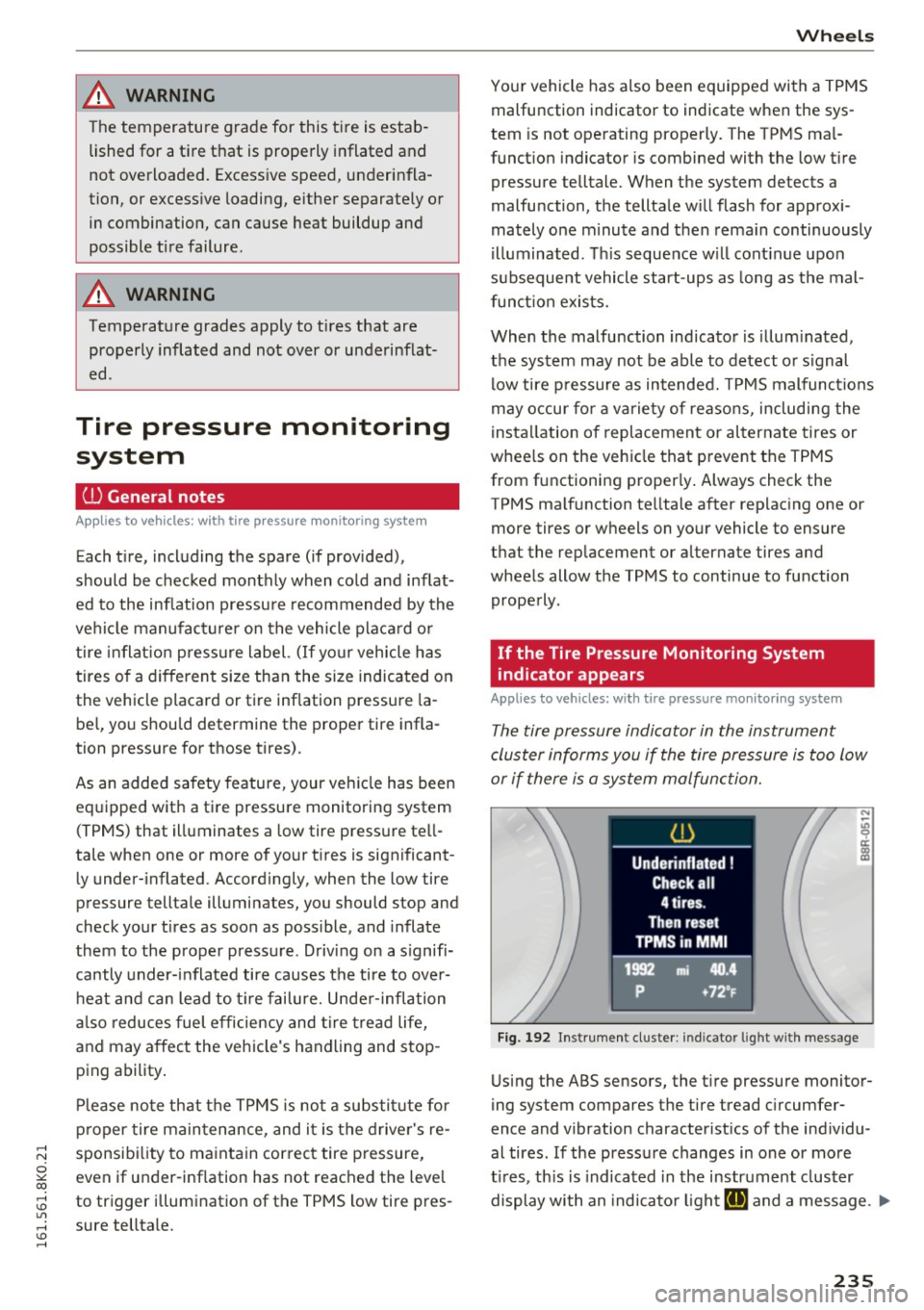
The tire pressure indicator in the instrument
cluster informs you if the tire pressure is too low
or if there is a system malfunction.
Fi g. 192 Instrument cluster: indicator light with message
Using the ABS sensors, the tire pressure monito r
ing system compares the tire tread c ircumfer-
ence and v ibration characterist ics of the ind ividu-
al tires. If the press ure changes in one or mo re
t ir es, th is is indicated in the instrument clust er
display with an indicato r light
RI] and a message . .,.
235
Page 257 of 278

.... N
0
""' CX)
.... I.Cl U"I
.... I.Cl ....
Technical data
Vehicle identification
F ig . 2 18 Vehi cle Ident if icatio n Number (VlN) plate : loca·
t ion on dr iver 's side dash pane l
XXXXX XX -X -XX XX X XX XX
CD+ ~t :1:: xxxxxxxx xx x xx xxx xxx
TVP/fffl XXX XXX
XX XXXXXXX XX X X xx
XXX KW XXX
®i ~:J ·f lfils~~ XXXX XXX XXX
®-+ ~ N:a=i~l xxxx ; xxxx xx x ; xx
II. · AUSS, I OPTIONS
,__ __
EO A 7D 5
2E H J0Z
3FC
F O A
TL 6 3KA
lXW
7T6 C V7
3L4 lS A
4UB 6XM 5SG
llB lA S
S M U 7Xl
9G3 OG7 0YH
SE H UlA X 98
803 908 824
7 K0 4 X3 2K2
4KC 3Y0 413
7G8 01 A
5RW
18A
0JF
QZ7
020
502
4G0
XX . X XX X XX X XXXX
Fig. 219 Th e ve hicle ident ifica tion label: ins ide the l ug·
gage co mpartment
Veh icle Identification Number (VlN )
The Vehicle Identific ation N umbe r is lo cate d in
d if f eren t places:
- u nder the w indshield on the dr iver's side
~ fig. 218.
-in the radio or i n the MMI*: Select: !CAR! func
t io n but ton
> Vehicle ID number (VIN) or se
l e ct:
I CAR ! funct ion button > Car system s* con
t rol but ton
> Servicing & checks > VIN num
ber .
-on the vehicle identific ation label.
Technical data
Vehicle identification label
T he vehicle identi fica tion label is lo cate d in t he
l uggage compa rtment near the ba tte ry.
T he labe l
~ fig. 219 shows the fo llow ing vehicle
da ta:
(D Vehicle Identification Number (VIN)
@ Vehicle type, eng ine output, transm ission
@ Engine and transmission code
@ Paint numbe r and interior
® Optional equipment numbers
T he information of the veh icle identification label
c an also be fo und in your Warran ty
& Mainte
nance booklet.
Safety compliance sticker
The safety compliance sticker is yo ur ass urance
t h at your n ew vehi cle complies w ith all appli cable
Fede ral Motor Vehicle Safety Stand ard s which
we re in effe ct at the time the veh icle w as m anu
fac tured. Yo u ca n fi nd this sticker on the door
jamb on the driver 's side. It shows the month and
year of production and t he ve hicle identification
number of your ve hicle (perforation) as well as
t h e Gross Vehicle Weight Rat ing (GVWR) and the
G ross Axle We ight Rati ng (GAWR).
H igh vo ltage warning label
T he hig h voltage warning label is located in the
engine compa rtment ne xt to the engine hood re
lease. The spark ignition system complies with
the Canadian standard ICES-002.
Weights
Gross Vehicle W eight Rating
The Gross Vehicle Weight Rating (GVWR), and
the Gross Axle Weight Rating (GAWR) for front
and rear a re listed on a sticker on the door jamb
o n the dr iver 's side .
T he Gross Vehicle Weight Rating includes the
weight o f the basic vehicle plus fu ll fuel tank, oil
and coolant, p lus maxim um load, which includes
passenger weight (150 lbs/68 kg per des ignated
seat ing pos ition) and luggage weight
c:> .&, . .,.
255
Page 260 of 278

Consumer information
Consumer information
Warranty coverages
Your Audi is covered by the following warran
ties:
- New Vehicle Limited Warranty
- Limited Warranty Against Corrosion Perfora-
tion
- Emissions Control System Warranty
- Emissions Performance Warranty
- California Emissions Control Warranty (USA
vehicles only)
- California Emissions Performance Warranty
(USA vehicles only)
Detailed information regarding your warranties
can be found in your
Warranty & Maintenance
booklet .
Operating your vehicle
outside the U.S.A. or
Canada
Government regulati ons in the United States and
Canada require that automobi les meet specific
emission regulations and safety standards.
Therefore, vehicles built for the U.S.A. and Cana
da differ from vehicles sold in other countries.
If you plan to take your vehicle outside the conti
nenta l limits of the United States or Canada,
there is the poss ibility that:
- un leaded fue ls for vehicles with catalytic con
verter may not be available;
- fuel may have a considerably lower octane rat
ing . Improper fuel may cause engine damage;
- service may be inadequate due to lack of proper
service facilities, tools or testing equipment;
- r eplacement parts may not be readily available.
- Nav igation systems for veh icles built for the
U.S .A . and Canada will not necessarily work in
Europe, and may not work in other countries
outside of North America.
258
(D Note
Audi cannot be responsib le for mechanical
damage that could result from inadequate
fuel, service or parts ava ilability.
Audi Service Repair
Manuals and Literature
Audi Official Factory Service Manuals and Litera
ture are published as soon as poss ible after mod
el introduction . Service manuals and literature
are available to order from the Audi Technical Lit
erature Ordering Center at :
www.audi.techliterature .com
Maintenance
General '
Your vehicle has been designed to help keep
maintenance requirements to a minimum. How
ever, a certain amount of regular maintenance is
still necessary to assure your vehicle's safety,
economy and reliability . For detailed vehicle
maintenance consult your Warranty & Mainte
nance booklet .
Under difficult operating conditions, for exam
ple at extremely low outside temperatures, in
very dusty regions, when towing a trailer very fre
quently, etc., some service work should be per
formed between the intervals specified. This ap
plies particularly to:
- oil changes, and
- cleaning or replac ing the a ir filter .
'
@) For the sake of the environment
By regularly maintain ing your vehicle, you
help make sure that em iss ion standards are
maintained, thus minimizing adverse effects
on the environment .
Important considerations for you and your
vehicle
The increasing use of electronics, sophisticated
fuel injection and emission control systems, and
the generally increas ing technica l complexity of ..,_