2016 Alfa Romeo Giulia engine
[x] Cancel search: enginePage 112 of 204

START & STOP EVO
The Start & Stop Evo system
automatically stops the engine each time
the vehicle is stationary and starts it
again when the driver wants to move off.
In this way, the vehicle efficiency is
increased, by reducing consumption,
dangerous gas emissions and sound
pollution.
OPERATING MODE
Stopping the engine
Versions with mechanical gearbox
With the vehicle stopped, the engine
stops with gearbox in neutral and clutch
pedal released.
Versions with automatic transmission
With vehicle at a standstill and brake
pedal pressed, the engine switches off if
the gear lever is in a position other than
R.
The system does not operate when the
gear lever is in R, for making parking
manoeuvres easier.
In the event of stops uphill, engine
switching off is disabled to make the "Hill
Start Assist" function available (works
only with running engine).
NOTE The engine can only be
automatically stopped after having run atabout 6 mph (10 km/h). After an
automatic restart, to stop the engine you
only need to move the vehicle (exceed a
speed of 0.3 mph (0.5 km/h)).
Engine stopping is signalled by the
symbol lighting up on the instrument
panel display.
Restarting the engine
Versions with mechanical gearbox
To restart the engine, press the clutch
pedal.
If the vehicle does not start when the
clutch is pressed, place the gear lever in
neutral and repeat the procedure. If the
problem persists, contact an Alfa Romeo
Dealership.
Versions with automatic transmission
To restart the engine, release the brake
pedal.
With brake pressed, if the gear lever is in
automatic mode - D (Drive) - the engine
can be restarted by moving the lever to R
(Reverse) or N (Neutral) or "AutoStick".
With brake pressed, if the gear lever is in
"AutoStick" mode, the engine can be
restarted by moving the lever to "+" or
"–", or R (Reverse) or N (Neutral).
When the engine has been stopped
automatically, keeping the brake pedal
pressed, the brake can be releasedkeeping the engine off by quickly shifting
the gear lever to P (Park).
To restart the engine, just move the lever
out of a position other than P.SYSTEM MANUAL ACTIVATION/
DEACTIVATION
110)
37)
To manually activate/deactivate the
system, press the button inserted in the
control panel on the left of the steering
wheel, fig. 107
LED off: system activated;
LED on: system deactivated.
10707126S0001EM
110
STARTING AND DRIVING
Page 115 of 204

RECALLING THE SPEED
For versions with automatic transmission
operating in D mode (Drive - automatic),
press and release the RES
fig. 108 button to recall the previously
set speed.
For versions with manual gearbox or
automatic transmission in Autostick
(sequential) mode, before recalling the
previously set speed you should
accelerate until getting close to it, then
press and release the RES button.
DEACTIVATING THE DEVICE
Lightly pressing the brake pedal
deactivates the Cruise Control without
deleting the stored speed.
The Cruise Control may be deactivated
also by applying the electric parking
brake or when the braking system is
operated (e.g. operation of the ESC
system).
The stored speed is deleted in the
following cases:
pressing the on/off button or
switching off the engine;
if there is a malfunction in the Cruise
Control.
DEACTIVATING THE DEVICE
The Cruise Control is deactivated by
pressing the activation/deactivation
button or bringing the ignition device to
the STOP position.
WARNING
111)When travelling with the device active,
never move the gear lever to neutral.
112)In case of a malfunction or failure of
the device, contact an Alfa Romeo
Dealership.
113)The Cruise Control can be dangerous if
the system cannot keep a constant speed. In
specific conditions speed may be excessive,
resulting in the risk of losing control of the
vehicle and causing accidents. Do not use the
device in heavy traffic or on winding, icy,
snowy or slippery roads.
PARK SENSORSSYSTEM
(where provided)
114)
38) 39) 40)
VERSIONS WITH 4 SENSORS
The parking sensors, located in the rear
bumper fig. 109, detect the presence of
any obstacles and warn the driver about
them, through an acoustic signal and,
where provided, visual indications on the
instrument panel display.
Engagement/disengagement
To disengage the system press button
fig. 110.
The LED in the button will light up or not
when the system switches from on to off
(and vice versa).
10907176S0001EM
113
Page 118 of 204

LANE DEPARTURE WARNING
(LDW) SYSTEM
DESCRIPTION
41) 42) 43) 44) 45) 46)
The Lane Departure Warning system
makes use of a camera located on the
windscreen to detect the lane limits and
calculate the position of the vehicle
within such limits, in order to make sure
that it remains inside the lane.
When one or both lane limits are
detected and the vehicle passes over one
without the driver's say-so (direction
indicator not turned on), the system
emits an acoustic signal.
If the vehicle continues to go beyond the
line of the lane without any intervention
from the driver, the surpassed line will
light up on the display (left or right) to
urge the driver to bring the vehicle back
into the limits of the lane.
SYSTEM ACTIVATION/DEACTIVATION
The system is activated/deactivated by
pressing the button, fig. 113
When the engine is started the system is
always activated.Activation conditions
Once switched on, the system becomes
active only if the following conditions are
met:
the vehicle speed is above 45 mph
(70 km/h);
the lane limit lines are visible at least
on one side;
there are suitable visibility conditions;
the road is straight or with wide radius
bends;
a suitable distance is kept from the
vehicle in front;
the direction indicator (for leaving the
lane) is not active.
IMPORTANT
41)Projecting loads on the roof of the
vehicle may interfere with the correct
operation of the camera. Before starting
make sure the load is correctly positioned, in
order not to cover the camera operating
range.
42)If the windscreen must be replaced due
to scratches, chipping or breakage, contact
exclusively an Alfa Romeo Dealership. Do not
replace the windscreen on your own, risk of
malfunction! It is advisable to replace the
windscreen if it is damaged in the area of the
camera.
43)Do not tamper with nor operate on the
camera. Do not close the openings in the
aesthetic cover located under the interior
rear view mirror. In the event of a failure of
the camera, contact an Alfa Romeo
Dealership.
44)Do not cover the operating range of the
camera with stickers or other objects. Also
pay attention to other objects on the bonnet
(e.g. a layer of snow) and make sure they do
not interfere with the camera
45)The camera may have limited or absent
operation due to weather conditions such as:
heavy rain, hail, thick fog, heavy snow,
formation of ice layers on the windscreen.
11307226S0001EM
116
STARTING AND DRIVING
Page 120 of 204
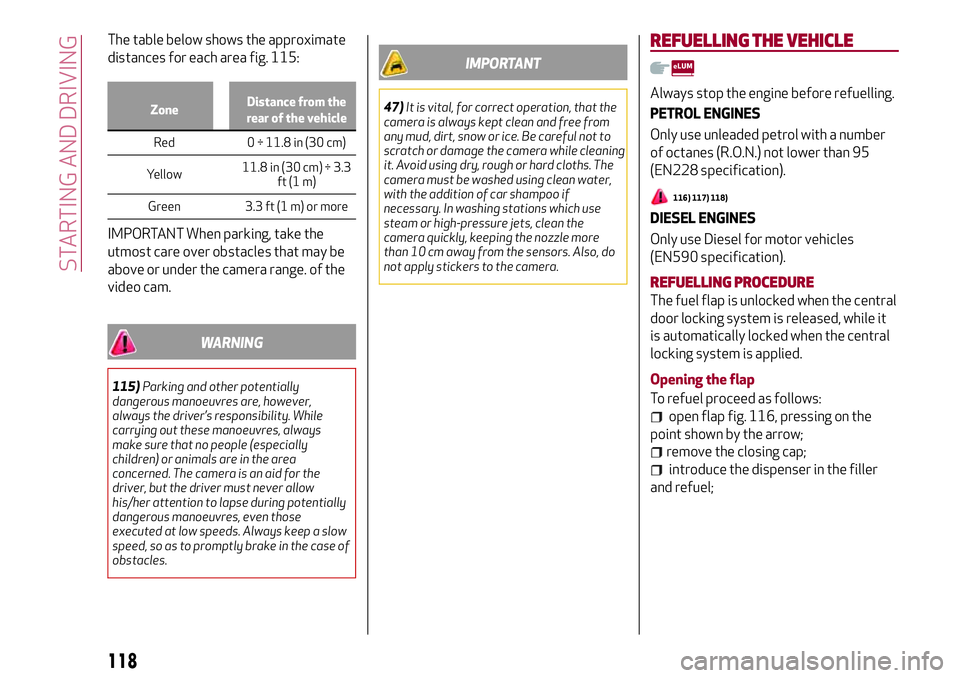
The table below shows the approximate
distances for each area fig. 115:
ZoneDistance from the
rear of the vehicle
Red 0 ÷ 11.8 in (30 cm)
Yellow11.8 in
(30 cm) ÷ 3.3
ft (1 m)
Green 3.3 ft (1 m) or more
IMPORTANT When parking, take the
utmost care over obstacles that may be
above or under the camera range. of the
video cam.
WARNING
115)Parking and other potentially
dangerous manoeuvres are, however,
always the driver’s responsibility. While
carrying out these manoeuvres, always
make sure that no people (especially
children) or animals are in the area
concerned. The camera is an aid for the
driver, but the driver must never allow
his/her attention to lapse during potentially
dangerous manoeuvres, even those
executed at low speeds. Always keep a slow
speed, so as to promptly brake in the case of
obstacles.
IMPORTANT
47)It is vital, for correct operation, that the
camera is always kept clean and free from
any mud, dirt, snow or ice. Be careful not to
scratch or damage the camera while cleaning
it. Avoid using dry, rough or hard cloths. The
camera must be washed using clean water,
with the addition of car shampoo if
necessary. In washing stations which use
steam or high-pressure jets, clean the
camera quickly, keeping the nozzle more
than 10 cm away from the sensors. Also, do
not apply stickers to the camera.
REFUELLING THE VEHICLE
Always stop the engine before refuelling.
PETROL ENGINES
Only use unleaded petrol with a number
of octanes (R.O.N.) not lower than 95
(EN228 specification).
116) 117) 118)
DIESEL ENGINES
Only use Diesel for motor vehicles
(EN590 specification).
REFUELLING PROCEDURE
The fuel flap is unlocked when the central
door locking system is released, while it
is automatically locked when the central
locking system is applied.
Opening the flap
To refuel proceed as follows:
open flap fig. 116, pressing on the
point shown by the arrow;
remove the closing cap;
introduce the dispenser in the filler
and refuel;
118
STARTING AND DRIVING
Page 127 of 204

REPLACING AN EXTERNAL BULB
IMPORTANT Only replace the bulb when
the engine is off. Also ensure that the
engine is cold, to prevent the risk of
burns.
Front light cluster with main
beam/dipped beam halogen headlights
Dipped headlights
To change the bulb of these lights,
proceed as follows:
remove the top cover from the wheel
arch by unscrewing the two fixing screws
fig. 119;
remove the cover fig. 120;
remove the bulb/connector assembly
from the headlight body fig. 121;
remove the bulb by sliding it off the
connector;
install the new bulb, making sure it is
correctly inserted in the connector;
then insert the bulb/connector
assembly in the housing on the headlight
body and make sure that it is locked
correctly;
remount the lid and cover, tightening
the fixing bolts.
Main beam headlights
To change the bulb of these lights,
proceed as follows:
operating inside the engine
compartment fig. 122;
remove the cover fig. 123;
turn the bulb, bulb holder and
connector assembly anticlockwise and
11908026S0001EM
12008026S0002EM
12108026S0003EM
12208026S0023EM
12308026S0004EM
125
Page 128 of 204

then slide it off the headlight body
fig. 124;
remove the bulb by sliding it off the
bulb holder;
install the new bulb, making sure it is
correctly inserted in the bulb holder;
then insert the bulb, bulb holder and
connector assembly in the housing on the
headlight body and turn it clockwise,
making sure that it is locked correctly;
refit the protective cover.
Direction indicators
To change the bulb of these lights,
proceed as follows:
operating inside the engine
compartment fig. 125;
remove cover by turning it fig. 126;
release the bulb, bulb holder and
connector assembly and then slide it off
the headlight body fig. 127;
remove the bulb by sliding it off the
bulb holder;
install the new bulb, making sure it is
correctly inserted in the bulb holder;
then insert the bulb, bulb holder and
connector assembly in the housing on the
headlight body and turn it clockwise,
making sure that it is locked correctly;
refit the protective cover.
Front fog lights
To replace the bulbs, proceed as follows:
remove the lower cover from the
wheel arch by unscrewing the two fixing
screws fig. 128;
12408026S0005EM
12508026S0023EM
12608026S0006EM
12708026S0007EM
126
IN AN EMERGENCY
Page 134 of 204

WARNING
122)Never replace a fuse with another with
a higher amp rating; DANGER OF FIRE.
123)Before replacing a fuse, make sure
that the ignition device is at STOP and that
all devices are switched off and/or
disconnected.
124)Contact an Alfa Romeo Dealership if a
safety system (airbags, brakes),
transmission system (engine, gearbox) or
steering system general protection fuse
blows.
125)If a fuse blows again, contact an Alfa
Romeo Dealership.
126)If a general protective fuse
(MAXI-FUSE, MEGA-FUSE, MIDI-FUSE)
blows, contact an Alfa Romeo Dealership.
IMPORTANT
50)Never replace a fuse with metal wires or
anything else.
51)If it is necessary to wash the engine
compartment, take care not to directly hit
the fuse box and the window wiper motors
with the water jet.
TIRE REPAIR KIT
DESCRIPTION
127) 128) 129) 130) 131) 132) 133) 134) 135)
52)
3)
The Tire Repair Kit is located in the boot,
inside a specific container.
To access the Tire Repair Kit, open the
boot, lift the load platform.
The Tire Repair Kit includes also:
one tank 1 fig. 137 containing the
sealing fluid, provided with: filler tube
2 and adhesive label 3 with the writing
"Max. 50 mph (80 km/h)”, to be attached
in a position easily visible to the driver
(eg. on the dashboard) after repairing the
tyre;
compressor 4 complete with pressure
gauge and connectors;
an instruction leaflet, to refer to for
prompt and correct use of the Tire Repair
Kit and that must be then given to the
personnel dealing with the tyre treated
with sealant;
a pair of protective gloves;
some adaptors, for inflating different
elements.
IMPORTANT The sealing fluid is effective
with external temperatures of between
-40°F (-40°C) and 122°F (+50°C). The
sealing fluid has an expiry date.
INFLATION PROCEDURE
127) 128) 130) 131) 132) 133) 134) 135)
Proceed as follows:
engage the electric parking brake.
Insert the tank 1 fig. 138 containing the
sealing liquid in the proper compressor
holder, pressing down hard. Unscrew the
tyre valve cap, take out the filler hose
2 and tighten the ring nut on the tyre
valve;
13708066S0002EM
132
IN AN EMERGENCY
Page 135 of 204

make sure that switch 5 fig. 139 of
the compressor is in position O (OFF);
insert the plug into the socket on the
central tunnel, start the engine;
start the compressor, placing the
switch 5 fig. 139 to position I (ON);
inflate the tyre to the pressure
indicated in the “Rims and Tyres”
paragraph (see “Technical data” chapter).
In order to obtain a more precise reading,check the pressure value on pressure
gauge 6 fig. 139 with the compressor off;
if after 15 minutes pressure is not at
least 1.8 bar (26 psi), disengage the
compressor from the valve and power
socket, then move the vehicle forwards
approx. five tyre turns in order to
distribute the sealing fluid inside the tyre
evenly, then repeat the inflation
operation;
if you still cannot obtain a pressure of
at least 1,8 bar (26 psi) within
15 minutes from the compressor
switching on, do not drive off and contact
an Alfa Romeo Dealership;
after having driven for about 5 mph
(8 km), stop, engage the electric parking
brake and recheck the tyre pressure;
if the pressure is less than 1.8 bar
(26 psi), do not go back into gear but see
an Alfa Romeo dealer;
if a pressure value of at least 1.8 bar
(26 psi) is detected, restore the correct
pressure (with engine running and
electric parking brake), resume driving
immediately and drive with great care to
an Alfa Romeo Dealership.
SEALANT BOTTLE REPLACEMENT
IMPORTANT Only use original cartridges,
which can be purchased at an Alfa Romeo
dealership.
Proceed as follows:
Remove the tank 1 fig. 140 pressingthe unhooking button 9;
insert the new tank pressing it
downwards hard.
WARNING
127)Punctures on the sides of the tire may
not be repaired. Do not use the Tire Repair
kit if the tyre was damaged as a result of
being used when underinflated.
128)Wear the protective gloves provided
with the Tire Repair kit.
129)Apply the adhesive label where it can
be easily seen by the driver as a reminder
that the tyre has been treated with the Tire
Repair Kit. Drive carefully, particularly on
bends. Do not exceed 80 km/h. Avoid sudden
acceleration or braking.
130)You must always indicate that the tyre
was repaired using the Tire Repair Kit. Give
the booklet to the technicians who will be
handling the tyre that was treated using the
Tire Repair Kit.
13808066S0004EM
13908066S0005EM
14008066S0009EM
133