2016 Alfa Romeo Giulia engine
[x] Cancel search: enginePage 136 of 204
131)Repairs are not possible in the case of
damage to the wheel rim (bad groove
distortion causing air loss). Do not remove
foreign bodies (screws or nails) from the
tyre.
132)Never operate the compressor for
longer than 20 consecutive minutes. Risk of
overheating. The Tire Repair Kit is not
suitable for definitive repairs, so the
repaired tyres may only be used temporarily.
133)As required by current regulations, the
information on chemical substances for the
protection of human health and the
environment and on the safe use of the
sealing fluid are on the packaging label.
Compliance with the indications on the label
is an essential condition to ensure the safety
and the effectiveness of the product.
Remember to carefully read the label before
use; the user of the product is responsible
for any damages caused by improper use.
The sealing fluid has an expiry date. Replace
the bottle if the sealant has expired.
134)If the pressure falls below 1.8 bar, do
not drive any further: the Tire Repair Kit
cannot guarantee proper seal because the
tyre is too damaged. Contact an Alfa Romeo
Dealership.
135)The Tire Repair Kit provide a
temporary repair, therefore the tyre must be
examined and repaired by a specialist as
soon as possible. The sealant is suitable for
use at temperatures in the range from −40°C
to +50°C.IMPORTANT
52)In the event of a puncture caused by
foreign bodies, the kit may be used to repair
tyres showing damage on the tyre tread up
to max. 6mm diameter.
IMPORTANT
3)Dispose of the bottle and the sealant
liquid properly. Have them disposed of in
compliance with national and local
regulations.
EMERGENCY STARTING
If the battery is flat, a jump starting can
be performed using the battery and the
cables of another vehicle, or using an
auxiliary battery. In all cases, the battery
used must have a capacity equal to or a
little higher than the flat one.
Jump starting may be dangerous if
carried out incorrectly: carefully follow
the procedures described below.
53)
IMPORTANT NOTES
Do not use an auxiliary battery or any
other source of external supply with a
voltage above 12 V: the battery, the
starter, the alternator and the electrical
system of the vehicle could be damaged.
Do not attempt jump starting if the
battery is frozen. The battery could break
and explode!
REMOTE BATTERY CONNECTION
POLES
To facilitate the operation, the remote
poles of the battery for the jump starting
can be found in the engine compartment:
the battery, on the other hand, is placed
in the luggage compartment.
The negative terminal (-) fig. 141 fig. 8 is
positioned next to the right bonnet lock.
134
IN AN EMERGENCY
Page 138 of 204
Cable connection
54)
Proceed as follows to carry out a jump
starting:
connect a terminal on the end of the
positive cable from the remote positive
pole (+) of the car with flat battery;
connect the terminal on the opposite
end of the positive (+) cable to the
positive (+) pole of the auxiliary battery;
connect a negative cable end terminal
to the negative (-) pole of the auxiliary
battery;
connect the terminal on the opposite
end of the negative (-) cable to the earth
point (-) on the vehicle with the battery
flat;
start the engine of the car with an
auxiliary battery, let it run for some
minutes at idle and then start the engine
of the car with flat battery. In case a
portable battery is used, before starting
the vehicle, wait a few seconds after
completing the connection.
Cable disconnection
Once the engine is started, remove the
connection cables in reverse sequence,
as shown below:
disconnect the negative cable end
terminal (-) from the earth point (-) of the
car with flat battery;
disconnect the terminal on the
opposite end of the negative cable fromthe negative (-) pole of the auxiliary
battery;
disconnect the terminal on the
opposite end of the positive (+) cable
from the positive (+) pole of the auxiliary
battery;
disconnect the terminal on the end of
the positive cable from the remote
positive pole (+) of the car with flat
battery.
WARNING
136)Do not get too close to the radiator
cooling fan: the electric fan may start;
danger of injury. Scarves, ties and other
loose clothing might be pulled by moving
parts.
137)Remove any metal objects (e.g. rings,
watches, bracelets), that might cause an
accidental electrical contact and cause
serious injury.
138)The batteries contain acid that can
burn skin or eyes. Batteries produce
hydrogen, which is easily flammable and
explosive. Thus keep away flames or devices
which may cause sparks.
IMPORTANT
53)Never use a fast battery-charger to
start the engine as this could damage the
electronic systems of your vehicle,
particularly the ignition and engine fuel
supply control units.54)Do not connect the cable to the negative
terminal (–) of the flat battery. The following
spark could lead to battery explosion and
cause serious harm. Only use the specific
earth point; do not use any other exposed
metallic part.
136
IN AN EMERGENCY
Page 139 of 204
FUEL CUT-OFFSYSTEM
DESCRIPTION
139)
Depending on the type and violence of
the impact, the control unit of the ORC
occupant protection systems determines
whether to activate the airbags and the
front seatbelt pretensioners and whether
to immediately interrupt the current
from the batteries to the supply pumps
and to the devices that operate the
engine. The power from the battery is
interrupted by "skipping" the pyrotechnic
fuse placed on the fuse box next to the
positive pole of the battery.
When the fuse is "skipped", only some
services, necessary for the safety of the
vehicle (eg: door locks, anti-theft device,
etc.), remain powered.
IMPORTANT After the impact, carefully
check the vehicle for fuel leaks, for
instance in the engine compartment,
under the vehicle or near the tank area.
IMPORTANT Contact an Alfa Romeo
Dealership to have the system checked.
WARNING
139)If, after an impact, you smell fuel or
notice leaks from the fuel system, do not
reactivate the system to avoid the risk of
fire.
137
Page 141 of 204

take the tow hook from its housing in
the boot and carefully clean the threaded
housing on the vehicle before using it;
tighten the vehicle's tow hook in its
place for about 11 turns.
IMPORTANT The largest work angle of
the cable to fix on the tow hook must not
exceed 15°, as shown in fig. 147.
WARNING
140)Move the ignition device to ON and
then to STOP, without opening the door.
141)The brake servo and the
electromechanical power steering will not
work while the vehicle is being towed. You
will therefore need to apply more force on
the brake pedal and steering wheel. Do not
use flexible ropes when towing, and avoid
jerky movements. During towing, make sure
that the trailer hitch does not damage any
components it is touching. When towing the
car, you must comply with all specific traffic
regulations and adopt an appropriate
driving behaviour. Do not start the engine
while towing the car. Before tightening the
ring, clean the threaded housing thoroughly.
Make sure that the ring is fully screwed into
the housing before towing the car.
14608136S0003EM
14708136S0002EM
139
Page 143 of 204
Correct servicing permits the performance of the vehicle to be
maintained over time, as well as limited running costs and
safeguarding the efficiency of the safety systems.
This chapter explains how.
SERVICING AND CARE
SCHEDULED SERVICING.........................142
ENGINE COMPARTMENT.........................146
BATTERY RECHARGING .........................149
SERVICING PROCEDURES . . ......................151
LIFTING THE VEHICLE..........................153
WHEELS AND TYRES...........................153
BODY.....................................154
Page 144 of 204

SCHEDULED SERVICING
Correct servicing is crucial for
guaranteeing a long life for the vehicle
under the best conditions.
For this reason, Alfa Romeo has planned
a series of checks and services at fixed
distance intervals and, for
versions/markets, where provided, at
fixed time intervals, as described in the
Scheduled Servicing Plan.
Before each service, it is always
necessary to carefully follow the
instructions in the Scheduled Servicing
Plan (e.g. periodically check level of
fluids, tyre pressure, etc.).
Scheduled Servicing is offered by an Alfa
Romeo Dealership according to a set
time schedule. If, during each operation,
in addition to the ones scheduled, the
need arises for further replacements or
repairs, these may be carried out with the
owner's explicit consent only.
IMPORTANT Scheduled Servicing
Coupons are required by the
Manufacturer. Failure to have them
carried out may invalidate the warranty.
It is advisable to inform the Alfa Romeo
Dealership of any small operating
irregularities without waiting for the next
service.
PERIODIC CHECKS
Every year or every600mi (1,000 km) or
before long trips check and, if necessary,
top up:
engine coolant level;
brake fluid level (if insufficient, see an
Alfa Romeo dealership as soon as
possible);
windscreen washer fluid level;
tyre inflation pressure and condition;
operation of lighting system
(headlights, direction indicators, hazard
warning lights, etc.);
operation of screen washing/wiping
system and positioning/wear of wiper
blades.
Every1,800mi (3,000 km), check and
top up if required: engine oil level.
HEAVY USAGE OF THE CAR
If the vehicle is used under one of the
following conditions:
dusty roads;
short, repeated journeys (less than
4-5 mi (7-8 km)) at sub-zero outside
temperatures;
engine often idling or driving long
distances at low speeds or long periods
of inactivity;
in the event of a long period of
inactivity;
the following checks must be carried outmore often than indicated in the
Scheduled Servicing Plan:
check front and rear disc brake pad
condition and wear;
check cleanliness of bonnet and boot
locks, cleanliness and lubrication of
linkage;
visually inspect conditions of: engine,
gearbox, transmission, pipes and hoses
(exhaust/fuel system/brakes) and rubber
elements (gaiters/sleeves/bushes, etc.);
check battery charge and battery fluid
level (electrolyte);
visually inspect conditions of the
accessory drive belts;
check and, if necessary, change engine
oil and replace oil filter;
check and, if necessary, replace pollen
filter;
check and, if necessary, replace air
cleaner;
check and, if necessary, replace the
Bad Fuel fuel filter (where available).
142
SERVICING AND CARE
Page 145 of 204

SCHEDULED SERVICING PLAN (2.2 JTD diesel engine versions)
The checks listed in the Scheduled Servicing Plan, after reaching 120,000 mi (200,000 km)/10 years, must be cyclically repeated
starting from the first interval, thus following the same intervals as before.
Thousands of miles12 24 36 48 60 72 84 96 108 120
Thousands of kilometres20 40 60 80 100 120 140 160 180 200
Years12345678910
Check battery charge status with the proper instrument●●●●●●●●●●
Check tyre condition/wear and adjust pressure, if necessary.
Check the Tyre Repair Kit recharge condition and expiry date●●●●●●●●●●
Check operation of lighting system (headlights, direction
indicators, hazard warning lights, boot, passenger
compartment, glove compartment, instrument panel warning
lights, etc.)
●●●●●●●●●●
Check and, if necessary, top up fluid levels (1)●●●●●●●●●●
Check exhaust emissions/smokiness●●●●●●●●●●
Use the diagnosis socket to check supply/engine
management systems operation, emissions and, for
versions/markets, where provided, engine oil degradation (2)
●●●●●●●●●●
Visually inspect conditions of: exterior bodywork, underbody
protection, pipes and hoses (exhaust, fuel system, brakes),
rubber elements (gaiters, sleeves, bushes, etc.)
●●●●●
Check position/wear of front windscreen wiper blade●●●●●
(1) Top up using the fluids indicated in the “Fluids and lubricants” paragraph of the “Technical data” chapter and only after checking that the system is
intact.
(2) If the vehicle diagnostics shows the oil to be degraded to less than 20%, replacing the engine oil and filter is advised.
143
Page 146 of 204
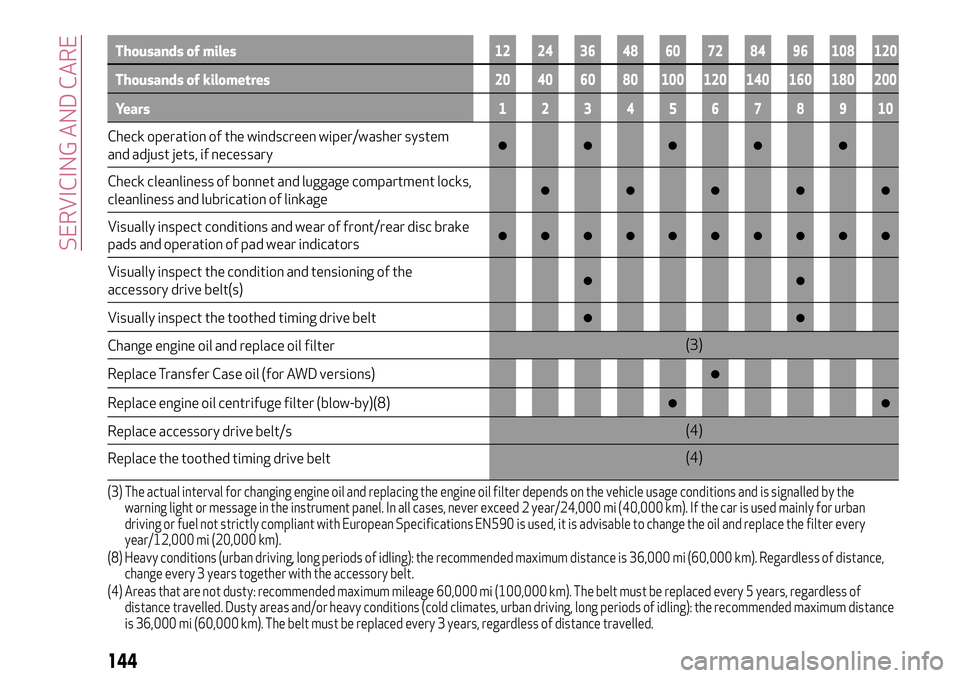
Thousands of miles12 24 36 48 60 72 84 96 108 120
Thousands of kilometres20 40 60 80 100 120 140 160 180 200
Years12345678910
Check operation of the windscreen wiper/washer system
and adjust jets, if necessary●●●●●
Check cleanliness of bonnet and luggage compartment locks,
cleanliness and lubrication of linkage●●●●●
Visually inspect conditions and wear of front/rear disc brake
pads and operation of pad wear indicators●●●●●●●●●●
Visually inspect the condition and tensioning of the
accessory drive belt(s)●●
Visually inspect the toothed timing drive belt●●
Change engine oil and replace oil filter(3)
Replace Transfer Case oil (for AWD versions)
●
Replace engine oil centrifuge filter (blow-by)(8)●●
Replace accessory drive belt/s(4)
Replace the toothed timing drive belt(4)
(3) The actual interval for changing engine oil and replacing the engine oil filter depends on the vehicle usage conditions and is signalled by the
warning light or message in the instrument panel. In all cases, never exceed 2 year/24,000 mi (40,000 km). If the car is used mainly for urban
driving or fuel not strictly compliant with European Specifications EN590 is used, it is advisable to change the oil and replace the filter every
year/12,000 mi (20,000 km).
(8) Heavy conditions (urban driving, long periods of idling): the recommended maximum distance is 36,000 mi (60,000 km). Regardless of distance,
change every 3 years together with the accessory belt.
(4) Areas that are not dusty: recommended maximum mileage 60,000 mi (100,000 km). The belt must be replaced every 5 years, regardless of
distance travelled. Dusty areas and/or heavy conditions (cold climates, urban driving, long periods of idling): the recommended maximum distance
is 36,000 mi (60,000 km). The belt must be replaced every 3 years, regardless of distance travelled.
144
SERVICING AND CARE