Page 631 of 684
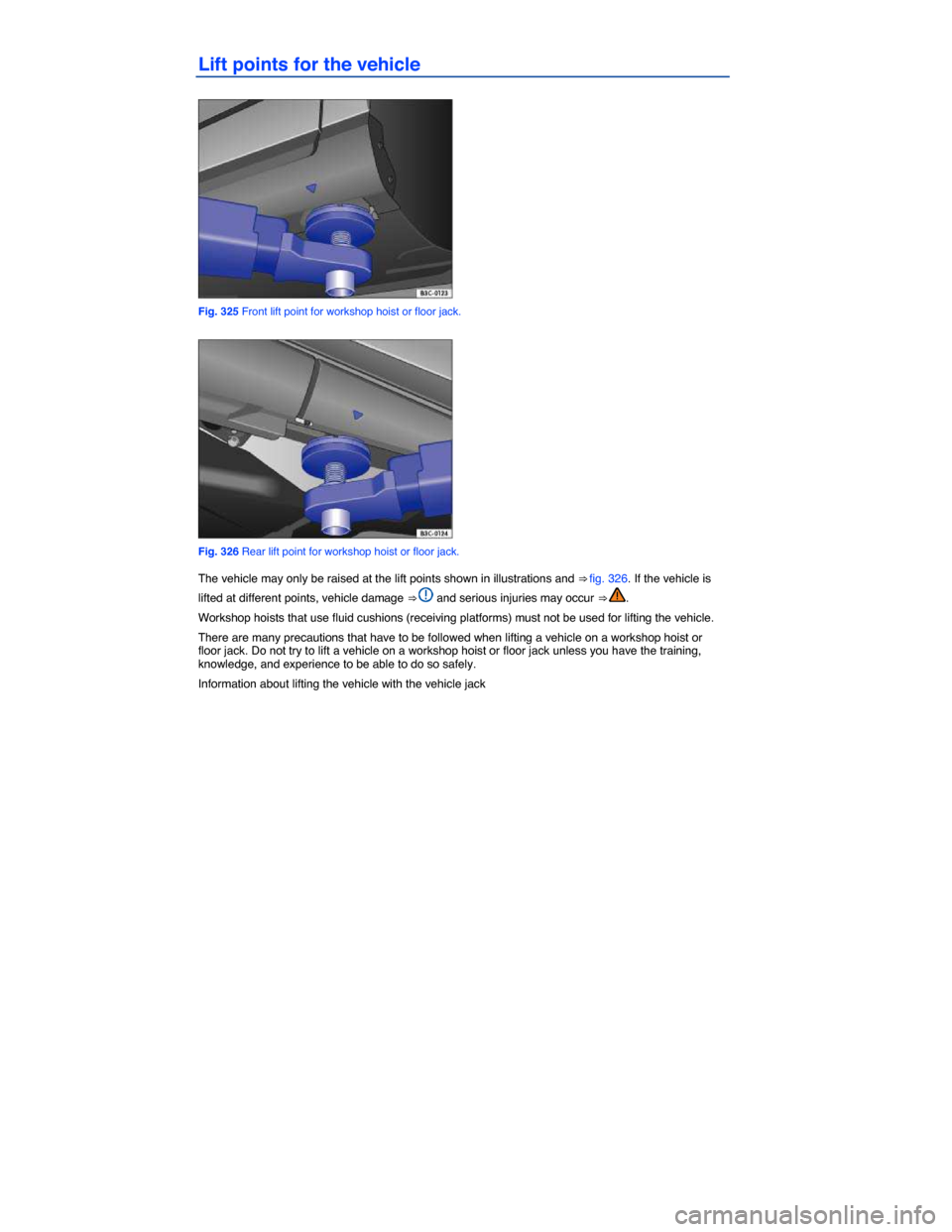
Lift points for the vehicle
Fig. 325 Front lift point for workshop hoist or floor jack.
Fig. 326 Rear lift point for workshop hoist or floor jack.
The vehicle may only be raised at the lift points shown in illustrations and ⇒ fig. 326. If the vehicle is
lifted at different points, vehicle damage ⇒ and serious injuries may occur ⇒ .
Workshop hoists that use fluid cushions (receiving platforms) must not be used for lifting the vehicle.
There are many precautions that have to be followed when lifting a vehicle on a workshop hoist or floor jack. Do not try to lift a vehicle on a workshop hoist or floor jack unless you have the training, knowledge, and experience to be able to do so safely.
Information about lifting the vehicle with the vehicle jack
Page 634 of 684

Checklist
For your own safety and that of your passengers, carry out the following steps in the order listed ⇒ :
1. Park the vehicle at safe distance from traffic and on a suitable surface ⇒ .
2. Switch on emergency flashers by pressing the � switch ⇒ fig. 327.
3. Apply the electronic parking brake to help prevent the vehicle from moving.
4. Shift the transmission into Park (P)
5. Stop the engine and remove the key from the ignition switch
6. Have all passengers exit and go to a safe location away from moving traffic, such as behind a guard rail.
7. Take all vehicle keys with you when leaving your vehicle.
8. Set up a warning triangle or other warning device in order to alert other motorists and cyclists.
9. Let the engine cool down and get expert assistance if necessary.
If the emergency flashers are on, use the turn signal lever to indicate a direction or lane change, for example when the vehicle is being towed. This temporarily interrupts the emergency flashers.
Switch on the emergency flashers when:
x Traffic suddenly slows down or stops in front of you to warn those approaching from behind.
x In any emergency situation.
x If the vehicle breaks down.
x When being towed.
Always obey traffic laws that govern the use of emergency flashers where you are driving.
If the emergency flashers are not working, a different method – as permitted by law – must be used to alert other motorists and cyclists to the breakdown.
WARNING
Disregarding the safety-related checklist may lead to accidents and serious injuries.
x Always review and follow the checklist. Follow accepted safety practices and use common sense.
WARNING
The vehicle exhaust system and the catalytic converter or diesel particulate filter get very hot and can cause a fire and serious personal injury.
x Never park where parts of the hot exhaust system or catalytic converter could ignite flammable materials, such as dry grass, brush, leaves, spilled fuel, etc.
The vehicle battery will be drained if the emergency flashers are on for a long time – even if the ignition is switched off.
Page 654 of 684
Wheel bolt tightening torque
Correctly tightened bolts for steel and alloy wheel rims should have a torque of 133 ft-lbs. (180 Nm). After changing a wheel, have the wheel bolt tightening torque checked right away with an accurate torque wrench.
Before you check the tightening torque, replace corroded and difficult-to-turn wheel bolts and clean the threads in the wheel hub.
Never grease or oil the wheel bolts and the threads in the wheel hubs. The bolts can come loose while driving if greased or oiled, even if tightened to the required torque.
WARNING
Improperly tightened wheel bolts can come loose while driving and cause you to lose control over the vehicle, resulting in accidents and serious injuries.
x Only use wheel bolts that belong your vehicle and to the wheel being installed.
x Never use different wheel bolts.
x Wheel bolts and wheel hub threads must always be clean, easy-to-turn and free of oil and grease.
x Only use the lug wrench that is supplied with the vehicle to loosen the wheel bolts.
x Loosen the wheel bolts only about one turn before lifting the vehicle with the jack.
x Never grease or oil the wheel bolts and the threads in the wheel hubs. The bolts can come loose while driving if greased or oiled, even if tightened to the required torque.
x Never loosen bolted connections on wheel rims with bolted rim rings.
x If the wheel bolts are not tightened to the proper torque, the wheel can come off the vehi-cle when it is moving. Extremely high torque can damage the wheel bolts and/or their threads.
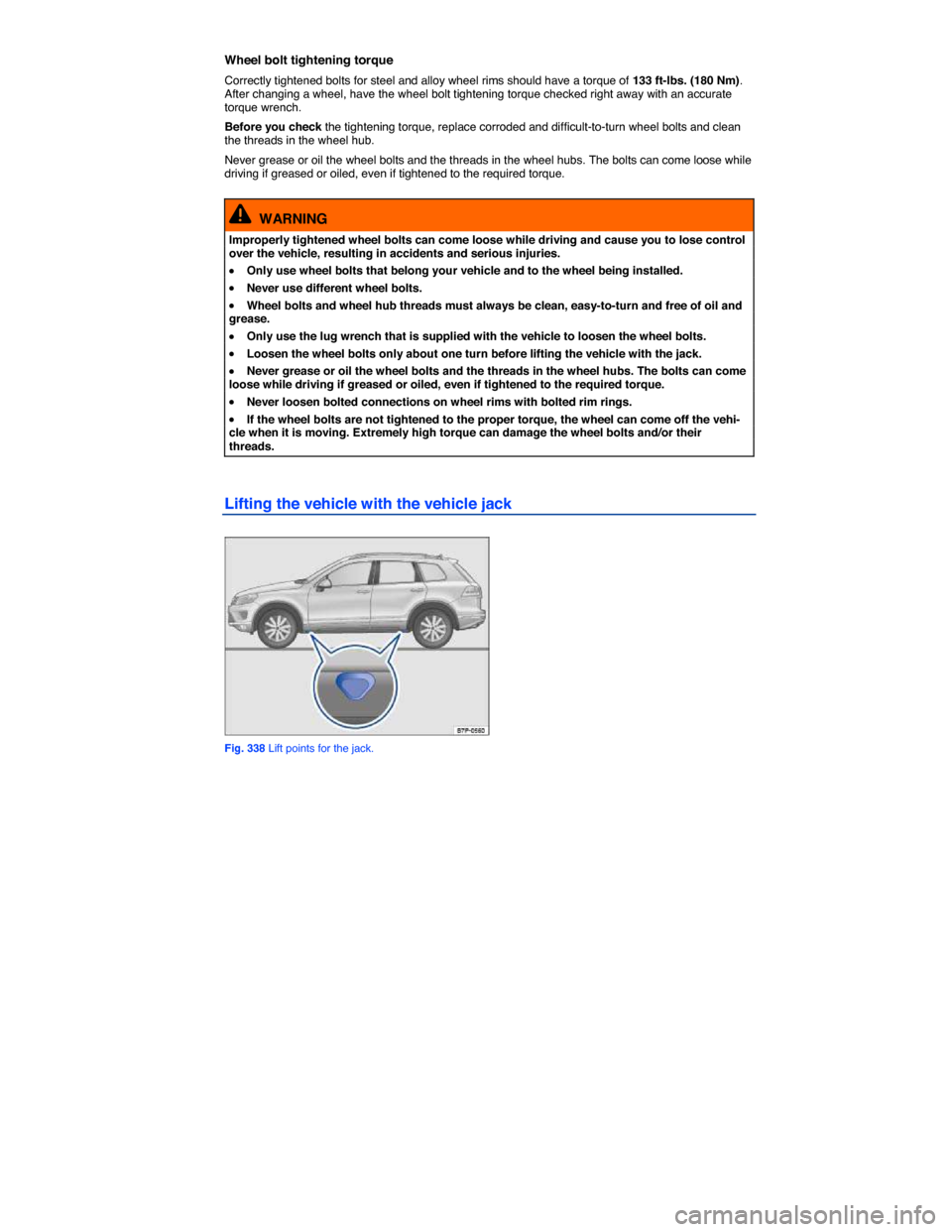
Lifting the vehicle with the vehicle jack
Fig. 338 Lift points for the jack.
Page 682 of 684

Abbreviations
Abbreviation Meaning
A2DP Advanced Audio Distribution Profile for cross-manufacturer Bluetooth audio signal transmission compatibility.
ABS Anti-lock Brake System.
AFS Adaptive Front Lighting System.
AKI Anti-Knock Index.
AM AM (amplitude modulation).
ANSI American National Standards Institute.
ASL Automatic Shift Lock.
ASR Anti-Slip Regulation.
ATA Anti-Theft Alarm system.
BAS Brake Assist System.
cc Cubic centimeter unit of volume for specifying engine displacement.
ccm Cubic centimeters. Unit of measure for engine displacement.
CCS Cruise Control System.
CCS Cruise Control System.
CID Cubic inch displacement, unit of volume for specifying engine displacement.
cm Centimeter – metric unit of measure for length.
CO2 Carbon dioxide.
DIN Deutsches Institut für Normung (German Institute for Standardization).
DPF Diesel Particulate Filter.
DRL Daytime Running Lights.
DTMF Dual Tone Multiple Frequency.
EDL Electronic Differential Lock.
EN European Norm.
EON Enhanced Other Network (support for other radio networks).
EPC Engine control (Electronic Power Control).
ESC Electronic Stability Control.
ETC Electronic Toll Collection system.
FLA Headlight assistant.
FSI Fuel Stratified Injection.
g/mi Generated carbon monoxide amount in grams per mile driven.