2015 VOLKSWAGEN TOUAREG differ
[x] Cancel search: differPage 195 of 684
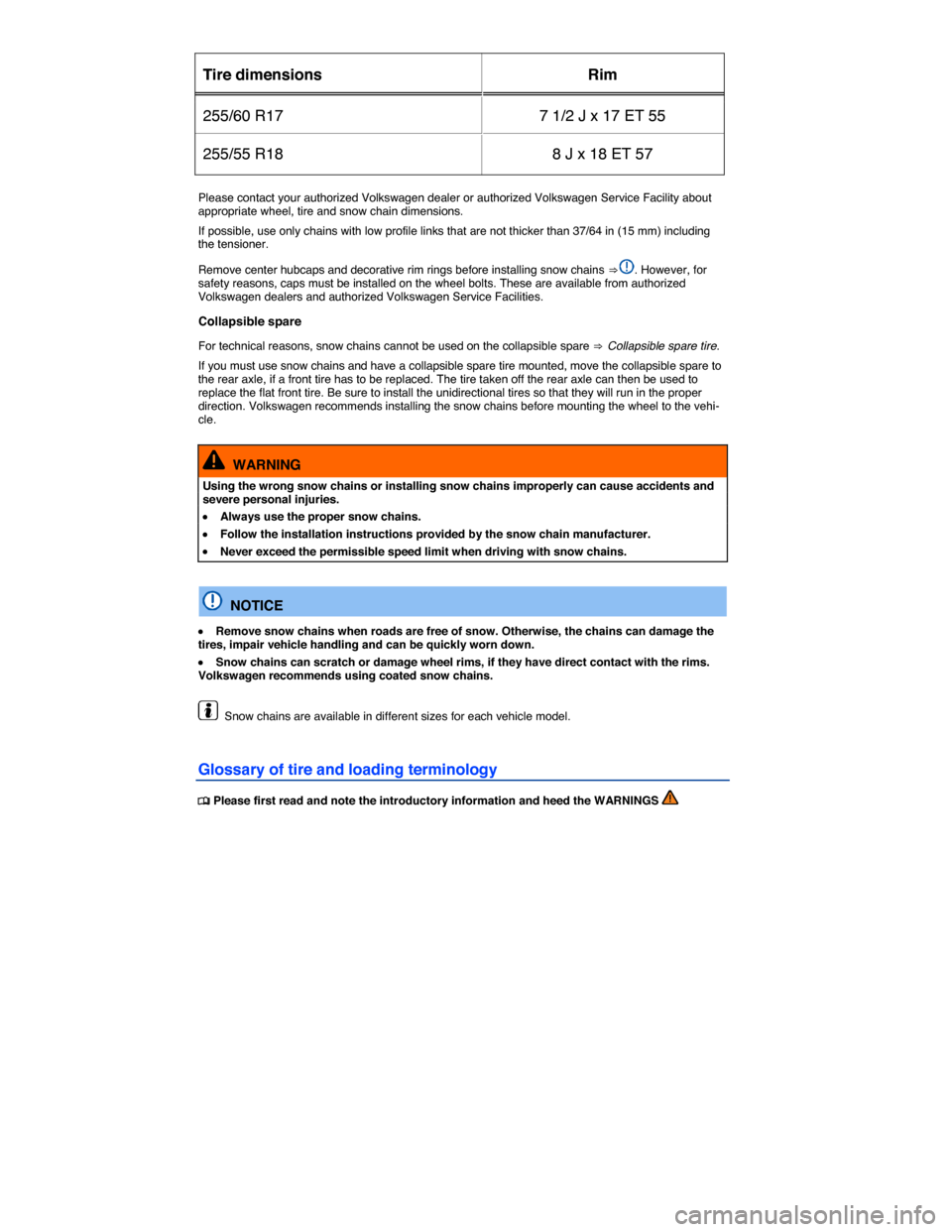
Tire dimensions Rim
255/60 R17 7 1/2 J x 17 ET 55
255/55 R18 8 J x 18 ET 57
Please contact your authorized Volkswagen dealer or authorized Volkswagen Service Facility about appropriate wheel, tire and snow chain dimensions.
If possible, use only chains with low profile links that are not thicker than 37/64 in (15 mm) including the tensioner.
Remove center hubcaps and decorative rim rings before installing snow chains ⇒ . However, for safety reasons, caps must be installed on the wheel bolts. These are available from authorized Volkswagen dealers and authorized Volkswagen Service Facilities.
Collapsible spare
For technical reasons, snow chains cannot be used on the collapsible spare ⇒ Collapsible spare tire.
If you must use snow chains and have a collapsible spare tire mounted, move the collapsible spare to the rear axle, if a front tire has to be replaced. The tire taken off the rear axle can then be used to replace the flat front tire. Be sure to install the unidirectional tires so that they will run in the proper direction. Volkswagen recommends installing the snow chains before mounting the wheel to the vehi-cle.
WARNING
Using the wrong snow chains or installing snow chains improperly can cause accidents and severe personal injuries.
x Always use the proper snow chains.
x Follow the installation instructions provided by the snow chain manufacturer.
x Never exceed the permissible speed limit when driving with snow chains.
NOTICE
x Remove snow chains when roads are free of snow. Otherwise, the chains can damage the tires, impair vehicle handling and can be quickly worn down.
x Snow chains can scratch or damage wheel rims, if they have direct contact with the rims. Volkswagen recommends using coated snow chains.
Snow chains are available in different sizes for each vehicle model.
Glossary of tire and loading terminology
Page 198 of 684

Radial ply tires
A pneumatic tire in which the ply cords that extend to the beads are laid at substantially 90 degrees to the centerline of the tread.
Recommended inflation pressure
The tire pressure recommended by the vehicle manufacturer for a tire of a specified size that has not been driven for more than a couple of miles (kilometers) at low speeds in the 3 hour period before the tire pressure is measured or adjusted.
Reinforced tire
A tire designed to operate at higher loads and at higher inflation pressures than the corresponding standard tire.
Rim
The outer edge of a wheel upon which the tire beads are seated.
Rim diameter
The nominal diameter of the wheel's tire bead seating surface. If you change your wheel size, to wheels of a different diameter, you will have to purchase new tires to match the new wheels.
Rim size
Designation means rim diameter and width.
Rim type designation
The industry or manufacturer's designation for a rim by style or code.
Rim width
The nominal distance between wheel rim flanges.
Section width
The linear distance between the exteriors of the sidewalls of an inflated tire, excluding elevations due to labeling decoration, or protective bands.
Sidewall
The portion of a tire between the bead and the tread.
Sidewall separation
The parting of the rubber compound from the cord material in the sidewall.
Speed rating (letter code)
A standardized letter code indicating the maximum speed at which a tire is designed to be driven for extended periods of time. The ratings range from 93 mph or 150 km/h (“P”) to 186 mph or (300 km/h) “Y”.
The speed rating letter code, where applicable, is molded on the tire sidewall ⇒ Tire labeling. You may not find this information on all tires because it is not required by law.
Tire Pressure Monitoring System (TPMS)
A system that detects when at least one of a vehicle's tires is underinflated and illuminates a low tire-pressure warning light.
Tread
The portion of a tire that normally touches the road.
Page 202 of 684

Uniform Tire Quality Grading (UTQG): Quality grades can be found where applicable on the tire side-wall between the tread shoulder and maximum section width. Example:
x Treadwear (number)
x Traction: AA, A, B or C
x Temperature: A, B or C
For example: Treadwear 200, Traction AA Temperature A
All passenger car tires must conform to Federal Safety Requirements in addition to these grades.
Treadwear
The tread wear grade is a comparative rating based on the wear rate of the tire when tested under controlled conditions on a specified government test course.
For example, a tire graded 150 (Tread wear-value 150) would wear one-and-one-half (1 1/2) times as well on the government course as a tire graded 100.
The relative performance of tires depends upon the actual conditions of their use, however, and may depart significantly from the norm due to variations in driving habits, service practices and differences in road characteristics and climate.
Traction
The traction grades from highest to lowest, are AA, A, B and C. Those grades represent the tire's ability to stop on wet pavement as measured under controlled conditions on specified government test
surfaces of asphalt and concrete. A tire marked C may have poor traction performance ⇒ .
Temperature
The temperature grades are A (the highest), B, and C representing the tire's resistance to the genera-tion of heat, and its ability to dissipate heat when tested under controlled conditions on a specified indoor laboratory test wheel.
Sustained high temperature can cause the material of the tire to degenerate and reduce tire life, and excessive temperature can lead to sudden tire failure.
The grade C corresponds to a level of performance which all passenger car tires must meet under the Federal Motor Vehicle Safety Standard No. 109. Grades B and A represent higher levels of perfor-
mance on the laboratory test wheel than the minimum required by law ⇒ .
WARNING
The traction grade assigned to this tire is based on straight-ahead braking traction tests, and does not include acceleration, cornering, hydroplaning or peak traction characteristics.
WARNING
The temperature grade for this tire is established for a tire that is properly inflated and not overloaded. Excessive speed, underinflation or excessive loading, either separately or in combination, can cause heat buildup and possible tire failure.
Page 204 of 684

WARNING
Incorrect tire pressures and/or underinflation can cause sudden tire failure, loss of control, collision, serious personal injury or even death.
x When the warning symbol appears in the instrument cluster, stop and inspect the tires.
x Incorrect tire pressure and/or underinflation can cause increased tire wear and can affect the handling of the vehicle and stopping ability.
x Incorrect tire pressures and/or underinflation can also lead to sudden tire failure, includ-ing a blowout and sudden deflation, causing loss of vehicle control.
x The driver is responsible for the correct tire pressures for all tires on the vehicle. The
recommended tire pressure values are listed on a sticker on the driver door ⇒ Tires and wheels.
x The TPMS can only work correctly when all tires on the vehicle are filled to the correct cold tire pressure specified for the tires installed on the vehicle.
x Using incorrect tire pressure values can cause accidents or other damage. Always inflate the tires to the correct specified cold tire pressure values for the tires installed on the vehicle.
x Always maintain correct cold tire inflation pressure so that TPMS can do its job.
x Always inflate tires to the recommended and correct tire pressure before driving off.
x Driving with underinflated tires causes them to flex (bend) more, letting them get too hot, resulting in tread separation, sudden tire failure, and loss of control.
x Excessive speed and/overloading can cause heat build-up, sudden tire failure and loss of control.
x If the tire pressure is too low or too high, the tires will wear prematurely and the vehicle will not handle well.
x If the tire is not “flat” and you do not have to change a wheel immediately, drive carefully and at reduced speed to the nearest service station to check the tire pressure and add air as required.
x When replacing tires or wheel rims on vehicles equipped with TPMS always read and heed
the information and all WARNINGS regarding Tires and wheels ⇒ Tires and wheels.
NOTICE
x The wheel electronics are attached to special aluminum valves on the wheels. These valves are screwed on rigidly. Never bend the valves “into position” when checking and adjusting tire pressure.
x Missing valve stem caps can cause damage to the valves as well as to the TPMS sensors. To help prevent damage, always use valve stem caps like those originally installed at the facto-ry. The caps must be screwed on tightly. Do not use metal valve stem caps.
x Do not use “comfort valve caps”. They do not seal properly and can damage the sensors.
x When switching to different tires, make certain the valves and sensors are not damaged.
x When replacing the valve cores, use only nickel-plated replacement cores.
x The batteries in the wheel electronics have a life of up to 10 years. It is not possible to replace the batteries. The entire device must be replaced.
Underinflation increases fuel consumption and tire wear.
Dispose of the wheel electronics and the old batteries in an environmentally responsible manner. Batteries of the type used in the wheel electronics may contain Perchlorate Material. Special handling
Page 205 of 684

may apply. See http://www.dtsc.ca.gov/hadardouswaste/perchlorate. Obey all applicable legal re-quirements regarding proper disposal.
Do not rely solely on the Tire Pressure Monitoring System (TPMS). Check your tires regularly to make sure they are properly inflated and have no signs of damage, such as punctures, cuts, cracks, and blisters. Remove any objects that become embedded in the tire tread but have not penetrated into the body of tire itself.
When you take delivery of the vehicle, the Tire Pressure Monitoring System (TPMS) is calibrated for the factory-recommended cold tire inflation pressure for the tires on your vehicle, as shown on the
label inside the driver door ⇒ fig. 111.
x For replacement tires that require a different inflation pressure, the TPMS must be adjusted to the new pressure specification by an authorized Volkswagen dealer or an authorized Volkswagen Service Facility. Only one value can be entered for each tire partial or full load; see the tire inflation pressure
label on the driver door pillar ⇒ Tire inflation pressure.
x To help prevent damage to the sensor and valve, do not put excessive force on the valve when checking the tire pressure. Do not try to bend the valve.
x If sensors have to be replaced, have the valves changed at the same time.
x The tire valve gaskets must be replaced whenever a tire is mounted on the rim. Your authorized Volkswagen dealer or authorized Volkswagen Service Facility has a valve seal and gasket kit for this purpose. Always make sure that a valve seal and gasket kit is also used whenever a sensor is re-placed.
x If you have to adjust the tire pressure on a “warm” tire, fill the tire with 2.0 - 4.35 psi (20 - 30 kPa) more than the pressure specified on the tire pressure label.
x When the TPMS determines that the air pressure in at least one tire is too low, carefully check the pressure in all 4 tires with an accurate tire pressure gauge. Low tire pressure usually cannot be deter-mined by looking at the tire. This is especially true of low-profile tires.
x A Declaration of Compliance with the United States FCC and Industry Canada regulations is found on of this manual.
There may be differences between the pressure readings from a tire pressure gauge and the pressures registered by the Tire Pressure Monitoring System (TPMS). The electronic TPMS is more accurate.
If you have work done on your wheels or tires, inform the workshop that the vehicle is equipped with a Tire Pressure Monitoring System (TPMS) that has sensors in the wheels.
New tires may expand slightly the first time they are driven at high speeds, which can trigger a tire pressure warning. Remember that tire pressure can only be properly measured when the tire is
“cold” ⇒ Tires and wheels.
Indicator light (telltale)
Page 210 of 684

Key to ⇒ fig. 116
Position number Meaning
(5) No data received, right rear tire.
(6) Benchmark pressure, rear tires.
If the tire pressure is too low, the relevant tires and the respective readings are shown in yellow
⇒ fig. 116.
Each tire, including the spare (if provided), should be checked monthly when cold and inflated to the inflation pressure recommended by the vehicle manufacturer on the vehicle placard or tire inflation pressure label. (If your vehicle has tires of a different size than the size indicated on the vehicle plac-ard or tire inflation pressure label, you should determine the proper tire inflation pressure for those tires.)
As an added safety feature, your vehicle has been equipped with a Tire Pressure Monitoring System (TPMS) that illuminates a low tire pressure telltale when one or more of your tires is significantly underinflated. Accordingly, when the low tire pressure telltale illuminates, you should stop and check your tires as soon as possible, and inflate them to the proper pressure. Driving on a significantly underinflated tire causes the tire to overheat and can lead to tire failure. Underinflation also reduces fuel efficiency and tire tread life, and may affect the vehicle's handling and stopping ability.
Please note that the TPMS is not a substitute for proper tire maintenance, and it is the driver's respon-sibility to maintain correct tire pressure, even if underinflation has not reached the level to trigger illumination of the TPMS low tire pressure telltale.
Your vehicle has also been equipped with a TPMS malfunction indicator to indicate when the system is not operating properly. The TPMS malfunction indicator is combined with the low tire pressure telltale. When the system detects a malfunction, the telltale will flash for approximately 1 minute and then remain continuously illuminated. This sequence will continue upon subsequent vehicle start-ups as long as the malfunction exists.
When the malfunction indicator is illuminated, the system may not be able to detect or signal low tire pressure as intended. TPMS malfunctions may occur for a variety of reasons, including the installation of replacement or alternate tires or wheels on the vehicle that prevent the TPMS from functioning properly. Always check the TPMS malfunction telltale after replacing one or more tires or wheels on your vehicle to ensure that the replacement or alternate tires and wheels allow the TPMS to continue to function properly.
Collapsible spare tire
The collapsible spare tire has no tire pressure sensor. When the collapsible spare tire is mounted on the vehicle, the Tire Pressure Monitoring System (TPMS) indicator light will flash in the instrument cluster display. The TPMS continues to monitor the other 3 wheels.
Tire storage
If the tires do not move for an extended period of time, the sensors will not transmit tire pressures to the system. This saves sensor battery life. When the ignition is switched on, the sensors transmit signals to the Tire Pressure Monitoring System (TPMS).
Page 228 of 684

Safety information on Infotainment System
WARNING
Driving on today's roads demands the full attention of the driver at all times. Driver distrac-tion causes accidents, collisions and serious personal injury!
x Never let yourself be distracted when setting, adjusting, or using the Infotainment System, when using your mobile phone, or when operating the mobile phone controls.
x Always drive attentively and responsibly. Use the Infotainment system, your mobile phone, and the mobile phone controls only if road, traffic, and weather conditions permit and you will not be distracted from your driving.
x If you cannot use the Infotainment System, your mobile phone, or the mobile phone con-trols safely while driving, wait until later or find a safe spot where you can pull off the road and park the vehicle.
x Always set sound volume levels so that you can clearly hear horns, sirens, and other warning sounds outside the vehicle.
x Setting the sound volume too high may damage your hearing. This applies even if you are exposed to high volumes for short periods only.
WARNING
The volume level may suddenly get louder change when you switch media source or connect a new audio source.
x Always lower the base volume before switching media source or connecting a new audio source.
WARNING
Driving recommendations and traffic symbols displayed by the navigation system may differ from the current traffic situation.
x Traffic signs and traffic regulations have priority over the recommendations and displays provided by the navigation system.
x Always adjust your speed and driving style to road, traffic, weather, and visibility condi-tions.
WARNING
External devices that are loose in the vehicle or not properly secured could be thrown around the interior and cause injuries during a sudden driving or braking maneuver, or in a crash.
x Never put or attach an external device on a door, on the windshield or above or near to the areas marked “AIRBAG” on the steering wheel, the instrument panel and the seat backrests, or between these areas and the vehicle occupants. External devices could cause serious injury in an accident, especially when the airbags inflate.
Page 266 of 684

The station list closes automatically after a period of inactivity.
Selecting a different station by changing the category
The currently selected category is displayed in the function key at the top right of the station list.
The order of the satellite stations and which categories are displayed can be preselected in the Ra-
dio settings
x Press the function key with the display of the current categories.
x Press a category to select it in the pop-up window.
The station list view “jumps” to the display of the selected category and plays the first station in this category.
SCAN
x Press the SIRIUS