2015 VAUXHALL ANTARA heating
[x] Cancel search: heatingPage 123 of 223

Climate control121Fixed air ventsAdditional air vents are located
beneath the windscreen, door
windows and in the front and rear foot
wells.
The area underneath the front seats
must be kept clear, to allow air flow to the rear passenger foot well.Maintenance
Air intake
The air intakes in front of the
windscreen in the engine
compartment must be kept clear to
allow air intake. Remove any leaves,
dirt or snow.
Pollen filterCabin air filtration
A particle filter cleans the cabin air
from dust, soot, pollen and spores.
Active carbon filter
In addition to the particle filter the
active carbon filter reduces odours.
Air conditioning regular
operation In order to ensure continuously
efficient performance, cooling must
be operated for a few minutes once a
week, irrespective of the weather and time of year. Operation with cooling is
not possible when outside
temperature is too low.
Service For optimal cooling performance, it isrecommended to annually check the
climate control system, starting
3 years after initial vehicle
registration, including:
■ Functionality and pressure test■ Heating functionality
■ Leakage check
■ Check of drive belts
Page 126 of 223

124Driving and operatingStarting and operating
New vehicle running-in Do not brake unnecessarily hard for
the first few journeys.
During the first drive, smoke may
occur because of wax and oil
evaporating off the exhaust system.
Park the vehicle in the open for a
while after the first drive and avoid
inhaling the fumes.
During the running-in period fuel and engine oil consumption may be
higher and the cleaning process of the diesel particle filter may take
place more often. Autostop may be
inhibited to allow for charging of the
battery.
Diesel particle filter 3 128.Ignition switch positionsLOCK=Ignition offACC=Steering wheel lock
released, ignition offON=Ignition on, for diesel
engine: preheatingSTART=StartingStarting the engine
Manual transmission: operate clutch
and brake pedals.
Automatic transmission: operate
brake pedal and move selector lever
to P or N.
Do not operate accelerator pedal.
Diesel engines: turn the key to
position ON for preheating until
control indicator ! extinguishes
3 88.
Turn key briefly to position START
and release. Key returns
automatically to position ON.
Page 128 of 223
126Driving and operating
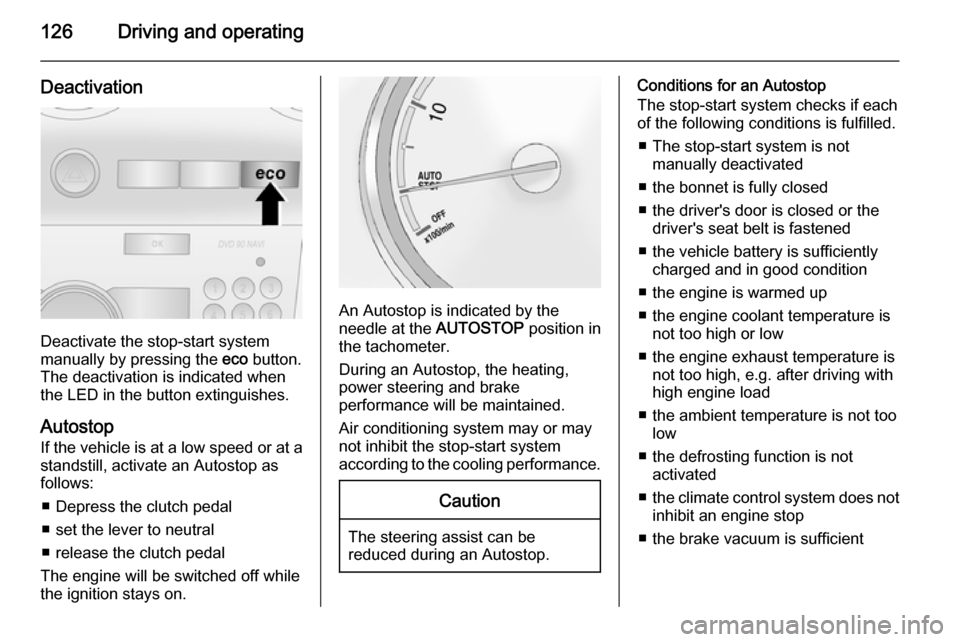
Deactivation
Deactivate the stop-start system
manually by pressing the eco button.
The deactivation is indicated when
the LED in the button extinguishes.
Autostop
If the vehicle is at a low speed or at a
standstill, activate an Autostop as
follows:
■ Depress the clutch pedal
■ set the lever to neutral
■ release the clutch pedal
The engine will be switched off while
the ignition stays on.
An Autostop is indicated by the
needle at the AUTOSTOP position in
the tachometer.
During an Autostop, the heating,
power steering and brake
performance will be maintained.
Air conditioning system may or may
not inhibit the stop-start system
according to the cooling performance.
Caution
The steering assist can be
reduced during an Autostop.
Conditions for an Autostop
The stop-start system checks if each
of the following conditions is fulfilled.
■ The stop-start system is not manually deactivated
■ the bonnet is fully closed
■ the driver's door is closed or the driver's seat belt is fastened
■ the vehicle battery is sufficiently charged and in good condition
■ the engine is warmed up
■ the engine coolant temperature is not too high or low
■ the engine exhaust temperature is not too high, e.g. after driving with
high engine load
■ the ambient temperature is not too low
■ the defrosting function is not activated
■ the climate control system does not
inhibit an engine stop
■ the brake vacuum is sufficient
Page 138 of 223

136Driving and operating
operations for wading , involving
checks for water contamination, at
the earliest opportunity.
Service checks after wading
Check for the ingress of water into the following:
■ Brake fluid reservoir
■ Air cleaner element
■ Engine
■ Transmission
■ Axles
■ Interior of vehicle
Renew any lubricating oil or hydraulic
fluid that has a milky appearance,
indicating contamination with water.
Cleaning
Clean the vehicle thoroughly and as
soon as possible after driving off-
road.
Do not let mud remain dry on any part
of the vehicle as it becomes abrasive and can damage paint, glass, seals,
bearings and brake components. If
left to build up, mud can seriously
affect the airflow through and overmechanical components and cause
localised overheating and failure of
parts, especially in the engine
compartment.
Ensure the radiator core and the area
between the radiator and intercooler/
oil cooler (where installed) is cleaned, to maintain proper cooling air flow.
Check the radiator and cooler cores
for blockage (sand, silt etc.).
Check the tyre treads.
Clean and check the mechanical
parts of the vehicle, particularly the
following areas:
■ Driveshafts, including sealing bellows
■ Front brake calipers, pads and discs
■ Front suspension
■ Clutch fork sealing bellows
■ Rear brake calipers, pads and discs
■ Rear suspension
■ Fuel tank and underguard
■ Breathers, axles and fuel tank
■ Load sensing valve■ Transfer box and underguard
■ Engine oil pan and underguard
Observe the following: ■ Do not spray high-pressure water directly at the vehicle seals
■ The wheels must be removed to clean all mud and stones from the
brake calipers and to check brake
pad wear
■ The areas on the upper side of the underguards must be cleared of
stones, to prevent damage to the
engine oil pan and the fuel tank
Page 148 of 223

146Driving and operating
Do not use marine diesel oils, heating
oils, Aquazole and similar diesel-
water emulsions. Diesel fuels must
not be diluted with fuels for petrol
engines.
Refuelling9 Danger
Before refuelling, switch off engine
and any external heaters with
combustion chambers. Switch off
any mobile phones.
Follow the operating and safety
instructions of the filling station
when refuelling.
9 Danger
Fuel is flammable and explosive.
No smoking. No naked flames or
sparks.
If you can smell fuel in your
vehicle, have the cause of this
remedied immediately by a
workshop.
Caution
In case of misfuelling, do not
switch on ignition.
Fuel filler flap is located at left rear
side of vehicle.
The fuel filler flap can only be opened
if the vehicle is unlocked 3 21.
Release the fuel filler flap by pushing the flap.
To unlock fuel filler cap: turn it
anticlockwise. If hissing occurs, wait
until it stops before completely
unscrewing the cap.
The fuel filler cap can be retained in
the holder on the inside of the fuel
filler flap.
When refuelling, fully insert the pump nozzle and switch it on.
After the automatic cut-off, the fuel
tank can be topped up with a
maximum two doses of fuel.Caution
Wipe off any overflowing fuel
immediately.
After refuelling, replace the fuel filler
cap and turn it clockwise until you
hear several clicks. Ensure the cap is
screwed in completely, otherwise
control indicator Z may illuminate in
the instrument cluster 3 85.
Close fuel filler flap.
Fuel filler cap
Only a genuine fuel filler cap provides
full functionality. Diesel-engined
vehicles have special fuel filler caps.
Page 176 of 223

174Vehicle care
FuseCircuitAMPAmplifierAPO JACK
(CONSOLE)Power outlet
(centre console)APO JACK
(REAR CARGO)Power outlet
(load compart‐
ment)AWD/VENTAll-wheel drive,
ventilationBCM (CTSY)Courtesy lightsBCM (DIMMER)Instrument illu‐
minationBCM (INT LIGHT
TRLR FOG)Interior lights,
trailer fog lightBCM (PRK/TRN)Parking lights,
turn signalsBCM (STOP)Brake lightsBCM (TRN SIG)Turn signalsBCM (VBATT)Battery voltageFuseCircuitCIMCommunica‐
tions Integration
ModuleCLSTRInstrument
clusterDRLDaytime running
lightsDR/LCKDriver door lockDRVR PWR
SEATDriver power
seatDRV/PWR
WNDWDriver power
windowF/DOOR LOCKFuel filler flapFRT WSRFront washerFSCMFuel systemFSCM/VENT SOLFuel system,
vent solenoidHEATING MAT
SWHeating mat
switchHTD SEAT PWRSeat heatingFuseCircuitHVAC BLWRClimate control,
air conditioning
fanIPCInstrument panel clusterISRVM/RCMInterior mirror,
remote compass moduleKEY CAPTUREKey captureL/GATETailgateLOGISTIC MODELogistic modeOSRVMExterior mirrorsPASS PWR
WNDWPassenger
power windowPWR DIODEPower diodePWR MODINGPower modingRADIORadioRR FOGHeated rear
window
Page 197 of 223

Vehicle care195
When cleaning with a high-pressure
jet cleaner, ensure a minimum
distance of 30 cm when working
around the tailgate to prevent
unintended unlocking.
Thoroughly rinse and leather-off the
vehicle. Rinse leather frequently. Use
separate leathers for painted and
glass surfaces: remnants of wax on
the windows will impair vision.
Exterior lights Headlight and other light covers are
made of plastic. Do not use any
abrasive or caustic agents, do not use
an ice scraper, and do not clean them dry.
Polishing and waxing
Wax the vehicle regularly (at the
latest when water no longer beads).
Otherwise, the paintwork will dry out.
Polishing is necessary only if the paint
has become dull or if solid deposits
have become attached to it.
Paintwork polish with silicone forms a
protective film, making waxing
unnecessary.Plastic body parts must not be treated with wax or polishing agents.
Windows and windscreen wiper blades
Use a soft lint-free cloth or chamois
leather together with window cleaner and insect remover.
When cleaning the rear window,
make sure the heating element inside
is not damaged.
For mechanical removal of ice, use a
sharp-edged ice scraper. Press the
scraper firmly against the glass so
that no dirt can get under it and
scratch the glass.
Clean smearing wiper blades with a
soft cloth and window cleaner.
Sunroof
Never clean with solvents or abrasive
agents, fuels, aggressive media
(e.g. paint cleaner, acetone-
containing solutions etc.), acidic or
highly alkaline media or abrasive
pads. Do not apply wax or polishing
agents to the sunroof.Wheels and tyres
Do not use high-pressure jet
cleaners.
Clean rims with a pH-neutral wheel
cleaner.
Rims are painted and can be treated
with the same agents as the body.
Paintwork damage
Rectify minor paintwork damage with
a touch-up pen before rust forms.
Have more extensive damage or rust areas repaired by a workshop.
Underbody Some areas of the vehicle underbody
have a PVC undercoating while other critical areas have a durable
protective wax coating.
After the underbody is washed, check
the underbody and have it waxed if
necessary.
Bitumen/rubber materials could
damage the PVC coating. Have
underbody work carried out by a
workshop.
Page 220 of 223

218
Fuel consumption - CO2-
Emissions ............................... 147
Fuel economy mode ....................90
Fuel filler cap ................................ 85
Fuel for diesel engines ..............145
Fuel for petrol engines ...............144
Fuel gauge ................................... 81
Fuses ......................................... 167
G
Gauges ......................................... 80
General information ...................147
Glovebox ..................................... 57
Graphic-Info-Display, Colour- Info-Display .............................. 95
H Halogen headlights ....................162
Hand brake ................................. 137
Hazard warning flashers ............108
Headlight flash ........................... 107
Headlight range adjustment ......107
Headlights .................. 106, 107, 161
Headlights when driving abroad 108
Headlight washer ..........................74
Head restraint adjustment .............8
Head restraints ............................ 34
Heated mirrors ............................. 29
Heated rear window ..................... 32
Heating ........................................ 39Heating and ventilation system . 115
High beam ........................... 91, 107
Hill start assist ........................... 139
Horn ....................................... 13, 74
I
Identification plate .....................201
Ignition switch positions .............124
Immobiliser ............................ 27, 90
Indicators ...................................... 80
Information displays...................... 92
Initial drive information.................... 6 Instrument cluster ........................80
Instrument panel fuse box .........172
Instrument panel illumination .....167
Instrument panel illumination control .................................... 111
Instrument panel overview ........... 10
Instrument panel storage ..............56
Interior care ............................... 196
Interior lighting ............................ 111
Interior lights ...................... 111, 166
Interior mirrors .............................. 29
Interruption of power supply ......133
Introduction .................................... 3
ISOFIX child restraint systems ....55
J
Jump starting ............................. 190K
Kerb weight........................... 71, 207
Keys ............................................. 19
Keys, locks ................................... 19
Kickdown .................................... 132
L Lashing eyes ............................... 70
Light covers, misted.................... 110
Lighting ....................................... 106
Lighting features .........................113
Light switch ................................ 106
Load compartment ................23, 68
Load compartment cover .............68
Load compartment lighting ........112
Load compartment storage ..........68
Loading information .....................71
Low engine oil level .....................90
Low fuel ....................................... 90
M
Malfunction indicator light ............85
Manual anti-dazzle ......................29
Manual mode ............................. 131
Manual transmission .................. 134
Mirror adjustment ........................... 9
Mirrors .................................... 28, 29
Misted light covers .....................110