Page 51 of 540
511-1. For safe use
1
For safety and security
YARIS_F_WE_52G04E
Airbag manual on-off system
“PASSENGER AIR BAG” indi-
cator
Vehicles without a smart entry
& start system
This indicator light turns on
when the airbag system is on
(only when the engine switch is
in the “ON” position).
Vehicles with a smart entry &
start system
This indicator light turns on
when the airbag system is on
(only when the engine switch is
in IGNITION ON mode).
Airbag manual on-off switch
This system deactivates the front passenger airbag.
Only deactivate the airbags when using a child restraint system
on the front passenger seat.
1
2
Page 53 of 540
531-1. For safe use
1
For safety and security
YARIS_F_WE_52G04E
WARNING
■When installing a child restraint system
For safety reasons, always install a child restraint system in a rear seat. In
the event that the rear seat cannot be used, the front seat be used as long
as the airbag manual on-off system is set to “OFF”.
If the airbag manual on-off system is left “ON”, the strong impact of the air-
bag deployment (inflation) may cause serious injury or even death.
■ When a child restraint system is not installed on the front passenger
seat
Ensure that the airbag manual on-off system is set to “ON”.
If it is left “OFF”, the airbag may not deploy in the event of an accident,
which may result in serious injury or even death.
Page 55 of 540
551-1. For safe use
1
For safety and security
YARIS_F_WE_52G04E
Child restraint systems
Studies have shown that installing a child restraint on a rear seat is
much safer than installing one on the front passenger seat.
● Choose a child restraint system that suits your vehicle and is appro-
priate to the age and size of the child.
● For installation details, follow the instructions provided with the child
restraint system.
General installation instructions are provided in this manual.
( P. 6 5 )
● If child restraint system regulations exist in the country where you
reside, please contact any authorized Toyota dealer or repairer, or
another duly qualified and equipped professional for the child
restraint system installation.
● Toyota recommends that you use a child restraint system which
conforms to the regulation ECE No.44.
Toyota strongly urges the use of child restraint systems.
Points to remember
Page 56 of 540
561-1. For safe use
YARIS_F_WE_52G04E
Child restraint systems are classified into the following 5 groups
according to the regulation ECE No.44:
Group 0: Up to 10 kg (22 lb.) (0 - 9 months)
Group 0+: Up to 13 kg (28 lb.) (0 - 2 years)
Group I: 9 to 18 kg (20 to 39 lb.) (9 months - 4 years)
Group II: 15 to 25 kg (34 to 55 lb.) (4 years - 7 years)
Group III: 22 to 36 kg (49 to 79 lb.) (6 years - 12 years)
In this owner’s manual, the following 3 types of popular child restraint
systems that can be secured with the seat belts are explained:
Types of child restraints
Baby seatChild seat
Equal to Group 0 and 0+ of ECE
No.44
Equal to Group 0+ and I of ECE
No.44
Junior seat
Equal to Group II and III of ECE
No.44
Page 57 of 540

571-1. For safe use
1
For safety and security
YARIS_F_WE_52G04E
Information provided in the table shows your child restraint system
suitability for various seating positions.
Front passenger seat
NOTE:
Vehicles with a vertical height adjustment lever, must have the seat
cushion adjusted to the highest position.
Child restraint system suitability for various seating positions
Front passenger seat
Recommended child
restraint systemsAirbag manual on-off switch
ONOFF
0
Up to 10 kg
(22 lb.)
(0 - 9 months)
X
Never put L
“TOYOTA G 0+,
BABYSAFE”
“TOYOTA G 0+,
BABYSAFE PLUS”
“TOYOTA G 0+,
BABYSAFE PLUS with
SEAT BELT FIXATION,
BASE PLATFORM”
0+
Up to 13 kg
(28 lb.)
(0 - 2 years)
X
Never put L
“TOYOTA G 0+,
BABYSAFE”
“TOYOTA G 0+,
BABYSAFE PLUS”
“TOYOTA G 0+,
BABYSAFE PLUS with
SEAT BELT FIXATION,
BASE PLATFORM”
I
9 to 18 kg
(20 to 39 lb.)
(9 months -
4 years)
Rear-facing —
X
Never put UF*1“TOYOTA DUO+”
Forward-facing —
UF*1
II, III
15 to 36 kg
(34 to 79 lb.)
(4 - 12 years)
UF*1UF*1“TOYOTA KID”
“TOYOTA KIDFIX”
Mass groups
Seating positions
Page 59 of 540

591-1. For safe use
1
For safety and security
YARIS_F_WE_52G04E
Rear center seat
Key of letters inserted in the above table:
U: Suitable for “universal” category child restraint system approved
for the use in this mass group.
UF: Suitable for forward-facing “universal” category child restraint
system approved for the use in this mass group.
L: Suitable for specific child seats. These child seats may be
intended for use in a special car model, limited or semi-universal
categories.
X: Not suitable seat position for children in this mass group.
*1: Adjust the front seat back to the most upright position. Move the
front seat cushion to the fully rearward.
*2: When you use a child restraint system in this position, remove
the head restraint.
The child restraint systems mentioned in the table may not be avail-
able outside of the EU area. Other child restraint systems which are
different from the systems mentioned in the table can be used, but the
suitability of the systems must be carefully checked with the child
restraint system manufacturer concerned and the seller of those
seats.
CenterRecommended child restraint
systems
0
Up to 10 kg (22 lb.)
(0 - 9 months)
L “TOYOTA G 0+, BABYSAFE”
“TOYOTA G 0+, BABYSAFE PLUS”
0+
Up to 13 kg (28 lb.)
(0 - 2 years)
L “TOYOTA G 0+, BABYSAFE”
“TOYOTA G 0+, BABYSAFE PLUS”
I
9 to 18 kg (20 to 39 lb.)
(9 months - 4 years)
L*2“TOYOTA DUO+”
II, III
15 to 36 kg
(34 to 79 lb.)
(4 - 12 years)
L*2“TOYOTA KID”
“TOYOTA KIDFIX”
Mass groups
Seating positions
Page 61 of 540

611-1. For safe use
1
For safety and security
YARIS_F_WE_52G04E
(1) For the CRS which do not carry the ISO/XX size class identifica-
tion (A to G), for the applicable mass group, the car manufacturer
shall indicate the vehicle specific ISOFIX child restraint system(s)
recommended for each position.
Key of letters inserted in the above table:
IUF: Suitable for ISOFIX forward-facing child restraint systems of uni-
versal category approved for the use in this mass group.
IL: Suitable for ISOFIX child restraint systems of the categories for
“specific vehicles”, “restricted”, or “semiuniversal”, approved for
this type of vehicle.
X: ISOFIX position not suitable for ISOFIX child restraint systems in
this mass group and/or this size class.
*1: If the child seat is installed behind a front seat equipped with
height adjuster and the front seat is adjusted below middle height
position, then adjust the front seat head restraint to the highest
position.
*2: When you use a child restraint system in this position, remove
the head restraint.
The child restraint systems mentioned in the table may not be avail-
able outside of the EU area. Other child restraint systems different
from the systems mentioned in the table can be used, but the suitabil-
ity of the systems must be carefully checked with the child restraint
system manufacturer and retailer.
Page 62 of 540
621-1. For safe use
YARIS_F_WE_52G04E
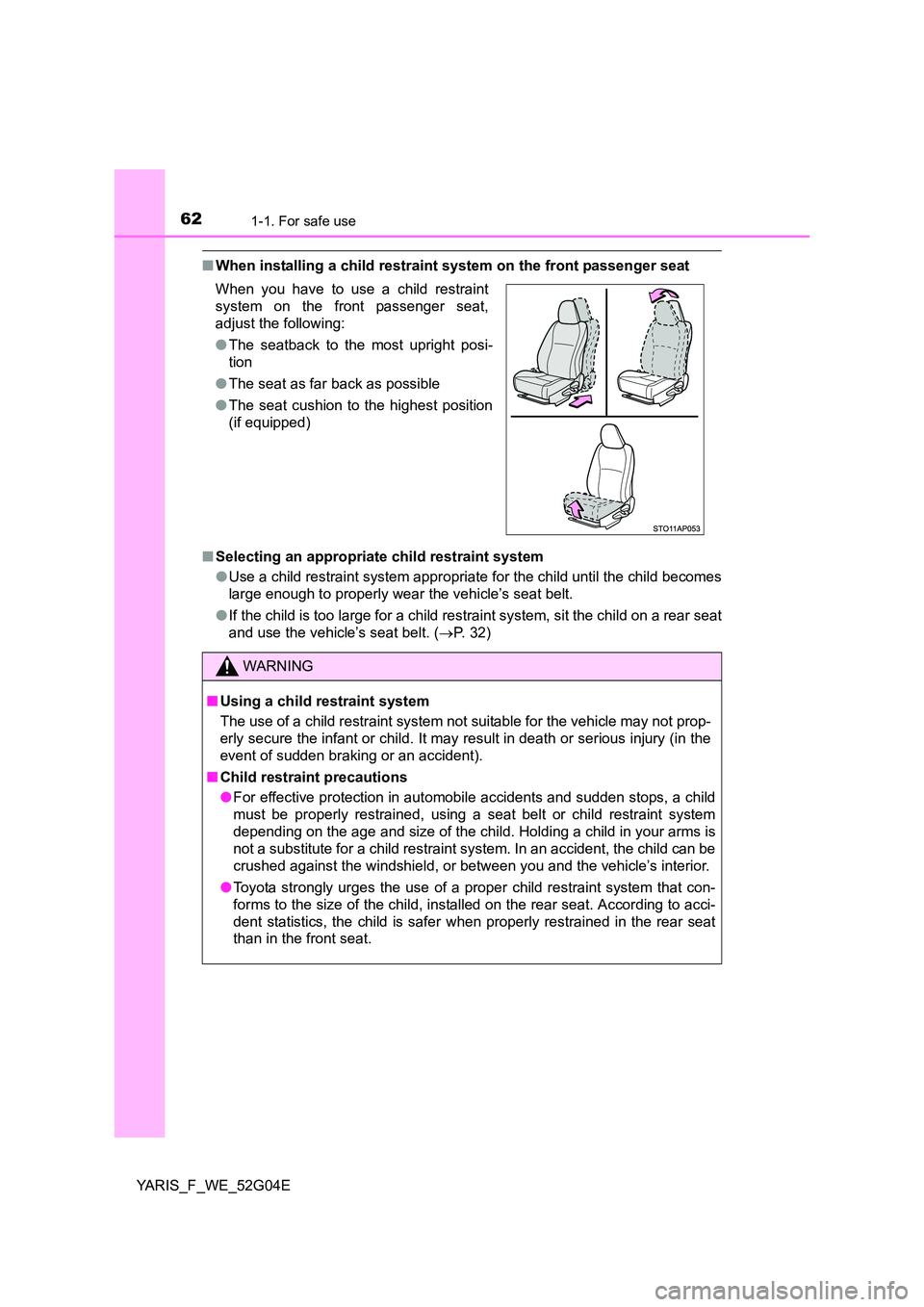
■When installing a child restraint system on the front passenger seat
■ Selecting an appropriate child restraint system
● Use a child restraint system appropriate for the child until the child becomes
large enough to properly wear the vehicle’s seat belt.
● If the child is too large for a child restraint system, sit the child on a rear seat
and use the vehicle’s seat belt. ( P. 32)
When you have to use a child restraint
system on the front passenger seat,
adjust the following:
● The seatback to the most upright posi-
tion
● The seat as far back as possible
● The seat cushion to the highest position
(if equipped)
WARNING
■ Using a child restraint system
The use of a child restraint system not suitable for the vehicle may not prop-
erly secure the infant or child. It may result in death or serious injury (in the
event of sudden braking or an accident).
■ Child restraint precautions
● For effective protection in automobile accidents and sudden stops, a child
must be properly restrained, using a seat belt or child restraint system
depending on the age and size of the child. Holding a child in your arms is
not a substitute for a child restraint system. In an accident, the child can be
crushed against the windshield, or between you and the vehicle’s interior.
● Toyota strongly urges the use of a proper child restraint system that con-
forms to the size of the child, installed on the rear seat. According to acci-
dent statistics, the child is safer when properly restrained in the rear seat
than in the front seat.