Page 425 of 540
4258-2. Steps to take in an emergency
8
When trouble arises
YARIS_F_WE_52G04E
If a tow truck is not available in an emergency, your vehicle may be
temporarily towed using cables or chains secured to the emergency
towing eyelets. This should only be attempted on hard surfaced roads
for at most 80 km (50 miles) at under 30 km/h (18 mph).
A driver must be in the vehicle to steer and operate the brakes. The
vehicle’s wheels, drive train, axles, steering and brakes must be in
good condition.
For vehicles with a Multidrive, only the front towing eyelets may be
used.
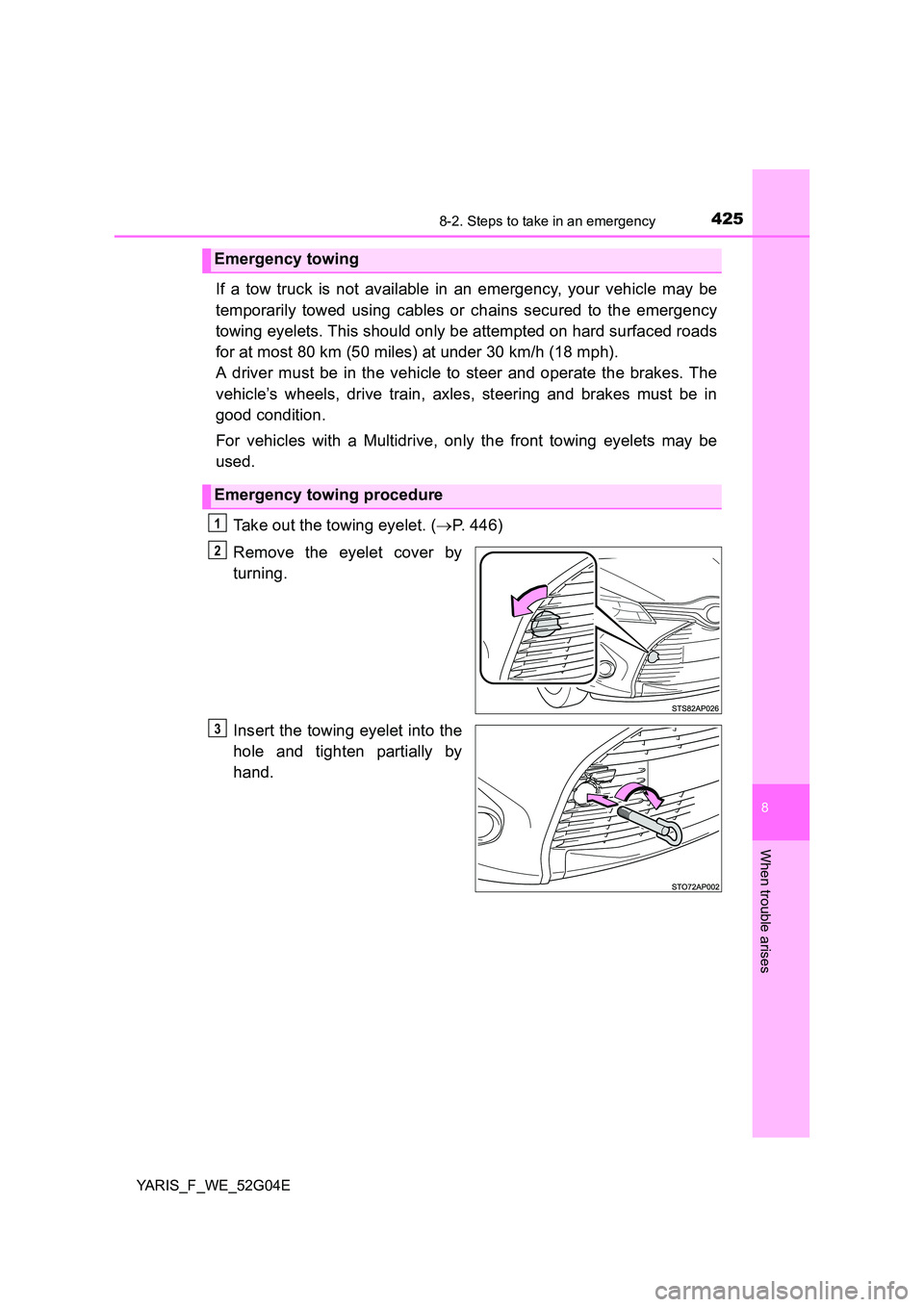
Take out the towing eyelet. ( P. 446)
Remove the eyelet cover by
turning.
Insert the towing eyelet into the
hole and tighten partially by
hand.
Emergency towing
Emergency towing procedure
1
2
3
Page 426 of 540
4268-2. Steps to take in an emergency
YARIS_F_WE_52G04E
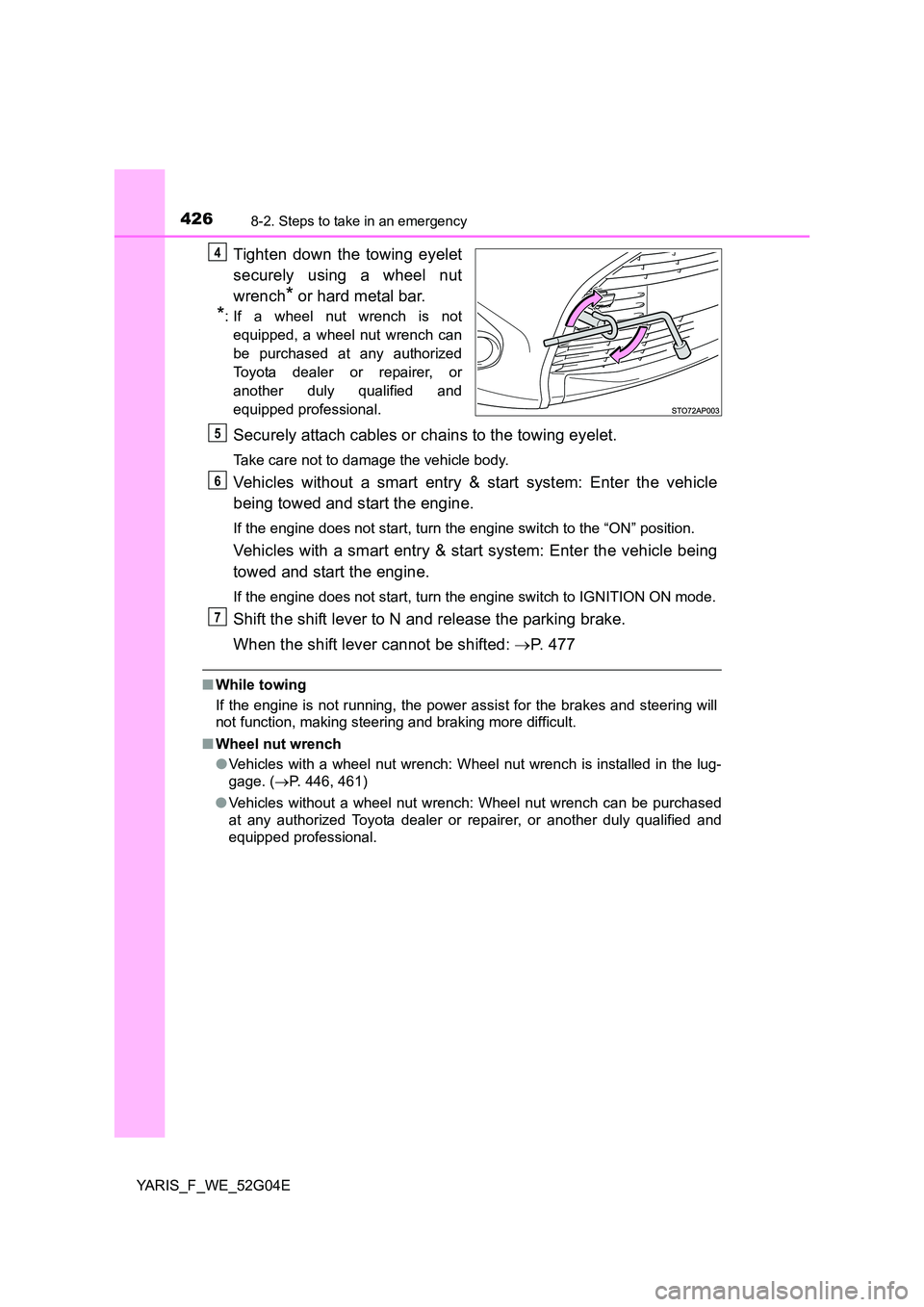
Tighten down the towing eyelet
securely using a wheel nut
wrench* or hard metal bar.
*: If a wheel nut wrench is not
equipped, a wheel nut wrench can
be purchased at any authorized
Toyota dealer or repairer, or
another duly qualified and
equipped professional.
Securely attach cables or chains to the towing eyelet.
Take care not to damage the vehicle body.
Vehicles without a smart entry & start system: Enter the vehicle
being towed and start the engine.
If the engine does not start, turn the engine switch to the “ON” position.
Vehicles with a smart entry & start system: Enter the vehicle being
towed and start the engine.
If the engine does not start, turn the engine switch to IGNITION ON mode.
Shift the shift lever to N and release the parking brake.
When the shift lever cannot be shifted: P. 477
■While towing
If the engine is not running, the power assist for the brakes and steering will
not function, making steering and braking more difficult.
■ Wheel nut wrench
● Vehicles with a wheel nut wrench: Wheel nut wrench is installed in the lug-
gage. ( P. 446, 461)
● Vehicles without a wheel nut wrench: Wheel nut wrench can be purchased
at any authorized Toyota dealer or repairer, or another duly qualified and
equipped professional.
4
5
6
7
Page 427 of 540
4278-2. Steps to take in an emergency
8
When trouble arises
YARIS_F_WE_52G04E
WARNING
Observe the following precautions.
Failure to do so may result in death or serious injury.
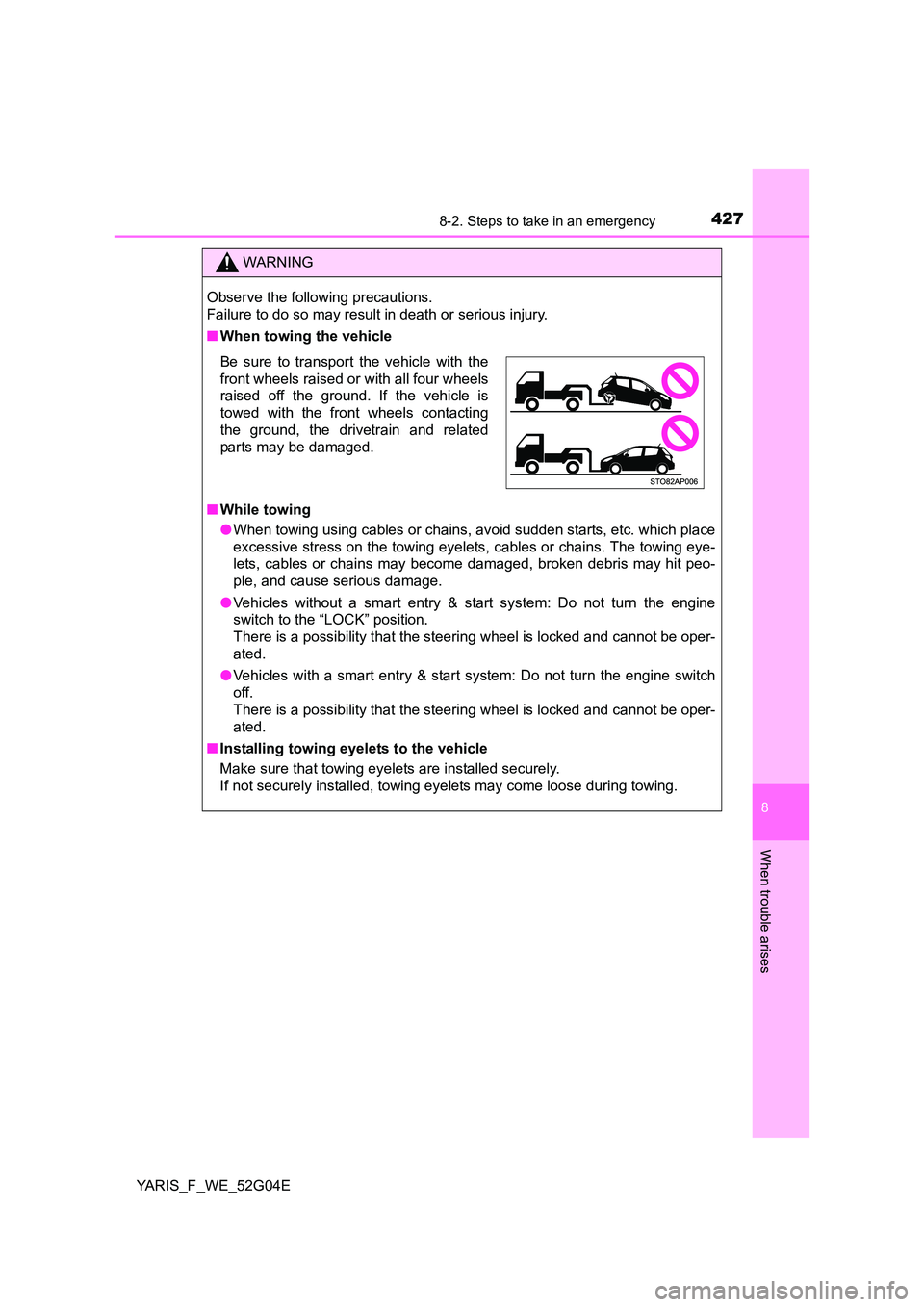
■ When towing the vehicle
■ While towing
● When towing using cables or chains, avoid sudden starts, etc. which place
excessive stress on the towing eyelets, cables or chains. The towing eye-
lets, cables or chains may become damaged, broken debris may hit peo-
ple, and cause serious damage.
● Vehicles without a smart entry & start system: Do not turn the engine
switch to the “LOCK” position.
There is a possibility that the steering wheel is locked and cannot be oper-
ated.
● Vehicles with a smart entry & start system: Do not turn the engine switch
off.
There is a possibility that the steering wheel is locked and cannot be oper-
ated.
■ Installing towing eyelets to the vehicle
Make sure that towing eyelets are installed securely.
If not securely installed, towing eyelets may come loose during towing.
Be sure to transport the vehicle with the
front wheels raised or with all four wheels
raised off the ground. If the vehicle is
towed with the front wheels contacting
the ground, the drivetrain and related
parts may be damaged.
Page 428 of 540

4288-2. Steps to take in an emergency
YARIS_F_WE_52G04E
NOTICE
■To prevent damage to the vehicle when towing using a wheel-lift type
truck
● Vehicles without a smart entry & start system: Do not tow the vehicle from
the rear when the engine switch is in the “LOCK” position or the key is
removed.
The steering lock mechanism is not strong enough to hold the front wheels
straight.
● Vehicles with a smart entry & start system: Do not tow the vehicle from the
rear when the engine switch is off. The steering lock mechanism is not
strong enough to hold the front wheels straight.
● When raising the vehicle, ensure adequate ground clearance for towing at
the opposite end of the raised vehicle. Without adequate clearance, the
vehicle could be damaged while being towed.
■ To prevent damage to the vehicle when towing with a sling-type truck
Do not tow with a sling-type truck, either from the front or rear.
■ To prevent damage to the vehicle during emergency towing
Do not secure cables or chains to the suspension components.
Page 444 of 540

4448-2. Steps to take in an emergency
YARIS_F_WE_52G04E
Once(Flashes in yellow for 15 seconds.)
Smart entry & start system indicator
Indicates that the electronic key is not
present when attempting to start the
engine.
Confirm the location of the electronic
key.
9 times(Flashes in yellow)
Smart entry & start system indicator
An attempt was made to drive when the
regular key was not inside the vehicle.
Confirm that the electronic key is inside
the vehicle.
Once(Flashes in yellow for 15 seconds.)
Smart entry & start system indicator
Indicates that the electronic key battery is
low.
Replace the battery. (P. 394)
Once(Flashes quickly in green for 15 seconds.)
Smart entry & start system indicator
Indicates that the steering lock has not
been released.
Release the steering lock. (P. 190)
Once(Flashes in yellow for 30 seconds.)
Smart entry & start system indicator
• When the doors were unlocked with the
mechanical key and then the engine
switch was pressed, the electronic key
could not be detected in the vehicle.
• The electronic key could not be detected
in the vehicle even after the engine switch
was pressed two consecutive times.
Vehicles with a Multidrive:
Touch the electronic key to the engine
switch while depressing the brake
pedal.
Vehicles with a manual transmission:
Touch the electronic key to the engine
switch while depressing the clutch
pedal.
Interior
buzzer
Exterior
buzzer
Warning
lightWarning light/Details/Actions
Page 458 of 540

4588-2. Steps to take in an emergency
YARIS_F_WE_52G04E
WARNING
■When using the compact spare tire
● Remember that the compact spare tire provided is specifically designed
for use with your vehicle. Do not use your compact spare tire on another
vehicle.
● Do not use more than one compact spare tire simultaneously.
● Replace the compact spare tire with a standard tire as soon as possible.
● Avoid sudden acceleration, abrupt steering, sudden braking and shifting
operations that cause sudden engine braking.
■ When storing the compact spare tire
Be careful not to catch fingers or other body parts between the compact
spare tire and the body of the vehicle.
■ After using the tools and jack
Before driving, make sure all the tools and jack are securely in place in their
storage location to reduce the possibility of personal injury during a collision
or sudden braking.
■ When the compact spare tire is attached
The vehicle speed may not be correctly detected, and the following systems
may not operate correctly:
● ABS
● Brake assist
● VSC (if equipped)
● TRC (if equipped)
● PCS (Pre-Crash Safety system) (if equipped)
● LDA (Lane Departure Alert) (if equipped)
● Automatic High Beam (if equipped)
● Cruise control (if equipped)
● Navigation system (if equipped)
■ Speed limit when using the compact spare tire
Do not drive at speeds in excess of 80 km/h (50 mph) when a compact
spare tire is installed on the vehicle.
The compact spare tire is not designed for driving at high speeds. Failure to
observe this precaution may lead to an accident causing death or serious
injury.
Page 473 of 540
4738-2. Steps to take in an emergency
8
When trouble arises
YARIS_F_WE_52G04E
WARNING
●Connect the valve and hose securely with the tire installed on the vehicle.
If the hose is not properly connected to the valve, air leakage may occur
as sealant may be sprayed out.
● If the hose comes off the valve while inflating the tire, there is a risk that
the hose will move abruptly due to air pressure.
● After inflation of the tire has completed, the sealant may splatter when the
hose is disconnected or some air is let out of the tire.
● Follow the operation procedure to repair the tire. If the procedures not fol-
lowed, the sealant may spray out.
● Keep back from the tire while it is being repaired, as there is a chance of it
bursting while the repair operation is being performed. If you notice any
cracks or deformation of the tire, turn off the compressor switch and stop
the repair operation immediately.
● The repair kit may overheat if operated for a long period of time. Do not
operate the repair kit continuously for more than 40 minutes.
● Parts of the repair kit become hot during operation. Be careful when han-
dling the repair kit during and after operation. Do not touch the metal part
around the connecting area between the bottle and compressor. It will be
extremely hot.
● Do not attach the vehicle speed warning sticker to an area other than the
one indicated. If the sticker is attached to an area where an SRS airbag is
located, such as the pad of the steering wheel, it may prevent the SRS air-
bag from operating properly.
■ Driving to spread the liquid sealant evenly
Observe the following precautions to reduce the risk of accidents.
Failing to do so may result in a loss of vehicle control and cause death or
serious injury.
● Drive the vehicle carefully at a low speed. Be especially careful when turn-
ing and cornering.
● If the vehicle does not drive straight or you feel a pull through the steering
wheel, stop the vehicle and check the following.
• Tire condition. The tire may have separated from the wheel.
• Tire inflation pressure. If the tire inflation pressure is 130 kPa (1.3 kgf/cm2
or bar, 19 psi) or less, the tire may be severely damaged.