Page 375 of 564
375 4-3. Do-it-yourself maintenance
4
Maintenance and care
NOTICE
To prevent serious engine damage
Check the oil level on a regular basis.
When replacing the engine oil
Be careful not to spill engine oil on the vehicle components.
Avoid overfilling, or the engine could be damaged.
Check the oil level on the dipstick every time you refill the vehicle.
Be sure the engine oil filler cap is properly tightened.
Engine oil (diesel engine only)
Using an engine oil other than ACEA C2 may damage the catalytic con-
verter.
Page 381 of 564

381 4-3. Do-it-yourself maintenance
4
Maintenance and care
CAUTION
Chemicals in the battery
Batteries contain poisonous and corrosive sulfuric acid and may produce
hydrogen gas which is flammable and explosive. To reduce the risk of death
or serious injury, take the following precautions while working on or near the
battery:
Do not cause sparks by touching the battery terminals with tools.
Do not smoke or light a match near the battery.
Avoid contact with eyes, skin and clothes.
Never inhale or swallow electrolyte.
Wear protective safety glasses when working near the battery.
Keep children away from the battery.
Where to safely charge the battery
Always charge the battery in an open area. Do not charge the battery in a
garage or closed room where there is insufficient ventilation.
Emergency measures regarding electrolyte
If electrolyte gets in your eyes
Flush your eyes with clean water for at least 15 minutes and get immedi-
ate medical attention. If possible, continue to apply water with a sponge or
cloth while traveling to the nearest medical facility.
If electrolyte gets on your skin
Wash the affected area thoroughly. If you feel pain or burning, get medical
attention immediately.
If electrolyte gets on your clothes
It can soak through clothing on to your skin. Immediately take off the cloth-
ing and follow the procedure above if necessary.
If you accidentally swallow electrolyte
Drink a large quantity of water or milk. Follow with milk of magnesia,
beaten raw egg or vegetable oil. Get emergency medical attention immedi-
ately.
Page 398 of 564

398 4-3. Do-it-yourself maintenance
When replacing wheels
The wheels of your vehicle are equipped with tire pressure warning valves
and transmitters that allow the tire pressure warning system to provide
advance warning in the event of a loss in tire inflation pressure. Whenever
wheels are replaced, tire pressure warning valves and transmitters must be
installed. (P. 385)
CAUTION
When replacing wheels
Do not use wheels that are a different size from those recommended in the
Owner’s Manual, as this may result in a loss of handling control.
Never use an inner tube in a leaking wheel which is designed for a tube-
less tire. Doing so may result in an accident, causing death or serious
injury.
When installing the wheel nuts
Never use oil or grease on the wheel bolts or wheel nuts.
Oil and grease may cause the wheel nuts to be excessively tightened,
leading to bolt or disc wheel damage. In addition, the oil or grease can
cause the wheel nuts to loosen and the wheel may fall off, causing an acci-
dent and resulting in death or serious injury. Remove any oil or grease
from the wheel bolts or wheel nuts.
Be sure to install the wheel nuts with
the tapered end facing inward. Install-
ing the nuts with the tapered end facing
outward can cause wheel to break and
eventually cause a wheel to come off
while driving, which could lead to an
accident resulting in death or serious
injury.
Tapered portion
Page 426 of 564
426 4-3. Do-it-yourself maintenance
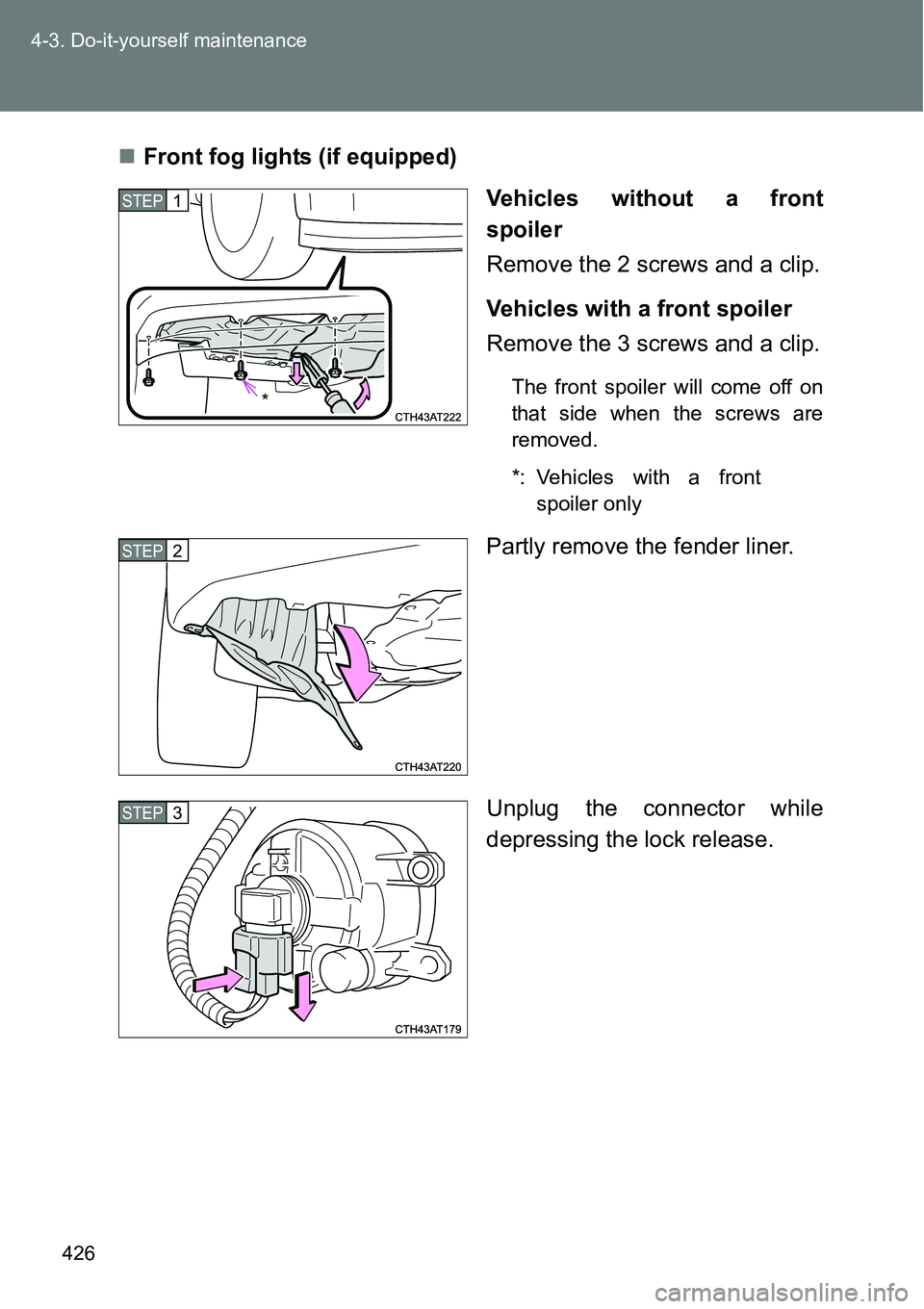
Front fog lights (if equipped)
Vehicles without a front
spoiler
Remove the 2 screws and a clip.
Vehicles with a front spoiler
Remove the 3 screws and a clip.
The front spoiler will come off on
that side when the screws are
removed.
*: Vehicles with a front
spoiler only
Partly remove the fender liner.
Unplug the connector while
depressing the lock release.
STEP1
*
STEP2
STEP3
Page 433 of 564
433 4-3. Do-it-yourself maintenance
4
Maintenance and care
CAUTION
Replacing light bulbs
Turn off the lights. Do not attempt to replace the bulb immediately after
turning off the lights.
The bulbs become very hot and may cause burns.
Do not touch the glass portion of the light bulb with bare hands. When it is
unavoidable to hold the glass portion, use and hold with a clean dry cloth
to avoid getting moisture and oils on the bulb.
Also, if the bulb is scratched or dropped, it may blow out or crack.
Fully install light bulbs and any parts used to secure them. Failure to do so
may result in heat damage, fire, or water entering the headlight unit. This
may damage the headlights or cause condensation to build up on the lens.
To prevent damage or fire
Make sure bulbs are fully seated and locked.
Page 448 of 564
448 5-2. Steps to take in an emergency
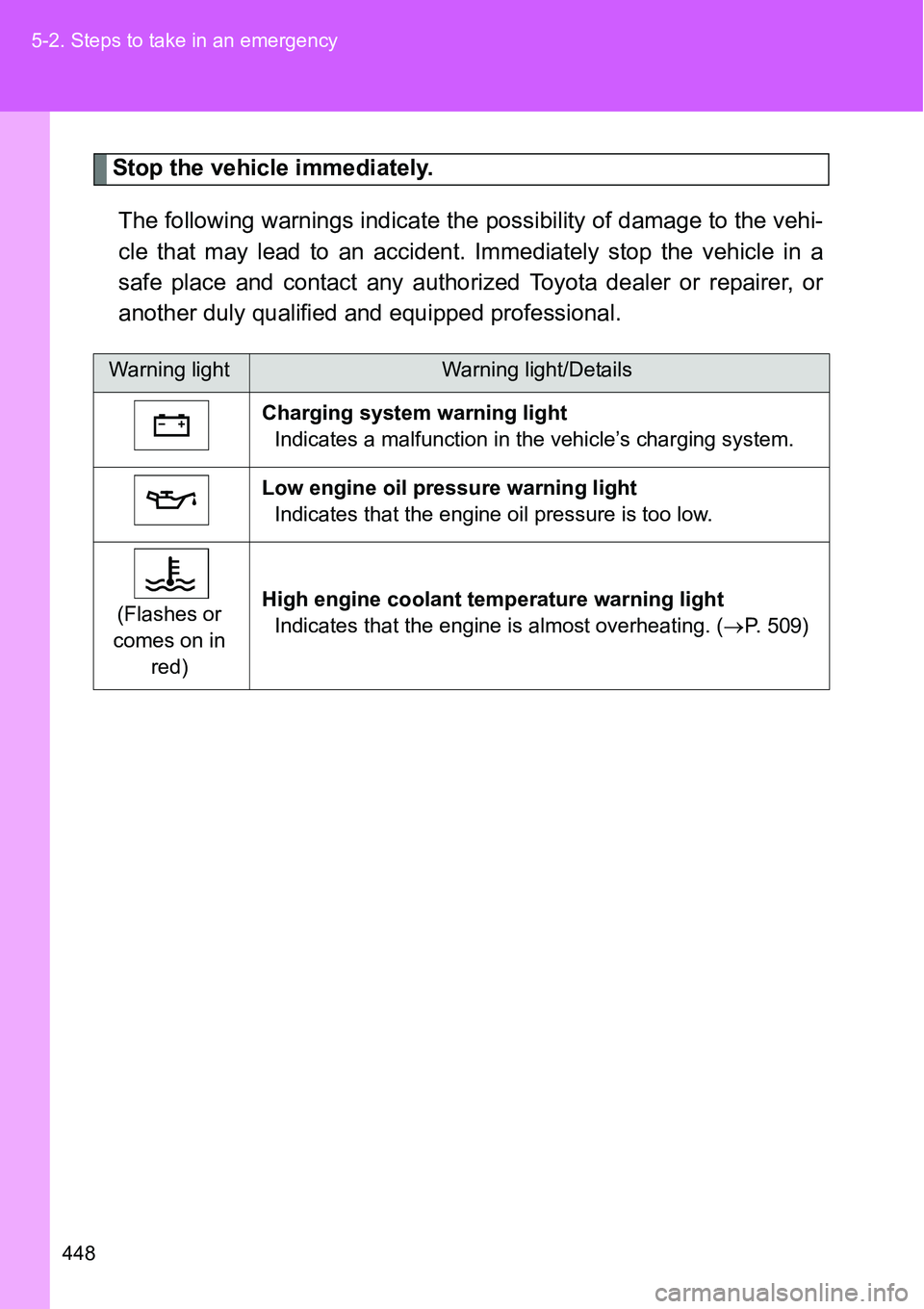
Stop the vehicle immediately.
The following warnings indicate the possibility of damage to the vehi-
cle that may lead to an accident. Immediately stop the vehicle in a
safe place and contact any authorized Toyota dealer or repairer, or
another duly qualified and equipped professional.
Warning lightWarning light/Details
Charging system warning light
Indicates a malfunction in the vehicle’s charging system.
Low engine oil pressure warning light
Indicates that the engine oil pressure is too low.
(Flashes or
comes on in
red)High engine coolant temperature warning light
Indicates that the engine is almost overheating. (P. 509)
Page 451 of 564
5
451 5-2. Steps to take in an emergency
When trouble arises
Low fuel level warning
light
Gasoline engine: Indi-
cates that remaining fuel is
about 5.8 L (1.5 gal., 1.3
Imp. gal.) or less.
Diesel engine: Indicates
that remaining fuel is
about 6.4 L (1.7 gal., 1.4
Imp. gal.) or less.Refuel the vehicle.
(On the instru-
ment cluster)Driver’s and front passen-
ger’s seat belt reminder
light (warning buzzer)*
3
Warns the driver and front
passenger to fasten their
seat belts.Fasten the seat belt.
(On the center
panel)Rear passengers’ seat
belt reminder lights
(warning buzzer)*
3
Warns the rear passen-
gers to fasten their seat
belts.Fasten the seat belt.
Low engine oil level warn-
ing light (diesel engine
only)
Indicates that engine oil
level is low.Check the level of engine
oil, and add if necessary.
Warning lightWarning light/DetailsCorrection procedure
Page 452 of 564

452 5-2. Steps to take in an emergency
DPF system warning light
(diesel engine only)
• Indicates that the DPF cat-
alytic converter needs to
be cleaned due to
repeated short trips and/or
low-speed driving.
• Indicates that the amount
of accumulated deposits in
the DPF catalytic con-
verter has reached the
specified level.To clean the DPF catalytic
converter, drive the vehicle
at a speed of 65 km/h (40
mph) or greater for 20 to 30
minutes as much as possi-
ble until the DPF system
warning light turns off.*4
Do not turn off the engine as
much as possible until the
DPF system warning light
turns off.
If it is not possible to drive
the vehicle at speeds of 65
km/h (40 mph) or greater, or
the DPF system warning
light does not turn off even
after driving for more than
30 minutes, have the vehi-
cle inspected by any autho-
rized Toyota dealer or
repairer, or another duly
qualified and equipped pro-
fessional.
(Flashes)Engine oil change
reminder light (diesel
engine only)
Indicates that the engine
oil is scheduled to be
changed.
Flashes approximately
14500 km (9000 miles)
after the engine oil is
changed. (P. 459) (The
indicator will not work
properly unless the oil
maintenance date has
been reset).Check the engine oil, and
change if necessary. After
changing the engine oil, the
oil change system should
be reset. (P. 374)
Warning lightWarning light/DetailsCorrection procedure