Page 179 of 564
179 2-1. Driving procedures
2
When driving
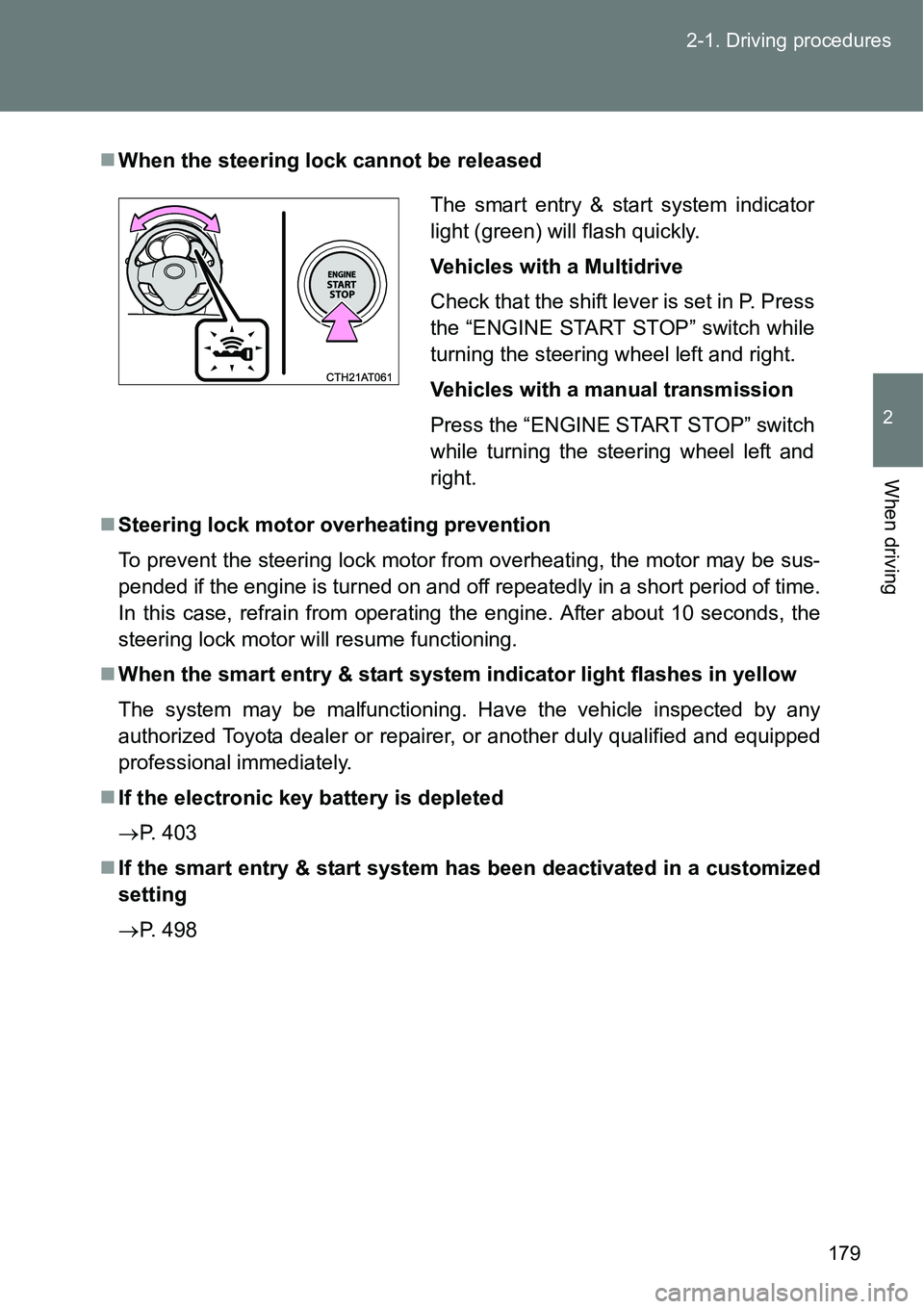
When the steering lock cannot be released
Steering lock motor overheating prevention
To prevent the steering lock motor from overheating, the motor may be sus-
pended if the engine is turned on and off repeatedly in a short period of time.
In this case, refrain from operating the engine. After about 10 seconds, the
steering lock motor will resume functioning.
When the smart entry & start system indicator light flashes in yellow
The system may be malfunctioning. Have the vehicle inspected by any
authorized Toyota dealer or repairer, or another duly qualified and equipped
professional immediately.
If the electronic key battery is depleted
P. 403
If the smart entry & start system has been deactivated in a customized
setting
P. 498
The smart entry & start system indicator
light (green) will flash quickly.
Vehicles with a Multidrive
Check that the shift lever is set in P. Press
the “ENGINE START STOP” switch while
turning the steering wheel left and right.
Vehicles with a manual transmission
Press the “ENGINE START STOP” switch
while turning the steering wheel left and
right.
Page 181 of 564
181 2-1. Driving procedures
2
When driving
NOTICE
To prevent battery discharge
Do not leave the “ENGINE START STOP” switch in ACCESSORY or IGNI-
TION ON mode for long periods of time without the engine running.
If the smart entry & start system indicator light (green) is illuminated, the
“ENGINE START STOP” switch is not off. When exiting the vehicle,
always check that the “ENGINE START STOP” switch is off.
Vehicles with a Multidrive: Do not stop the engine when the shift lever is in
a position other than P. If the engine is stopped in another shift lever posi-
tion, the “ENGINE START STOP” switch will not be turned off but instead
be turned to ACCESSORY mode. If the vehicle is left in ACCESSORY
mode, battery discharge may occur.
When starting the engine
Do not race a cold engine.
If the engine becomes difficult to start or stalls frequently, have the engine
checked immediately.
Symptoms indicating a malfunction with the “ENGINE START STOP”
switch
If the “ENGINE START STOP” seems to be operating somewhat differently
than usual, such as the switch sticking slightly, there may be a malfunction.
Contact any authorized Toyota dealer or repairer, or another duly qualified
and equipped professional immediately.
Page 182 of 564
182
2-1. Driving procedures
Engine (ignition) switch (vehicles without a smar t entr y & star t system)
Starting the engine
Vehicles with a Multidrive
Check that the parking brake is set.
Check that the shift lever is set in P.
Firmly depress the brake pedal.
Turn the engine switch to the “START” position to start the
engine.
Vehicles with a manual transmission (gasoline engine)
Check that the parking brake is set.
Check that the shift lever is set in N.
Firmly depress the clutch pedal.
Turn the engine switch to the “START” position to start the
engine.
Vehicles with a manual transmission (diesel engine)
Check that the parking brake is set.
Check that the shift lever is set in N.
Firmly depress the clutch pedal.
Turn the engine switch to the “ON” position.
The indicator turns on.
After the indicator light goes out, turn the engine
switch to the “START” position to start the engine.
STEP1
STEP2
STEP3
STEP4
STEP1
STEP2
STEP3
STEP4
STEP1
STEP2
STEP3
STEP4
STEP5
Page 195 of 564
195
2-1. Driving procedures
2
When driving
Turn signal lever
Turn signals can be operated when
Vehicles without a smart entry & start system: The engine switch is in the
“ON” position.
Vehicles with a smart entry & start system: The “ENGINE START STOP”
switch is in IGNITION ON mode.
If the indicator flashes faster than usual
Check that a light bulb in the front or rear turn signal lights has not burned
out.
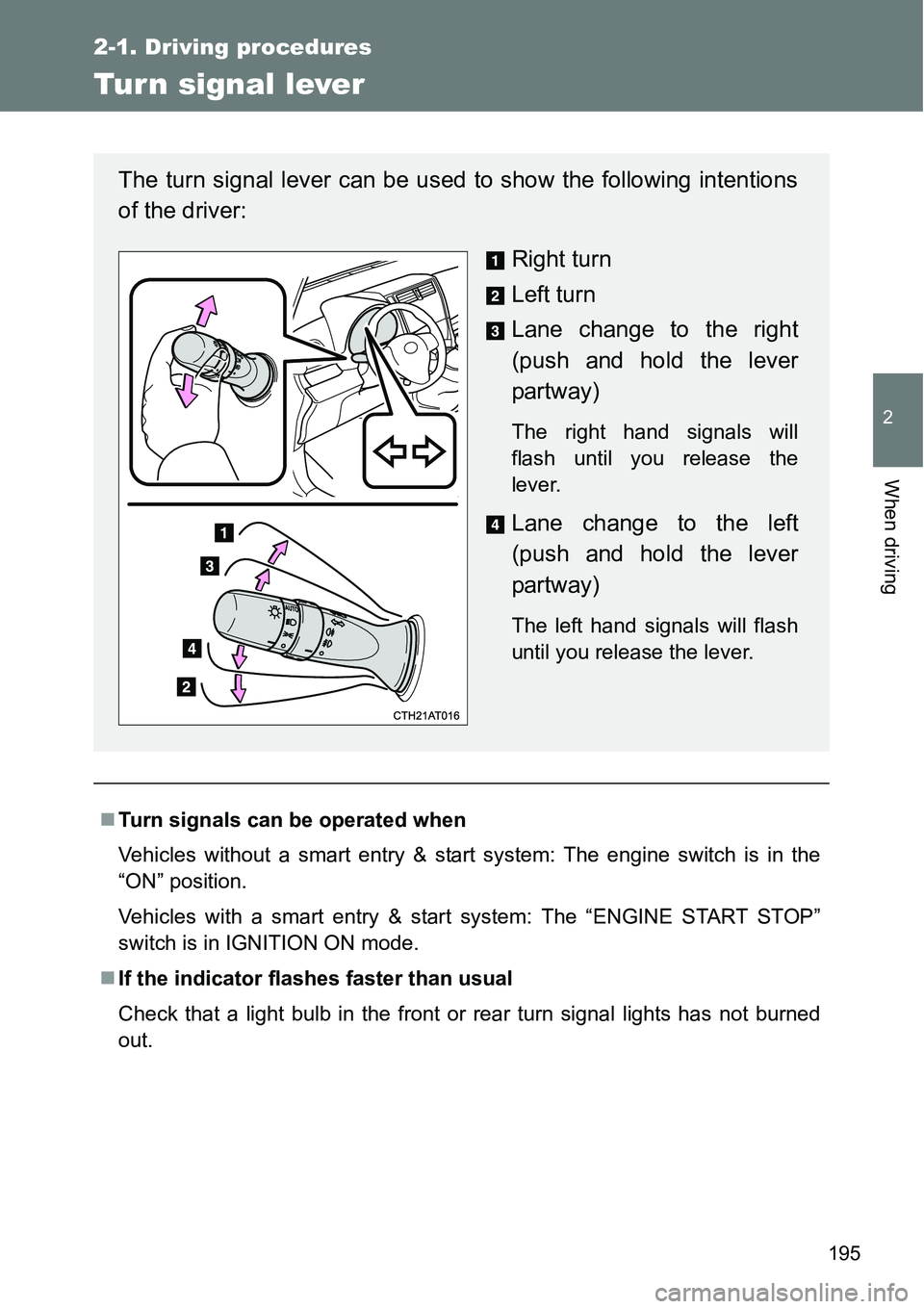
The turn signal lever can be used to show the following intentions
of the driver:
Right turn
Left turn
Lane change to the right
(push and hold the lever
partway)
The right hand signals will
flash until you release the
lever.
Lane change to the left
(push and hold the lever
partway)
The left hand signals will flash
until you release the lever.
Page 203 of 564
203 2-2. Instrument cluster
2
When driving
NOTICE
To prevent damage to the engine and its components
Do not let the indicator needle of the tachometer enter the red zone, which
indicates the maximum engine speed.
The engine may be overheating if the high engine coolant temperature
warning light flashes or turns on. In this case, immediately stop the vehicle
in a safe place, and check the engine after it has cooled completely.
(
P. 509)
Page 207 of 564
207 2-2. Instrument cluster
2
When driving
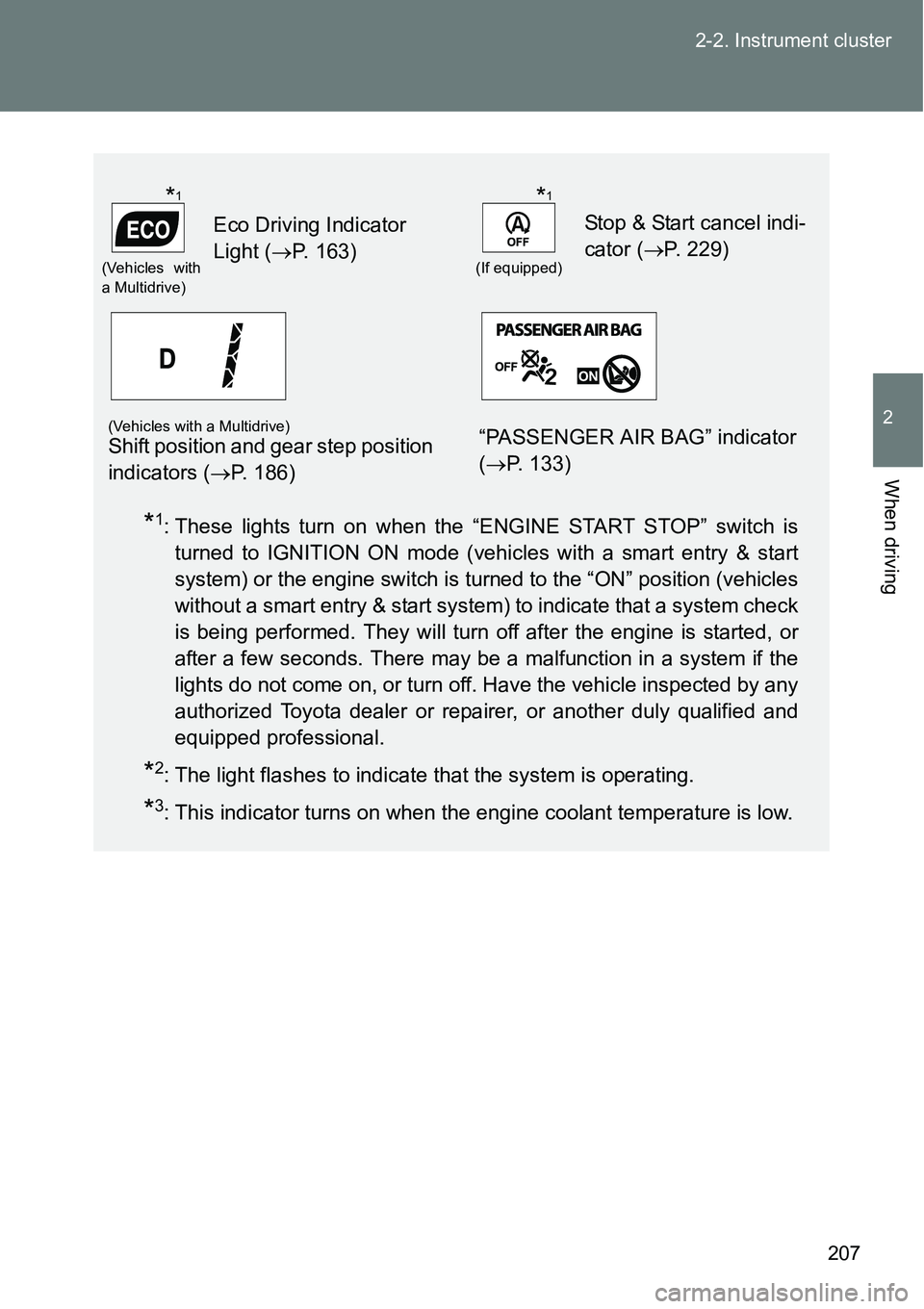
*1: These lights turn on when the “ENGINE START STOP” switch is
turned to IGNITION ON mode (vehicles with a smart entry & start
system) or the engine switch is turned to the “ON” position (vehicles
without a smart entry & start system) to indicate that a system check
is being performed. They will turn off after the engine is started, or
after a few seconds. There may be a malfunction in a system if the
lights do not come on, or turn off. Have the vehicle inspected by any
authorized Toyota dealer or repairer, or another duly qualified and
equipped professional.
*2: The light flashes to indicate that the system is operating.
*3: This indicator turns on when the engine coolant temperature is low.
(Vehicles with
a Multidrive)
Eco Driving Indicator
Light (P. 163)
(If equipped)
Stop & Start cancel indi-
cator (P. 229)
(Vehicles with a Multidrive)Shift position and gear step position
indicators (P. 186)“PASSENGER AIR BAG” indicator
(P. 133)
*1*1
Page 208 of 564
208 2-2. Instrument cluster
Warning lights
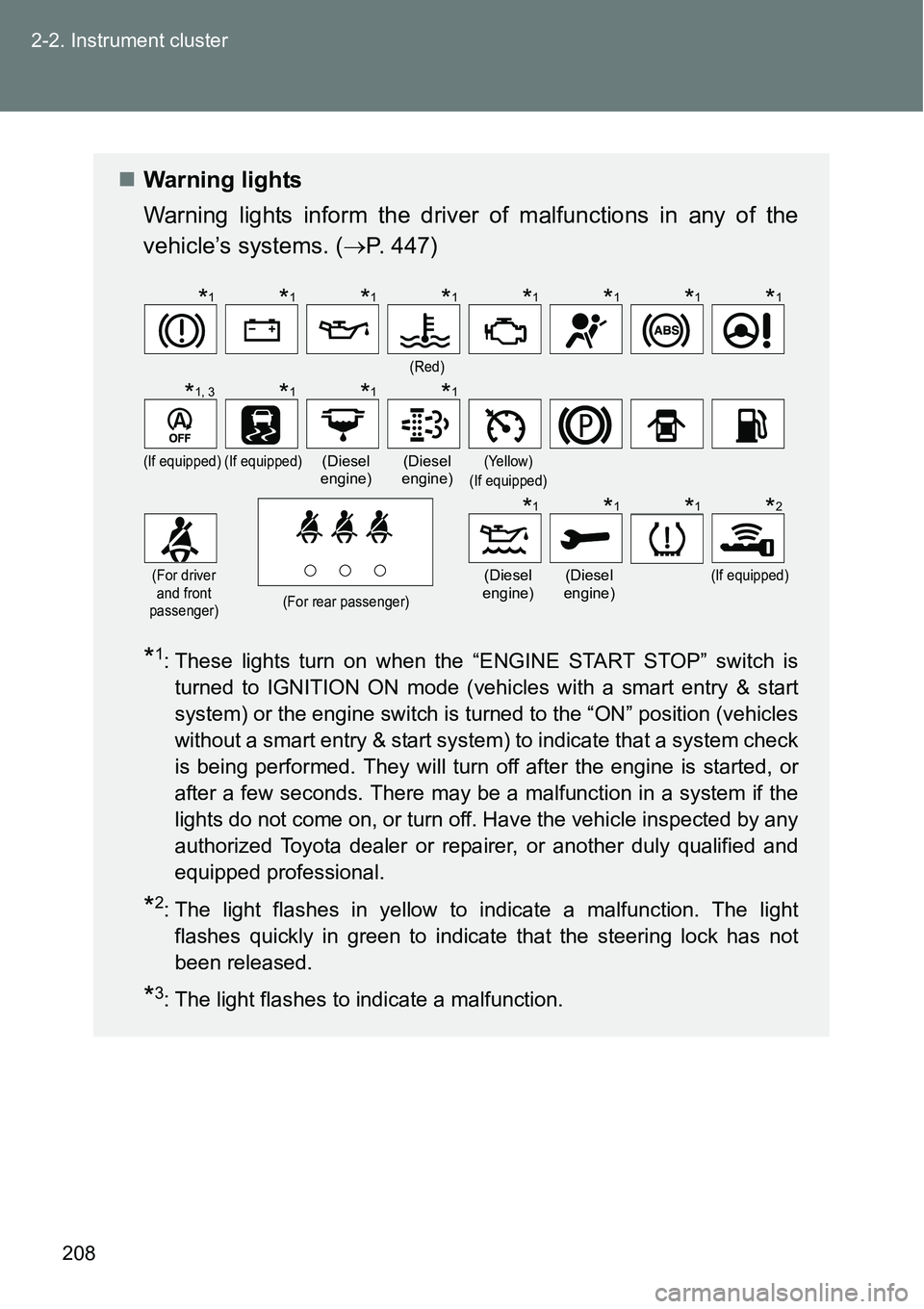
Warning lights inform the driver of malfunctions in any of the
vehicle’s systems. (P. 447)
*1: These lights turn on when the “ENGINE START STOP” switch is
turned to IGNITION ON mode (vehicles with a smart entry & start
system) or the engine switch is turned to the “ON” position (vehicles
without a smart entry & start system) to indicate that a system check
is being performed. They will turn off after the engine is started, or
after a few seconds. There may be a malfunction in a system if the
lights do not come on, or turn off. Have the vehicle inspected by any
authorized Toyota dealer or repairer, or another duly qualified and
equipped professional.
*2: The light flashes in yellow to indicate a malfunction. The light
flashes quickly in green to indicate that the steering lock has not
been released.
*3: The light flashes to indicate a malfunction.
(Red)
(If equipped)(If equipped)(Diesel
engine)(Diesel
engine)(Yellow)
(If equipped)
(For driver
and front
passenger)
(For rear passenger)
(Diesel
engine)(Diesel
engine)(If equipped)
*1*1*1*1*1*1*1*1
*1, 3*1*1*1
*1*1*1*2
Page 225 of 564

225 2-3. Operating the lights and wipers
2
When driving
Vehicles with a smart entry & start system
If the wiper switch is turned to the “AUTO” position while the “ENGINE
START STOP” switch is in IGNITION ON mode, the wiper will operate
once to show that “AUTO” mode is activated.
When the sensor sensitivity ring is turned toward high while in “AUTO”
mode, the wiper will operate once to indicate that the sensor sensitivity is
enhanced.
If the temperature of the raindrop sensor is 90C (194F) or higher, or
-15C (5F) or lower, automatic operation may not occur. In this case,
operate the wiper in any mode other than “AUTO”.
If no windshield washer fluid sprays
Check that the washer nozzles are not blocked if there is washer fluid in the
windshield washer fluid reservoir.
CAUTION
Caution regarding the use of windshield wiper in “AUTO” mode (vehi-
cles with rain-sensing windshield wiper)
The windshield wiper may operate unexpectedly if the sensor is touched or
the windshield is subject to vibration in “AUTO” mode. Take care that your
fingers etc. do not become caught in the windshield wiper.