2015 TOYOTA TACOMA heating
[x] Cancel search: heatingPage 128 of 590
128 2-1. Driving procedures
CAUTION
■When taking a nap in the vehicle
Always turn the engine off. Otherwise, you may accidentally move the shift
lever or depress the accelerator pedal, which could cause an accident or fire
due to engine overheating. Additionally, if the vehicle is parked in a poorly
ventilated area, exhaust gases may collect and enter the vehicle, leadin\
g to
death or a serious health hazard.
■ When braking the vehicle
●When the brakes are wet, drive more cautiously.
Braking distance increases when the brakes are wet, and may cause one
side of the vehicle to brake differently than the other side. Also the parking
brake may not securely hold the vehicle.
● If the power brake assist function does not operate, do not follow other
vehicles closely and avoid hills or sharp turns that require braking.
In this case, braking is still possible, but the brake pedal should be
depressed more firmly than usual. Also, the braking distance will increase.
Have your brakes fixed immediately.
● Do not pump the brake pedal if the engine stalls.
Each push on the brake pedal uses up the reserve for the power-assisted
brakes.
● The brake system consists of 2 individual hydraulic systems: If one of the
systems fails, the other will still operate. In this case, the brake pedal
should be depressed more firmly than usual and braking distance
becomes longer.
Have your brakes fixed immediately.
Page 143 of 590

143
2-1. Driving procedures
2
When driving
■
Parking brake engaged warning buzzer
The buzzer sounds to indicate that parking brake is still engaged (with the
vehicle having reach a speed of 3 mph [5 km/h]).
■ Usage in winter time
See “Winter driving tips” for parking brake usage in winter time. (P. 209)
NOTICE
■Before driving
Fully release the parking brake.
Driving the vehicle with the parking brake set will lead to brake components
overheating, which may affect braking performance and increase brake
wear.
Page 147 of 590

147
2-2. Gauges and meters
2
When driving
NOTICE
■
To prevent damage to the engine and its components
●Do not let the indicator needle of the tachometer enter the red zone, which
indicates the maximum engine speed.
● The engine may be overheating if the engine coolant temperature gauge is
in the red zone (H). In this case, immediately stop the vehicle in a safe
place, and check the engine after it has cooled completely. (
P. 508)
Page 227 of 590
227
2-5. Driving information
2
When driving
●
Instability happens more frequently when descending steep or long
downhill grades. Before descending, slow down and downshift. Do
not make sudden downshifts while descending steep or long down-
hill grades.
● Avoid holding the brake pedal down too long or applying the
brakes too frequently. This could cause the brakes to overheat and
result in reduced braking efficiency.
● Due to the added load of the trailer, your vehicle’s engine may
overheat on hot days (at temperatures over 85°F [30°C]) when
driving up a long or steep grade. If the engine coolant temperature
gauge indicates overheating, immedi ately turn off the air condition-
ing (if in use), pull your vehicle off the road and stop in a safe spot.
( P. 508)
● Always place wheel blocks under both the vehicle’s and the
trailer’s wheels when parking. Ap ply the parking brake firmly, and
put the transmission in P (automatic transmission) or in 1 or R
(manual transmission). Avoid park ing on a slope, but if unavoid-
able, do so only after performing the following:
Apply the brakes and keep them applied.
Have someone place wheel blo cks under both the vehicle’s
and trailer’s wheels.
When the wheel blocks are in pl ace, release the brakes slowly
until the blocks absorb the load.
Apply the parking brake firmly.
Shift into P (automatic transmission) or 1 or R (manual trans-
mission) and turn off the engine.
● When restarting after parking on a slope:
With the transmission in P (automatic transmission) or the
clutch pedal (manual transmission) depressed, start the
engine. On vehicles with an au tomatic transmission, be sure
to keep the brake pedal depressed.
Shift into a forward gear. If reversing, shift into R.
Page 356 of 590
356 3-5. Other interior features
CAUTION
■Using a power outlet
Observe the following precautions to reduce the risk of injury.
●Use of the power outlet when it is wet with rain, drinks water or snow may
result in electrical shocks and is extremely dangerous. The power outlet
must be thoroughly dried before use.
● Do not allow children to use or play with the power outlet.
● Be careful not to get any part of your body caught in the power outlet lid.
● When using electrical appliances, strictly follow any cautions and notices
written on their labels and in the manufacturers’ instruction manuals.
● Do not modify, disassemble or repair the power outlet or its inverter, in any
way. Doing so may result in unexpected malfunctions or accidents, which
could cause serious damage or injuries. Contact a Toyota dealer for any
necessary repairs.
■ To prevent injuries and accidents, securely fix all electric appliances
before use and do not use any appl iances that may do any of the fol-
lowing:
● Distract the driver while driving, or hamper safe driving.
● Result in a fire or burn injuries due to the appliance rolling, falling or over-
heating while driving.
● Emit steam, while the windows of the cabin are closed.
■ To prevent unexpected accidents, su ch as electric shocks, do not per-
form any of the following
● Using the power outlet for electric heaters while sleeping.
● Contaminating the power outlet with liquid substances or mud.
● Handling electrical appliance plugs at the power outlet with wet hands o\
r
feet.
● Inserting foreign objects into the power outlet.
● Using malfunctioning electric appliances.
● Inserting inappropriate or badly fitting plugs into the power outlet.
Page 360 of 590

360 3-5. Other interior features
CAUTION
■Burns
●Use caution when seating the following persons in a seat with the seat
heater on to avoid the possibility of burns:
• Babies, small children, the elderly, the sick and the physically chal-
lenged
• Persons with sensitive skin
• Persons who are fatigued
• Persons who have taken alcohol or drugs that induce sleep (sleeping drugs, cold remedies, etc.)
● Do not cover the seat with anything when using the seat heater.
Using the seat heater with a blanket or cushion increases the temperature
of the seat and may lead to overheating.
● Do not use the seat heater more than necessary.
Doing so may cause minor burns or overheating.
NOTICE
■To prevent seat heater damage
Do not put heavy objects that have an uneven surface on the seat and do
not stick sharp objects (needles, nails, etc.) into the seat.
■ To prevent battery discharge
Turn the seat heaters off when the engine is not running.
Page 508 of 590
508
5-2. Steps to take in an emergency
If your vehicle overheats
Correction proceduresStop the vehicle in a safe place and turn off the air condition-
ing system, and then stop the engine.
If you see steam: Carefully lift the hood after the steam subsides completely.
If you do not see steam: Carefully lift the hood.
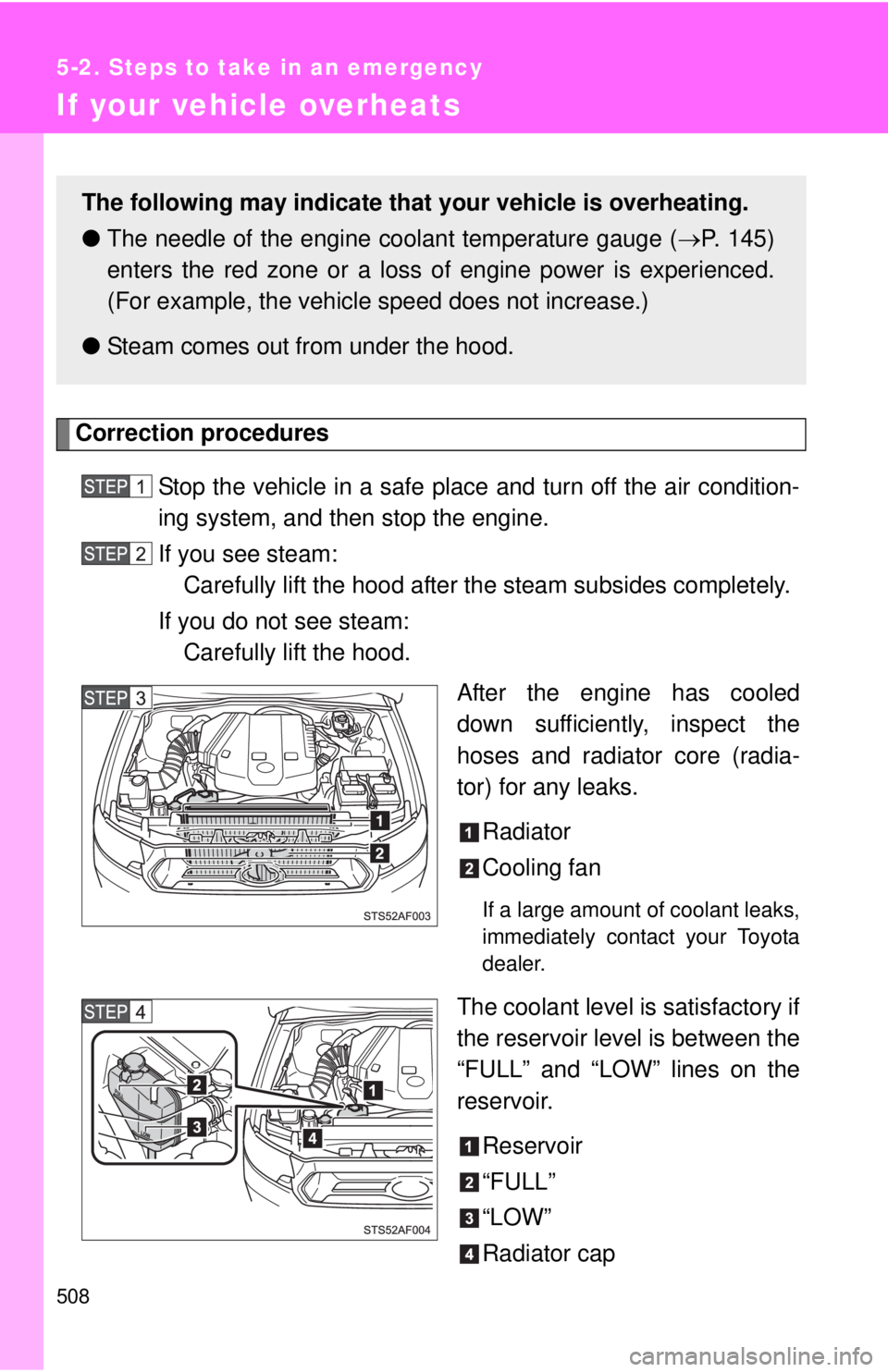
After the engine has cooled
down sufficiently, inspect the
hoses and radiator core (radia-
tor) for any leaks.
Radiator
Cooling fan
If a large amount of coolant leaks,
immediately contact your Toyota
dealer.
The coolant level is satisfactory if
the reservoir level is between the
“FULL” and “LOW” lines on the
reservoir.Reservoir
“FULL”
“LOW”
Radiator cap
The following may indicate that your vehicle is overheating.
● The needle of the engine co olant temperature gauge (P. 145)
enters the red zone or a loss of engine power is experienced.
(For example, the vehicl e speed does not increase.)
● Steam comes out from under the hood.
Page 579 of 590

577
Alphabetical index
Brakes
Brake system warning buzzer
........... 182, 184, 189, 195, 476
Brake system warning light .................................... 476
Fluid...................................... 414
Parking brake ....................... 142
Break-in tips ............................ 122
Camper information ................ 567
Care
Exterior ................................. 388
Interior .................................. 391
Seat belts ............................. 392
Cargo capacity ................ 202, 518
Cargo net hook ................ 364, 372
CD player ................................. 263
Certification label ............ 217, 521
Chains ...................................... 210
Child restraint system Booster seats, definition ....... 100
Booster seats, installation .... 113
Convertible seats, definition............................. 100
Convertible seats,
installation .......................... 110
Front passenger occupant classification system ............ 95
Infant seat, definition ............ 100
Infant seats, installation ........ 110
Installing CRS with LATCH system........................ 107, 109
Installing CRS with seat belts ................................... 110
Installing CRS with top tether straps ............... 114, 115 Child safety
Airbag precautions ..................89
Battery precautions .......419, 507
Child restraint system............100
Child-protectors .......................37
How your child should wear
the seat belt ..........................59
Installing child restraints ........104
Power window lock switch.......71
Power window precautions .....72
Removed wireless remote
control battery
precautions .........................443
Seat belt extender
precautions ...........................62
Seat belt precautions ..............60
Seat heater precautions ........360
Child-protectors .........................37
Cleaning Exterior ..................................388
Interior ...................................391
Seat belts ..............................392
Clock ........................................ 351
Clutch start cancel switch.......190
Compass ...................................381
Condenser ................................414
Console box .....................340, 341
Cooling system Engine overheating ...............508
CRS ...........................................100
Cruise control...........................162
Cup holders ......................340, 342
Curtain shield airbags ...............82
Customizable features.............551
*: Refer to the “NAVIGATION SYSTEM OWNER’S MANUAL”.
C