Page 588 of 648
5888-2. Steps to take in an emergency
AVENSIS_OM_OM20C20E_(EE)●
Vehicles with Stop & Start system:
Use a battery specified for use with the Stop & Start system and an equiva-
lent battery. If an unsupported battery is used, Stop & Start system functions
may be restricted to protect the battery.
Also, battery performance may decrease and the engine may not be able to
restart. Contact any authorized Toyota dealer or repairer, or another duly
qualified and equipped professional for details.
WARNING
■ Avoiding battery fires or explosions
Observe the following precautions to prevent accidentally igniting the flam-
mable gas that may be emitted from the battery.
● Make sure each jumper cable is connected to the correct terminal and that
it is not unintentionally in contact with any part other than the intended ter-
minal.
● Do not allow the + and - clamps of the jumper cables to come into contact
with each other.
● Do not smoke, use matches, cigarette lighters or allow open flame near
the battery.
■ Battery precautions
The battery contains poisonous and corrosive acidic electrolyte, while
related parts contain lead and lead compounds. Observe the following pre-
cautions when handling the battery.
●When working with the battery, always wear safety glasses and take care
not to allow any battery fluids (acid) to come into contact with skin, clothing
or the vehicle body.
● Do not lean over the battery.
● In the event that battery fluid comes into contact with the skin or eyes,
immediately wash the affected area with water and seek medical attention.
Place a wet sponge or cloth over the affected area until medical attention
can be received.
● Always wash your hands after handling the battery support, terminals, and
other battery-related parts.
● Do not allow children near the battery.
■ To prevent damage to the vehicle (vehicles with manual transmission)
Do not pull- or push-start the vehicl e, because the catalytic converter may
overheat and become a fire hazard.
AVENSIS_OM_OM20C20E_(EE).book Page 588 Thursday, January 29, 2015 1:47 PM
Page 590 of 648
5908-2. Steps to take in an emergency
AVENSIS_OM_OM20C20E_(EE)
If your vehicle overheats
Stop the vehicle in a safe place and turn off the air conditioning sys-
tem, and then stop the engine.
If you see steam:
Carefully lift the hood after the steam subsides.
If you do not see steam:
Carefully lift the hood.
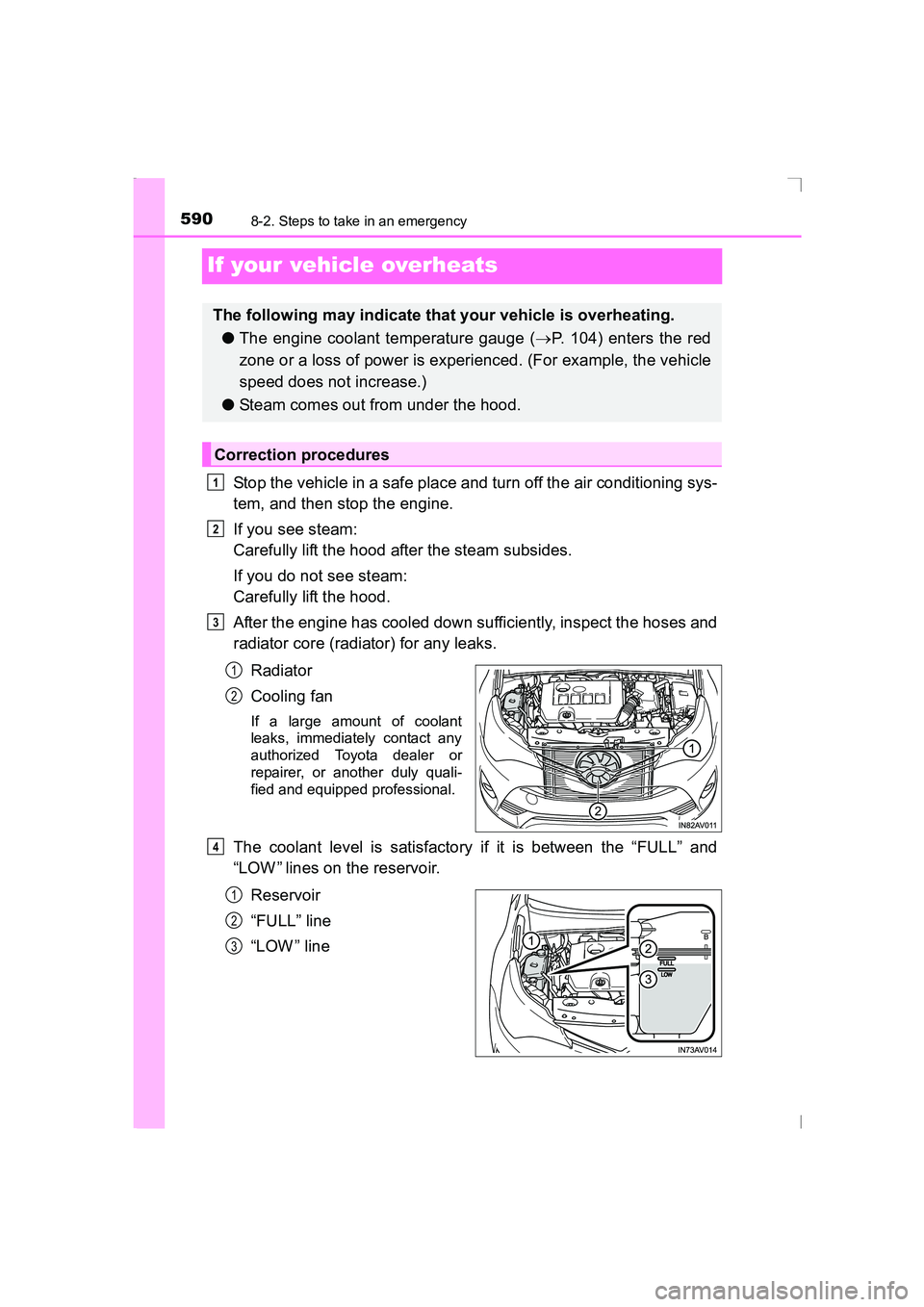
After the engine has cooled down sufficiently, inspect the hoses and
radiator core (radiator) for any leaks.Radiator
Cooling fan
If a large amount of coolant
leaks, immediately contact any
authorized Toyota dealer or
repairer, or another duly quali-
fied and equipped professional.
The coolant level is satisfactory if it is between the “FULL” and
“LOW ” lines on the reservoir.Reservoir
“FULL” line
“LOW ” line
The following may indicate that your vehicle is overheating.● The engine coolant temperature gauge ( →P. 104) enters the red
zone or a loss of power is experienced. (For example, the vehicle
speed does not increase.)
● Steam comes out from under the hood.
Correction procedures
1
2
3
1
2
4
1
2
3
AVENSIS_OM_OM20C20E_(EE).book Page 590 Thursday, January 29, 2015 1:47 PM
Page 591 of 648
5918-2. Steps to take in an emergency
AVENSIS_OM_OM20C20E_(EE)
8
When trouble arises
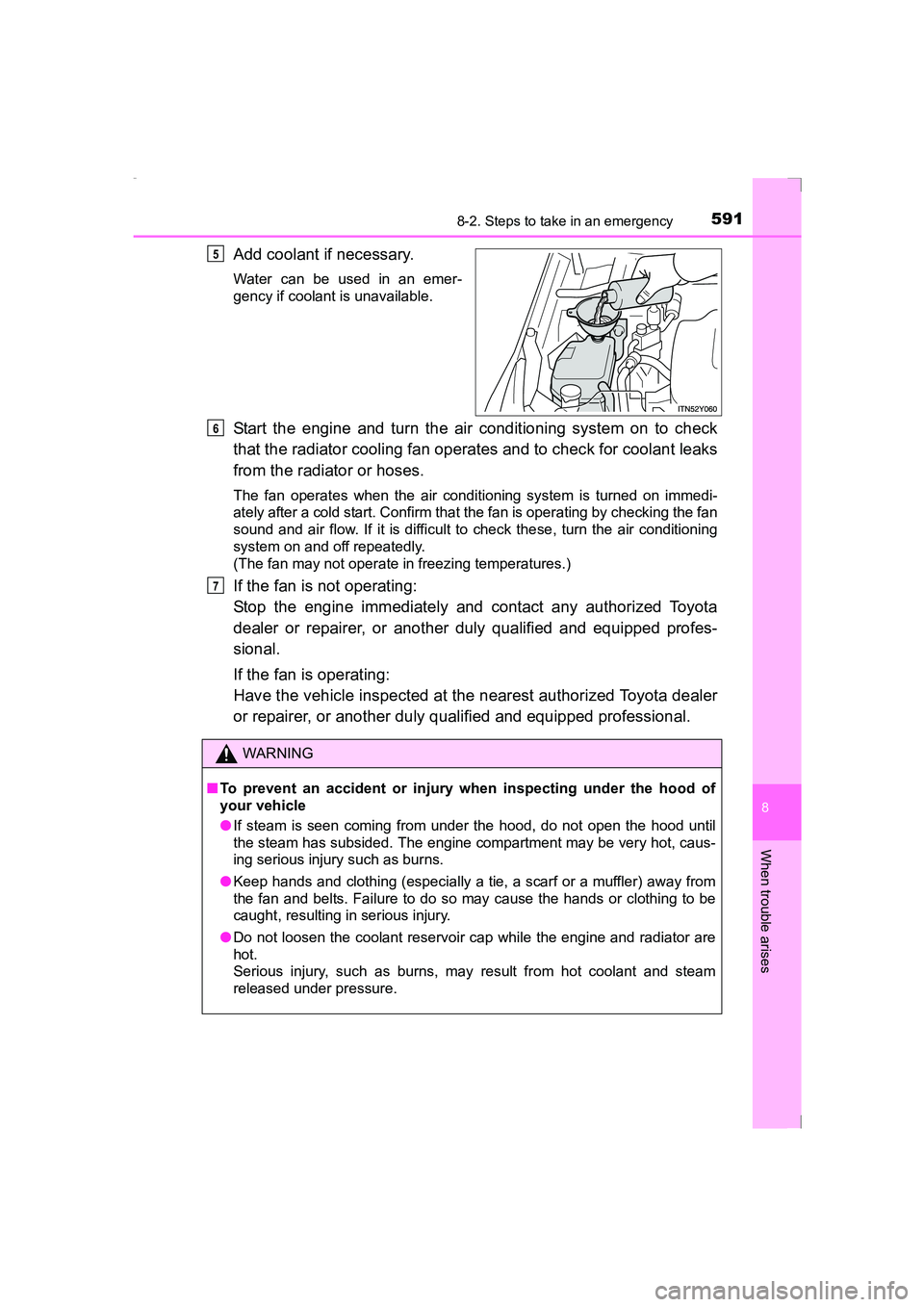
Add coolant if necessary.
Water can be used in an emer-
gency if coolant is unavailable.
Start the engine and turn the air conditioning system on to check
that the radiator cooling fan operates and to check for coolant leaks
from the radiator or hoses.
The fan operates when the air conditioning system is turned on immedi-
ately after a cold start. Confirm that the fan is operating by checking the fan
sound and air flow. If it is difficult to check these, turn the air conditioning
system on and off repeatedly.
(The fan may not operate in freezing temperatures.)
If the fan is not operating:
Stop the engine immediately and contact any authorized Toyota
dealer or repairer, or another duly qualified and equipped profes-
sional.
If the fan is operating:
Have the vehicle inspected at the nearest authorized Toyota dealer
or repairer, or another duly qualified and equipped professional.
5
WARNING
■ To prevent an accident or injury when inspecting under the hood of
your vehicle
●If steam is seen coming from under the hood, do not open the hood until
the steam has subsided. The engine compartment may be very hot, caus-
ing serious injury such as burns.
● Keep hands and clothing (especially a tie, a scarf or a muffler) away from
the fan and belts. Failure to do so may cause the hands or clothing to be
caught, resulting in serious injury.
● Do not loosen the coolant reservoir cap while the engine and radiator are
hot.
Serious injury, such as burns, may result from hot coolant and steam
released under pressure.
6
7
AVENSIS_OM_OM20C20E_(EE).book Page 591 Thursday, January 29, 2015 1:47 PM
Page 592 of 648
5928-2. Steps to take in an emergency
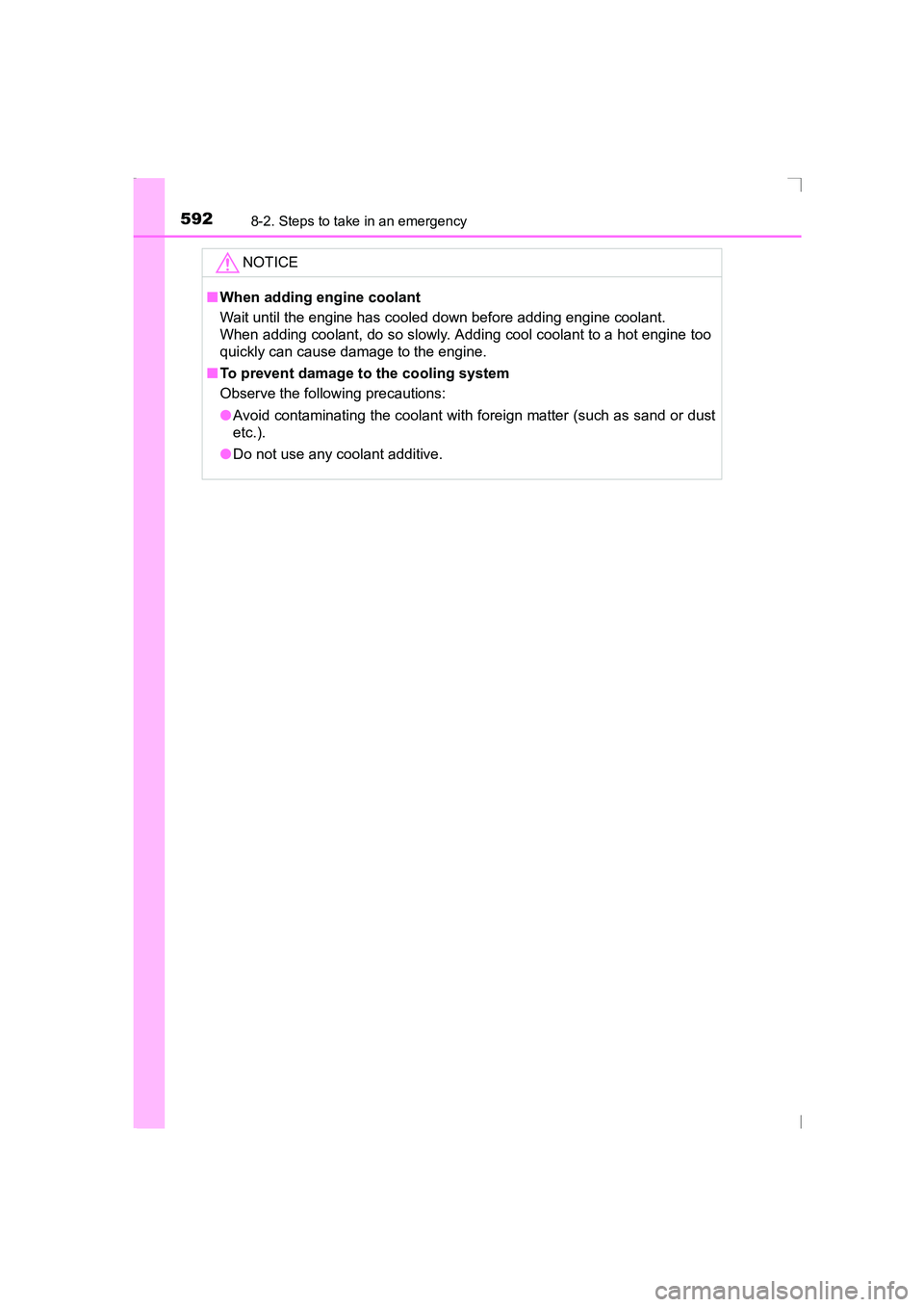
AVENSIS_OM_OM20C20E_(EE)NOTICE
■
When adding engine coolant
Wait until the engine has cooled down before adding engine coolant.
When adding coolant, do so slowly. Addi ng cool coolant to a hot engine too
quickly can cause damage to the engine.
■ To prevent damage to the cooling system
Observe the following precautions:
●Avoid contaminating the coolant with foreign matter (such as sand or dust
etc.).
● Do not use any coolant additive.
AVENSIS_OM_OM20C20E_(EE).book Page 592 Thursday, January 29, 2015 1:47 PM
Page 593 of 648
5938-2. Steps to take in an emergency
AVENSIS_OM_OM20C20E_(EE)
8
When trouble arises
If the vehicle becomes stuck
Stop the engine. Set the parking brake and shift the shift lever to P
(Multidrive) or N (manual transmission).
Remove the mud, snow or sand from around the stuck tire.
Place wood, stones or some other material to help provide traction
under the tires.
Restart the engine.
Shift the shift lever to the D or R (Multidrive), or 1 or R (manual
transmission) and release the parking brake. Then, while exercising
caution, depress the accelerator pedal.
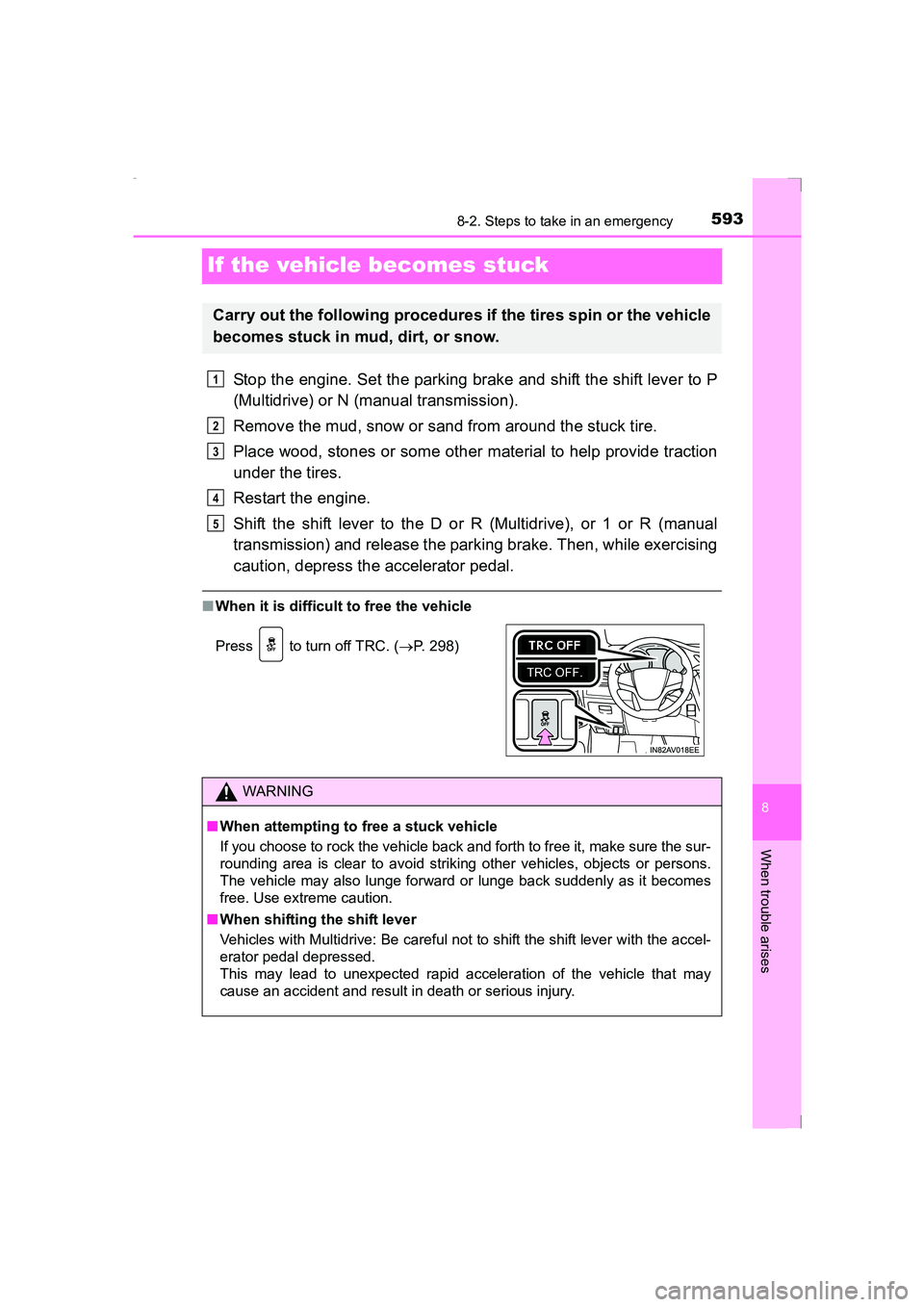
■When it is difficult to free the vehicle
Carry out the following procedures if the tires spin or the vehicle
becomes stuck in mud, dirt, or snow.
Press to turn off TRC. ( →P. 298)
WARNING
■ When attempting to free a stuck vehicle
If you choose to rock the vehicle back and forth to free it, make sure the sur-
rounding area is clear to avoid striking other vehicles, objects or persons.
The vehicle may also lunge forward or lunge back suddenly as it becomes
free. Use extreme caution.
■ When shifting the shift lever
Vehicles with Multidrive: Be careful not to shift the shift lever with the accel-
erator pedal depressed.
This may lead to unexpected rapid acceleration of the vehicle that may
cause an accident and result in death or serious injury.
1
2
3
4
5
AVENSIS_OM_OM20C20E_(EE).book Page 593 Thursday, January 29, 2015 1:47 PM
Page 596 of 648
5969-1. Specifications
AVENSIS_OM_OM20C20E_(EE)
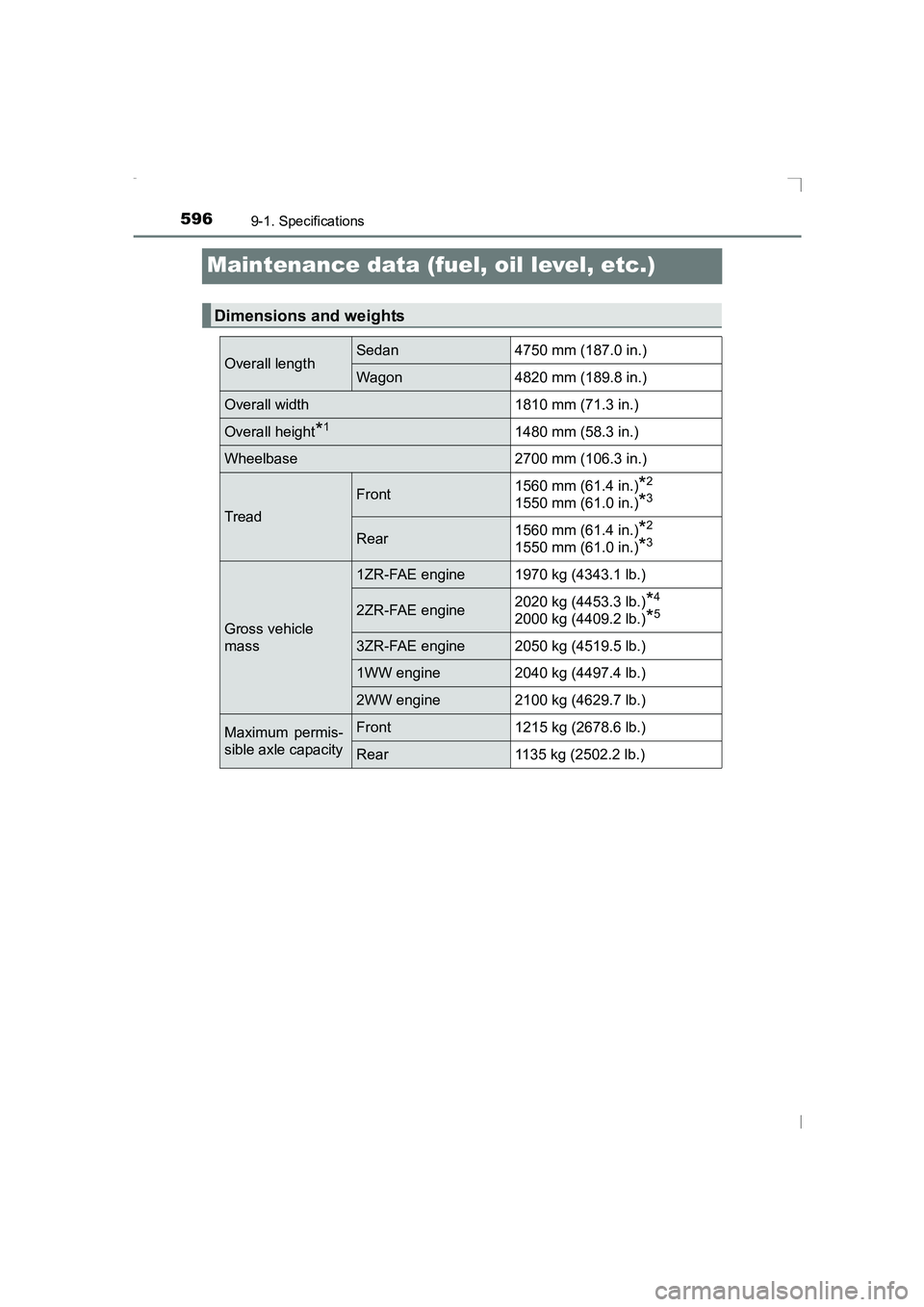
Maintenance data (fuel, oil level, etc.)
Dimensions and weights
Overall lengthSedan 4750 mm (187.0 in.)
Wagon 4820 mm (189.8 in.)
Overall width 1810 mm (71.3 in.)
Overall height*11480 mm (58.3 in.)
Wheelbase 2700 mm (106.3 in.)
Tread
Front1560 mm (61.4 in.)*2
1550 mm (61.0 in.)*3
Rear1560 mm (61.4 in.)*2
1550 mm (61.0 in.)*3
Gross vehicle
mass
1ZR-FAE engine 1970 kg (4343.1 lb.)
2ZR-FAE engine2020 kg (4453.3 lb.)*4
2000 kg (4409.2 lb.)*5
3ZR-FAE engine 2050 kg (4519.5 lb.)
1WW engine 2040 kg (4497.4 lb.)
2WW engine 2100 kg (4629.7 lb.)
Maximum permis-
sible axle capacityFront 1215 kg (2678.6 lb.)
Rear 1135 kg (2502.2 lb.)
AVENSIS_OM_OM20C20E_(EE).book Page 596 Thursday, January 29,
2015 1:47 PM
Page 597 of 648
5979-1. Specifications
AVENSIS_OM_OM20C20E_(EE)
9
Vehicle specifications
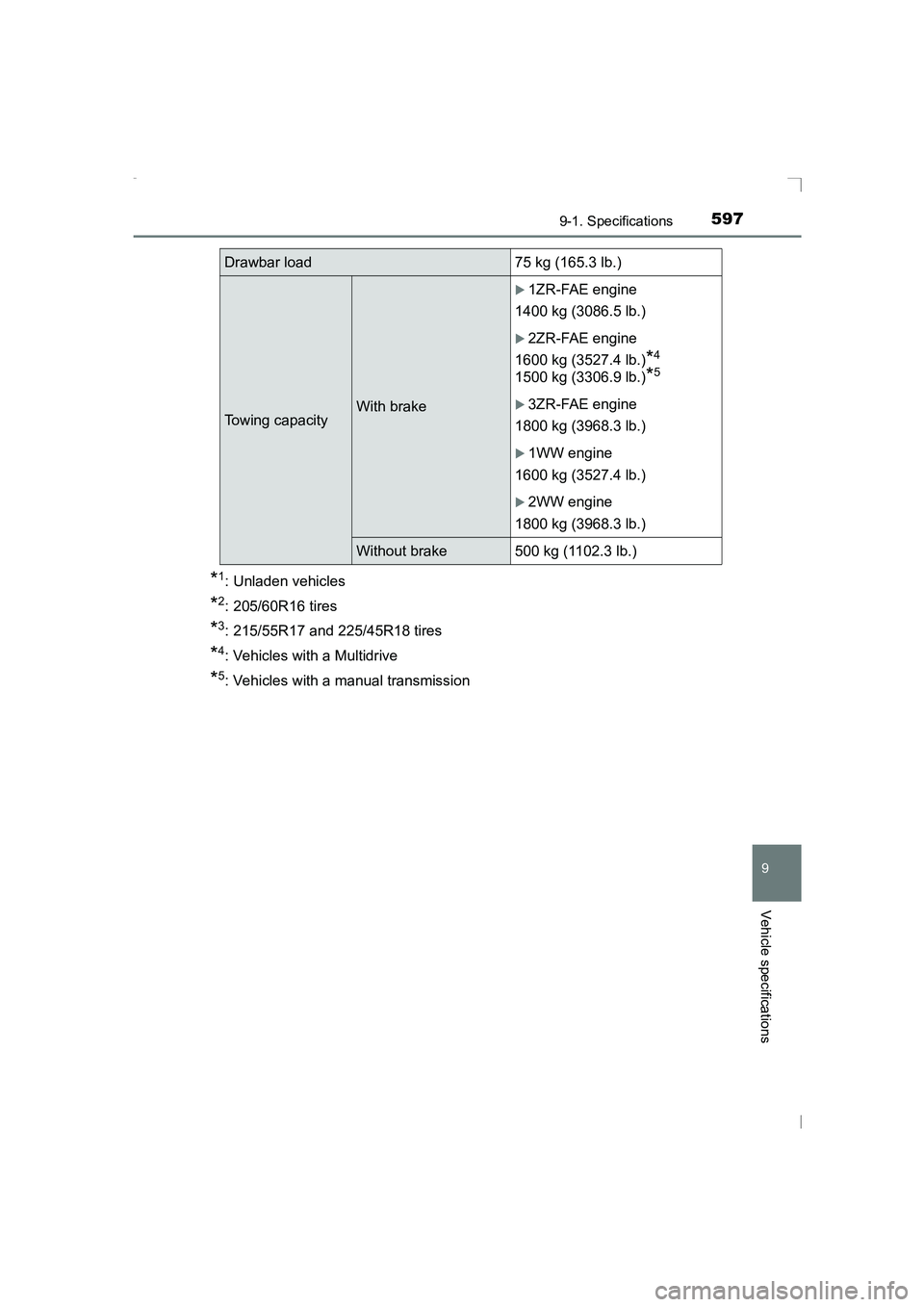
*1: Unladen vehicles
*2: 205/60R16 tires
*3: 215/55R17 and 225/45R18 tires
*4: Vehicles with a Multidrive
*5: Vehicles with a manual transmission
Drawbar load 75 kg (165.3 lb.)
Towing capacityWith brake
X1ZR-FAE engine
1400 kg (3086.5 lb.)
X2ZR-FAE engine
1600 kg (3527.4 lb.)
*4
1500 kg (3306.9 lb.)*5
X3ZR-FAE engine
1800 kg (3968.3 lb.)
X1WW engine
1600 kg (3527.4 lb.)
X2WW engine
1800 kg (3968.3 lb.)
Without brake 500 kg (1102.3 lb.)
AVENSIS_OM_OM20C20E_(EE).book Page 597 Thursday, January 29, 2015 1:47 PM
Page 599 of 648
5999-1. Specifications
AVENSIS_OM_OM20C20E_(EE)
9
Vehicle specifications
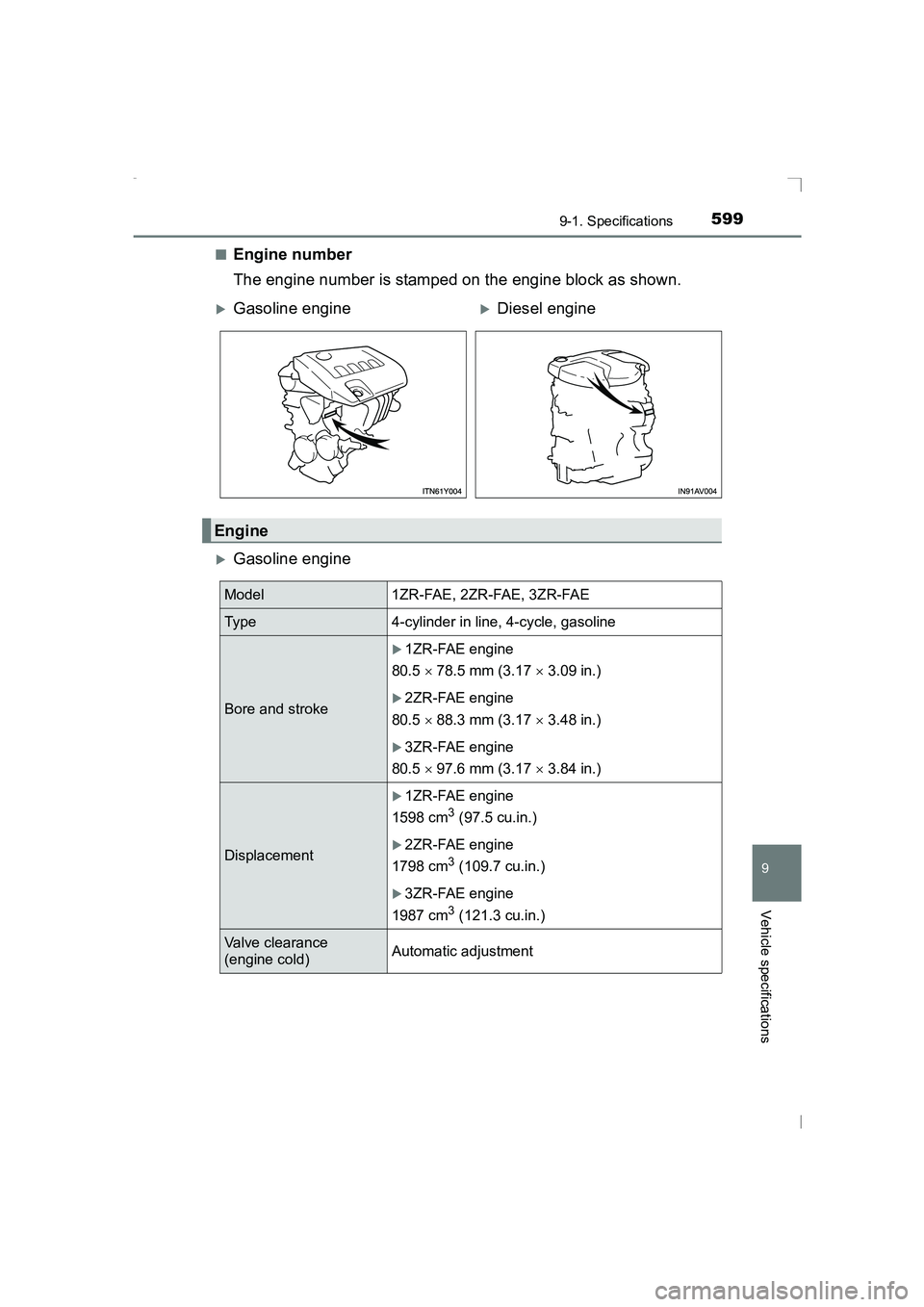
■Engine number
The engine number is stamped on the engine block as shown.
XGasoline engine
XGasoline engineXDiesel engine
Engine
Model 1ZR-FAE, 2ZR-FAE, 3ZR-FAE
Type 4-cylinder in line, 4-cycle, gasoline
Bore and stroke
X1ZR-FAE engine
80.5 × 78.5 mm (3.17 × 3.09 in.)
X2ZR-FAE engine
80.5 × 88.3 mm (3.17 × 3.48 in.)
X3ZR-FAE engine
80.5 × 97.6 mm (3.17 × 3.84 in.)
Displacement
X1ZR-FAE engine
1598 cm
3 (97.5 cu.in.)
X2ZR-FAE engine
1798 cm
3 (109.7 cu.in.)
X3ZR-FAE engine
1987 cm
3 (121.3 cu.in.)
Valve clearance
(engine cold) Automatic adjustment
AVENSIS_OM_OM20C20E_(EE).book Page 599 Thursday, January 29,
2015 1:47 PM