2015 SKODA FABIA seats
[x] Cancel search: seatsPage 90 of 220
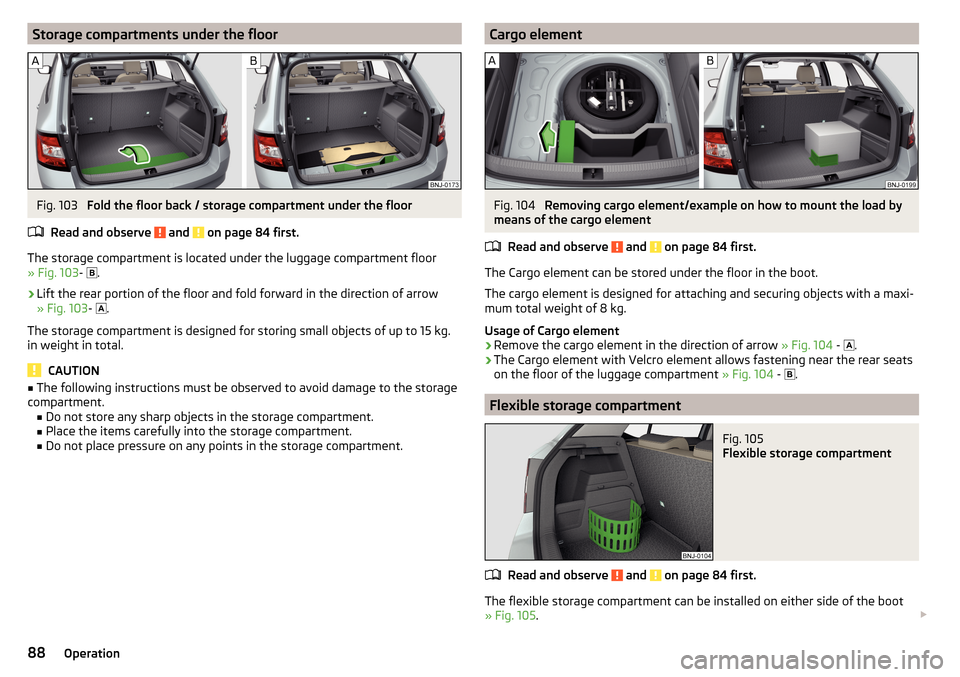
Storage compartments under the floorFig. 103
Fold the floor back / storage compartment under the floor
Read and observe
and on page 84 first.
The storage compartment is located under the luggage compartment floor
» Fig. 103 -
.
›
Lift the rear portion of the floor and fold forward in the direction of arrow
» Fig. 103 -
.
The storage compartment is designed for storing small objects of up to 15 kg. in weight in total.
CAUTION
■ The following instructions must be observed to avoid damage to the storage
compartment. ■ Do not store any sharp objects in the storage compartment.
■ Place the items carefully into the storage compartment.
■ Do not place pressure on any points in the storage compartment.Cargo elementFig. 104
Removing cargo element/example on how to mount the load by
means of the cargo element
Read and observe
and on page 84 first.
The Cargo element can be stored under the floor in the boot.
The cargo element is designed for attaching and securing objects with a maxi-
mum total weight of 8 kg.
Usage of Cargo element
›
Remove the cargo element in the direction of arrow » Fig. 104 -
.
›
The Cargo element with Velcro element allows fastening near the rear seats
on the floor of the luggage compartment » Fig. 104 -
.
Flexible storage compartment
Fig. 105
Flexible storage compartment
Read and observe and on page 84 first.
The flexible storage compartment can be installed on either side of the boot
» Fig. 105 .
88Operation
Page 95 of 220

Place bicycle into the carrierFig. 113
Insert the front fork of the bicycle into the carrier / mounting ex-
ample of the front wheel
Read and observe
and on page 91 first.
›
Remove the front wheel from the bike.
›
Release the quick release
A
» Fig. 113 on the carrier and adjust according to
the bicycle fork width.
›
Place the bicycle fork on the fixing axle and tighten with the quick release
A
.
›
Set the left bicycle pedal towards the vehicle front to secure the front wheel
more easily.
›
If you want to transport two bicycles, loosen screw
A
» Fig. 112 on page 92
on the carrier and move the carrier along with attached bike to the left.
The handlebar must not touch the side window of the luggage compartment.
›
Tighten screw
A
» Fig. 112 on page 92 on the support.
›
Guide the boot lid gently downwards and check while doing this that there is
no contact between the handlebar and the rear window.
›
If necessary, the position of the sliding part
E
» Fig. 112 on page 92 can be
adjusted.
›
The dismantled front wheel can best be stowed between the left crank and
the bicycle frame.
›
Attach the front wheel with belt
B
to the front fork » Fig. 113 or to the bicy-
cle frame.
›
The second carrier is installed and the bicycle is secured in a similar way.
Ensure the stability of the bicycles with a beltFig. 114
Ensure the stability of the bicycles with a belt
Read and observe
and on page 91 first.
›
In order to loosen the rubber part of the clamp, push both parts against each
other and open the clamp.
›
Position the clamp with the rubber part in the direction of travel as low down
on the saddle support as possible and close it.
›
When transporting two bicycles, stretch the belt » Fig. 114 -
between the
saddles by moving the bicycles apart.
›
Hook the carabiners on the ends of the belt into the lower lashing eyelets
behind the rear seats » Fig. 114 -
.
›
Pull the belt through the tensioning clasps on both sides in turn.
›
If necessary, you can correct the position of the bicycles in the vehicle after-
wards.
Roof rack
Introduction
This chapter contains information on the following subjects:
fixing points for base support
94
Roof load
94WARNINGWhen transporting cargo, the instructions below must be followed.■The transported items on the roof rack must always be securely attached
– risk of accident! 93Transporting and practical equipment
Page 148 of 220

CAUTION■For Alcantara ®
seat covers, do not use any solvents, floor wax, shoe cream,
stain remover, leather cleaners or similar agents.■
Avoid leaving the vehicle in bright sunlight for long periods of time in order
to stop the artificial leather, materials or Alcantara ®
from bleaching. During ex-
tended periods of standing outdoors, protect artificial leather, fabrics or Alcan-
tara ®
by covering.
■
Some clothing materials, such as dark denim, do not have sufficient colour
fastness. This can cause damage or clearly visible discolouration to seat covers
even when treated correctly. This is particularly true for light-coloured uphols-
tery. This is not a defect in the seat cover, but poor colour fastness of the
clothing textiles.
Seat covers
Read and observe
and on page 144 first.
Electrically heated seats
Use a specific cleaning agent such as dry foam or similar to clean the covers.
»
.
Seats without seat heating
Thoroughly vacuum the seat covers with a vacuum cleaner before cleaning.
Clean the seat covers with a damp cloth or cleaning agents particularly formu-
lated for them.
Compressed areas created on the fabrics by everyday use can be removed by
brushing against the nap with a lightly moistened brush.
Always treat all parts of the upholstery so that no visible boundaries are cre-
ated. Then leave the seat to dry completely.
CAUTION
■ Do not clean the covers of electrically heated seats either with water or with
other liquids - there is a risk of damaging the seat heating system.■
Regularly vacuum dust from the seat covers using a vacuum cleaner.
■
Electrically heated seats must not be dried after cleaning by switching on the
heater.
■
Do not sit on wet seats - there is a risk of stretching the upholstery.
■
Always clean the seats “from seam to seam”.
Safety belts
Read and observe
and on page 144 first.
Wash dirty seat belts with a mild, soapy solution.
Remove dirt with a soft brush.
WARNING■ The seat belts must not be removed for cleaning.■Never clean the seat belts chemically as chemical cleaning products could
destroy the fabric.■
The seat belts must not be allowed to come into contact with corrosive
liquids (such as acids etc.).
■
Inertia reel belts must be completely dried before being rolled up.
146General Maintenance
Page 184 of 220

Assignment of the fuses in the dash panelFig. 200
Schematic representation of the fuse box for vehicles with left-
hand steering/right-hand steering
Read and observe
and on page 181 first.
No.Power consumer1Left parking light, parking light, high-mounted brake light2Central locking system3Relay for ignition4Right-hand light, rear fog light, license plate light5Power windows - driver6Central control unit, interior lighting7Horn8Towing hitch - left light
9
Operating lever beneath the steering wheel, engine control unit (on-
ly without KESSY), automatic gearbox (only without KESSY), selector
lever of the automatic transmission (only without KESSY), ESC (only
without KESSY), towing equipment (only without KESSY), power
steering (only without KESSY)10Power windows - rear left11Headlight cleaning system12Radio display1312 volt socket in luggage compartment14Operating lever under the steering wheel, light switch, ignition key
removal lock (automatic transmission), diagnostic connector, head-
light flasher, SmartGate, rain sensor, light sensorNo.Power consumer15Air conditioning, selector lever for the automatic transmission16Instrument cluster17Alarm system, horn18Not assigned19Not assigned20Not assigned21Not assigned22Front- and rear windscreen wiper system23Not assigned24Blower fan for the air conditioning system, heating, air conditioning,
heating25Not assigned26Switch for front seat heating27Rear window wiper28Not assigned29airbag30Power windows, light switches, reversing light switch, exterior mir-
rors, feed for the central toolbar, feed for the side toolbar, rear view
mirror31Fuel pump, radiator fan, cruise control, coil of the relay for the front
and rear windscreen wipers32Diagnostic connector, headlamp levelling, air conditioning, park as-
sist33Coil on starter relay, clutch pedal switch34Heated windscreen washer jets35Not assigned36Heated front seats37Radar38Not assigned39Electrical auxiliary heating system40Not assigned41Rear window heater42Power windows - front passenger 182Do-it-yourself
Page 185 of 220

No.Power consumer43Towing hitch - contact in the socket44Cigarette lighter, 12-volt power socket45Power windows - rear right46Front and rear window washer, operating lever under the steering
wheel47Towing hitch - contact in the socket48Towing hitch - right light49Fuel pump50Radio51Heating of the external mirror52KESSY53KESSY steering lock54Not assigned55Heated front seats56Not assigned57Not assigned58Not assigned59Not assigned
Fuses in the engine compartment
Fig. 201
Remove the cover
Read and observe and on page 181 first.
Replacing fuses
›
Press the lock button on the cover in direction of arrow
1
» Fig. 201 .
›
Raise the cover and remove in the direction of the arrow
2
.
›
Remove the plastic clip from the holder on the cover of the fuse box in the
dash panel.
›
Replace the appropriate fuse.
›
Replace the clamp in the original position.
›
Place the cover on top of the fuse box.
›
Push in the locking button on the cover and lock.
The cover must engage securely.
CAUTION
The cover for the fuse box in the engine compartment must always be applied
correctly. Water may get into the fuse box if the cover is not replaced properly
- there is a risk of damage to the vehicle!
Fuse assignment in the engine compartment
Fig. 202
Fuses
Read and observe and on page 181 first.
No.Power consumer1Radiator fan2Glow plug system3ABS or ESC4Electrical auxiliary heating system5Electrical auxiliary heating system6Automatic gearbox7Engine control unit 183Fuses and light bulbs
Page 203 of 220

Index
Numbers and Symbols
12-volt power outlet
77
A
abroad lead-free petrol
148
Abroad Headlights
64
ABS Operation
115
Warning light33
Acceptance and recycling of used vehicles139
Accessories136
Adjusting Exterior mirrors
68
headrests70
Seat69
Steering wheel9
Adjusting the seats8
Adjustment Headlight beam
60
Adjustments and technical changes Spoiler
138
Adjustments and technical modifications Airbags
138
Advance warning/emergency braking Warning light
38
Air-conditioning system Air outlet vents
98
Airbag14
Adjustments and impairment of the airbag sys- tem
138
Deactivating18
Deployment15
Front airbag15
Head airbag17
Side airbag17
Switching off the front passenger airbag19
Warning light34
Airbag system14
Air conditioning95
Climatronic96
Manual air conditioning95
Recirculated air mode97
Air outlet vents98
Alarm Enable/disable
54
Switch off54
Trailer135
Triggering54
Alcantara cleaning
145
Anodized parts Refer to vehicle maintenance
142
Anti-lock braking system (ABS)115
Anti-theft alarm system Enable/disable
54
Trailer135
Anti-theft wheel bolts 169
Armrest71
artificial leather145
Ashtray76
Assembling the bar ball, Step 1
129
bar ball, Step 2130
Assist systems114
Auto-check control39
Automatic driving lamp control61
Automatic gearbox Selector lever-emergency unlocking
179
Selector lever lock110
Starting-off and driving111
Tiptronic110
Using the selector lever109
Automatic gearbox modes109
Automatic load deactivation159
automatic transmission selector lever lock defect110
Automatic transmission109
Kickdown111
Malfunction36
Selector lever lock110
Warning light36
Warning messages36
AUX82
Avoiding damage to your vehicle113
B
Bags on the backs of the front seats
81
on the inner sides of the front seats81
Ball head Check fitting
130
Ready position128, 129
Battery In the remote control key
177
Belts11
Belt tensioners14
Bicycle carrier91
Bonnet Closing
151
Opening151
Boot Class N1 vehicles
89
Hooks85
See Boot lid55
Boot lid automatic locking
56
Close55
Open55
Brake Assist (HBA)116
Brake booster107
brake fluid specification
156
201Index
Page 204 of 220

Brake fluid155
Checking156
Information messages32
Brake pedal (automatic transmission) Indicator light
35
Brakes Brake booster
107
Brake fluid156
Braking and stabilisation systems114
Handbrake107
Information messages32
Running-in111
Warning light32
Brakes and parking106
Brake system114
Braking Information for braking
106
Breakdown kit171
Bulbs Replacing
184
Button CAR see Infotainment
4
Button in driver's door electric windows
57
C
Car care Jack
143
Car computer see multifunction display
40
Care and maintenance136
Car park108
Car park ticket holder74
Carrier Roof rack
93
Cavity protection143
Central locking49
Problems54
Central locking button52
Change Bulb for daytime running lights (halogen spot-light)
187
Bulb for indicator (halogen headlight)186
Engine oil152
Light bulb in tail light190
Changing Fuses
181
Fuses in the dash panel181
Licence plate light bulb189
Wheels168
Changing a wheel Preparation
168
Subsequent steps171
Changing wheels Wheel removal and fix
171
Charging a vehicle battery158
Check Fit ball head properly
130
Checking Battery electrolyte level
158
Brake fluid156
Coolant level155
Engine oil153
Oil level153
Windscreen washer fluid152
Checks Statutory checks
136
Children and safety20
Child safety Side airbag
22
Child safety lock53
Child safety seat Use of child safety seats
22
child seat Use of ISOFIX child seats
23
Child seat Classification
22
ISOFIX22
on the front passenger seat21
TOP TETHER24
Chrome parts Refer to vehicle maintenance
142
Cigarette lighter76
Clean Anodized parts
142
Chrome parts142
Cleaning Alcantara
145
and maintaining belts146
artificial leather145
headlight glasses143
materials145
natural leather145
plastic parts142
seats covers of the electrically heated seats146
wheels143
Cleaning safety belt
146
Cleaning seat covers
146
Cleaning the interior artificial leather
145
Seat covers146
Cleaning the vehicle exterior Cavity protection
143
Door locking cylinder143
Headlight glasses143
Towing device144
Under-body protection144
wheels143
Windows and external mirrors142
Cleaning vehicle139
Cleaning vehicle exterior140
Anodized parts142
Chrome parts142
Decorative films141
Plastic parts142
Protective films141
202Index
Page 205 of 220

Rubber seals142
Vehicle paint work141
Wiper blades144
Clean interior Safety belt
146
Climatronic Automatic operation
97
Operating elements96
Recirculated air mode97
Clothes hook81
Cockpit 12-volt power outlet
77
Ashtray76
Cigarette lighter76
General view26
Lighting64
Storage compartments73
useful equipment73
COMING HOME63
compartments73
Component protection138
Components of the puncture repair kit172
Computer see multifunction display
40
Convenience turn signal61
Coolant154
Checking155
Replenishing155
Temperature gauge29
Warning light36
Warning messages36
CORNER See Headlights with CORNER function
62
Correct routing of seat belt
12
Correct seated position8
Front passenger10
Rear seats10
Correct seat position Driver
9
Counter for distance driven30
cruise control operation
119
operation description120
Cup holders76
D
DAY LIGHT see Daylight running lights
60
Daylight running lights60
Dazzle see sun screen of the panoramic roof
66
De-icing windows
142
De-icing rear window65
Deactivating airbags18
Decorative films141
Delayed locking of the boot lid see boot lid
56
Departure angle196
Diesel refer to Fuel
149
Diesel fuel Operation in winter
149
Diesel particulate filter37
information messages37
Digital Clock31
Dipstick153
Display29
Compass points45
Coolant temperature29
Fuel supply30
Gear changes39
Service interval46
Disposal Acceptance and recycling of used vehicles
139
Distance driven30
Distance warning Warning light
38
DoorChild safety lock53
Closing53
Emergency locking178
Emergency locking the driver's door178
Opening53
Door warning39
Drive Driving through water
114
DriveGreen112
driving emissions
194
fuel consumption194
Driving Maximum speed
197
through water114
driving data operation
40
E
Economical driving Tips
112
EDL116
Electrical power windows Button in the rear doors
58
Electric window lifter Window operation malfunctions
59
Electric Windows57
Button in driver's door57
Electronic differential lock (EDL, XDS)116
Electronic immobilizer100
Emergency Changing a wheel
168
Hazard warning light system63
Jump-starting174
Locking the door without a locking cylinder178
Locking the driver's door178
Selector lever-unlocking179
Switch off the engine by pressing a button103
203Index