2015 Seat Mii ECU
[x] Cancel search: ECUPage 66 of 232

Safety
Important information regarding the
fr ont
p
assenger's airbag Read the additional information carefully
›› ›
page 16.
Read and always observe the safety informa-
tion included in the following chapters: ● Safety distance with respect to the passen-
ger airbag ›
›› in Introduction on page 58.
● Objects between the passenger and the
pa s
senger side airbag ››› in Front airbags
on p ag
e 61
.
The passenger side front airbag, when ena-
bled, is a serious risk for a child that is facing
backward since the airbag can strike the seat
with such force that it can cause serious or
fatal injuries. Children up to 12 years old
should always travel on the rear seat.
Therefore we strongly recommend you to
transport children on the rear seats. This is
the safest location in the vehicle. Alternative-
ly, the front passenger airbag can be disa-
bled with a key-operated switch ›››
page 62.
When transporting children, use a child seat
suitable for the age and size of each child
››› page 66. WARNING
● If a c hi
ld seat is secured to the front pas-
senger seat, the risk to the child of sustain- ing critical or fatal injuries in the event of an
acc
ident
increases.
● An inflating front passenger airbag can
strike the r
ear-facing child seat and project it
with great force against the door, the roof or
the backrest.
● Never install a child seat facing backwards
on the front p
assenger seat unless the front
passenger front airbag has been disabled.
Risk of potentially fatal injuries to the child!
However, if it is necessary, in exceptional ca-
ses, to transport a child in the front passen-
ger seat, the front passenger front airbag
must always be disabled ››› page 62. If the
passenger seat has a height adjustment op-
tion, move it to the highest, most upright po-
sition. If you have a fixed seat, do not install
any child restraint system in this location.
● For those vehicles that do not include a key
lock sw
itch to deactivate the airbag, the vehi-
cle must be taken to a technical service.
● All vehicle occupants, especially children,
must
assume the proper sitting position and
be properly belted in while travelling.
● Never hold children or babies on your lap,
this c
an result in potentially fatal injuries to
the child!
● Never allow a child to be transported in a
vehicl
e without being properly secured, or to
stand up or kneel on a seat while travelling.
In an accident, the child could be flung
through the vehicle, causing possibly fatal in-
juries to themselves and to the other vehicle
occupants. ●
If c hi
ldren assume an improper sitting posi-
tion when the vehicle is moving, they expose
themselves to greater risk of injury in the
event of a sudden braking manoeuvre or in an
accident. This is particularly important if the
child is travelling on the front passenger seat
and the airbag system is triggered in an acci-
dent; as this could cause serious injury or
even death.
● A suitable child seat can protect your child!
● Never leave a child alone in the child seat
or inside the
vehicle because depending on
the season, very high temperatures may be
reached inside a parked vehicle, which could
be fatal.
● Children who are less than 1.5 metres tall
must
not wear a normal seat belt without a
child seat, as this could cause injuries to the
abdominal and neck areas during a sudden
braking manoeuvre or in an accident.
● Do not allow the seat belt to become twis-
ted and the seat
belt should be properly in
place ››› page 51.
● Only one child may occupy a child seat
›››
page 66.
● When a child seat is mounted in the rear
seats, the door c
hild-proof lock should be ac-
tivated ››› page 97.64
Page 67 of 232

Transporting children safely
Child seats Saf ety
in
structionsRead the additional information carefully
›› ›
page 16. WARNING
The lower anchor points for child seats do not
include rin g
s. Only secure booster seats to
lower anchor points. WARNING
Child seats with lower anchor points and with
an upper r et
aining strap must be installed in
line with the manufacturer's instructions.
Failure to comply could result in severe inju-
ries.
● Always secure just one r
etaining strap to a
child seat with the luggage compartment re-
taining ring.
● Always use the correct retaining rings for
the retainin
g strap.
● Never secure the retaining strap to a retain-
er. WARNING
In general, the rear seat is always the safest
pl ac
e for children, who are belted correctly, in
the event of an accident.
● A suitable child seat that is correctly instal-
led and used on one of
the rear seats offer the most protection possible for babies and
chi
l
dren up to 12 years in most accidents. WARNING
Unbuckling the seat belt while the vehicle is
in motion c an cau
se severe or fatal injuries in
the event of an accident or sudden braking.
● The seat belt must not be unfastened until
the vehic
le has come to a standstill. CAUTION
● To av oid m
aking permanent marks in the
padding, remove the auxiliary introduction
elements from the anchor points when the
child seat is not installed in the vehicle an-
chor points.
● To prevent damage being done to the up-
hols
tery, the padding or the auxiliary intro-
duction elements, always remove the auxili-
ary introduction elements from the anchor
points before folding the rear seat bench. 65
Technical data
Advice
Operation
Emergencies
Safety
Page 68 of 232

Safety
General information on transporting
c hi
l
dren in the vehicle Read the additional information carefully
›› ›
page 17.
Legal regulations and provisions will always
take priority over the descriptions of this in-
struction manual. There are different regula-
tions and provisions for the use of child seats
and their mountings ( ››› table on page 66).
In some countries, for example, the use of
child seats on certain seats in the vehicle
may be forbidden.
The physical principles and the forces acting
on the vehicle in the event of a collision or
other type of accidents also apply to children
››› page 51. However, unlike adults and
youngsters, children do not have fully devel-
oped muscle and bone structures. In the
event of an accident, children are subject to a
greater risk than adults of sustaining severe
injuries.
Given that children's bodies are not yet fully
developed, child restraint systems must be
used that are especially adapted to their
height, weight and constitution. There are
laws in force in many countries that indicate
the use of approved seat systems for trans-
porting babies and children. Only used authorised, approved child seats
that
ar
e suitable for the vehicle. Always con-
sult with a SEAT dealership or a Specialised
workshop should you have any doubts.
Specific child seat regulations for each coun-
try (selection)
Child seats must comply with the ECE-R 44 1)
regulation. You can get additional informa-
tion by consulting your SEAT dealership or at
the internet address www.seat.es.
Categorisation of child seats according to
ECE-R 44
Weight cat- egoryWeight ofthe childAge
Group 0up to 10 kgup to approximately. 9 months
Group 0+up to 13 kgup to approximately.18 months
Group 19 to 18 kgapprox. 8 months to 31
/ 2 years
Group 215 to 25 kgapprox. 3 to 7 years
Group 322 to 36 kgapprox. 6 to 12 years Not all children fit in the seat of their weight
gr
oup
. Nor do al
l seats adapt to the vehicle.
Therefore, always check whether the child fits properly in the child seat and whether the
seat c
an be installed safely in the vehicle.
Child seats approved under the ECE-R 44 reg-
ulation are fitted with the corresponding ap-
proval symbol. The sign is an upper-case E in
a circle with the identification number below
it.
Use of the child seat on the front pas-
senger se
at Transporting children on the front passenger
se
at
i
s not permitted in all countries. Further-
more, not all child seats are approved for use
on the front passenger seat. Your SEAT deal-
ership has an updated list of all approved
child seats. Only used child seats that are ap-
proved for each vehicle.
The front airbag on the front passenger side
is highly dangerous for a child. The front pas-
senger seat is life-threatening to a child if he
or she is transported in a rear-facing child
seat.
If a rear-facing child seat is secured to the
front passenger seat, an inflating front airbag
can strike it with such great force that severe
or fatal injuries may result ››› . Therefore,
r e
ar
-facing child seats must never be placed1)
ECE-R: Economic Comi
ssion for Europe Regulation.
66
Page 71 of 232

Self-help
Emergencies
Self -help
In c a
se of emergency
First aid kit, warning triangle and fire
extinguishers* Fig. 76
In the luggage compartment: storage
c omp
ar
tment for the warning triangle Warning triangle
In some
v
ehic
le equipment it is possible to
store the warning triangle model shown in a
storage compartment of the luggage com-
partment ››› Fig. 76. First-aid kit
The first
aid kit must comply with legal re-
quirements. Check the expiry date of the con-
tents of the first aid kit.
Fire extinguisher
A fire extinguisher can be stored in a holder
in the passenger seat footwell.
The fire extinguisher must conform to legal
requirements, be ready for use and be
checked regularly. Check the certification
seal on the extinguisher. WARNING
Loose objects in the vehicle interior can be vi-
ol ently
thrown in case of a sudden manoeu-
vre or braking and especially in accidents
causing serious injury.
● Secure or store fire extinguishers, first aid
kit, refl
ective vests and warning triangle se-
curely in the vehicle. Vehicle tool kit*
Intr oduction When securing the vehicle in case of a break-
do
wn, p
l
ease note the legal requirements for
each country. Vehicle tool kit
For v
ehicles with a factory-fitted spare wheel
or temporary spare wheel, in addition to win-
ter wheels, the luggage compartment may
contain additional vehicle tools ››› page 70. WARNING
When the vehicle tool kit, tyre mobility set
and sp ar
e wheel are loose in the interior they
can be violently thrown in case of a sudden
manoeuvre or braking and especially in acci-
dents, causing serious injury.
● Ensure that the vehicle tool kit, the tyre
mobi
lity set and the spare wheel or tempora-
ry spare wheel are safely secured in the lug-
gage compartment. WARNING
Unsuitable or damaged vehicle tools can
cau se injur
y or accidents.
● Never work with inappropriate or damaged
tool
s. 69
Technical data
Advice
Operation
Emergencies
Safety
Page 72 of 232

Emergencies
Location Fig. 77
In the luggage compartment: Raised
c arpet
. The vehicle tool kit, spare wheel, temporary
s
p
ar
e wheel and the tyre mobility set are
stored in the luggage compartment under the
carpeted floor panel ›››
Fig. 77.
● If necessary, remove the boot variable floor
›››
page 118.
● Raise the carpet at the recess (arrow)
›››
Fig. 77. Note
After use, return the jack to its initial position
us in
g the handle in order to securely store it
in the vehicle. Accessing the vehicle tool kit and tyre
mo
b
i
lity system in vehicles fitted with
the SEAT SOUND 7 speaker system
(with subwoofer)* ●
Open the boot hatch and lift the shelf.
● If necessary, remove the boot variable floor
›› ›
page 120.
● Lift up the carpet from the recess and re-
move it
from the luggage compartment.
● Disconnect the subwoofer’s speaker cable.
● Completely remove the hand-controlled
wheel fr om the c
entre of the subwoofer
speaker by turning it anti-clockwise.
● Take out the subwoofer, which is on top of
the tool
s and tyre mobility system.
● When finished, place the tools and system
back
in the same way and place as before to
ensure the speaker sits properly in its hous-
ing.
● Place the subwoofer in the direction of the
arrow and w
ith the word “FRONT” facing for-
ward.
● Reconnect the speaker cable and firmly ro-
tate the sec
uring wheel clockwise so that the
subwoofer is firmly in place. Components
Fig. 78
Components of the vehicle tool kit The vehicle tool kit depends on the vehicle
equipment
.
The f
ollowing is a description for
a vehicle with all options.
The individual elements of the vehicle tool
kit ››› Fig. 78
Screwdriver with hexagon socket in the
handle for screwing and unscrewing the
wheel bolts. The screwdriver bit is inter-
changeable. The screwdriver may be
found underneath the wheel spanner.
Adapter for anti-theft bolt. SEAT recom-
mend you carry the wheel bolt adapter in
the vehicle tool kit at all times. The code
number of the anti-theft wheel bolt is
stamped on the front of the adapter. In
1 2
70
Page 83 of 232

Fuses and bulbsComplete operations only in the sequence giv-
en:
7.Insert the bulb holder in the headlight and turn it
clockwise as far as the stop.
8.Plug the connector
1 into the bulb holder. The
connector must audibly click into place.
9.Replace the wheel arch trim into its position.
10.Place the expansive rivet in the wheel arch trim
and bumper and press it completely inwards
››› Fig. 86 A
.
11.Securely screw the 2 retaining screws
››› Fig. 86
(arrows) with a screwdriver. Changing the bulbs in the rear lights
Fig. 88
On the side of the luggage compart-
ment: A: R emo
v
e the cover, B: Removing the
tail light units Fig. 89
Tail light unit: C: Remove the bulb
ho l
der
, D: Remove the bulbs. Complete operations only in the sequence
giv
en.
R emo
ving the rear light units
1.Open the rear lid ››› page 97.
2.Carefully remove the cover 1 towards the lever
››› Fig. 88 A.
3.Pull the release 3 in the connector 2 in the di-
rection of the arrow ››› Fig. 88 B. Use the screwdriv-
er in the vehicle tool kit.
4.Press position 4 and remove the connector 2›››
Fig. 88 B.» 81
Technical data
Advice
Operation
Emergencies
Safety
Page 84 of 232
Emergencies5.Unscrew the wing nut
5
››› Fig. 88 B.
6.Remove the tail light from the bodywork by careful-
ly pulling backwards.
7.Disassemble the tail light unit and place it on a
flat, clean surface. To change the bulb
8.Unlock the bulb holder locking tab (arrow)
››› Fig. 89 C and remove the bulb holder from the
tail light.
9.Replace the faulty bulb by a new identical bulb
››› Fig. 89 D.
10.Place the bulb holder in the tail light unit. The at-
tachment tabs (arrow) should audibly click into
place ››› Fig. 89 C. Assembling the rear light units
11.Carefully insert the tail light unit into the opening
in the bodywork.
12.Support the tail light with one hand in the assem-
bly position and securely screw the wing nut with
the other
5
››› Fig. 88 B.
13.Ensure that the tail light unit has been correctly
fitted and is firmly secured.
14.Insert the connector 2 into the bulb holder and
press the lock 3 on the connector in the oppo-
site direction to the arrow ››› Fig. 88 B.
15.Insert the cover. The cover should lock into place.
16.Close the rear lid ››› page 97. Changing the number plate light
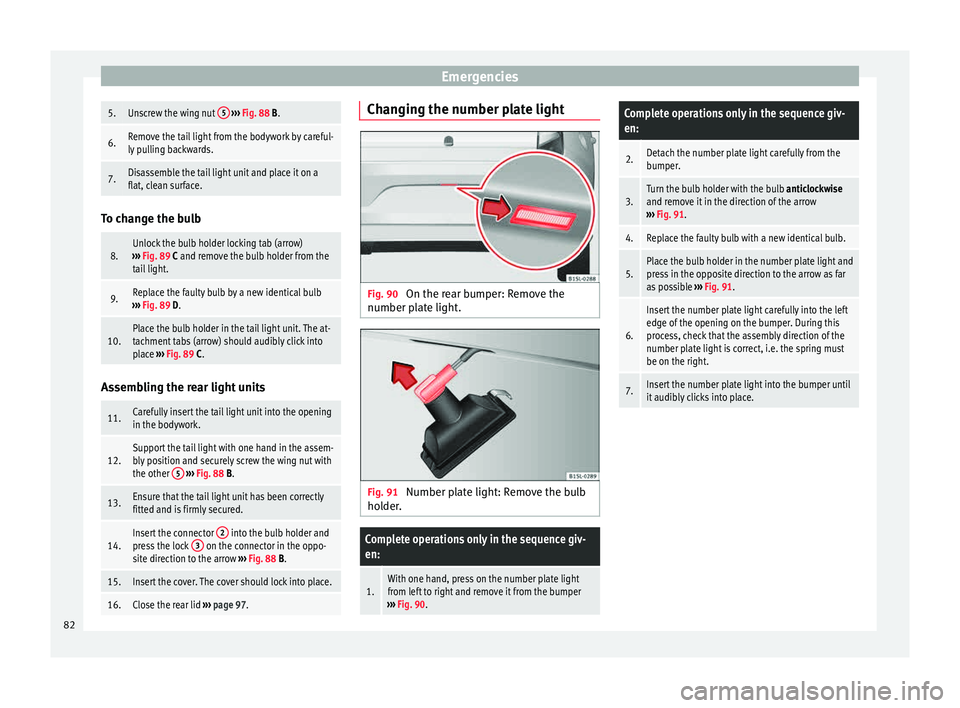
Fig. 90
On the rear bumper: Remove the
number p l
at
e light. Fig. 91
Number plate light: Remove the bulb
ho lder
.
Complete operations only in the sequence giv-
en:
1.With one hand, press on the number plate light
from left to right and remove it from the bumper
››› Fig. 90.
Complete operations only in the sequence giv-
en:
2.Detach the number plate light carefully from the
bumper.
3.Turn the bulb holder with the bulb anticlockwise
and remove it in the direction of the arrow
››› Fig. 91.
4.Replace the faulty bulb with a new identical bulb.
5.Place the bulb holder in the number plate light and
press in the opposite direction to the arrow as far
as possible ››› Fig. 91.
6.
Insert the number plate light carefully into the left
edge of the opening on the bumper. During this
process, check that the assembly direction of the
number plate light is correct, i.e. the spring must
be on the right.
7.Insert the number plate light into the bumper until
it audibly clicks into place. 82
Page 97 of 232

Opening and closing
Locking or unlocking the vehicle from
the in s
ide Fig. 103
In the driver door: central locking
b utt
on Fig. 104
In the passenger door: door handle
f or mec
h
anical locking. Central locking
Push the button
››› Fig. 103:
Unlocking the vehicle.
Locking the vehicle.
The central locking button is still operative
when the ignition is
sw
itched off.
If the vehicle has been locked with the vehi-
cle key, the central locking button does not
operate.
Please note the following when you use the
central locking button to lock your vehicle:
● The "Safe" security system wil
l not activate
››› page 95.
● It will not be possible to open the doors or
the rear lid fr
om the outside. This may offer
extra safety, for example when stopped at
traffic lights.
● The doors can be opened and unlocked in-
dividually
from the inside by pulling the in-
side door handle. If necessary, pull the door
release lever twice.
● The driver door cannot be locked when
open. This
avoids locking the vehicle key in-
side the vehicle when there is nobody inside. Mechanical locking
The doors ar
e locked by pressing the door
lever, so that the red mark becomes visible
››› Fig. 104 1 .
T o u
n
lock a door, pull its corresponding door
lever.
If the vehicle becomes locked, take note of
the following:
● The "Safe" security system wil
l not activate
››› page 95.
● It will not be possible to open the doors
from the out
side, when stopped at traffic
lights for example.
● The doors can be opened and unlocked in-
dividually
from the inside by pulling the in-
side door handle.
● The driver door cannot be locked using the
central
locking system when it is still open.
This avoids locking the vehicle key inside the
vehicle when there is nobody inside.
“Safe” security system*
FunctionNecessary operations
Locks the vehicle with
the "Safe" security sys-
tem.Press the button once on
the vehicle key.» 95
Technical data
Advice
Operation
Emergencies
Safety