2015 Seat Altea light
[x] Cancel search: lightPage 24 of 236

Safety
the doors nor the door panels should be
modified in any way (e.g. fitting loudspeak-
ers). If the front door is damaged, the airbag
system may not work correctly. All work car-
ried out on the front door must be done in a
specialised workshop.
●
In a side collision, the side airbags will not
work, if the sensors do not correctly measure
the pressure increase on the interior of the
doors, due to air escaping through the areas
with holes or openings in the door panel.
● Never drive the vehicle if the interior panels
have been removed.
● Never drive if the interior door panels have
been removed or if the panels have not been
correctly fitted.
● Never drive the vehicle if the loudspeakers
in the door panels have been removed, un-
less the holes left by the loudspeakers have
been closed properly.
● Always check that the openings are closed
or covered if additional loudspeakers or other
equipment are fitted inside the door panels.
● Any work carried out to the doors should be
made in an authorised specialised workshop. Head-protection airbags*
Fig. 17
Location of head-protection airbags
on the left side of the vehicle Fig. 18
Deployed head-protection airbags. The head-protection airbags are located on
both sides in the interior above the doors
››› Fig. 17 and are identified with the text
“AIRB AG”.
In c
onjunction with the seat belts, the head-
protection airbag system gives the occupants additional protection for the head and upper
body in the event of a severe side collision. WARNING
● In order for the head-protection airbags to
provide their maximum protection, the pre-
scribed sitting position must always be main-
tained with seat belts fastened while travel-
ling.
● For safety reasons, the curtain airbag must
be disabled in those vehicles fitted with a
screen dividing the interior of the vehicle.
See a Technical Service to make this adjust-
ment.
● There must be no other persons, animals or
objects between the occupants of the outer
seats and the deployment space of the head-
protection airbags so that the head-protec-
tion airbag can deploy completely without re-
striction and provide the greatest possible
protection. Therefore, sun blinds which have
not been expressly approved for use in your
vehicle may not be attached to the side win-
dows ››› page 147.
● The b ui
lt-in coat hooks should be used only
for lightweight clothing. Do not leave any
heavy or sharp-edged objects in the pockets.
Please, do not hang the clothes on coat hang-
ers.
● The airbags provide protection for just one
accident; replace them once they have de-
ployed. 22
Page 26 of 236

Safety
››› Fig. 19 . About 3/4 of the key should en-
t er
, as far as it will go.
– Then turn the key gently to the ON position.
Do not f
orce it if you feel resistance, and
make sure you have inserted the key fully.
– Check that the control lamp on the instru-
ment panel ››› Fig. 20 does not light up
when the ignition i
s switched on ››› .
WARNING
● It is the driver's responsibility to ensure
that the key-operated switch is set to the cor-
rect position.
● You should deactivate the front passenger
front airbag only if you have to use a rear-fac-
ing child seat in exceptional cases
››› page 24, Transporting children safety.
● Never install a child seat facing backwards
on the front passenger seat unless the front
passenger front airbag has been disabled.
Otherwise, there is a risk of death.
● As soon as the child seat is no longer nee-
ded on the front passenger seat, enable the
front passenger front airbag again.
● Only deactivate the front passenger front
airbag when the ignition is off, otherwise a
fault may occur in the airbag system, which
could cause the airbag to not deploy properly
or not deploy at all in case of an accident.
● Never leave the key in the airbag deactiva-
tion switch as it could get damaged or acti-
vate or deactivate the airbag during driving. ●
When the front passenger front airbag is
deactivated, if the control lamp AIRBAG OFF
is not continuously lit up, there may be a
fault in the airbag system:
– Have the airbag system inspected imme-
diately by a specialised workshop.
– Do not use a child seat on the front pas-
senger seat! The front passenger front
airbag could be triggered in the event of
an accident, even if there is a fault in the
system and, as a result, a child could sus-
tain serious or fatal injuries.
– It is unpredictable whether the front pas-
senger airbag will deploy in the event of
an accident. Warn all your passengers of
this.
● When using the ignition key to activate/de-
activate the front passenger front airbag, on-
ly the front passenger airbag will be activa-
ted/deactivated. The side airbag and head
airbag on the passenger side will remain ac-
tive. Transporting children safety
Safety for children Introduction For safety reasons, as we have learned from
accident statistics, we recommend that chil-
dren under 12 years of age travel in the rear
seats. Depending on their age, height and
weight, children travelling in the rear seat
must use a child seat or a seat belt. For safety
reasons, the child seat should be installed in
the rear seat, behind the front passenger
seat or in the centre back seat.
The physical laws involved and the forces
acting in a collision apply also to children
››› page 13 . But unlike adults, children do not
h av
e fully developed muscle and bone struc-
tures. This means that children are subject to
a greater risk of injury.
To reduce the risk of injuries, children must
always use special child restraint systems
when travelling in the vehicle.
We recommend the use of child safety prod-
ucts from the SEAT Original Accessories Pro-
gramme, which includes systems for all ages
made by “Peke” (not for all countries).
These systems have been especially de-
signed and approved, complying with the
ECE-R44. regulation.
24
Page 33 of 236
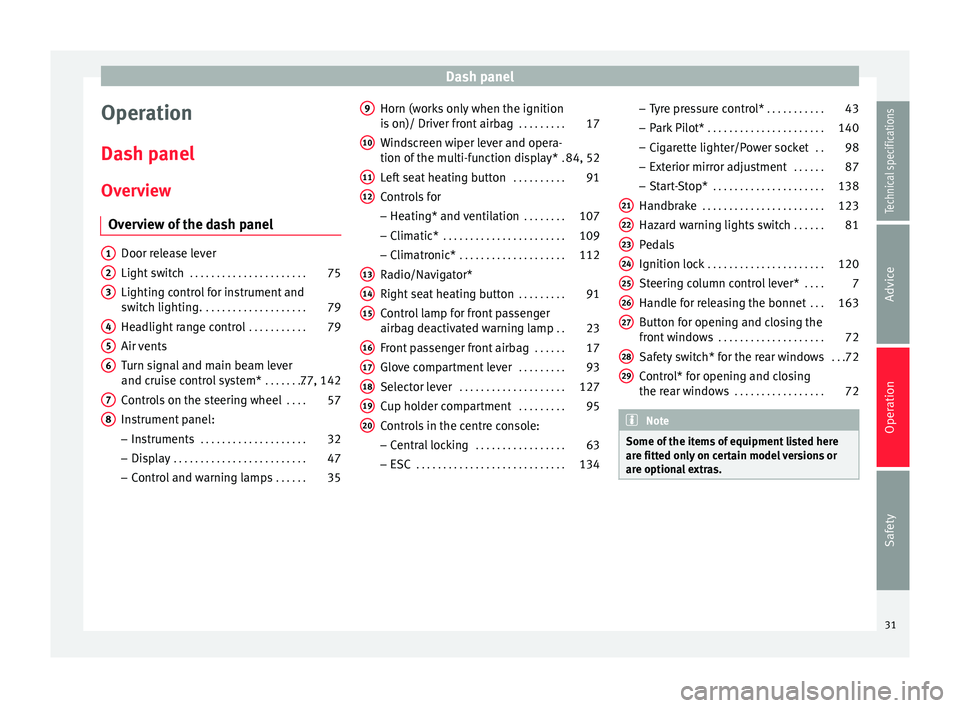
Dash panel
Operation
Dash panel Overview Overview of the dash panel Door release lever
Light switch
. . . . . . . . . . . . . . . . . . . . . . 75
Lighting control for instrument and
switch lighting. . . . . . . . . . . . . . . . . . . . 79
Headlight range control . . . . . . . . . . .79
Air vents
Turn signal and main beam lever
and cruise control system* . . . . . . . .77, 142
Controls on the steering wheel . . . .57
Instrument panel:
– Instruments . . . . . . . . . . . . . . . . . . . . 32
– Display . . . . . . . . . . . . . . . . . . . . . . . . . 47
– Control and warning lamps . . . . . .35
1 2
3
4
5
6
7
8 Horn (works only when the ignition
is on)/ Driver front airbag
. . . . . . . . .17
Windscreen wiper lever and opera-
tion of the multi-function display* .84, 52
Left seat heating button . . . . . . . . . .91
Controls for
– Heating* and ventilation . . . . . . . .107
– Climatic* . . . . . . . . . . . . . . . . . . . . . . . 109
– Climatronic* . . . . . . . . . . . . . . . . . . . . 112
Radio/Navigator*
Right seat heating button . . . . . . . . .91
Control lamp for front passenger
airbag deactivated warning lamp . .23
Front passenger front airbag . . . . . .17
Glove compartment lever . . . . . . . . .93
Selector lever . . . . . . . . . . . . . . . . . . . . 127
Cup holder compartment . . . . . . . . .95
Controls in the centre console: – Central locking . . . . . . . . . . . . . . . . . 63
– ESC . . . . . . . . . . . . . . . . . . . . . . . . . . . . 134
9 10
11
12
13
14
15
16
17
18
19
20 –
Tyre pressure control* . . . . . . . . . . .43
– Park Pilot* . . . . . . . . . . . . . . . . . . . . . . 140
– Cigarette lighter/Power socket . .98
– Exterior mirror adjustment . . . . . .87
– Start-Stop* . . . . . . . . . . . . . . . . . . . . . 138
Handbrake . . . . . . . . . . . . . . . . . . . . . . . 123
Hazard warning lights switch . . . . . .81
Pedals
Ignition lock . . . . . . . . . . . . . . . . . . . . . . 120
Steering column control lever* . . . .7
Handle for releasing the bonnet . . .163
Button for opening and closing the
front windows . . . . . . . . . . . . . . . . . . . . 72
Safety switch* for the rear windows . . .72
Control* for opening and closing
the rear windows . . . . . . . . . . . . . . . . . 72 Note
Some of the items of equipment listed here
are fitted only on certain model versions or
are optional extras. 21
22
23
24
25
26
27
28
29
31Technical specifications
Advice
Operation
Safety
Page 35 of 236

Dash panel
Speedometer The speedometer is equipped with a digital
odometer and a trip odometer, in addition to
a service intervals display.
During the running-in period, the instructions
shown on
››› page 130 should be followed.
F uel
gauge and reserve indicator Fig. 27
Instrument panel: fuel gauge The fuel tank has a capacity of approx. 55 li-
tres.
When the needle reaches the reserve area
››› Fig. 27 (arrow), the warning lamp will light up and an audib
l
e warning will sound
re-
minding the driver to refuel. At this point
there are still 7 litres of fuel in the tank.
The following text appears in the dash panel
display 1)
:
PLEASE REFUEL [XXX]
LPG gauge* 3 Applies to the model: ALTEA / ALTEA XL
Fig. 28
Instrument panel: gas gauge. LPG system filler level display
The LPG tank
››› in the spare wheel well
has a capacity of 39 litres at an outside tem- perature of +15 °C (+59 °F)
››› page 160, Re-
fuelling with LPG .
The c h
arge level can be checked on the ana-
logue gas gauge located on the instrument
panel ››› Fig. 28. When the level reaches re-
serv
e, a notification text is displayed on the
screen. Refill with LPG at the earliest opportu-
nity.
If while driving with LPG a sudden acoustic
warning signal is heard, the on-screen mes-
sage is shown 2)
:
LPG fault, consult Workshop
This means there is a fault in the LPG system.
Take the vehicle to a specialised workshop to
check the system.
Problem: If the vehicle is left parked for a
long time immedi
ately after refuelling, the
natural gas level indicator may not accurately
indicate the same level shown after refuelling
when the vehicle is started up again. This is
not necessarily due to a leak in the system. WARNING
LPG is a highly explosive and inflammable
substance. It may cause severe burns and
other injury. »1)
Depending on the version of the model.
2) Depending on the model version
33
Technical specifications
Advice
Operation
Safety
Page 36 of 236

Operation
●
Due care must be taken to avoid any risk of
fire or explosion.
● When parking the vehicle in a closed area
(e.g. in a garage), make sure that there is ad-
equate ventilation, either natural or mechani-
cal, to neutralise the LPG in the event of a
leak. Note
● The values shown in the average fuel con-
sumption and distance to empty indications
on the multifunction display (MFI) 1)
on the in-
strument panel display 2)
are approximate val-
ues only.
● Two different consumption values are given
on the MFI, depending on whether the vehi-
cle is running in gas or petrol mode.
● Please check the fuel level on the fuel level
gauge on the instrument panel ››› page 33.
● If frequent short journeys are made, espe-
cially when the outside temperature is low,
the vehicle will tend to run on petrol more of-
ten than on LPG. Therefore, the petrol tank
may empty before the LPG tank. Engine coolant temperature gauge
Fig. 29
Instrument panel: Engine coolant
temperature gauge. Needle in cold zone
A Avoid high engine speeds and heavy engine
loads
››› Fig. 29 .
Needl e in norm
al zone B In normal driving conditions, the needle
should be in the middle section of the scale.
The temperature may also rise when the en-
gine is working hard, especially at high out-
side temperatures. This is no cause for con-
cern as long as the warning lamp does notlight up and no warning message* appears
on the dash panel display.
Needle in warning zone
C The warning lamp*
››› Fig. 30 2 will light up
if the needle is in the warning zone. The fol-
lowing warning message appears on the in-
strument panel display 3)
. Stop the vehicle
and sw it
ch off the engine. Check the coolant
level ››› page 169 ››› .
Even if the coolant level is correct do not con-
tinue driving . You should obtain technical as-
s i
stance. WARNING
When working in the engine compartment, al-
ways observe the safety warnings
››› page 163. CAUTION
Accessories in front of the air inlet reduce the
cooling effect of the coolant. At high outside
temperatures and high engine loads, there is
a risk of the engine overheating. 1)
Optional equipment
2) Depending on the model version
3) Depending on the version of the model.
34
Page 38 of 236

OperationItemSymbolMeaning of control and warning lampsFurther information
3
Rear fog light switched on›››
page 40
4 Turn signals in operation›››
page 41
5 Engine fault (petrol engine)›››
page 41
Glow plug system (diesel engines)›››
page 41
6 Main beam switched on›››
page 41
7 Soot accumulation in the diesel engine particulate filter›››
page 41
8 ABS system fault›››
page 41
9 Windscreen washer fluid level›››
page 42
10 Alternator fault›››
page 42
11 Fasten seat belts!›››
page 11
12 Brake pad worn›››
page 42
13 Tyre pressure›››
page 43
14 Airbag or belt tensioner system fault or airbag disabled›››
page 16 ››› page 19
15 Bulb defective›››
page 44
16 Brake fluid required or
brake system fault›››
page 44
17
Red:
Engine oil pressure
›››
page 44Yellow:
If flashing: engine oil sensor faulty
If it remains lit: insufficient engine oil
18 Handbrake on›››
page 123 36
Page 39 of 236

Dash panelItemSymbolMeaning of control and warning lampsFurther information
19
Cruise speed activated (Cruise control)›››
page 45
20 Door open indicator›››
page 45
21 If it stays lit:
ASR switched off››› page 45 ››› page 46 ››› page 134
22 Electromechanical steering›››
page 45
23 Fault in the emission control system›››
page 45
24 If flashing:
the Electronic Stability Control (ESC) is working or the ASR is working
If it remains lit: ESC or ASR faulty››› page 45 ››› page 46 ››› page 134
25
Selector lever lock (automatic gearbox)›››
page 46 WARNING
● Failure to observe control lamps and warn-
ing messages can result in serious personal
injury or damage to your vehicle.
● The risk of an accident increases if your ve-
hicle breaks down. Use a warning triangle to
draw the attention of other road users in or-
der to prevent danger to third parties.
● The engine compartment is a dangerous
area. Before you open the bonnet to work on
the engine or in the engine compartment,
switch the engine off and allow it to cool to
reduce the risk of burns or other injuries.
Read and observe the relevant warnings
››› page 163. Note
● The appropriate control lamp for a fault will
light up in vehicles without warning or infor-
mation messages in the display.
● In vehicles with warning or information
messages on the screen, the appropriate con-
trol lamp for a fault will light up and a warn-
ing or information message will also appear
on the screen. 37
Technical specifications
Advice
Operation
Safety
Page 40 of 236

Operation
Overview of control and warning
lamps (vehicles with LPG) 3 Applies to the model: ALTEA / ALTEA XL
Fig. 31
Instrument panel control and warning
lamps in vehicles with LPG1 Red: coolant level/coolant
temperature›››
page
40
2 Blue: cold engine warning›››
page
40
3
(green
)
The green lamp lights up
when the vehicle is in LPG
mode.
The lamp goes off when
you switch, automatically
or manually, to petrol
mode.
››› page
118
(yel-
low)
The yellow warning lamp
lights up when the petrol
has reached the reserve
level.
WARNING
● Failure to observe control lamps and warn-
ing messages can result in serious personal
injury or damage to your vehicle.
● The risk of an accident increases if your ve-
hicle breaks down. Use a warning triangle to
draw the attention of other road users in or-
der to prevent danger to third parties.
● The engine compartment is a dangerous
area. Before you open the bonnet to work on
the engine or in the engine compartment,
switch the engine off and allow it to cool to
reduce the risk of burns or other injuries.
Read and observe the relevant warnings
››› page 163. Note
● The appropriate control lamp for a fault will
light up in vehicles without warning or infor-
mation messages in the display. ●
In vehicles with warning or information
messages on the screen, the appropriate con-
trol lamp for a fault will light up and a warn-
ing or information message will also appear
on the screen. Warning symbols
There are red warning symbols (priority 1)
and yellow warning symbols (priority 2).
Warning messages, Priority 1 (red)
If one of these faults occurs, the warning
lamp will light up or flash and will be accom-
panied by
three audible warnings. This is a
danger warning. Stop the vehicle and switch
off the en
gine. Check the fault and correct it.
Obtain professional assistance if necessary.
If several priority 1 faults are detected at the
same time, the symbols will be displayed one
after the other for about 2 seconds at a time
and will continue until the fault is corrected.
No menus will be shown in the display for the
duration of a priority 1 warning message.
Examples of priority 1 warning messages
(red)
● Brake system symbol with the warning
message STOP BRAKE FLUID INSTRUCTION
MANUAL or STOP BRAKE FAULT INSTRUCTION MANUAL.
38