2015 Seat Alhambra warning lights
[x] Cancel search: warning lightsPage 220 of 305

Advice
The checking and refilling of service fluids
are carried out on the components men-
tioned above. These operations are descri-
bed in ››› page 214 .
Ov er
view
Further explanations, instructions and restric-
tions on the technical data are contained as
of ››› page 274
Engine oil Introduction WARNING
Incorrectly handling engine oil can cause in-
jury and serious burns.
● Always protect your eyes when handling
engine oil.
● Oil is toxic and must be kept out of the
reach of children.
● Engine oil should only be kept in its origi-
nal packaging; the same goes for used oil un-
til it is disposed of.
● Never store engine oil in empty food con-
tainers or bottles as other people may acci-
dentally drink it.
● Regular contact with engine oil can be bad
for the skin. If you come into contact with en-
gine oil, wash your skin with soap and water. ●
With the engine running, the engine oil
gets extremely hot and can cause severe skin
burns. Always wait until the engine has fully
cooled. For the sake of the environment
Similar to the other service liquids, spilled
engine oil can be bad for the environment.
Collect these liquids in suitable containers
and dispose of them while respecting the en-
vironment. Warning and control lamps
It lights
upPossible causeSolution
Insufficient engine
oil.Switch the ignition
off. Check the en-
gine oil level
››› page 219.
FlashesPossible causeSolution
Engine oil pres-
sure too low.
Stop the vehicle!
Switch off the en-
gine. Check the en-
gine oil level.
- If the warning lamp
flashes although the
oil level is correct,
do not continue driv-
ing or leave the en-
gine running. Other-
wise, the engine
could be damaged.
Seek specialist as-
sistance.
Engine oil sensor
faulty.Contact a special-
ised workshop. Have
the engine oil sensor
checked.
WARNING
Observe the safety warnings ››› in Control
and warning lamps on page 47. Engine oil specifications
Replacement engine oil must strictly comply
with the specifications.
The correct oil must be used to ensure the
correct operation and long service life of the
engine. The engine comes with a high-quality
multigrade oil that can generally be used all
year round.
218
Page 224 of 305

Advice
Coolant temperature warning lamp and gauge Fig. 167
Engine coolant temperature gauge
on the instrument panel: A cold area;
B normal area;
C warning area When driving normally, the needle will re-
main in the middle area. The temperature
may also rise when the engine is working
hard, especially at high outside temperatures
and so the indicator will move quite far to the
right-hand side.
Several warning and control lamps light up
for a few seconds when the ignition is switch-
ed on, signalling that the function is being
verified. They will switch off after a few sec-
onds.It lights upGauge position
››› Fig. 167Possible causeSolution
Warning area
CExcessive engine coolant temperature.
Stop the vehicle!
Stop the vehicle safely as soon as possible. Switch off the engine
and wait for it to cool down and for the needle to return to the nor-
mal area. Check the engine coolant level ››› page 224.
Normal area BInsufficient engine coolant level.Check the engine coolant when the engine has cooled and, if it is
low, refill with engine coolant
››› page 224.
Although the coolant level is correct, there is a fault.
--Engine coolant system faulty. Do not drive any further.
Obtain professional assistance.
--Cold area A--Avoid revving the engine too much or making it work hard while it
has not reached normal service temperature.222
Page 230 of 305

Advice
●
Avoid sparks and electrostatic discharges
when working with cables and electrical devi-
ces.
● Never short the battery terminals.
● Never use a damaged battery. It can ex-
plode. Replace a damaged battery immedi-
ately.
● Replaced damaged or frozen batteries as
soon as possible. A flat battery can also
freeze at temperatures close to 0 °C (+32 °F).
● For vehicles with the battery in the luggage
compartment: Check that the battery gas
ventilation hose is securely attached. CAUTION
● Never disconnect the battery if the ignition
is switched on or if the engine is running.
This could damage the electrical system or
electronic components.
● Do not expose the battery to direct sunlight
over a long period of time, as the intense ul-
traviolet radiation can damage the battery
housing.
● If the car is left standing for long periods,
protect the battery from extreme cold temper-
ature so that it does not “freeze up” and be-
come damaged. Warning lampIt
lights upPossible causeSolution
Faulty generator.
Contact a specialised
workshop. Have the
electrical system
checked.
Disconnect any unneces-
sary electrical devices.
The generator does not
charge the battery while
the vehicle is in motion.
Several warning and control lamps light up
for a few seconds when the ignition is switch-
ed on, signalling that the function is being
verified. They will switch off after a few sec-
onds.
WARNING
If the warning lamps and messages are ignor-
ed, the vehicle may stall in traffic, or may
cause accidents and severe injuries.
● Never ignore the warning lamps or text
messages.
● Stop the vehicle safely as soon as possible. CAUTION
Failure to heed the control lamps and text
messages when they appear may result in
faults in the vehicle. Checking the electrolyte level of the
vehicle battery
Fig. 172
In the engine compartment: Remove
the cover from the vehicle's battery. Fig. 173
In the engine compartment: unfold
the vehicle's battery hose. The battery's electrolyte level should be
checked regularly in high-mileage vehicles,
in hot countries and in older batteries. Other
batteries do not require maintenance.
228
Page 232 of 305

Advice
● The vehicle must be unlocked before dis-
connecting the battery, otherwise the alarm
will be triggered.
● First disconnect the negative cable and
then the positive ››› .
Connecting the vehicle's battery
● Before reconnecting the battery, switch off
the engine and all electrical devices.
● First reconnect the positive cable and then
the negative ››› .
Different control lamps may light up after
connecting the battery and switching the ig-
nition on. They will be turned off after a short
trip at a speed of between 15-20 km/h
(10-12 mph). If the warning indicators remain
lit, please visit a specialised workshop to
have the vehicle checked.
If the battery has been disconnected for a
long time, it is possible that the next service
date is not displayed or calculated correctly
››› page 40 . Respect the maximum service in-
t er
vals permitted ››› Booklet Maintenance
Programme.
Vehic
les with Keyless Access (››› page 59): if,
after connecting the battery, the ignition can-
not be switched on, lock and unlock the vehi-
cle from outside. Then try to switch on the ig-
nition again. If the ignition does not work,
seek professional assistance. Automatic device disconnection
The intelligent vehicle electrical system auto-
matically implements a range of measures to
prevent the battery from discharging when
high demands are made on it:
● the idling speed is increased so that the al-
ternator provides more electricity.
● where necessary, the power of the most
powerful devices is reduced or even com-
pletely disconnected.
● On starting the engine, the power supply
from the 12-volt power sockets and the ciga-
rette lighter may be interrupted for a short
time.
The on-board management program cannot
always prevent the battery from running flat.
For example, if the ignition is left on for a
long period with the engine off or if the side
lights or parking lights are left on while the
vehicle is stationary.
Why does the battery run flat?
● When stationary for a long time without
starting the engine, particularly if the ignition
is switched on.
● Use of electrical devices with the engine
switched off.
● If the auxiliary heater is running
››› page 128
. WARNING
Incorrectly securing the battery or using the
wrong battery can cause short-circuits, fire
and serious injuries.
● Always use only maintenance free batteries
that do not run flat alone and whose proper-
ties, specifications and size correspond to
the standard battery. The specifications are
indicated on the battery case. WARNING
A highly explosive mixture of gases is re-
leased when the battery is under charge.
● The batteries should be charged in a well-
ventilated room only.
● Never charge a frozen or recently thawed
battery. A flat battery can also freeze at tem-
peratures close to 0 °C (+32 °F).
● Always replace a battery which has frozen.
● Battery cables not correctly connected may
cause a short circuit. Reconnect first the posi-
tive cable and then the negative cable. CAUTION
● Never disconnect the battery if the ignition
is switched on or if the engine is running.
This could damage the electrical system or
electronic components.
● Never plug accessories that supply current,
such as solar panels or a battery charger, to
the 12-volt power sockets or the cigarette 230
Page 245 of 305
Emergencies
First-aid kit
There is a first aid kit ››› page 112 in the rear
left-hand side storage compartment of the
luggage compartment.
The first aid kit must comply with legal re-
quirements. Check the expiry date of the con-
tents of the first aid kit.
Fire extinguisher
There is a Fire extinguisher underneath the
fr ont
passenger seat.
The fire extinguisher must conform to legal
requirements, be ready for use and be
checked regularly. Check the certification
seal on the extinguisher. WARNING
Loose objects in the vehicle interior can be vi-
olently thrown in case of a sudden manoeu-
vre or braking and especially in accidents
causing serious injury.
● Secure fire extinguishers, first aid kit, re-
flective vests and warning triangle securely
to their respective supports. Protecting yourself and securing the
vehicle
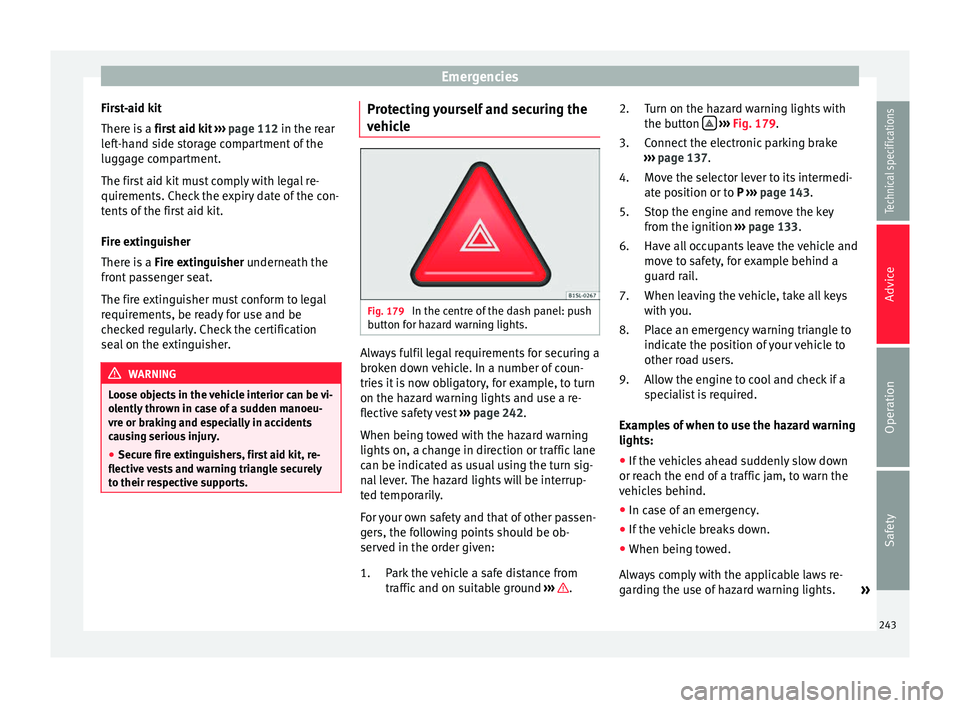
Fig. 179
In the centre of the dash panel: push
button for hazard warning lights. Always fulfil legal requirements for securing a
broken down vehicle. In a number of coun-
tries it is now obligatory, for example, to turn
on the hazard warning lights and use a re-
flective safety vest
››› page 242.
When being towed with the hazard warning
lights on, a change in direction or traffic lane
can be indicated as usual using the turn sig-
nal lever. The hazard lights will be interrup-
ted temporarily.
For your own safety and that of other passen-
gers, the following points should be ob-
served in the order given:
Park the vehicle a safe distance from
traffic and on suitable ground ››› .
1. Turn on the hazard warning lights with
the button
››› Fig. 179.
Connect the electronic parking brake
››› page 137 .
Mo v
e the selector lever to its intermedi-
ate position or to
P ››› page 143.
Stop the engine and remove the key
from the ignition ››› page 133.
Have all occupants leave the vehicle and
move to safety, for example behind a
guard rail.
When leaving the vehicle, take all keys
with you.
Place an emergency warning triangle to
indicate the position of your vehicle to
other road users.
Allow the engine to cool and check if a
specialist is required.
Examples of when to use the hazard warning
lights:
● If the vehicles ahead suddenly slow down
or reach the end of a traffic jam, to warn the
vehicles behind.
● In case of an emergency.
● If the vehicle breaks down.
● When being towed.
Always comply with the applicable laws re-
garding the use of hazard warning lights. »
2.
3.
4.
5.
6.
7.
8.
9.
243Technical specifications
Advice
Operation
Safety
Page 246 of 305

Advice
If the hazard warning lights are not working,
you must use an alternative method of draw-
ing attention to your vehicle. This method
must comply with traffic legislation. WARNING
A faulty vehicle in traffic represents a risk of
accident for the driver and for other road
users.
● Stop the vehicle safely as soon as possible.
Park the vehicle a safe distance from sur-
rounding traffic to lock all the doors in case of
an emergency. Turn on the hazard warning
lights to warn other road users.
● Never leave children or disabled people
alone in the vehicle if the doors are to be
locked. In case of an emergency, passengers
will be trapped inside the vehicle. Individuals
locked in the vehicle can be exposed to very
high or very low temperatures. WARNING
The components of the exhaust system reach
very high temperatures. This could cause a
fire and considerable damage.
● Always park your vehicle so that no part of
the exhaust system can come in contact with
flammable materials (such as dried grass or
fuel). Note
● The vehicle battery will discharge and run
down if the hazard warning lights remain on for too long (even with the ignition turned
off).
● For some vehicles, the brake lights will
blink when braking suddenly at speeds of ap-
proximately 80 km/h (50 mph) to alert vehi-
cles to the rear. If braking continues, the haz-
ard warning lights system will automatically be turned on at a speed of less than approxi-
mately 10 km/h (6 mph). The brake lights re-
main lit. Upon accelerating, the hazard warn-
ing lights will be automatically turned off. Vehicle tool kit*
Introduction When securing the vehicle in case of a break-
down, please note the legal requirements for
each country.
WARNING
Loose objects in the vehicle interior can be vi-
olently fired through the compartment in
case of a sudden manoeuvre or braking and
especially in accidents causing serious in-
jury.
● Make sure that the vehicle tools are stored
safely in the luggage compartment. WARNING
Unsuitable or damaged vehicle tools can
cause injury or accidents.
● Never work with inappropriate or damaged
tools. Location
Fig. 180
In the luggage compartment, viewed
from inside the vehicle: the vehicle tool kit lo-
cated in a cavity close to the lock carrier. Depending on the model, the vehicle tools
may be kept in the luggage compartment, in
a cavity close to the lock carrier
››› Fig. 180 .
L oo
sen the safety straps and remove the ve-
hicle tool kit. For vehicles factory-fitted with
winter tyres, you will find additional tools in a
toolbox located in the luggage compartment.
244
Page 248 of 305

Advice
WARNING
If the folding chocks are assembled or used
incorrectly, an accident may occur and seri-
ous injury caused.
● Never use damaged chocks.
● Never use chocks to immobilize the vehicle
on a slope. Changing a wheel*
Introduction The tyres mounted on the vehicle are anti-
puncture. The wheels should only be
changed when switching from summer to
winter tyres or vice-versa. See
›››
page 237
The vehicle only comes with the necessary
tools for changing wheels if factory supplied
with winter tyres. If this is not the case, you
need to go to a specialised workshop to get
the wheels changed.
You should only change the wheels yourself if
the vehicle is parked in a safe place, you are
familiar with the procedure and safety stand-
ards and you have all the necessary tools!
Otherwise, you should seek professional as-
sistance. WARNING
Changing a wheel can be dangerous, espe-
cially on the hard shoulder. Please observe
the following rules to minimise the risk of in-
jury:
● Stop the vehicle safely as soon as possible.
Park at a safe distance from surrounding traf-
fic to change a wheel.
● When changing a wheel, keep all passen-
gers, and particularly children, a safe dis-
tance away from the work area.
● Turn on the hazard warning lights to warn
other road users.
● Ensure the ground on which you park is flat
and solid. If necessary, support the jack on a
wide solid base.
● If you are changing a wheel yourself, you
should be familiar with the required proce-
dure. Otherwise, you should seek professio-
nal assistance.
● Only use suitable tools that are not dam-
aged when changing a wheel.
● Always stop the engine, turn on the elec-
tronic parking brake and place the gear selec-
tor lever in position P, for an automatic gear-
box, or engage a gear for a manual gearbox to
reduce the risk of the vehicle moving acciden-
tally.
● Have the tightening torque of the wheel
bolts checked as soon as possible with a reli-
able torque wrench. WARNING
If the wheel trims are not appropriate or not
fitted correctly, they could cause major acci-
dents or damage.
● Incorrectly mounted wheel trims may come
off while driving and endanger other road
users.
● Damaged trims must never be mounted on
the wheels.
● Always ensure that the brake ventilation
and cooling is not cut off or blocked. This is
also valid if hubcaps are fitted later. If there
is not enough air, you may require signifi-
cantly longer braking distances. CAUTION
Remove and remount wheel trims taking care
to avoid damage to the vehicle. 246
Page 253 of 305

Emergencies
and the necessary safety measures, and if
you have the right kit! Otherwise, you should
seek professional assistance.
The tyre sealant should not be used in the
following cases:
● If the wheel is damaged.
● The outside temperature is lower than -20
℃ (-4 °F).
● If the tear or puncture on the tyre is over 4
mm wide.
● If you have driven with very low pressure or
a flat tyre.
● If the expiry date on the bottle of tyre seal-
ant has passed. WARNING
Using the tyre mobility system can be dan-
gerous, especially when filling the tyre at the
roadside. Please observe the following rules
to minimise the risk of injury:
● Stop the vehicle safely as soon as possible.
Park it at a safe distance from surrounding
traffic to fill the tyre.
● Ensure the ground is flat and firm.
● All occupants, and especially children,
should always be at a safe distance outside
the work area.
● Turn on the hazard warning lights to warn
other road users. ●
Use the tyre mobility system only if you are
familiar with the necessary procedures. Oth-
erwise, you should seek professional assis-
tance.
● Only use the tyre mobility system in the
event of an emergency to get to the nearest
workshop.
● Replace the repaired tyre with the tire mo-
bility set as soon as possible.
● The sealant is hazardous for your health
and if it touches your skin, it must be imme-
diately washed off.
● Keep children away from the tyre mobility
system.
● Never use a jack even if it is approved for
the vehicle.
● To reduce the risk of the vehicle possibly
moving on its own, always turn off the en-
gine, set the electronic parking brake and put
the selector lever in position P or put into
gear if the gearbox is a manual. WARNING
A tyre repaired with sealant does not have
the normal drive properties.
● Never drive faster than 80 km/h (50 mph).
● Avoid hard acceleration, heavy braking and
fast cornering.
● Check the tyre after travelling 10 minutes
at no more than 80 km/h (50 mph). For the sake of the environment
Once used or expired, dispose of the sealant
according to legal provisions. Note
● Sealant bottles can be purchased from
SEAT dealers.
● Observe the usage instructions provided by
the snow chain manufacturer. Contents of the tyre mobility system*
Fig. 190
Standard representation: Contents
of the tyre mobility system. The tyre mobility system is located under-
neath the floor covering in the boot. It in-
cludes the following components
››› Fig. 190 :
»
251Technical specifications
Advice
Operation
Safety