2015 Seat Alhambra heating
[x] Cancel search: heatingPage 149 of 305

Driving
checked by a specialised workshop as soon
as possible.
Overload protection for the 6-speed DSG
gearbox ®
When the clutch is overloaded, the vehicle
begins to jerk and the selector lever position
indic at
or begins to flash. To prevent damage
to the clutch, this interrupts the power trans-
mission between the engine and the gear-
box. There is no more traction and it is not
possible to accelerate. If the clutch is opened
automatically due to overloading, press the
brake pedal. Wait a few seconds before start-
ing to move again.
Kick-down
The kick-down system provides maximum ac-
celeration when the gear selector lever is in
the positions D,
S or in the Tiptronic position.
When the accelerator pedal is pressed right
down, the automatic gearbox will shift down
to a lower gear, depending on road speed
and engine speed. This takes advantage of
the maximum acceleration of the vehicle
››› .
When the accelerator is pressed to the floor,
the automatic gearbox shifts to the next gear
only after the engine reaches the specified
maximum engine speed. Launch-Control Programme
The Launch-Control programme enables max-
imum acceleration while at a standstill.
●
Switch off the ASR ››› page 137.
● Press and hold the brake pedal with your
left foot.
● Place the selector lever in position S or Tip-
tronic.
● Press the accelerator with the right foot un-
til the vehicle reaches an engine speed of ap-
proximately 3200 rpm.
● Lift the left foot off the brake ››› . The ve-
hicle starts with maximum acceleration.
● Turn on the ASR after accelerating! WARNING
Rapid acceleration can cause loss of traction
and skidding, especially on slippery ground.
This could cause loss of control of the vehicle
resulting in an accident and considerable
damage.
● Only use kick-down and rapid acceleration
when weather conditions, surface conditions
and traffic conditions permit; accelerate and
drive in a manner that does not endanger
other road users.
● Please remember that the driven wheels
can slip and the vehicle can skid if the ASR is
turned off, especially on slippery ground.
● Turn on the ASR after accelerating! CAUTION
● If you stop on a hill with a gear range en-
gaged, do not try to prevent the vehicle from
rolling back by pressing on the accelerator.
This could cause overheating and damage the
automatic gearbox.
● Never allow the vehicle to move with the
gear selector lever in N, especially with the
engine turned off. The automatic gearbox will
not be lubricated and could be damaged. Recommended gear display
In some vehicles, the recommended gear for
reducing fuel consumption is displayed on
the instrument panel:DisplayMeaning
Optimum gear.
Recommendation to change up a gear.
Recommendation to change down a
gear.
Information for “cleaning” the diesel
particulate filter
The exhaust gas system control recognises
when the diesel particulate filter is blocked,
»
147
Technical specifications
Advice
Operation
Safety
Page 152 of 305
Operation
Think ahead and “flow” with the traffic
Frequent acceleration and braking considera-
bly increase fuel consumption. If you think
ahead as you drive and keep a safe distance
from the vehicle in front, it is possible to slow
down by simply lifting your foot off the accel-
erator. This eliminates the need for constant
braking and acceleration.
Calm and steady driving
Constancy is more important than speed: The
more you drive at a constant speed, the lower
the fuel consumption.
When driving on the motorway, it is more effi-
cient to drive at a constant and more moder-
ate speed than to be continuously accelerat-
ing and braking. As a general rule, you will
reach your destination just as quickly when
you drive at a constant speed.
The cruise control function helps you to ach-
ieve a constant style of driving.
Moderate use of additional devices
It is important to travel in comfort, but con-
venience systems should be used ecological-
ly.
Some equipment, when connected, increase
fuel consumption considerably, for example:
● Air conditioning cooling system: If the air
conditioning system is required to cool to
significantly lower temperatures than the true outside temperature, it will require a large
amount of energy from the engine. Therefore,
we recommend that the selected temperature
for the vehicle is not too different to the out-
side temperature. It is a good idea to air the
vehicle before starting your journey and to
drive a short distance with all the windows
open. Only then should you close all the win-
dows and switch on the air conditioning.
Keep windows closed when travelling at high
speeds. Driving with the windows open in-
creases fuel consumption.
●
Switch off the seat heating when the seats
have warmed up.
● Switch off the heated rear window and the
windscreen heating when the windows have
demisted and are free of ice.
● Do not leave the auxiliary heater switched
on when the vehicle is moving ››› page 128.
Avoid short journeys
Fuel consumption is much higher when the
engine is cold, immediately after it has been
started. It takes a few kilometres of driving
for the engine to warm up and to normalise
consumption.
The engine and catalytic converter need to
reach their proper working temperature in or-
der t o minimi
se fuel consumption and emis-
sions. The ambient temperature has a deci-
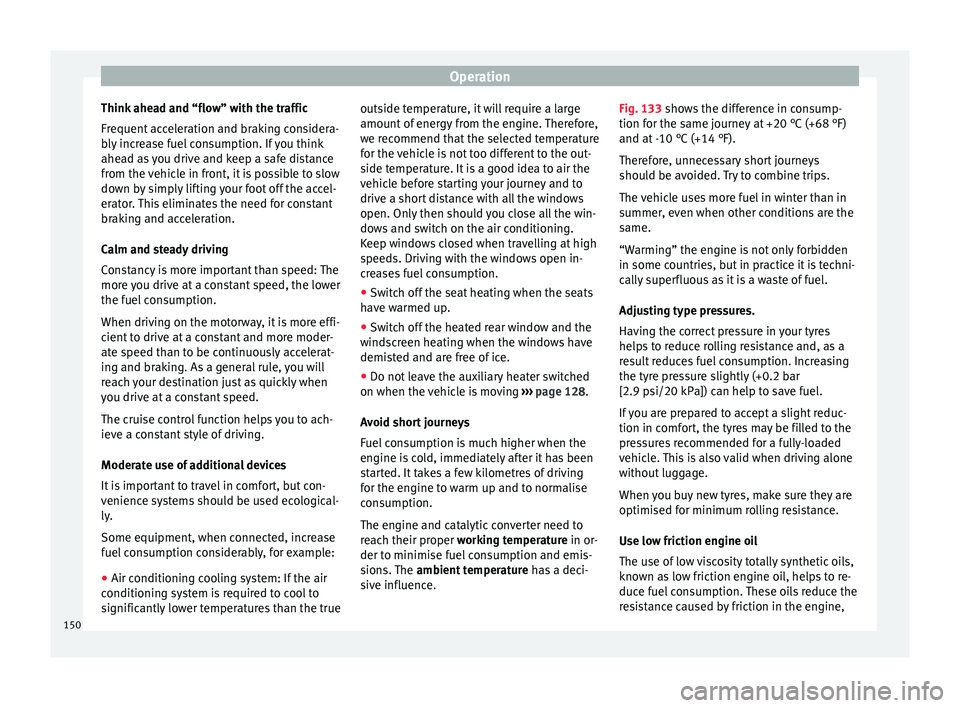
sive influence. Fig. 133 shows the difference in consump-
tion for the same journey at +20 °C (+68 °F)
and at -10 °C (+14 °F).
Therefore, unnecessary short journeys
should be avoided. Try to combine trips.
The vehicle uses more fuel in winter than in
summer, even when other conditions are the
same.
“Warming” the engine is not only forbidden
in some countries, but in practice it is techni-
cally superfluous as it is a waste of fuel.
Adjusting type pressures.
Having the correct pressure in your tyres
helps to reduce rolling resistance and, as a
result reduces fuel consumption. Increasing
the tyre pressure slightly (+0.2 bar
[2.9 psi/20 kPa]) can help to save fuel.
If you are prepared to accept a slight reduc-
tion in comfort, the tyres may be filled to the
pressures recommended for a fully-loaded
vehicle. This is also valid when driving alone
without luggage.
When you buy new tyres, make sure they are
optimised for minimum rolling resistance.
Use low friction engine oil
The use of low viscosity totally synthetic oils,
known as low friction engine oil, helps to re-
duce fuel consumption. These oils reduce the
resistance caused by friction in the engine,
150
Page 153 of 305

Driving
they flow around the engine more quickly
and efficiently, particularly in cold starts. The
effect is particularly noticeable in vehicles
frequently used for short journeys.
Always check the engine oil level and ob-
serve service intervals (engine oil change in-
tervals).
When purchasing engine oil, always observe
legal requirements and ensure that the oil is
approved by SEAT.
Avoid carrying unnecessary loads
The lighter the vehicle, the more economical
and ecological the driving style. For example,
an additional weight of 100 kg will increase
fuel consumption up to 0.3 l/100 km.
Remove any unnecessary objects or loads
from the vehicle.
Remove optional equipment and
unnecessary accessories
The more aerodynamic the vehicle, the lower
the fuel consumption. Optional equipment
and accessories (such as roof racks or bike
carriers) reduce the aerodynamic benefits of
the vehicle.
Therefore, we recommend you remove all op-
tional and unnecessary equipment and racks,
especially if you intend to drive at high
speeds. Other factors which increase fuel
consumption (examples):
●
Fault in engine management.
● Driving on hills.
● Trailer towing. WARNING
Always adapt your speed and the distance to
the vehicles ahead in line with visibility,
weather conditions, the condition of the road
and the traffic situation. Engine management and
exhaust gas purification
system
Introduction WARNING
The components of the exhaust system reach
very high temperatures. This could cause a
fire.
● Always park your vehicle so that no part of
the exhaust system can come in contact with
flammable materials (such as dried grass).
● Do not apply additional underseal or anti-
corrosion coatings to the exhaust pipes, cata-
lytic converter, heat shields or the diesel par-
ticulate filter. Control lampsIt lights
upPossible causeSolution
Fault in engine
management
(Electronic Power
Control).Take the vehicle to a
specialised work-
shop as soon as
possible and have
the engine checked.
Pre-heating a die-
sel engine before
starting the en-
gine.
›››
page 133
Fault in catalytic
converter.
You should reduce
speed accordingly.
Drive carefully until
you reach the next
specialised work-
shop. Have the en-
gine checked there.
Diesel particulate
filter blocked
Drive for 15 minutes
in 4th gear (manual
gearbox), or in D (au-
tomatic gearbox) at
a minimum speed of
70 km/h (45 mph).
Observe speed lim-
its
›››
.
If the warning lamp
remains lit up, take
the vehicle to a spe-
cialised workshop
››› page 152.
» 151
Technical specifications
Advice
Operation
Safety
Page 154 of 305

OperationFlashesPossible causeSolution
Fault in the engine
management (die-
sel engines).Take the vehicle to a
specialised work-
shop as soon as
possible and have
the engine checked.
Combustion fault
which could dam-
age the catalytic
converter.
You should reduce
speed accordingly.
Drive carefully until
you reach the next
specialised work-
shop. Have the en-
gine checked there.
Several warning and control lamps light up
for a few seconds when the ignition is switch-
ed on, signalling that the function is being
verified. They will switch off after a few sec-
onds.
WARNING
Observe traffic regulations when cleaning the
diesel particulate filter while driving.
● Only carry on driving if visibility, weather,
road and traffic conditions so permit.
● Never endanger your safety or that of other
road users. CAUTION
Always pay attention to any lit control lamps
and to the corresponding descriptions and in-
structions to avoid damage to the vehicle. Note
While the indicators ,
or remain lit,
there may be engine problems, fuel consump-
tion may be greater and the engine may lose
power. Catalytic converter
The catalytic converter permits the subse-
quent treatment of the exhaust gases thus
reducing contaminating gas emissions. To
ensure a longer working life for the exhaust
system and catalytic converter in a petrol en-
gine:
● Always use unleaded petrol.
● Never run the fuel tank completely dry.
● Do not top up with too much engine oil
››› page 218 .
● Do not t
ow-start the vehicle; use the starter
cables ›››
page 253.
If
you should notice misfiring, uneven run-
ning or loss of power when the car is moving,
reduce speed immediately. Have the car in-
spected by a specialised workshop. If this
happens, unburnt fuel can enter the exhaust
system and escape into the atmosphere. The
catalytic converter can also be damaged by
overheating. For the sake of the environment
Even when the emission control system is
working perfectly, there may be a smell of
sulphur under certain conditions. This de-
pends on the sulphur content of the fuel be-
ing used. Diesel particulate filter
The diesel particulate filter removes soot par-
ticulates from the exhaust gas, retains and
burns them. To assist the combustion proc-
ess, SEAT recommends you avoid frequent
short trips.
● Always use diesel with a low sulphur con-
tent ›››
page 209 .
● Nev er u
se petrol or fuel oil.
● Never use biodiesel. However, a blend pre-
pared by the diesel manufacturer containing
biodiesel within the limits established by the
EN 590 standard may be used ›››
page 209.
● Never run the fuel tank completely dry.
● Do not top up with too much engine oil
››› page 218.
● Do not t
ow-start the vehicle; use the starter
cables ›››
page 253.
In order t
o reduce blocking of the diesel par-
ticulate filter, some vehicles with an automat-
ic gearbox may increase the engine speed
slightly to start cleaning the filter
152
Page 157 of 305

Driver assistance systems
front wheels are turned, the normal ABS is
activated.
Brake assist system (BAS)
The brake assist system may reduce the re-
quired braking distance. The brake assist
system boosts the braking force if you press
the brake pedal quickly in an emergency. As
a result, the braking pressure increases rap-
idly, the braking force is multiplied and the
braking distance is reduced. This enables the
ABS to be activated more quickly and effec-
tively.
¡Do not lift your foot off the brake pedal!
When the br ak
e pedal is released or when
the brake force is reduced, braking assist au-
tomatically turns off the brake servo.
Traction control when accelerating (ASR)
In the event of wheelspin, the traction control
system reduces the engine torque to match
the amount of grip available. The ASR makes
some situations easier, for example, when
starting, accelerating or going uphill, even in
unfavourable road conditions.
The ASR can be switched on or off manually
››› page 156.
Electr
onic differential lock system (EDL and
XDS)
EDL is available when driving in straight lines
under normal conditions. When the EDL de- tects wheelspin, it brakes the spinning wheel
and directs the power to the other drive
wheels. To prevent the disc brake of the
braked wheel from overheating, the EDL cuts
out automatically if subjected to excessive
loads. The EDL will switch on again automati-
cally when the brake has cooled down.
The XDS function is an extension of the elec-
tronic differential lock. The XDS does not re-
act to the traction of the driving wheels, but
to the adherence of the front wheel on the in-
side of the curve whilst gripping rapidly in
corners. The XDS gives pressure to the brakes
of the wheel on the interior of the corner to
prevent skidding. This improves traction,
which assists the vehicle in continuing the
required line.
WARNING
Driving at high speed on icy, slippery wet
ground can result in loss of vehicle control
and serious injury to the driver and passen-
gers.
● Adjust your speed and driving style to visi-
bility, road, traffic and weather conditions.
Even though the brake assist systems, ABS,
BAS, EDL, ASR and ESC, provide more securi-
ty, do not take unnecessary risks while driv-
ing.
● Brake assist systems can not overcome the
laws of physics. Even with ESC and other sys-
tems, slippery and wet roads will always be
dangerous. ●
Driving to quickly on wet ground can result
in the wheels losing contact with the ground
in an effect known as “aquaplaning”. Without
adherence, it is impossible to brake, steer or
control the vehicle.
● Brake assist systems cannot avoid acci-
dents if, for example, the driver does not re-
spect safety distances or drives to quickly in
difficult conditions.
● Even though brake assist systems are ex-
tremely effective and help control the vehicle
in difficult situations, remember that the ve-
hicle stability depends on tyre grip.
● When accelerating on a slippery surface,
for example on ice or snow, press the acceler-
ator carefully. The wheels can still slip even
with brake assist systems resulting in loss of
vehicle control. WARNING
The effectiveness of the ESC can be consider-
ably reduced if other components and sys-
tems affecting driving dynamics are not main-
tained or are not functioning correctly. This
includes, among others, brakes, tyres and
other systems already mentioned.
● Remember that changing and fitting other
components to the vehicle can affect opera-
tion of the ABS, BAS, ASL EDL and ESC.
● Changes to the vehicle suspension or using
unapproved wheel/tyre combinations can af-
fect operation of the ABS, BAS, ASL EDL and
ESC, as well as their effectiveness. » 155
Technical specifications
Advice
Operation
Safety
Page 200 of 305

Advice
removing grease do not eliminate the wax
deposits ››› .
Special cleaning products or window cloths
are available at any technical service. To re-
move wax deposits, SEAT recommends the
following products:
● For the hottest time of the year: the
G 052 184 A1 window cleaner for summer
use. Proportion 1:100 (1 part detergent,
100 parts water) in the windscreen washer
reservoir.
● All year round: the G 052 164 A2 window
cleaner; proportion 1:2 in windscreen washer
bottle (1 part concentrate, 2 parts water) in
winter, up to -18 ℃
(-0.4 °F), or 1:4, durin
g
the r
est of the year.
● Window cloths G 052 522 A1 for all win-
dows and exterior mirrors.
Removing snow
Use a small brush to remove snow from the
windows and exterior mirrors.
Removing ice
If possible, use a de-icing spray to remove
ice. If you use an ice scraper, push it in one
direction only without
swinging it. If you pull
the scraper backwards, the dirt may scratch
the window. WARNING
Dirty or misted windows reduce visibility in
all directions and increase the risk of acci-
dent and serious injury.
● Do not drive unless you have good visibility
through all windows!
● Remove ice and snow from the windows
and demist inside and out. CAUTION
● Never mix our cleaning products with other
products not recommended by SEAT in the
windscreen washer reservoir. This could lead
to flocculation and may block the windscreen
washer jets.
● Do not use hot or warm water to remove ice
or snow from the windows and exterior mir-
rors. The glass could crack!
● The heating element for the rear window is
located on the inner side of the window. Do
not stick adhesive labels over the heating el-
ements and never clean the inside of the rear
window with corrosive or acid products or
other similar chemical cleaning products.
● Aerials on the inside of windows may be
damaged if knocked or if cleaned with corro-
sive or acid cleaning products. Do not stick
adhesive labels over the heating elements
and never clean the inside of the rear window
with corrosive or acid products or other simi-
lar chemical cleaning products. Caring for and polishing the vehicle
paintwork
Waxing
Regular waxing protects the paintwork. It is
time to apply a good coat of
wax when water
no lon g
er forms droplets and rolls off the
clean paintwork.
Even if a wax solution is used regularly in the
automatic car wash, SEAT recommends pro-
tecting the paint with a hard wax coating at
least twice a year.
Polishing
Polishing is only necessary if the paint has
lost its shine, and the gloss cannot be
brought back by applying wax.
If the polish does not contain wax, a wax
product should be applied after polishing. CAUTION
● To prevent damage, car polish or hard wax
should not be used on components painted in
matt paint, plastic components and the glass
headlamp and tail light covers.
● Do not polish the paintwork if it is dirty, ap-
ply polish in dusty or sandy zones. 198
Page 202 of 305

Advice
Protection of vehicle undercarriage The vehicle underbody is coated to protect it
from chemical and mechanical damage. The
protective coat on the undercarriage may
wear from use while driving. Therefore, SEAT
recommends that the protective coating on
the undercarriage and on the running gear
should be regularly checked, and repaired if
necessary.
WARNING
Additional underseal or anti-corrosion prod-
ucts could catch fire due to the high tempera-
tures reached by the exhaust gas system and
other engine components.
● Do not apply additional underseal or anti-
corrosion products to the exhaust pipes, cat-
alytic converters, heat shields or other parts
of the vehicle which reach high temperatures. Cleaning the engine compartment
The engine compartment of any motor vehi-
cle is a potentially hazardous area
››› page 214 .
The en gine c
ompartment should only be
cleaned by qualified personnel. If it is not
correctly cleaned, the anti-corrosion coating
and consequently electrical components may
be damaged. Moreover, water may filter di- rectly into the vehicle interior through the wa-
ter chamber
››› .
If the engine compartment is very dirty, al-
ways take the vehicle to a specialised work-
shop for professional cleaning. SEAT recom-
mends taking your car in for technical serv-
ice.
Water box
The water box is in the engine compartment,
between the windscreen and the engine, and
beneath a perforated cover. Air is taken in
through the water box from outside to the ve-
hicle interior via the heating and air condi-
tioner.
Leaves and other loose objects should be
regularly cleaned away from the water box ei-
ther by hand or with a vacuum. WARNING
When working on the engine or in the engine
compartment, there is a risk of injury, burns,
accident or fire.
● Before starting work, please ensure you are
familiar with the required procedure and the
safety precautions ››› page 214.
● SEAT recommends getting a specialised
workshop to do these jobs. CAUTION
If water is manually poured into the water box
(e.g. using a high pressure cleaning appli-
ance), this could cause significant damage to
the vehicle. For the sake of the environment
Only wash the engine compartment in areas
allocated for this purpose, to prevent dirty
water which may be contaminated by oil,
grease or fuel, from entering the drains. In
some places, washing this compartment out-
side the planned areas is even banned. Caring for and cleaning the
vehicle interior
Introduction The dye used in many modern garments, for
example dark jeans, is not always sufficiently
colour-fast. Seat upholstery (material and
leather), especially when light-coloured, may
visibly discolour if the dye comes out of
clothing (even when used correctly). This is
not an upholstery defect but indicates that
the dye in the item of clothing is not suffi-
ciently colour-fast.
The longer stains or dirt remain on the vehi-
cle surfaces, especially the fabrics covering
the padded upholstery, the more difficult it
200
Page 207 of 305

Care and maintenance
Notes for the user Labels and plates Some parts in the engine compartment come
from the factory with certificates of safety, la-
bels or plates containing important informa-
tion regarding the operation of the vehicle,
for example, on the petrol cap, on the pas-
senger's sun visor, on the driver door strut, or
on the floor of the boot.
● Never remove these certificates of safety,
labels or plates, and ensure they are kept in
good condition and are legible.
● If a vehicle part, bearing a certificate of
safety, label or plate, is replaced, the special-
ised workshop should attach the information
back in the same place.
Certificate of safety
A certificate of safety on the door strut states
that all the safety standards and regulations
established by the national traffic authorities
responsible for road safety were met at the
time of manufacture. It may also give the
month and year of manufacture, together
with the chassis number.
Warning of high voltage label*
There is a label close to the bonnet lock
which warns of high voltage in the vehicle's
electrical system. The vehicle ignition system complies with several standards, including
the Canadian standard, ICES-002.
Using your vehicle in other countries
and continents The vehicle is manufactured at the factory for
use in a particular country in accordance with
the national legislation in force at the time of
manufacture.
If the vehicle is sold in another country or
used in another country for an extended peri-
od of time, the applicable legislation of that
country should be observed.
It may be necessary to fit or remove certain
pieces of equipment or to deactivate certain
functions. Service work may also be affected.
This is particularly true if the vehicle is used
in a different climate for an extended period
of time.
As there are different types of frequency
bands around the world, you may find that
the radio or navigation system supplied at
the factory does not work in another country.
CAUTION
● SEAT does not accept liability for any dam-
age to the vehicle due to the use of a lower
quality fuel, an inadequate service or the
non-availability of genuine spare parts. ●
SEAT does not accept liability if the vehicle
does not comply in part or in full with the le-
gal requirements of other countries or conti-
nents. Radio reception and the aerial
The aerial of radio and navigation systems
fitted at the factory may be mounted in differ-
ent parts of the vehicle:
● On the inside of the rear window, next to
the rear window heating,
● on the inside of the rear side windows,
● on the inside of the windscreen,
● on the roof of the vehicle.
Aerials mounted on the inside of a window
can be recognised by the fine wires. CAUTION
Aerials on the inside of windows may be dam-
aged if knocked or if cleaned with corrosive or
acid cleaning products. Do not stick adhesive
labels over the heating elements and never
clean the inside of the rear window with cor-
rosive or acid products or other similar chem-
ical cleaning products. » 205Technical specifications
Advice
Operation
Safety