2015 RENAULT CLIO Break
[x] Cancel search: BreakPage 202 of 252

5.24
Courtesy light
Unclip the lens 1 (using a flat-bladed
screwdriver or similar).
Remove the bulb concerned.
Bulb type: W5W.
INTERIOR LIGHTING: changing bulbs (1/2)
The bulbs are under pres-
sure and can break when
replaced.
Risk of injury.
1
2
Luggage compartment light
Unclip the light 2 by pressing the tab on
its left side (using a flat-bladed screw-
driver or similar).
Remove the bulb concerned.
Bulb type: W5W.
Glovebox light
Unclip the light 3 by pressing the tab on
its left side (using a flat-bladed screw-
driver or similar).
Remove the bulb concerned.
Bulb type: W5W.
Ambient lighting
Please consult an authorised dealer.
3
Page 210 of 252

5.32
BATTERY: breakdown recovery (1/2)
To avoid all risk of sparks:
– Ensure that any electrical consumers (courtesy lights, etc.) are switched
off before disconnecting or recon-
necting the battery.
– When charging, stop the charger before connecting or disconnecting
the battery.
– Do not place metal objects on the battery to avoid creating a short cir-
cuit between the terminals.
– Always wait at least one minute after the engine has been switched off
before disconnecting a battery.
– Make sure that you reconnect the battery terminals after refitting.
Connecting a battery charger
The battery charger must be com-
patible with a battery with nominal
voltage of 12 volts.
Do not disconnect the battery when the
engine is running. Follow the instruc-
tions given by the manufacturer of
the battery charger you are using.
Special procedures may be
required to charge some
batteries. Contact your ap-
proved dealer.
Avoid all risk of sparks which may
cause an immediate explosion, and
charge the battery in a well-venti-
lated area. Risk of serious injury.
Handle the battery with care
as it contains sulphuric acid,
which must not come into
contact with eyes or skin. If
it does, wash the affected area with
plenty of cold water. If necessary,
consult a doctor.
Ensure that naked flames, red hot
objects and sparks do not come into
contact with the battery as there is a
risk of explosion.
The engine may be hot when car-
rying out operations in close prox-
imity. In addition, the engine cooling
fan can come on at any moment.
Risk of injury.
Before performing any
action in the engine com-
partment, the ignition must
be switched off by pressing
the engine stop button (please see
the information on “Starting, stop-
ping the engine” in Section 2).
Page 211 of 252

5.33
BATTERY: breakdown recovery (2/2)
Depending on the vehicle, unclip the
battery cover.
Connect the positive cable A to the
support on the (+) terminal 1, then to the
(+) terminal 4 of the battery supplying
the current.
Connect the negative cable B to the (–)
terminal 3 of the battery supplying the
current and then to the (–) terminal 2 of
the discharged battery.
Start the engine, and as soon as it starts
running, disconnect cables A and B in
reverse order ( 2 - 3 - 4 - 1 ).
Starting the vehicle using the
battery from another vehicle
If you have to use the battery from an-
other vehicle to start, obtain suitable
jump leads (with a large cross section)
from an approved dealer or, if you al-
ready have jump leads, ensure that
they are in perfect condition.
The two batteries must have an iden-
tical nominal voltage of 12 volts. The
battery supplying the current should
have a capacity (amp-hours, Ah) which
is at least the same as that of the dis-
charged battery.
Ensure that there is no risk of contact
between the two vehicles (risk of short
circuiting when the positive terminals
are connected) and that the discharged
battery is properly connected. Switch
off your vehicle ignition.
Start the engine of the vehicle supply-
ing the current and run it at an interme-
diate engine speed.
Check that there is no con-
tact between leads A and B
and that the positive lead A
is not touching any metal
parts on the vehicle supplying the
current.
Risk of injury and/or damage to the
vehicle.
1
2
12
4
A
B
3
Page 214 of 252
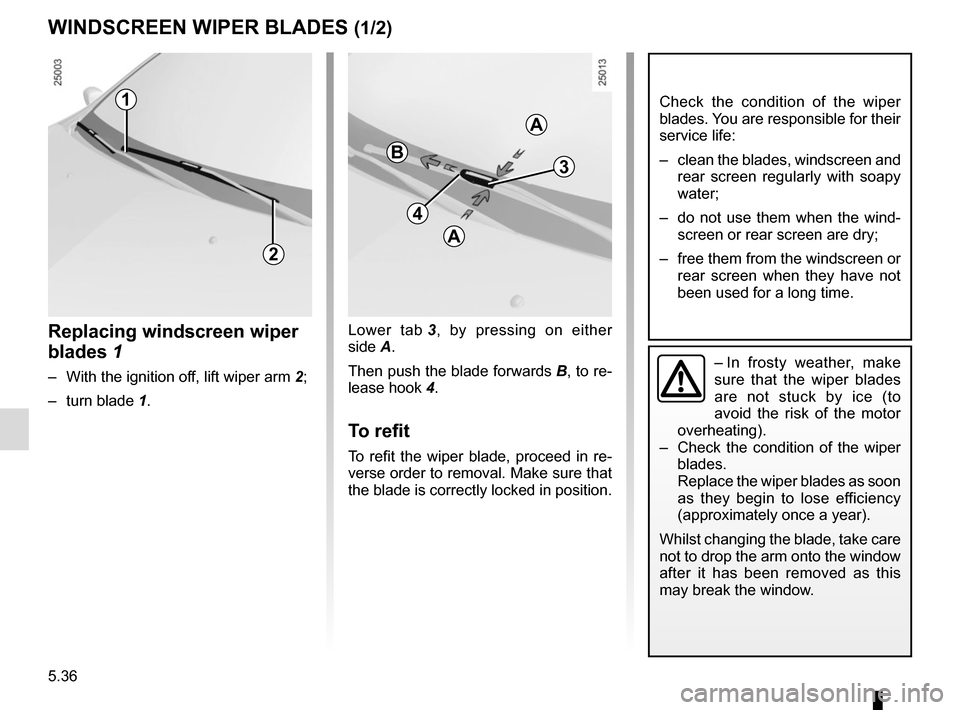
5.36
Lower tab 3, by pressing on either
side A.
Then push the blade forwards B, to re-
lease hook 4.
To refit
To refit the wiper blade, proceed in re-
verse order to removal. Make sure that
the blade is correctly locked in position.
Replacing windscreen wiper
blades 1
– With the ignition off, lift wiper arm 2;
– turn blade 1.
WINDSCREEN WIPER BLADES (1/2)
2
1
4
3B
A
A
– In frosty weather, make
sure that the wiper blades
are not stuck by ice (to
avoid the risk of the motor
overheating).
– Check the condition of the wiper
blades.
Replace the wiper blades as soon
as they begin to lose efficiency
(approximately once a year).
Whilst changing the blade, take care
not to drop the arm onto the window
after it has been removed as this
may break the window.
Check the condition of the wiper
blades. You are responsible for their
service life:
– clean the blades, windscreen and rear screen regularly with soapy
water;
– do not use them when the wind- screen or rear screen are dry;
– free them from the windscreen or rear screen when they have not
been used for a long time.
Page 215 of 252

5.37
To refit
To refit the wiper blade, proceed in re-
verse order to removal. Make sure that
the blade is correctly locked in position.
Rear screen wiper blade 5
– With the ignition off, lift wiper arm 6;
– release the blade 5 by pulling it.
WINDSCREEN WIPER BLADES (2/2)
5
6
– In frosty weather, make
sure that the wiper blades
are not stuck by ice (to
avoid the risk of the motor
overheating).
– Check the condition of the wiper
blades.
Replace the wiper blades as soon
as they begin to lose efficiency
(approximately once a year).
Whilst changing the blade, take care
not to drop the arm onto the window
after it has been removed as this
may break the window.
Check the condition of the wiper
blades. You are responsible for their
service life:
– clean the blades, windscreen and rear screen regularly with soapy
water;
– do not use them when the wind- screen or rear screen are dry;
– free them from the windscreen or rear screen when they have not
been used for a long time.
Page 216 of 252

5.38
TOWING: breakdown recovery (1/2)
Before towing, unlock the steering
column: with the clutch depressed,
engage first gear (lever in position N
or R for vehicles with automatic gear-
boxes), insert the RENAULT card in the
card reader, then press the engine start
button for two seconds.
Reposition the lever to neutral (posi-
tion N for vehicles fitted with an auto-
matic gearbox).
The column is unlocked, the acces-
sory functions are supplied: the vehi-
cle lights can be used (indicators, brake
lights etc.). At night the vehicle must
have its lights on.
Once you have finished towing, press
the engine start button twice (risk of
running down the battery). The speed specified by current legis-
lation for towing must always be ob-
served. If your vehicle is the towing
vehicle, do not exceed the maximum
towing weight for your vehicle (refer
to the information on “Weights” in
Section 6).
Towing a vehicle with an
automatic gearbox
With the engine switched off, the trans-
mission is no longer lubricated. It is
preferable to tow this type of vehicle on
a trailer or tow it with the front wheels
off the ground.
Under
exceptional circumstances, you
may tow the vehicle with all four wheels
on the ground, only going forward, with
the gear lever in the neutral N position,
and for a distance not exceeding
30 miles (50 km).
Do not remove the
RENAULT card from the
reader when the vehicle is
being towed.
If the lever is stuck in P ,
even though you are de-
pressing the brake pedal,
the lever can be released
manually. To do this, release the
base of the lever, then use a tool
(rigid rod) in the slot 1 and simulta-
neously press button 2 to unlock the
lever.
Contact an authorised dealer as
soon as possible.
1
2
Page 217 of 252

5.39
TOWING: breakdown recovery (2/2)
Only use the front 2 and rear 5 towing
points
(never use the drive shafts or any other
part of the vehicle).
These towing points may only be used
for towing: never use them for lifting the
vehicle directly or indirectly.Access to towing points
Unclip cover 4 or 6 by sliding a flat tool
(or the key integrated in the RENAULT
card) under the cover.
Tighten towing hitch 3 fully: as much
as possible by hand at first, then finish
tightening it using the wheelbrace or,
depending on the vehicle, the lever.
Only use the towing eye 3 and the
wheelbrace located under the lug-
gage compartment carpet in the tool kit
(please refer to the information under
“Tools” in Section 5).
When the engine is
stopped, steering and brak-
ing assistance are not op-
erational.Do not leave the tools unse-
cured inside the vehicle as
they may come loose under
braking.
5
6
3
– Use a rigid towing bar.
If a rope or cable is used
(where the law allows this),
the vehicle being towed
must be able to brake.
– A vehicle must not be towed if it is not fit to be driven.
– Avoid accelerating or braking suddenly when towing, as this
may result in damage being
caused to the vehicle.
– When towing a vehicle, it is ad- visable not to exceed 30 mph
(50 km/h).
– Do not push the vehicle if the steering column is locked.
4
3
2
Page 248 of 252

7.4
ALPHABETICAL INDEX (4/5)
P
paintworkmaintenance ..................................................... 4.13 – 4.14
parking distance control.......................................... 2.34 – 2.35
power-assisted steering.................................................\
.... 1.49
pretensioners .........................................................1\
.22 → 1.25
puncture.......................................... 5.2 → 5.5, 5.9, 5.11 – 5.12
R
radio...................................................................\
................ 3.32
rear bench seat.........................................................\
......... 3.22
rear parcel shelf ................................................................. 3.24
rear seats..............................................................\
............. 1.20 functions ..............................................................\
........ 3.22
rear view mirrors ................................................................ 1.72
RENAULT ANTI-INTRUDER DEVICE (RAID) ................... 1.13
RENAULT card battery ................................................................\
.......... 5.26
use ..................................................... 1.2 → 1.8, 2.3 → 2.5
RENAULT card battery ...................................................... 5.26
replacement parts ................................................................ 6.8
reverse gear selecting ..............................................................\
......... 2.12
reversing sensor ..................................................... 2.34 – 2.35
roof bars ........................................................................\
.... 3.31
roof rack roof bars ....................................................................... 3.31
running in ........................................................................\
..... 2.2
S
seat belt pretensioners front seat belt ...................................................1.22 → 1.25
seat belts ......................................................1.18 → 1.25, 1.28
service sheets..........................................................\
6.9 → 6.14
side protection devices ...................................................... 1.27
signals and lights ...................................................1.73 → 1.77speakers
location ...............................................................\
......... 5.34
special features of diesel versions.....................................\
2.11
special features of petrol vehicles ..................................... 2.10
speed limiter .................................................1.57, 2.27 → 2.29
starting the engine .....................................................2.3 → 2.9
steering wheel adjustment .............................................................\
...... 1.49
Stop & Start ......................................................1.57, 2.6 → 2.9
Stop & Start function..................................................2.6 → 2.9
stopping the engine ...................................................2.3 → 2.5
storage compartment.............................................3.16 → 3.19
storage compartments ...........................................3.16 → 3.19
sun visor ........................................................................\
.... 3.14
switching on the vehicle ignition ................................2.3 → 2.5
T
tailgate ........................................................... 3.23, 3.26 – 3.27
tanks and reservoirs brake fluid ...................................................................... 4.8
coolant ................................................................\
........... 4.7
tanks and reservoirs: windscreen washer ........................................................ 4.9
technical specifications ..............................................6.4 → 6.8
telephone ..............................................................\
............. 3.32
temperature regulation ............................................ 3.7 → 3.11
tool kit ........................................................................\
.......... 5.9
towing breakdown ........................................................ 5.38 – 5.39
towing equipment ......................................................... 3.28
towing a caravan ........................................................ 3.28, 6.7
towing equipment fitting ................................................................\
............ 3.28
towing hitch...................................................... 5.9, 5.38 – 5.39
towing rings ............................................................ 3.26 – 3.27
towing weights ..................................................................... 6.7