Page 60 of 130
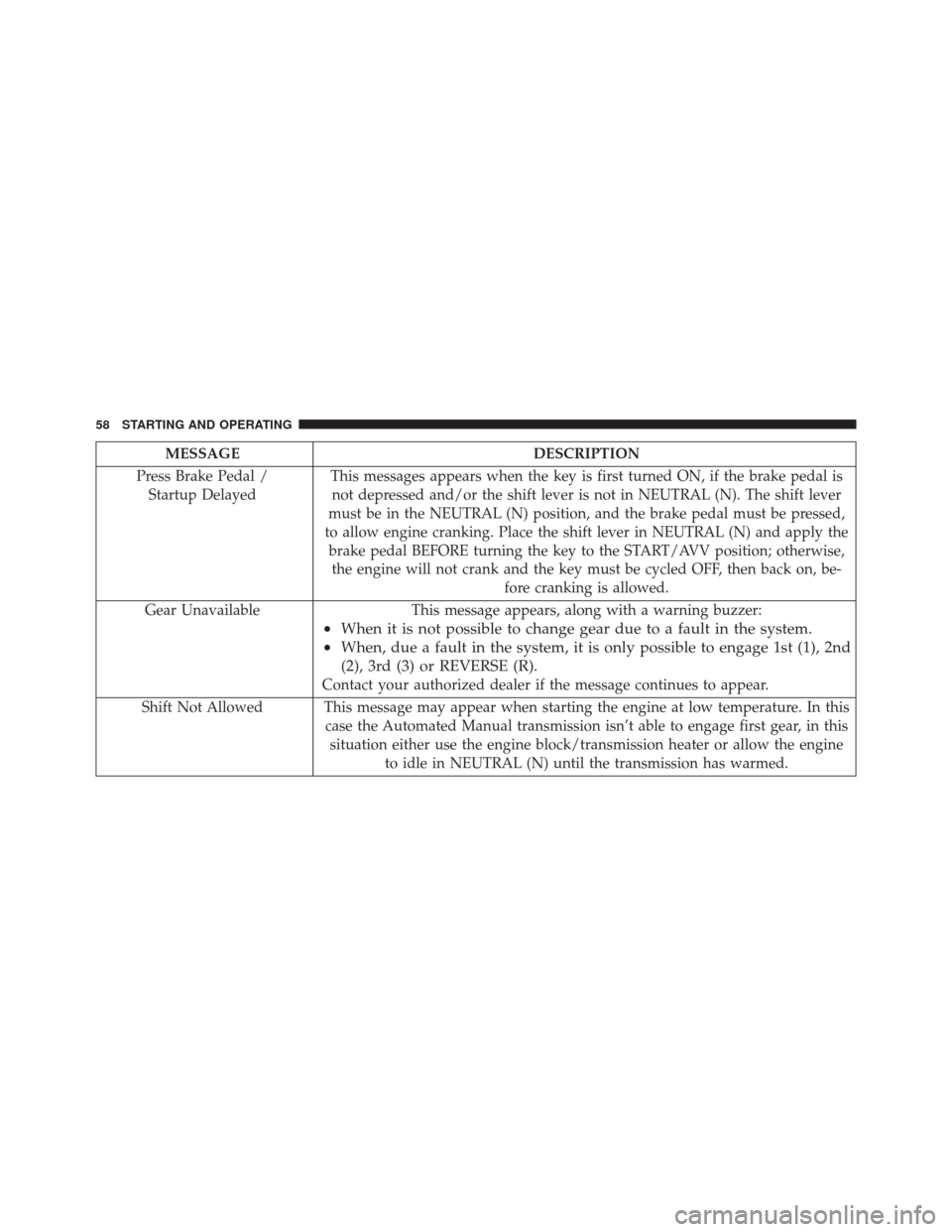
MESSAGEDESCRIPTION
Press Brake Pedal / Startup Delayed This messages appears when the key is first turned ON, if the brake pedal is
not depressed and/or the shift lever is not in NEUTRAL (N). The shift lever
must be in the NEUTRAL (N) position, and the brake pedal must be pressed,
to allow engine cranking. Place the shift lever in NEUTRAL (N) and apply the brake pedal BEFORE turning the key to the START/AVV position; otherwise,the engine will not crank and the key must be cycled OFF, then back on, be- fore cranking is allowed.
Gear Unavailable This message appears, along with a warning buzzer:
•When it is not possible to change gear due to a fault in the system.
• When, due a fault in the system, it is only possible to engage 1st (1), 2nd
(2), 3rd (3) or REVERSE (R).
Contact your authorized dealer if the message continues to appear.
Shift Not Allowed This message may appear when starting the engine at low temperature. In this case the Automated Manual transmission isn’t able to engage first gear, in thissituation either use the engine block/transmission heater or allow the engine to idle in NEUTRAL (N) until the transmission has warmed.
58 STARTING AND OPERATING
Page 61 of 130

MESSAGEDESCRIPTION
Press Brake And Try Again This message appears accompanied, in some cases, by a warning buzzer, if you attempt to change gear with the vehicle parked without pressing thebrake pedal.
To shift the transmission (with key on/engine off), press and hold the brake
pedal, move the shift lever to NEUTRAL (N), then move the shift lever to the desired position.
Shift To Neutral This message appears, together with a warning buzzer, when the shift lever
must be moved to the NEUTRAL (N) position.
When the shift lever is moved to NEUTRAL (N) the message on the display should go off.
Contact your authorized dealer if the message continues to appear.
Press Brake Pedal This message is shown in the display together with an acoustic signal, when the brake pedal is not pressed during a starting attempt.
Press Brake Shift to N key to start This message appears, after the door opening, to remind to Press the Brake
pedal and shift the lever in N to permit the cranking.
5
STARTING AND OPERATING 59
Page 63 of 130

For most year-round service, No. 2 diesel fuel meeting
ASTM (formerly known as the American Society for
Testing and Materials) specification D-975 Grade S15 will
provide good performance.
If the vehicle is exposed to extreme cold (below 20°F or
-7°C), or is required to operate at colder-than-normal
conditions for prolonged periods, use climatized No. 2
diesel fuel or dilute the No. 2 diesel fuel with 50% No. 1
diesel fuel. This will provide better protection from fuel
gelling or wax-plugging of the fuel filter.
WARNING!
Do not use alcohol or gasoline as a fuel blending
agent. They can be unstable under certain conditions
and hazardous or explosive when mixed with diesel
fuel.Diesel fuel is seldom completely free of water. If water is
detected in the water separator while the engine is
running or while the ignition switch is in the ON/RUN
position, the “Generic Warning Light” will illuminate
and the specific message, “Service Fuel Filter” will ap-
pear in the Electronic Vehicle Information Center (EVIC).
If this occurs you should stop the engine and drain the
water from the filter housing.
NOTE:
Please see your authorized dealer for draining the
fuel/water separator and fuel filter replacement.
Purchasing good quality fuel and by following the cold
weather advice above, fuel conditioners should not be
required in your vehicle.
NOTE: If available in your area, a high cetane “pre-
mium” diesel fuel may offer improved cold-starting and
warm-up performance.
5
STARTING AND OPERATING 61
Page 64 of 130
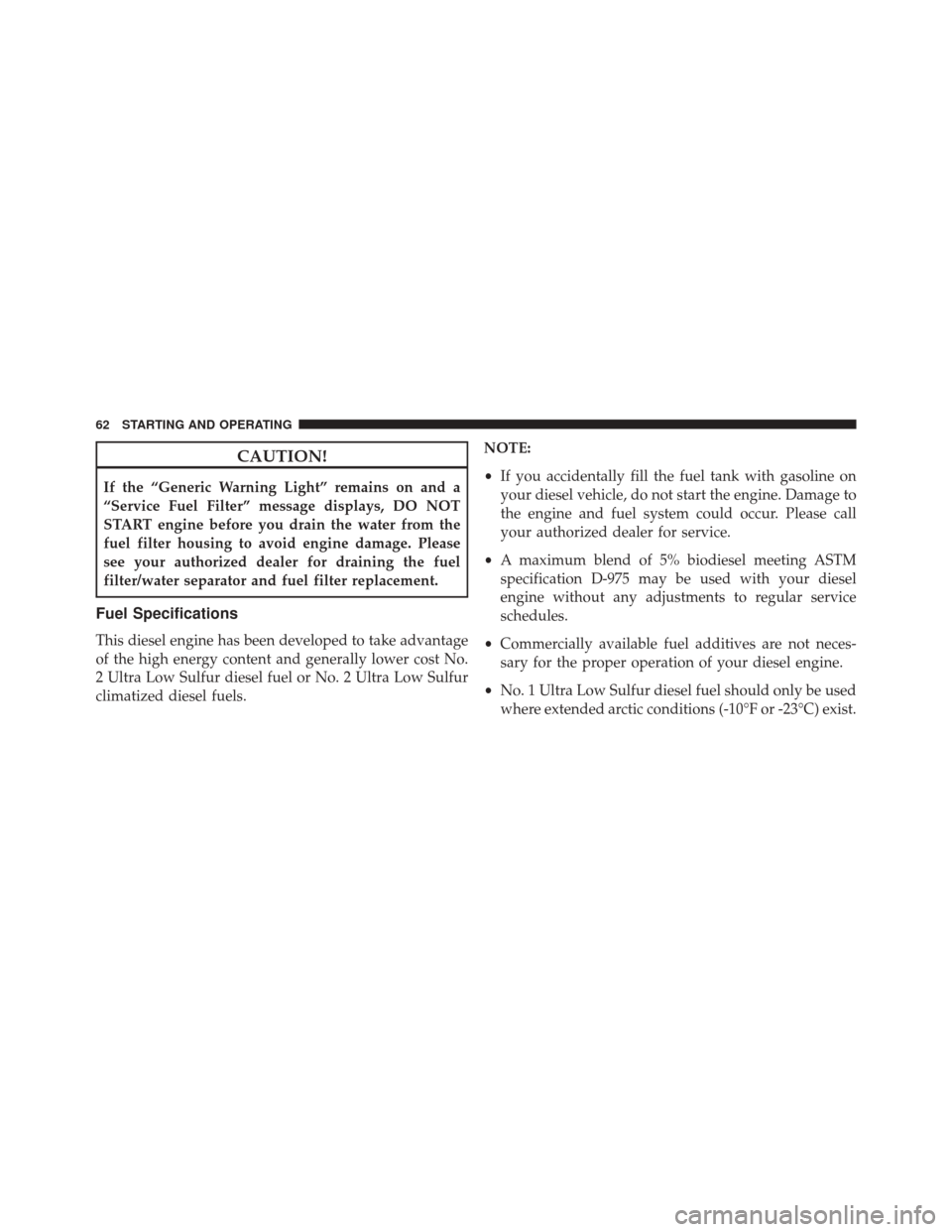
CAUTION!
If the “Generic Warning Light” remains on and a
“Service Fuel Filter” message displays, DO NOT
START engine before you drain the water from the
fuel filter housing to avoid engine damage. Please
see your authorized dealer for draining the fuel
filter/water separator and fuel filter replacement.
Fuel Specifications
This diesel engine has been developed to take advantage
of the high energy content and generally lower cost No.
2 Ultra Low Sulfur diesel fuel or No. 2 Ultra Low Sulfur
climatized diesel fuels.NOTE:
•
If you accidentally fill the fuel tank with gasoline on
your diesel vehicle, do not start the engine. Damage to
the engine and fuel system could occur. Please call
your authorized dealer for service.
• A maximum blend of 5% biodiesel meeting ASTM
specification D-975 may be used with your diesel
engine without any adjustments to regular service
schedules.
• Commercially available fuel additives are not neces-
sary for the proper operation of your diesel engine.
• No. 1 Ultra Low Sulfur diesel fuel should only be used
where extended arctic conditions (-10°F or -23°C) exist.
62 STARTING AND OPERATING
Page 69 of 130
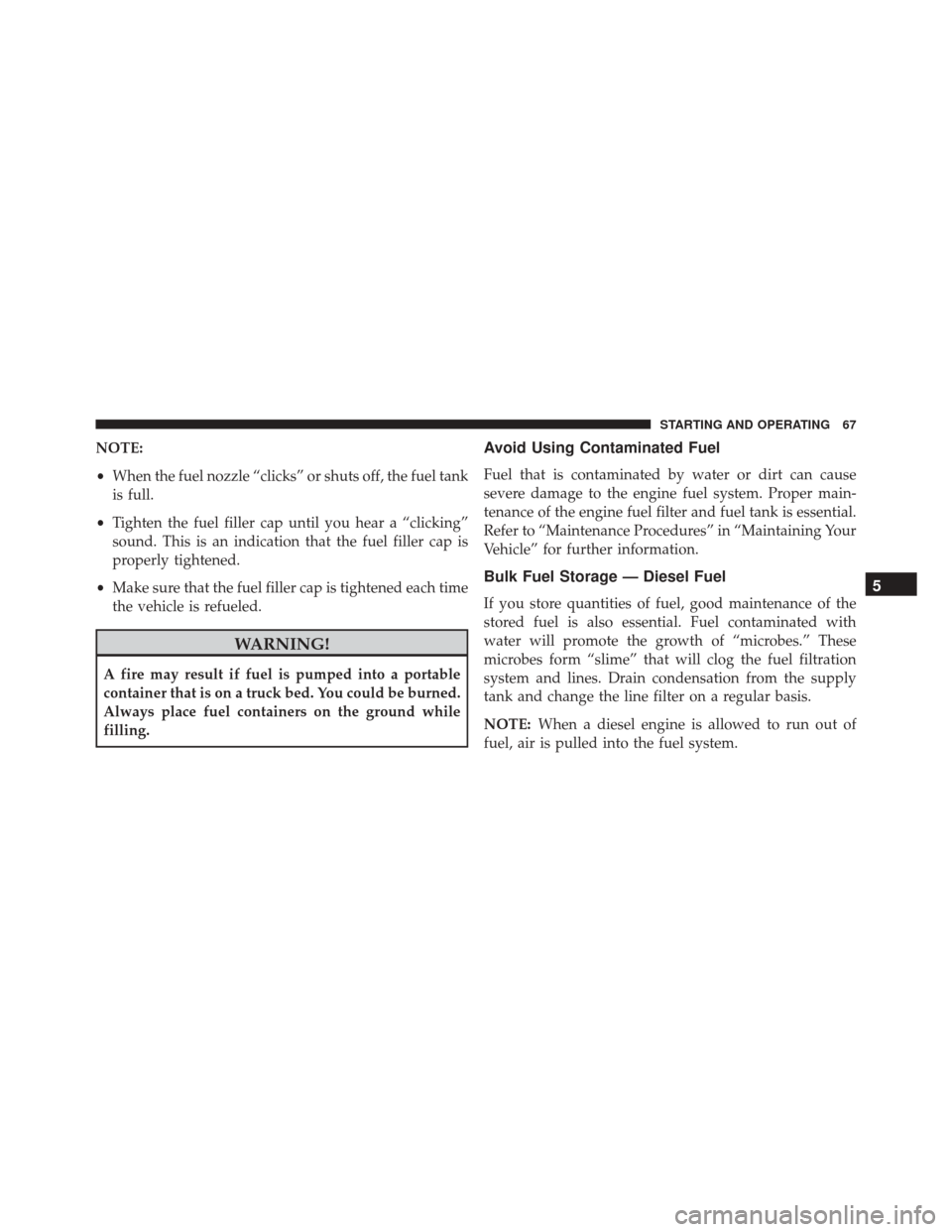
NOTE:
•When the fuel nozzle “clicks” or shuts off, the fuel tank
is full.
• Tighten the fuel filler cap until you hear a “clicking”
sound. This is an indication that the fuel filler cap is
properly tightened.
• Make sure that the fuel filler cap is tightened each time
the vehicle is refueled.
WARNING!
A fire may result if fuel is pumped into a portable
container that is on a truck bed. You could be burned.
Always place fuel containers on the ground while
filling.
Avoid Using Contaminated Fuel
Fuel that is contaminated by water or dirt can cause
severe damage to the engine fuel system. Proper main-
tenance of the engine fuel filter and fuel tank is essential.
Refer to “Maintenance Procedures” in “Maintaining Your
Vehicle” for further information.
Bulk Fuel Storage — Diesel Fuel
If you store quantities of fuel, good maintenance of the
stored fuel is also essential. Fuel contaminated with
water will promote the growth of “microbes.” These
microbes form “slime” that will clog the fuel filtration
system and lines. Drain condensation from the supply
tank and change the line filter on a regular basis.
NOTE: When a diesel engine is allowed to run out of
fuel, air is pulled into the fuel system.
5
STARTING AND OPERATING 67
Page 70 of 130
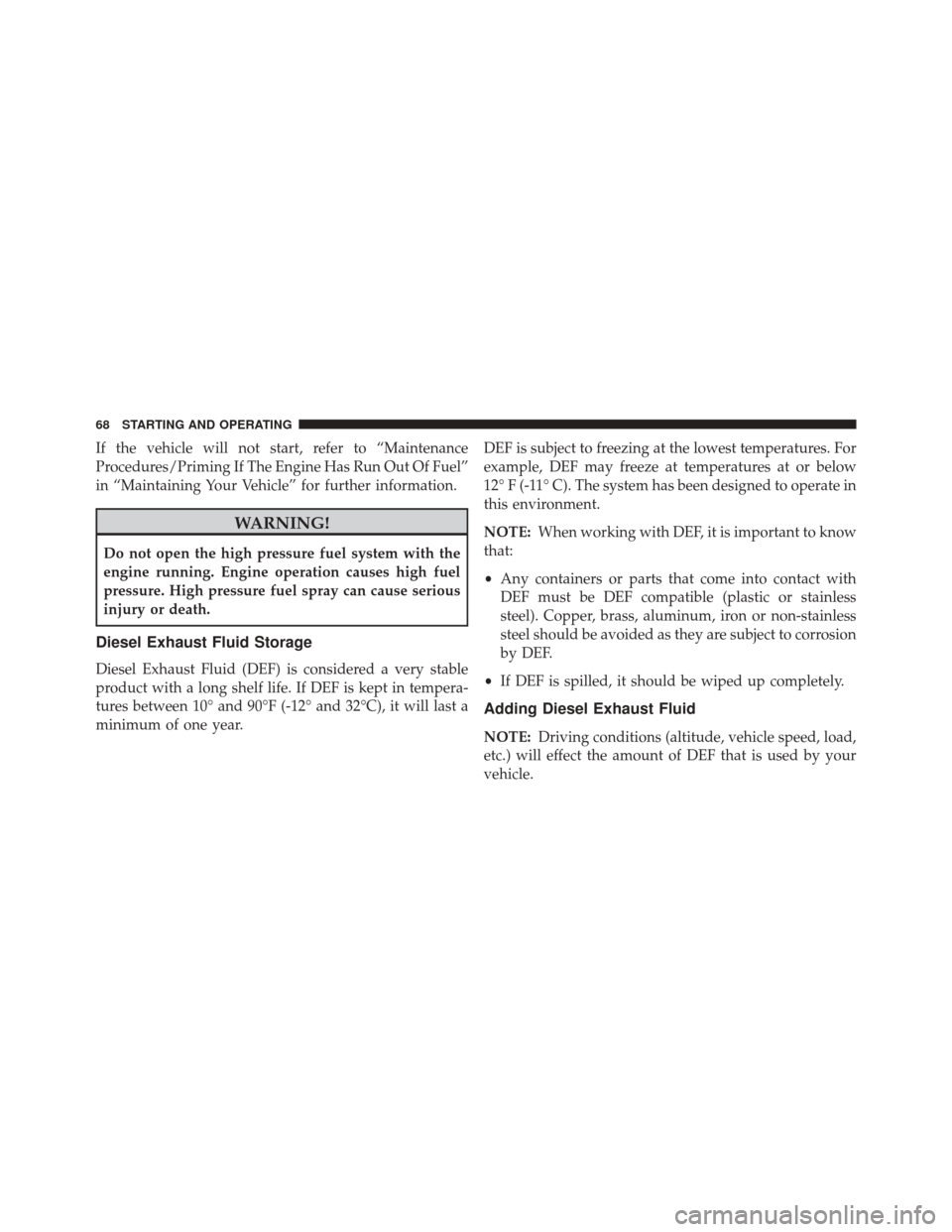
If the vehicle will not start, refer to “Maintenance
Procedures/Priming If The Engine Has Run Out Of Fuel”
in “Maintaining Your Vehicle” for further information.
WARNING!
Do not open the high pressure fuel system with the
engine running. Engine operation causes high fuel
pressure. High pressure fuel spray can cause serious
injury or death.
Diesel Exhaust Fluid Storage
Diesel Exhaust Fluid (DEF) is considered a very stable
product with a long shelf life. If DEF is kept in tempera-
tures between 10° and 90°F (-12° and 32°C), it will last a
minimum of one year.DEF is subject to freezing at the lowest temperatures. For
example, DEF may freeze at temperatures at or below
12° F (-11° C). The system has been designed to operate in
this environment.
NOTE:
When working with DEF, it is important to know
that:
• Any containers or parts that come into contact with
DEF must be DEF compatible (plastic or stainless
steel). Copper, brass, aluminum, iron or non-stainless
steel should be avoided as they are subject to corrosion
by DEF.
• If DEF is spilled, it should be wiped up completely.
Adding Diesel Exhaust Fluid
NOTE: Driving conditions (altitude, vehicle speed, load,
etc.) will effect the amount of DEF that is used by your
vehicle.
68 STARTING AND OPERATING
Page 74 of 130
The DEF injection system and SCR catalyst enable the
achievement of diesel emissions requirements; while
maintaining outstanding fuel economy, drivability,
torque and power ratings.
Refer to “Electronic Vehicle Information Center (EVIC)”
in “Understanding Your Instrument Panel” for system
messages and warnings.
NOTE:
•Your vehicle is equipped with a DEF injection system.
You may occasionally hear an audible clicking noise
from under the vehicle at a stop. This is normal
operation.
• The DEF pump will run for a period of time after
engine shutdown to purge the DEF system. This is
normal operation and may be audible from under the
vehicle.TRAILER TOWING
In this section you will find safety tips and information
on limits to the type of towing you can reasonably do
with your vehicle. Before towing a trailer, carefully
review this information to tow your load as efficiently
and safely as possible.
To maintain the New Vehicle Limited Warranty coverage,
follow the requirements and recommendations in this
manual concerning vehicles used for trailer towing.
Common Towing Definitions
The following trailer towing related definitions will assist
you in understanding the following information:
Gross Vehicle Weight Rating (GVWR)
The GVWR is the total allowable weight of your vehicle.
This includes driver, passengers, cargo and tongue
weight. The total load must be limited so that you do not
72 STARTING AND OPERATING
Page 75 of 130
exceed the GVWR. Refer to “Vehicle Loading/Vehicle
Certification Label” in “Starting And Operating” for
further information.
Gross Trailer Weight (GTW)
The GTW is the weight of the trailer plus the weight of all
cargo, consumables and equipment (permanent or tem-
porary) loaded in or on the trailer in its�loaded and
ready for operation� condition.
The recommended way to measure GTW is to put your
fully loaded trailer on a vehicle scale. The entire weight
of the trailer must be supported by the scale.
Gross Axle Weight Rating (GAWR)
The GAWR is the maximum capacity of the front and rear
axles. Distribute the load over the front and rear axles
evenly. Make sure that you do not exceed either front or rear GAWR. Refer to “Vehicle Loading/Vehicle Certifica-
tion Label” in “Starting And Operating” for further
information.
WARNING!
It is important that you do not exceed the maximum
front or rear GAWR. A dangerous driving condition
can result if either rating is exceeded. You could lose
control of the vehicle and have a collision.
Tongue Weight (TW)
The tongue weight is the downward force exerted on the
hitch ball by the trailer. The recommended tongue weight
is 10% to 15% of the vehicle’s GTW for a conventional
hitch. You must consider this as part of the load on your
vehicle.
5
STARTING AND OPERATING 73