Page 276 of 292
18
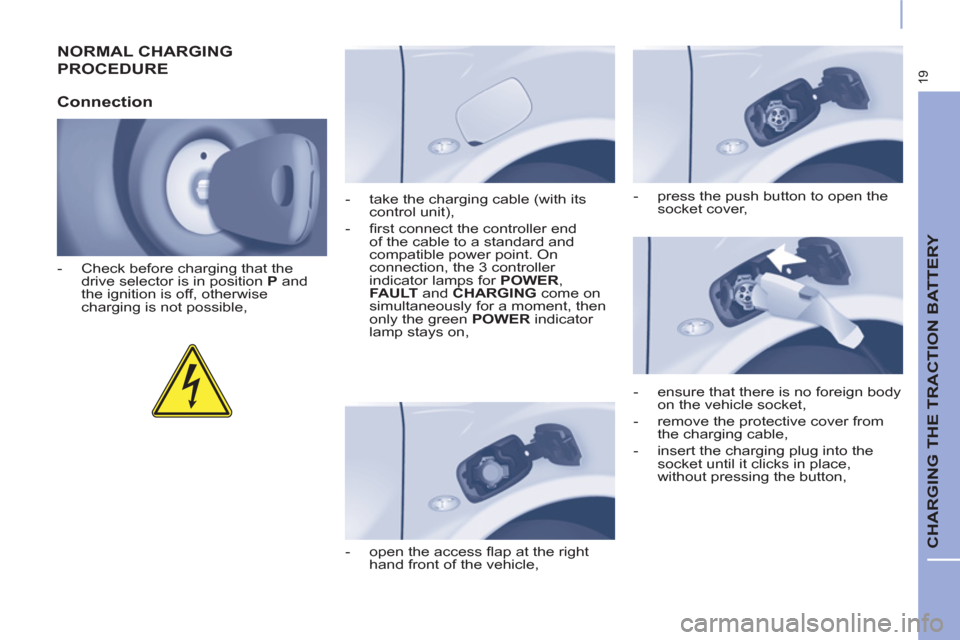
States of the control unit
POWER
FAULT
CHARGING
Normal operation
Once the charging cable is connected to a power point, all of the lamps come
on for about half a second.
Once the initialisation process is complete:
●
while the charging cable is not connected to the vehicle's socket,
●
while the charging cable is connected to the vehicle's socket, but charging
is not taking place.
While the traction battery is on charge.
When the charge has fi nished.
POWER
FAULT
CHARGING
Operating faults and solutions
When current leakage is detected or the charging cable has a fault.
- Stop the charging procedure immediately and contact a franchised dealer
or a qualifi ed workshop.
When the charging cable has a fault.
- Stop the charging procedure immediately and contact a franchised dealer
or a qualifi ed workshop.
If the lamp on the control unit does not come on when connecting the
charging cable to a power point, check the circuit breaker for the power point:
●
if the circuit breaker has opened, your installation may not be compatible
with use of the charging cable:
- contact a qualifi ed electrician to check and repair your electrical
installation.
●
if the circuit breaker has not opened:
- do not use the charging cable and contact a franchised dealer or a
qualifi ed workshop.
On in the corresponding
indicator lamp colour. Flashing in the corresponding
indicator lamp colour. Off.
Page 277 of 292
19
CHARGING THE TRACTION BATTERY
NORMAL CHARGING
PROCEDURE
Connection
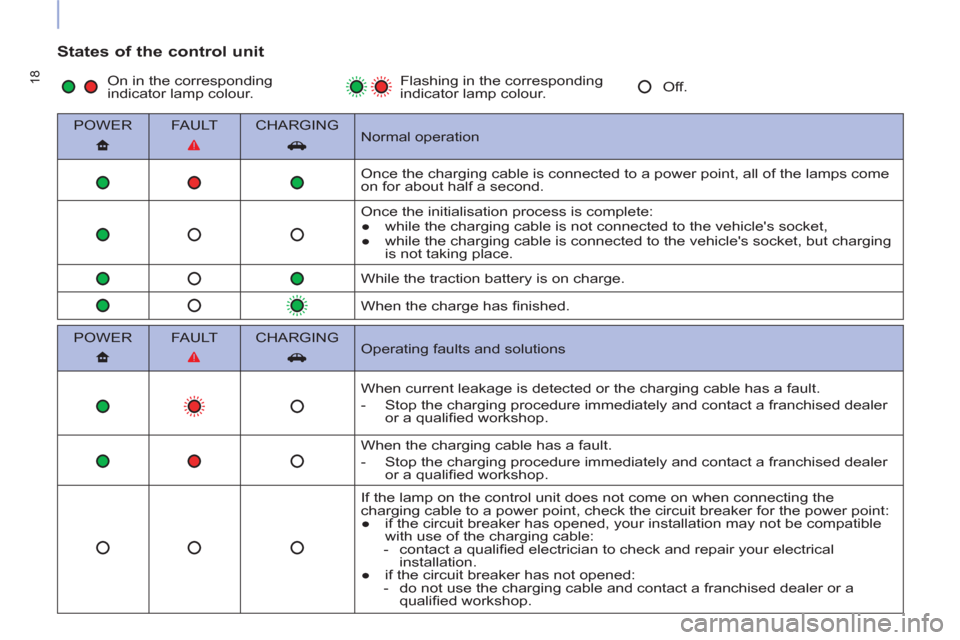
- Check before charging that the
drive selector is in position P
and
the ignition is off, otherwise
charging is not possible,
- open the access fl ap at the right
hand front of the vehicle,
- take the charging cable (with its
control unit),
- fi rst connect the controller end
of the cable to a standard and
compatible power point. On
connection, the 3 controller
indicator lamps for POWER
,
FAULT
and CHARGING
come on
simultaneously for a moment, then
only the green POWER
indicator
lamp stays on,
- ensure that there is no foreign body
on the vehicle socket,
- remove the protective cover from
the charging cable,
- insert the charging plug into the
socket until it clicks in place,
without pressing the button,
- press the push button to open the
socket cover,
Page 278 of 292
20
If this is not the case, charging ha snot
started; repeat the procedure ensuring
that all connections are correct.
If the ambient temperature is lower
than -25° C, charging may not be
possible.
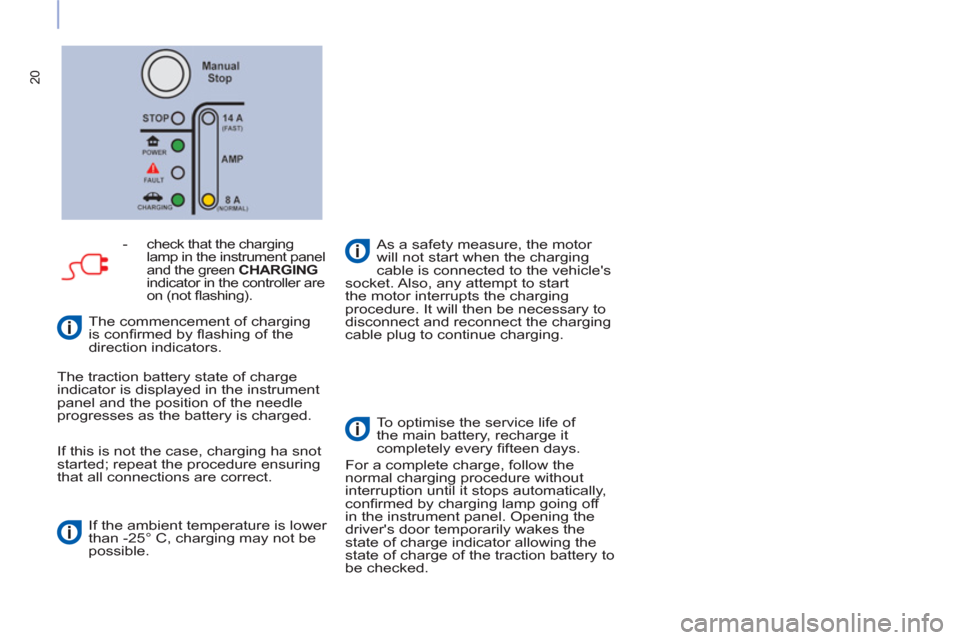
-
check that the charging
lamp in the instrument panel
and the green CHARGING
indicator in the controller are
on (not fl ashing).
The traction battery state of charge
indicator is displayed in the instrument
panel and the position of the needle
progresses as the battery is charged.
As a safety measure, the motor
will not start when the charging
cable is connected to the vehicle's
socket. Also, any attempt to start
the motor interrupts the charging
procedure. It will then be necessary to
disconnect and reconnect the charging
cable plug to continue charging.
To optimise the service life of
the main battery, recharge it
completely every fi fteen days.
For a complete charge, follow the
normal charging procedure without
interruption until it stops automatically,
confi rmed by charging lamp going off
in the instrument panel. Opening the
driver's door temporarily wakes the
state of charge indicator allowing the
state of charge of the traction battery to
be checked.
The commencement of charging
is confi rmed by fl ashing of the
direction indicators.
Page 279 of 292
21
CHARGING THE TRACTION BATTERY
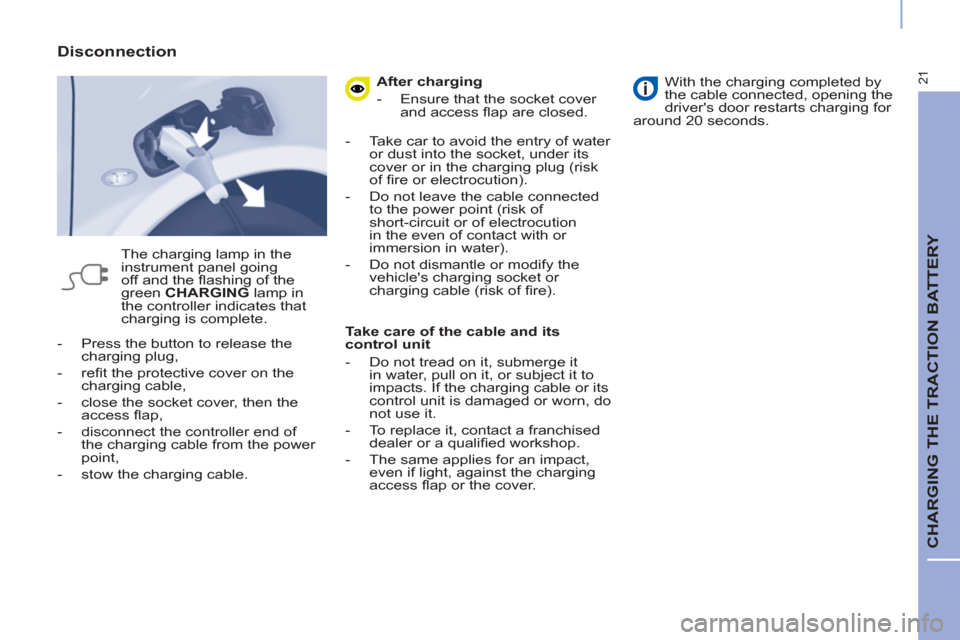
- Press the button to release the
charging plug,
- refi t the protective cover on the
charging cable,
- close the socket cover, then the
access fl ap,
- disconnect the controller end of
the charging cable from the power
point,
- stow the charging cable.
Disconnection
The charging lamp in the
instrument panel going
off and the fl ashing of the
green CHARGING
lamp in
the controller indicates that
charging is complete.
After charging
- Ensure that the socket cover
and access fl ap are closed.
- Take car to avoid the entry of water
or dust into the socket, under its
cover or in the charging plug (risk
of fi re or electrocution).
- Do not leave the cable connected
to the power point (risk of
short-circuit or of electrocution
in the even of contact with or
immersion in water).
- Do not dismantle or modify the
vehicle's charging socket or
charging cable (risk of fi re).
Take care of the cable and its
control unit
- Do not tread on it, submerge it
in water, pull on it, or subject it to
impacts. If the charging cable or its
control unit is damaged or worn, do
not use it.
- To replace it, contact a franchised
dealer or a qualifi ed workshop.
- The same applies for an impact,
even if light, against the charging
access fl ap or the cover.
With the charging completed by
the cable connected, opening the
driver's door restarts charging for
around 20 seconds.
Page 287 of 292
29
SUPPLEMENT FOR ELECTRIC MODE
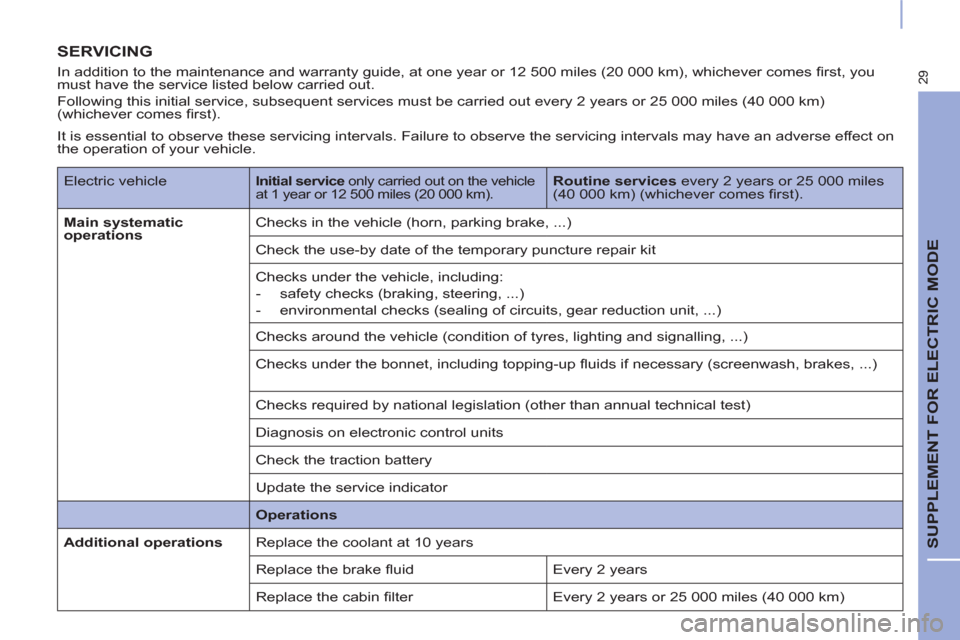
SERVICING
In addition to the maintenance and warranty guide, at one year or 12 500 miles (20 000 km), whichever comes fi rst, you
must have the service listed below carried out.
Following this initial service, subsequent services must be carried out every 2 years or 25 000 miles (40 000 km)
(whichever comes fi rst).
Electric vehicle
Initial service
only carried out on the vehicle
at 1 year or 12 500 miles (20 000 km).
Routine services
every 2 years or 25 000 miles
(40 000 km) (whichever comes fi rst).
Main systematic
operations
Checks in the vehicle (horn, parking brake, ...)
Check the use-by date of the temporary puncture repair kit
Checks under the vehicle, including:
- safety checks (braking, steering, ...)
- environmental checks (sealing of circuits, gear reduction unit, ...)
Checks around the vehicle (condition of tyres, lighting and signalling, ...)
Checks under the bonnet, including topping-up fl uids if necessary (screenwash, brakes, ...)
Checks required by national legislation (other than annual technical test)
Diagnosis on electronic control units
Check the traction battery
Update the service indicator
Operations
Additional operations
Replace the coolant at 10 years
Replace the brake fl uid Every 2 years
Replace the cabin fi lter Every 2 years or 25 000 miles (40 000 km)
It is essential to observe these servicing intervals. Failure to observe the servicing intervals may have an adverse effect on
the operation of your vehicle.