Page 187 of 364

185
Visual and audible front and rear parking sensors
System consisting of four proximity sensors,
installed in the front and/or rear bumper.
It detects any obstacle (person, vehicle, tree,
barrier...) located behind the vehicle, however,
it will not be able to detect obstacles located
immediately below the bumper.The parking sensors are switched on
:
- b y engaging reverse gear,
-
a
t a speed below 6 mph (10 km/h) in
forward gear.
This is accompanied by an audible signal
and display of the vehicle in the multifunction
screen. The proximity information is indicated by:
-
a n audible signal which becomes more
rapid as the vehicle approaches the
obstacle,
-
a
n image in the multifunction screen, with
blocks which move closer to the vehicle.
The obstacle is located in relation to the
emission of the audible signal by the speakers;
front or rear and right or left.
When the distance between the vehicle and
the obstacle is less than approximately thirty
centimetres, the audible signal becomes
continuous and/or the "Danger" symbol
appears, depending on the version of
multifunction screen.
An object, such as a stake, a roadworks
cone or any other similar object may be
detected at the start of the manoeuvre
but may no longer be detected when the
vehicle moves nearer to it.
8
Driving
Page 252 of 364
250
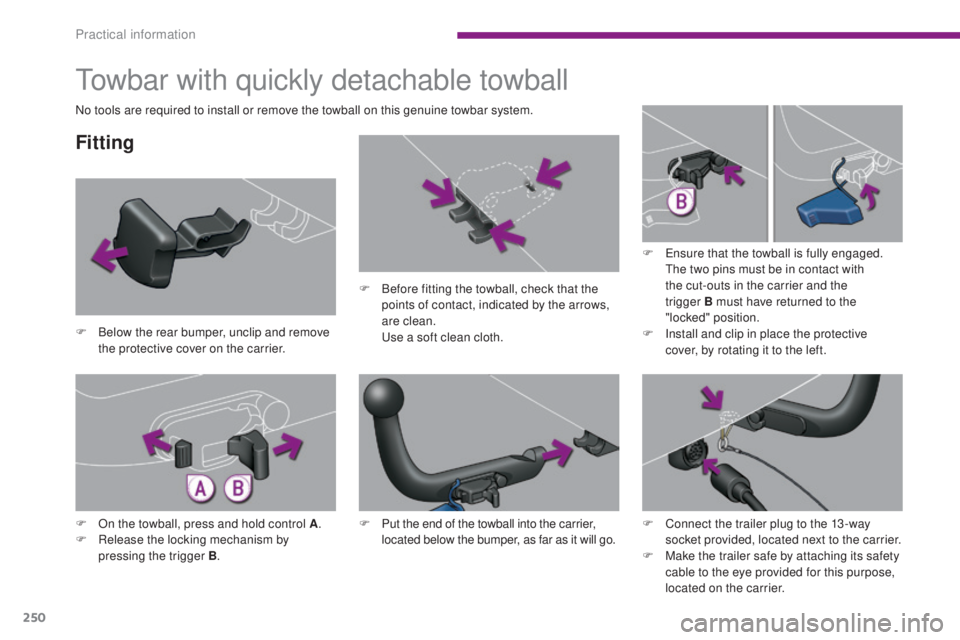
Towbar with quickly detachable towball
Fitting
F Below the rear bumper, unclip and remove the protective cover on the carrier. F
B
efore fitting the towball, check that the
points of contact, indicated by the arrows,
are clean. U se a soft clean cloth.F
E
nsure that the towball is fully engaged.
The two pins must be in contact with
the cut-outs in the carrier and the
trigger
B must have returned to the
"locked" position.
F I nstall and clip in place the protective
cover, by rotating it to the left.
F
O
n the towball, press and hold control A .
F
R
elease the locking mechanism by
pressing the trigger B . F
P
ut the end of the towball into the carrier,
located below the bumper, as far as it will go.
No tools are required to install or remove the towball on this genuine towbar system.
F
C
onnect the trailer plug to the 13 -way
socket provided, located next to the carrier.
F
M
ake the trailer safe by attaching its safety
cable to the eye provided for this purpose,
located on the carrier.
Practical information
Page 253 of 364
251
When the towball is installed, it may
inter fere with the complete opening of
the lower tailgate.
Take care to avoid the tailgate coming
into contact with the towball.
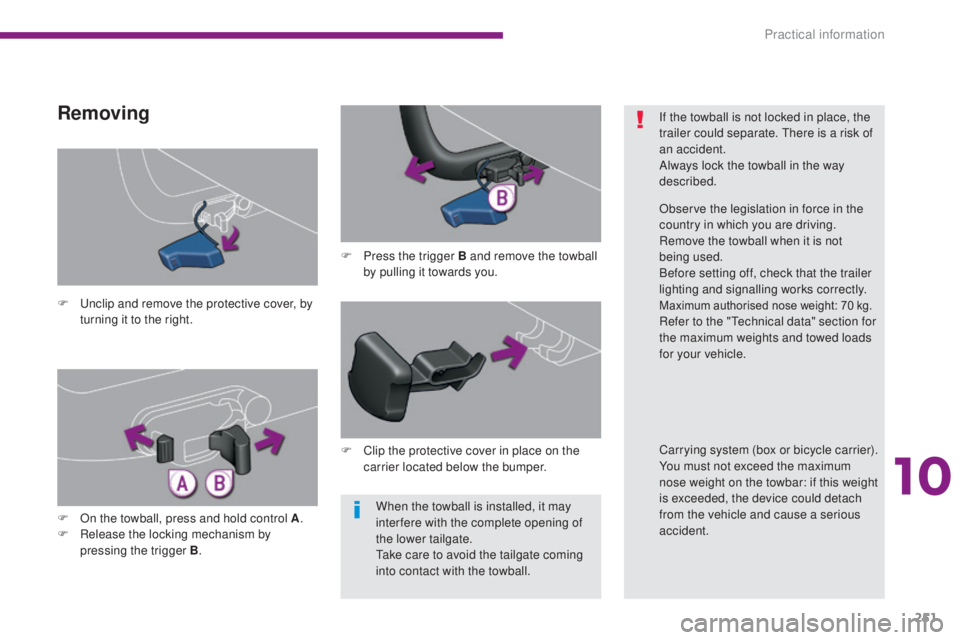
F
U
nclip and remove the protective cover, by
turning it to the right.
Removing
F Press the trigger B and remove the towball by pulling it towards you.
F
O
n the towball, press and hold control A .
F
R
elease the locking mechanism by
pressing the trigger B . F
C
lip the protective cover in place on the
carrier located below the bumper. If the towball is not locked in place, the
trailer could separate. There is a risk of
an accident.
Always lock the towball in the way
described.
Observe the legislation in force in the
country in which you are driving.
Remove the towball when it is not
being used.
Before setting off, check that the trailer
lighting and signalling works correctly.
Maximum authorised nose weight: 70 kg.Refer to the "Technical data" section for
the maximum weights and towed loads
for your vehicle.
Carrying system (box or bicycle carrier).
You must not exceed the maximum
nose weight on the towbar: if this weight
is exceeded, the device could detach
from the vehicle and cause a serious
accident.
10
Practical information