Page 125 of 348
In this case, the light will remain on until the condition
has been corrected. If the problem is related to the brake
booster, the ABS pump will run when applying the brake
and a brake pedal pulsation may be felt during each stop.
The dual brake system provides a reserve braking capac-
ity in the event of a failure to a portion of the hydraulic
system. A leak in either half of the dual brake system is
indicated by the Brake Warning Light, which will turn on
when the brake fluid level in the reservoir has dropped
below a specified level.
The light will remain on until the cause is corrected.
NOTE:The light may flash momentarily during sharp
cornering maneuvers, which change fluid level condi-
tions. The vehicle should have service performed, and
the brake fluid level checked.
If brake failure is indicated, immediate repair is neces-
sary.WARNING!
Driving a vehicle with the red brake light on is
dangerous. Part of the brake system may have failed.
It will take longer to stop the vehicle. You could have
a collision. Have the vehicle checked immediately.
Vehicles equipped with the Anti-Lock Brake System
(ABS), are also equipped with Electronic Brake Force
Distribution (EBD). In the event of an EBD failure, the
Brake Warning Light will turn on along with the ABS
Light. Immediate repair to the ABS system is required.
Operation of the Brake Warning Light can be checked by
turning the ignition switch from the OFF position to the
ON/RUN position. The light should illuminate for ap-
proximately two seconds. The light should then turn off
unless the parking brake is applied or a brake fault is
detected. If the light does not illuminate, have the light
inspected by an authorized dealer.
4
UNDERSTANDING YOUR INSTRUMENT PANEL 123
Page 126 of 348
The light also will turn on when the parking brake is
applied with the ignition switch in the ON/RUN posi-
tion.
NOTE:This light shows only that the parking brake is
applied. It does not show the degree of brake application.
30. Anti-Lock Brake (ABS) Light
This light monitors the Anti-Lock Brake System
(ABS). The light will turn on when the ignition
switch is turned to the ON/RUN position and
may stay on for as long as four seconds.If the ABS light remains on or turns on while driving, it
indicates that the Anti-Lock portion of the brake system
is not functioning and that service is required. However,
the conventional brake system will continue to operate
normally if the BRAKE warning light is not on.
If the ABS light is on, the brake system should be serviced
as soon as possible to restore the benefits of Anti-Lock
brakes. If the ABS light does not turn on when the
ignition switch is turned to the ON/RUN position, have
the light inspected by an authorized dealer.
124 UNDERSTANDING YOUR INSTRUMENT PANEL
Page 141 of 348
•Average speed
•Travel time
NOTE: “Trip B” functions may be excluded (see “Trip
B Data”). “Range” and “Instantaneous consumption”
cannot be reset.
New Trip
To reset:
•Push and hold theTRIPbutton to reset the system
manually.
•When the “Trip distance” reaches 9999.9 miles or
kilometers or when the “Travel time” reaches 999.59
(999 hours and 59 minutes), the system is reset auto-
matically.
•Disconnecting/Reconnecting the battery resets the
system.NOTE:If the reset operation occurs in the presence of
the screens concerning Trip A or Trip B, only the infor-
mation associated with Trip A or Trip B functions will be
reset.
Start Of Trip Procedure
With the ignition on, push and hold theTRIPbutton for
over one second to reset.
Exit Trip
To exit the Trip function, wait until all the values have
been displayed or hold theMENUbutton for longer than
one second.
Briefly push and release theMENUbutton to go back to
the menu screen or push and hold theMENU(approxi-
mately one second) to go back to the main screen without
storing settings.
4
UNDERSTANDING YOUR INSTRUMENT PANEL 139
Page 157 of 348

When the 1, N or R buttons are pressed (or�+�steering
wheel stalk is operated) without pressing the brake
pedal, no gear change request is implemented by the
system.
NOTE:REVERSE (R) cannot be engaged by pressing the
�-�stalk on the steering wheel.
Normal Starting
NOTE:Normal starting of either a cold or a warm
engine is obtained without pumping or pressing the
accelerator pedal.
Turn the ignition switch to the AVV/ACC (START)
position and release it when the engine starts. If the
engine fails to start within 10 seconds, turn the ignition
switch to the STOP (OFF/LOCK) position, wait 10 to 15
seconds, then repeat the “Normal Starting” procedure.
Cold Weather Operation
Your engine is designed to operate at temperatures as
low as 0°F (-18°C).
NOTE:Use of the recommended SAE 5W-40 Synthetic oil
and adhering to the prescribed oil change intervals is
important to prevent engine damage and ensure satisfac-
tory starting in cold conditions.
If Engine Fails To Start
WARNING!
Never pour fuel or other flammable liquids into the
throttle body air inlet opening in an attempt to start
the vehicle. This could result in a flash fire causing
serious personal injury.
5
STARTING AND OPERATING 155
Page 159 of 348
WARNING!(Continued)
•Unintended movement of a vehicle could injure
those in or near the vehicle. As with all vehicles,
you should never exit a vehicle while the engine is
running. Before exiting the vehicle, always apply
the parking brake, shift the transmission into gear,
turn the engine OFF, and remove the ignition key.
•When leaving the vehicle, always remove the igni-
tion key and lock your vehicle.
•Never leave children alone in a vehicle, or with
access to an unlocked vehicle. Allowing children to
be in a vehicle unattended is dangerous for a
number of reasons. A child or others could be
seriously or fatally injured. Children should be
warned not to touch the parking brake, brake pedal
or the transmission gear selector.
(Continued)
WARNING!(Continued)
•Do not leave the ignition key in or near the vehicle
(or in a location accessible to children). A child
could operate power windows, other controls, or
move the vehicle.
Using The Transmission
This vehicle is equipped with a Six-Speed Alfa Twin
Clutch transmission with steering wheel mounted shift
paddles.
When the ignition is in the OFF position, the transmission
controls (shift paddles on the steering wheel, and gear
selector buttons on the center console) are disabled.5
STARTING AND OPERATING 157
Page 163 of 348
transmission will then return to AUTO mode after a brief
interval. Pressing a shift paddle will only shift the
transmission one gear at a time. Holding a paddle
depressed will not command multiple shifts; the paddle
must be pressed multiple times in succession to generate
multiple shifts.
If the brake pedal is not depressed (and the car is
stationary for a period of time), the transmission will
automatically engage NEUTRAL (N).
Neutral (N)
Use this range when the vehicle is standing for prolonged
periods with the engine running. Always apply the
parking brake if you must leave the vehicle.
At engine startup, the transmission will automatically
select NEUTRAL (N) and AUTO mode. The brake pedal
must be pressed when starting the engine.To select NEUTRAL (N) when the vehicle is stationary,
turn the ignition key to the MAR-ON position (engine
running or not), press the brake pedal, and press the N
button on the transmission gear selector.
When the vehicle is moving (with ignition ON), pressing
the NEUTRAL (N) button will engage N, regardless of
whether the brake pedal is pressed.
WARNING!
Do not coast in NEUTRAL and never turn off the
ignition to coast down a hill. These are unsafe
practices that limit your response to changing traffic
or road conditions. You might lose control of the
vehicle and have a collision.
With car in motion, to engage a gear from the NEUTRAL
(N) position, press the 1 button on the transmission
5
STARTING AND OPERATING 161
Page 175 of 348
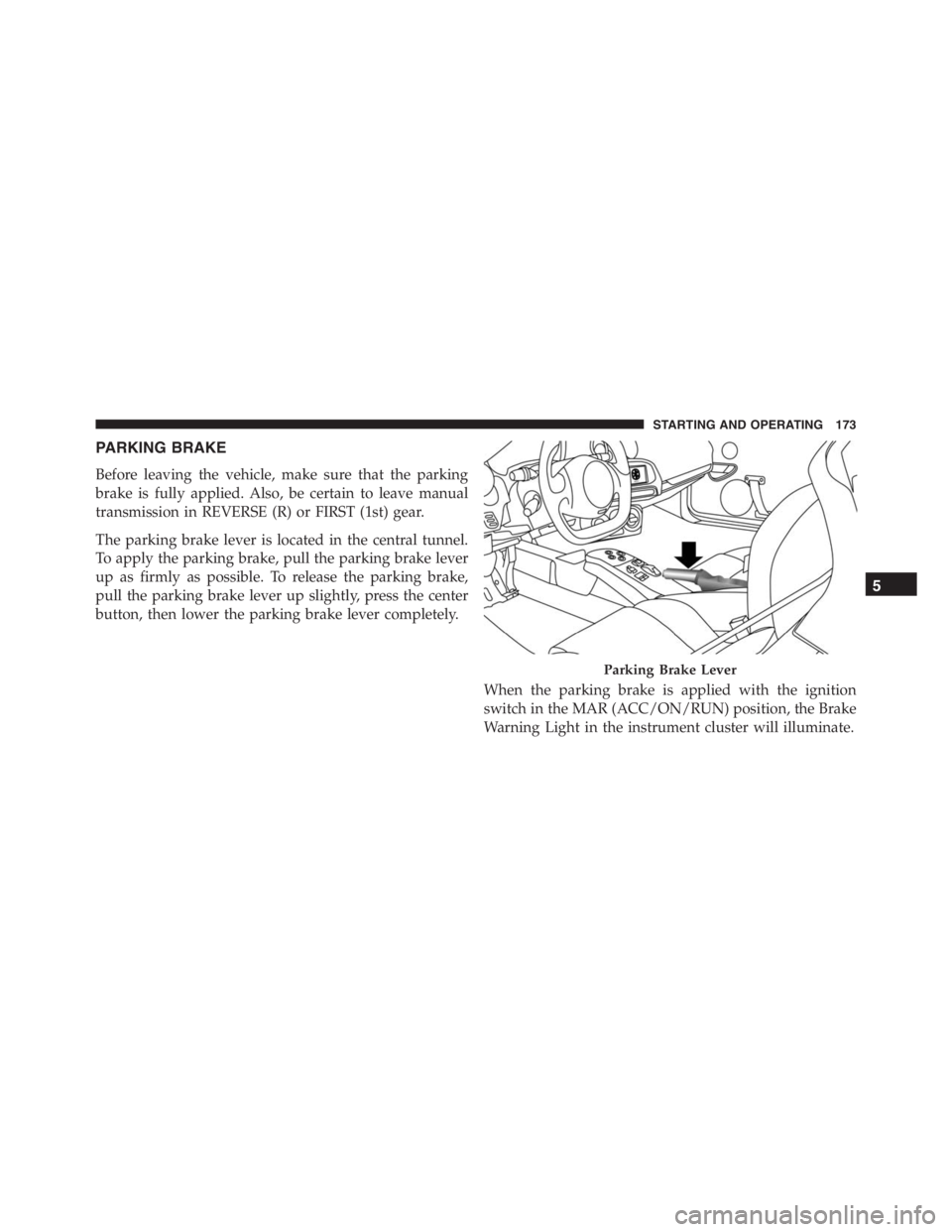
PARKING BRAKE
Before leaving the vehicle, make sure that the parking
brake is fully applied. Also, be certain to leave manual
transmission in REVERSE (R) or FIRST (1st) gear.
The parking brake lever is located in the central tunnel.
To apply the parking brake, pull the parking brake lever
up as firmly as possible. To release the parking brake,
pull the parking brake lever up slightly, press the center
button, then lower the parking brake lever completely.
When the parking brake is applied with the ignition
switch in the MAR (ACC/ON/RUN) position, the Brake
Warning Light in the instrument cluster will illuminate.
Parking Brake Lever
5
STARTING AND OPERATING 173
Page 180 of 348

This guarantees greater braking stability for the vehicle,
preventing sudden locking of the rear wheels and the
consequent instability of the vehicle.
Four-Wheel Anti-Lock Brake System (ABS)
The Four-Wheel ABS is designed to aid the driver in
maintaining vehicle control under adverse braking con-
ditions. The system operates with a separate computer to
modulate hydraulic pressure, to prevent wheel lock-up
and to help avoid skidding on slippery surfaces.
The system’s pump motor runs during an ABS stop to
provide regulated hydraulic pressure. The pump motor
makes a low humming noise during operation, which is
normal.
The ABS includes an amber ABS Warning Light. When
the light is illuminated, the ABS is not functioning. The
system reverts to standard non-anti-lock brakes. Turningthe ignition Off and On again may reset the ABS if the
fault detected was only momentary.
WARNING!
•When the ABS intervenes and you feel the brake
pedal pulsating, do not reduce the pressure, but
hold it down firmly and confidently; in doing so
you will brake in the shortest distance possible,
depending on the current road conditions.
•For maximum efficiency of the braking system, a
bedding-in period of about 311 miles (500 km) is
required: during this period it is advisable to avoid
sharp, repeated and prolonged braking.
•If the ABS intervenes, this indicates that the grip of
the tires on the road is nearing its limit: you must
slow down to a speed compatible with the avail-
able grip.
(Continued)
178 STARTING AND OPERATING