Page 268 of 348
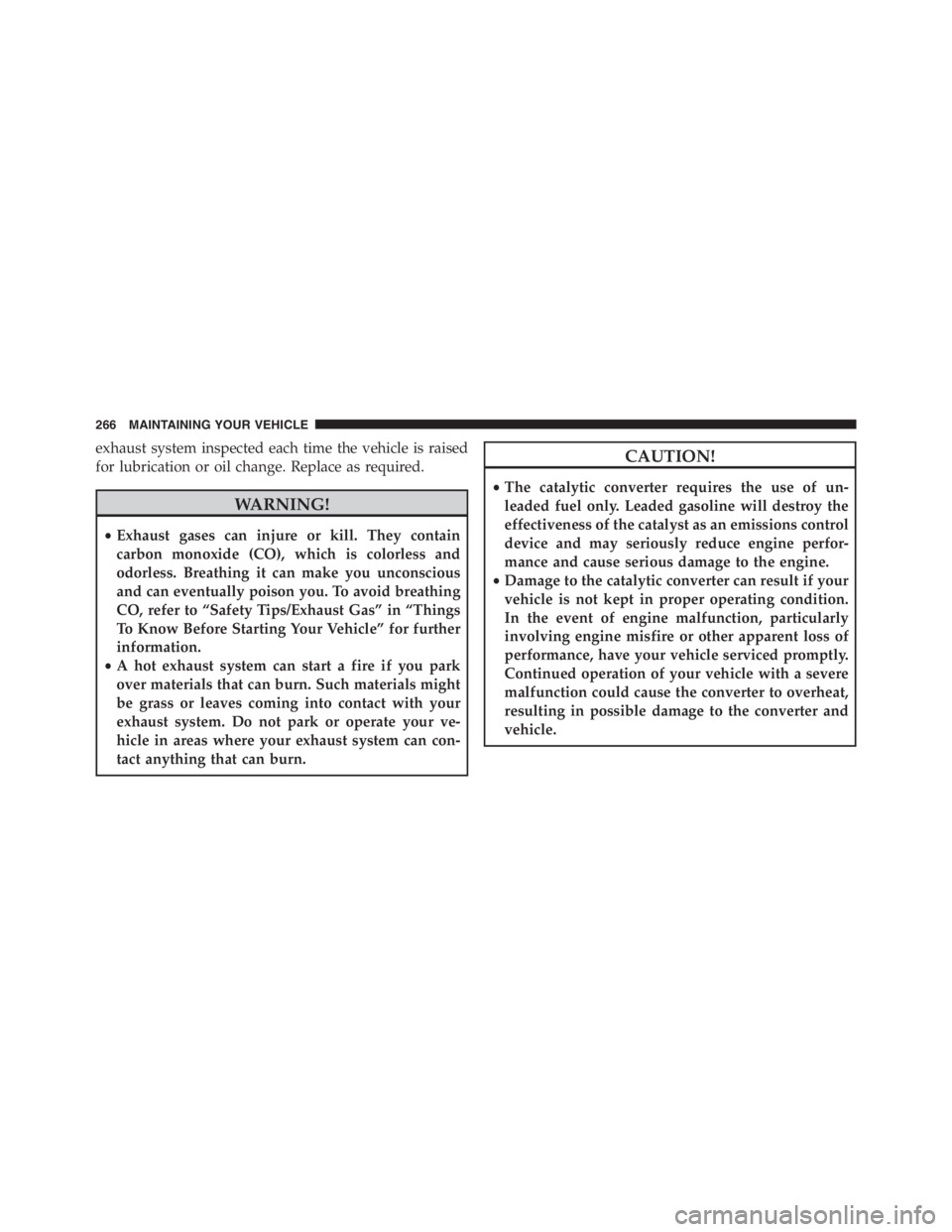
exhaust system inspected each time the vehicle is raised
for lubrication or oil change. Replace as required.
WARNING!
•Exhaust gases can injure or kill. They contain
carbon monoxide (CO), which is colorless and
odorless. Breathing it can make you unconscious
and can eventually poison you. To avoid breathing
CO, refer to “Safety Tips/Exhaust Gas” in “Things
To Know Before Starting Your Vehicle” for further
information.
•A hot exhaust system can start a fire if you park
over materials that can burn. Such materials might
be grass or leaves coming into contact with your
exhaust system. Do not park or operate your ve-
hicle in areas where your exhaust system can con-
tact anything that can burn.
CAUTION!
•The catalytic converter requires the use of un-
leaded fuel only. Leaded gasoline will destroy the
effectiveness of the catalyst as an emissions control
device and may seriously reduce engine perfor-
mance and cause serious damage to the engine.
•Damage to the catalytic converter can result if your
vehicle is not kept in proper operating condition.
In the event of engine malfunction, particularly
involving engine misfire or other apparent loss of
performance, have your vehicle serviced promptly.
Continued operation of your vehicle with a severe
malfunction could cause the converter to overheat,
resulting in possible damage to the converter and
vehicle.
266 MAINTAINING YOUR VEHICLE
Page 277 of 348
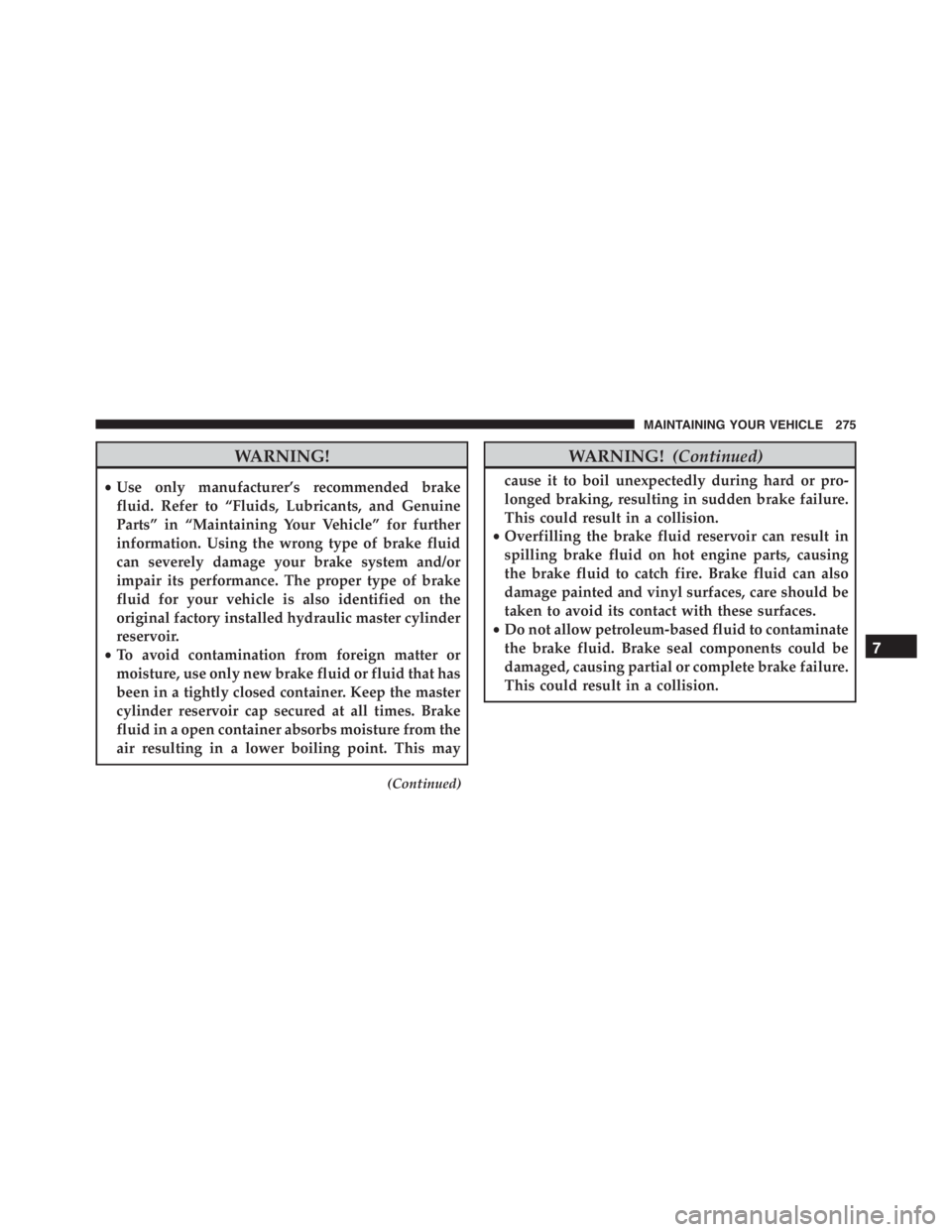
WARNING!
•Use only manufacturer’s recommended brake
fluid. Refer to “Fluids, Lubricants, and Genuine
Parts” in “Maintaining Your Vehicle” for further
information. Using the wrong type of brake fluid
can severely damage your brake system and/or
impair its performance. The proper type of brake
fluid for your vehicle is also identified on the
original factory installed hydraulic master cylinder
reservoir.
•To avoid contamination from foreign matter or
moisture, use only new brake fluid or fluid that has
been in a tightly closed container. Keep the master
cylinder reservoir cap secured at all times. Brake
fluid in a open container absorbs moisture from the
air resulting in a lower boiling point. This may
(Continued)
WARNING!(Continued)
cause it to boil unexpectedly during hard or pro-
longed braking, resulting in sudden brake failure.
This could result in a collision.
•Overfilling the brake fluid reservoir can result in
spilling brake fluid on hot engine parts, causing
the brake fluid to catch fire. Brake fluid can also
damage painted and vinyl surfaces, care should be
taken to avoid its contact with these surfaces.
•Do not allow petroleum-based fluid to contaminate
the brake fluid. Brake seal components could be
damaged, causing partial or complete brake failure.
This could result in a collision.
7
MAINTAINING YOUR VEHICLE 275
Page 308 of 348
4. Install luggage compartment roof light by inserting it
in its correct position, first on one side and then
pressing on the other side until it clicks into place.
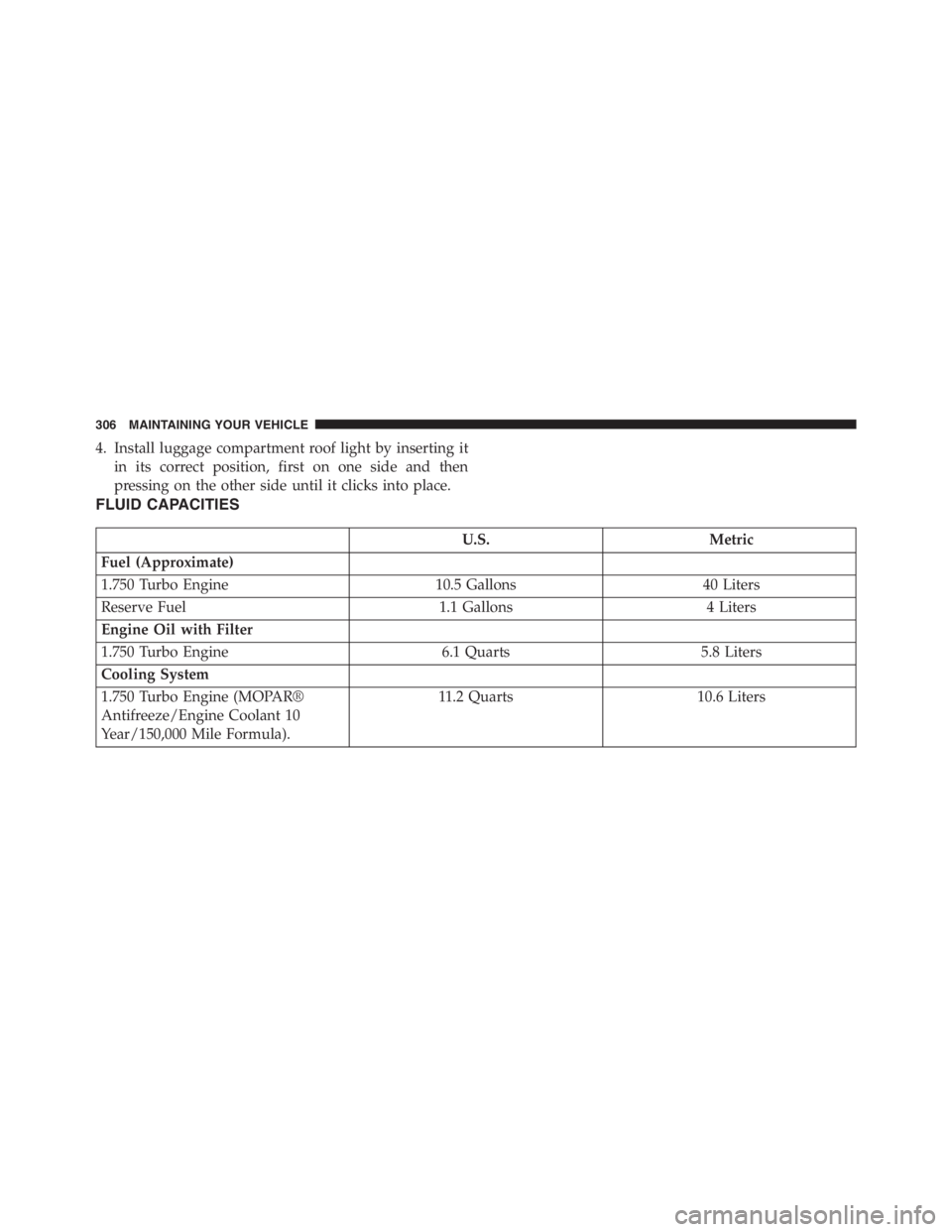
FLUID CAPACITIES
U.S. Metric
Fuel (Approximate)
1.750 Turbo Engine 10.5 Gallons 40 Liters
Reserve Fuel 1.1 Gallons 4 Liters
Engine Oil with Filter
1.750 Turbo Engine 6.1 Quarts 5.8 Liters
Cooling System
1.750 Turbo Engine (MOPAR®
Antifreeze/Engine Coolant 10
Year/150,000 Mile Formula).11.2 Quarts 10.6 Liters
306 MAINTAINING YOUR VEHICLE
Page 309 of 348
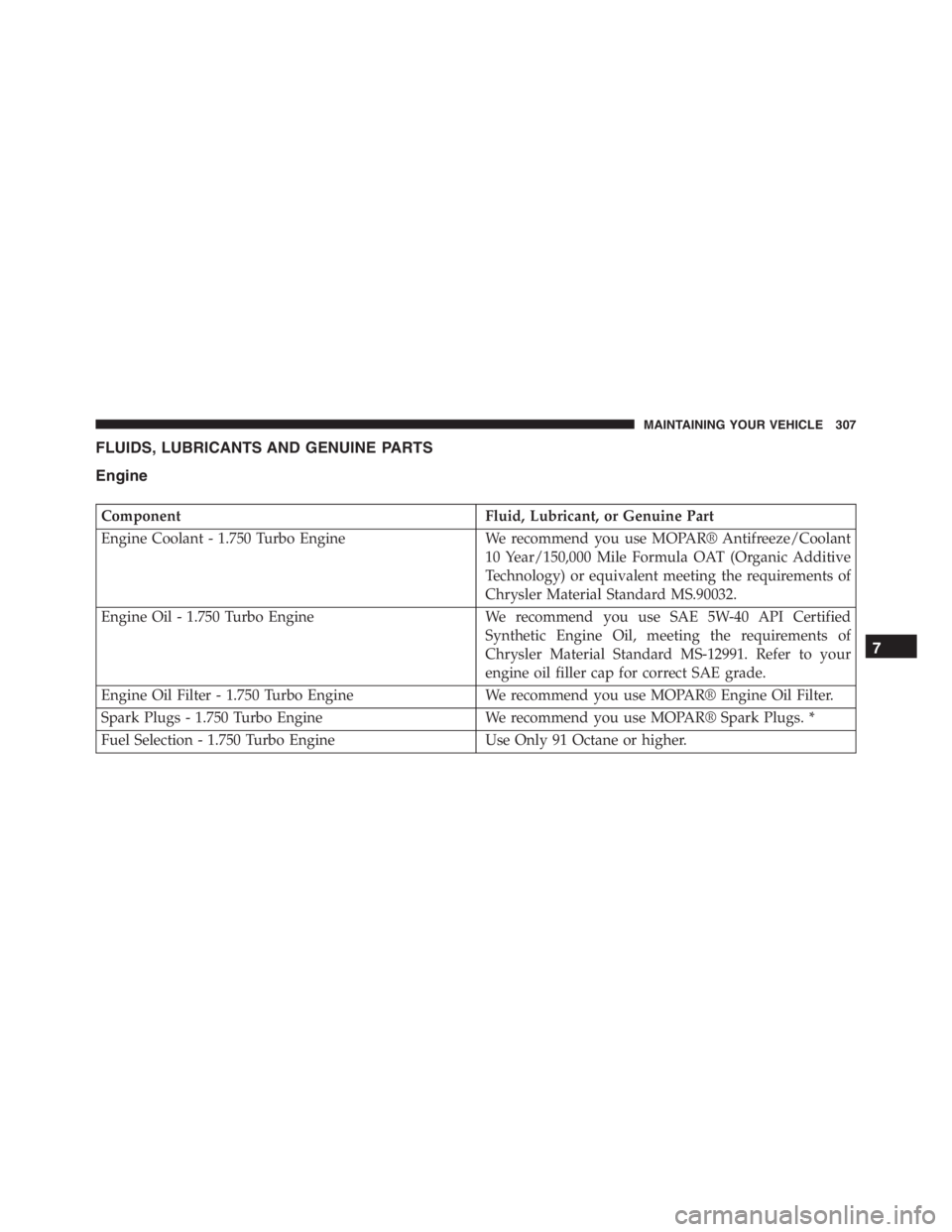
FLUIDS, LUBRICANTS AND GENUINE PARTS
Engine
Component Fluid, Lubricant, or Genuine Part
Engine Coolant - 1.750 Turbo Engine We recommend you use MOPAR® Antifreeze/Coolant
10 Year/150,000 Mile Formula OAT (Organic Additive
Technology) or equivalent meeting the requirements of
Chrysler Material Standard MS.90032.
Engine Oil - 1.750 Turbo Engine We recommend you use SAE 5W-40 API Certified
Synthetic Engine Oil, meeting the requirements of
Chrysler Material Standard MS-12991. Refer to your
engine oil filler cap for correct SAE grade.
Engine Oil Filter - 1.750 Turbo Engine We recommend you use MOPAR® Engine Oil Filter.
Spark Plugs - 1.750 Turbo Engine We recommend you use MOPAR® Spark Plugs. *
Fuel Selection - 1.750 Turbo Engine Use Only 91 Octane or higher.
7
MAINTAINING YOUR VEHICLE 307
Page 314 of 348

MAINTENANCE SCHEDULE
Your vehicle is equipped with an automatic oil change
indicator system. The oil change indicator system will
remind you that it is time to take your vehicle in for
scheduled maintenance.
Based on engine operation conditions, the oil change
indicator message will illuminate in the instrument clus-
ter. This means that an engine oil and engine oil filter
change is required for your vehicle. Operating conditions
such as frequent short-trips, trailer tow, extremely hot or
cold ambient temperatures, and E85 fuel usage will
influence when the “Change Oil” or “Oil Change Re-
quired” message is displayed. Severe Operating Condi-
tions can cause the change oil message to illuminate as
early as 3,500 miles (5,600 km) since last reset. Have your
vehicle serviced as soon as possible, within the next 500
miles (805 km).The Wrench Warning Light may appear in the cluster as
a service reminder when vehicle maintenance is required,
according to the scheduled maintenance mileage. The
maintenance schedule intervals are set by the manufac-
turer. Failure to have them carried out may void your
New Vehicle Warranty.
NOTE:The actual interval for changing the oil and
replacing the engine oil filter depends on the vehicle
usage conditions and is signalled by the warning light or
message (if present) on the instrument panel or every 12
months.
Severe Duty All Models
In addition, if your vehicle is used under demanding
conditions, including:
•On the track
•On dusty roads
312 MAINTENANCE SCHEDULES
Page 315 of 348

•Short, repeated trips (less than 4-5 miles or 7-8 km) at
sub-zero temperatures
•Allowing the engine to idle for extended periods of
time
•Driving for long distances at low speeds
•Allowing the vehicle to sit for long periods of inactiv-
ity
Under any of the above circumstances, the following
checks need to be performed more frequently than indi-
cated in the Maintenance Schedule:
•Check front and rear disc brake pad condition and
wear
•Check cleanliness of tailgate locks.
•Check cleanliness and lubrication of chassis and steer-
ing linkage•Visually inspect condition of: engine, gearbox, trans-
mission, pipes and hoses (exhaust - fuel system -
brakes) and rubber elements (gaiters - sleeves - bushes
- etc.)
•Check battery charge and battery fluid level (electro-
lyte)
•Visually inspect condition of the auxiliary drive belts
•Check and, if necessary, change engine oil and replace
oil filter
•Check and, if necessary, replace air cleaner
Using the car on track should be regarded as an excep-
tion. The car has been designed and produced for road
use.
8
MAINTENANCE SCHEDULES 313
Page 316 of 348
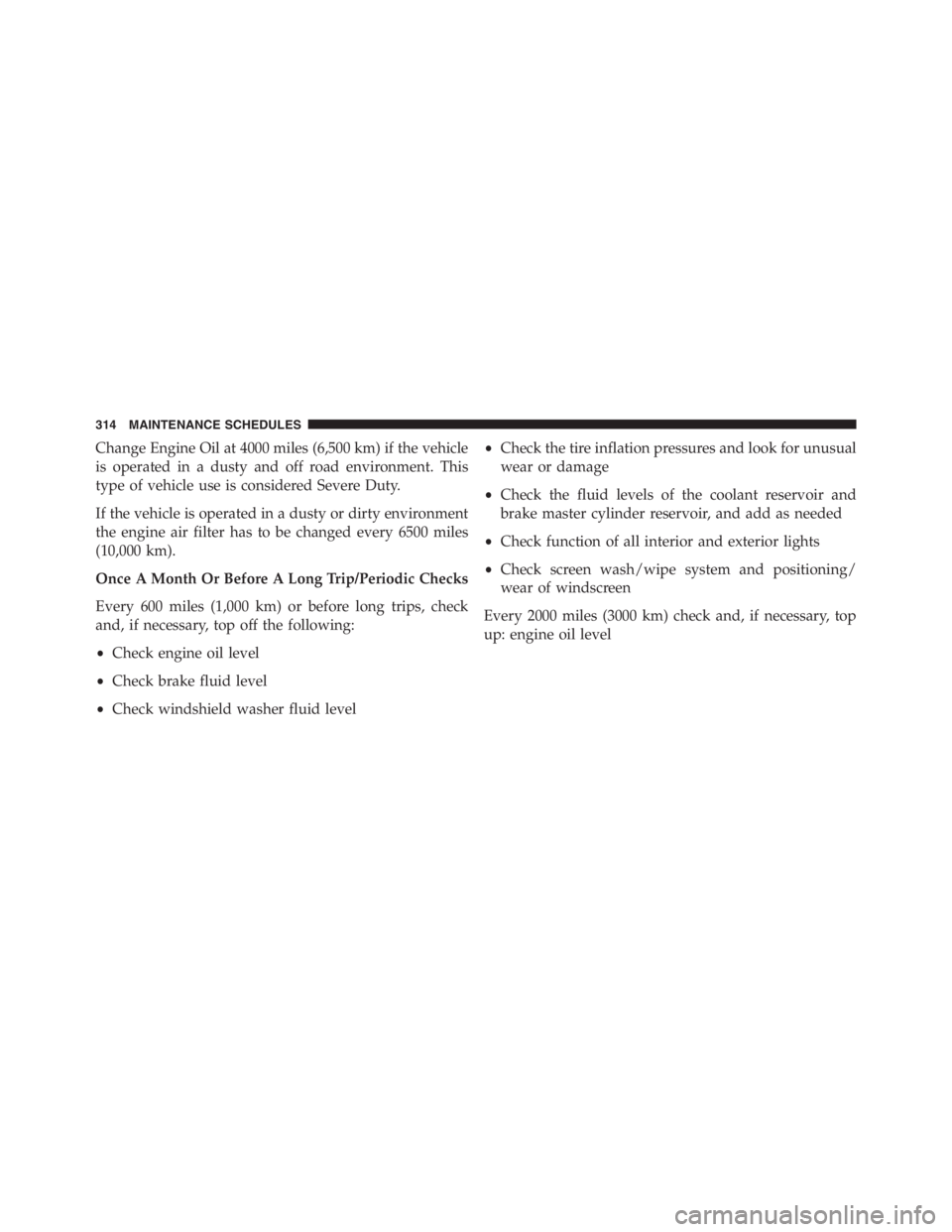
Change Engine Oil at 4000 miles (6,500 km) if the vehicle
is operated in a dusty and off road environment. This
type of vehicle use is considered Severe Duty.
If the vehicle is operated in a dusty or dirty environment
the engine air filter has to be changed every 6500 miles
(10,000 km).
Once A Month Or Before A Long Trip/Periodic Checks
Every 600 miles (1,000 km) or before long trips, check
and, if necessary, top off the following:
•Check engine oil level
•Check brake fluid level
•Check windshield washer fluid level•Check the tire inflation pressures and look for unusual
wear or damage
•Check the fluid levels of the coolant reservoir and
brake master cylinder reservoir, and add as needed
•Check function of all interior and exterior lights
•Check screen wash/wipe system and positioning/
wear of windscreen
Every 2000 miles (3000 km) check and, if necessary, top
up: engine oil level
314 MAINTENANCE SCHEDULES
Page 317 of 348
Required Maintenance Intervals
Refer to the maintenance schedules on the following
page for the required maintenance intervals.
At Every Oil Change Interval As Indicated By Oil
Change Indicator System:
Change oil and filter.
Inspect battery and clean and tighten terminals as
required.
Inspect brake pads, shoes, rotors, drums, and hoses.
Inspect engine cooling system protection and hoses.
Check and adjust hand brake.
Inspect exhaust system.
Inspect engine air cleaner if using in dusty or off-road
conditions.
8
MAINTENANCE SCHEDULES 315