Page 272 of 348
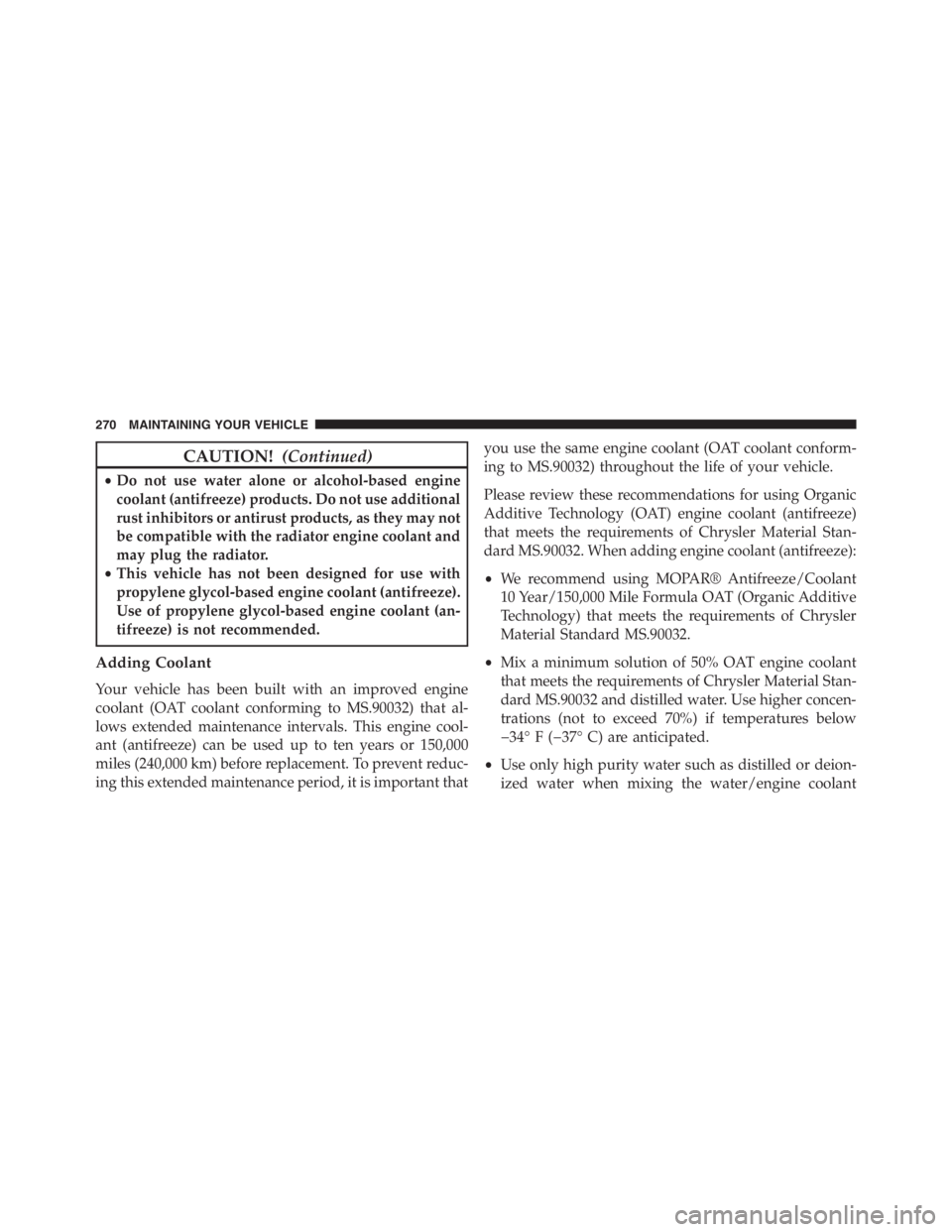
CAUTION!(Continued)
•Do not use water alone or alcohol-based engine
coolant (antifreeze) products. Do not use additional
rust inhibitors or antirust products, as they may not
be compatible with the radiator engine coolant and
may plug the radiator.
•This vehicle has not been designed for use with
propylene glycol-based engine coolant (antifreeze).
Use of propylene glycol-based engine coolant (an-
tifreeze) is not recommended.
Adding Coolant
Your vehicle has been built with an improved engine
coolant (OAT coolant conforming to MS.90032) that al-
lows extended maintenance intervals. This engine cool-
ant (antifreeze) can be used up to ten years or 150,000
miles (240,000 km) before replacement. To prevent reduc-
ing this extended maintenance period, it is important thatyou use the same engine coolant (OAT coolant conform-
ing to MS.90032) throughout the life of your vehicle.
Please review these recommendations for using Organic
Additive Technology (OAT) engine coolant (antifreeze)
that meets the requirements of Chrysler Material Stan-
dard MS.90032. When adding engine coolant (antifreeze):
•We recommend using MOPAR® Antifreeze/Coolant
10 Year/150,000 Mile Formula OAT (Organic Additive
Technology) that meets the requirements of Chrysler
Material Standard MS.90032.
•Mix a minimum solution of 50% OAT engine coolant
that meets the requirements of Chrysler Material Stan-
dard MS.90032 and distilled water. Use higher concen-
trations (not to exceed 70%) if temperatures below
34° F (37° C) are anticipated.
•Use only high purity water such as distilled or deion-
ized water when mixing the water/engine coolant
270 MAINTAINING YOUR VEHICLE
Page 273 of 348
(antifreeze) solution. The use of lower quality water
will reduce the amount of corrosion protection in the
engine cooling system.
Please note that it is the owner’s responsibility to main-
tain the proper level of protection against freezing ac-
cording to the temperatures occurring in the area where
the vehicle is operated.
NOTE:
•Some vehicles require special tools to add coolant
properly. Failure to fill these systems properly could
lead to severe internal engine damage. If any coolant is
needed to be added to the system please contact your
local authorized dealer.•Mixing engine coolant (antifreeze) types is not recom-
mended and can result in cooling system damage. If
HOAT and OAT coolant are mixed in an emergency,
have a authorized dealer drain, flush, and refill with
OAT coolant (conforming to MS.90032) as soon as
possible.
Cooling System Pressure Cap
The cap must be fully tightened to prevent loss of engine
coolant (antifreeze) and to ensure that engine coolant
(antifreeze) will return to the radiator from the coolant
recovery tank.
The cap should be inspected and cleaned if there is any
accumulation of foreign material on the sealing surfaces.
7
MAINTAINING YOUR VEHICLE 271
Page 274 of 348

WARNING!
•Do not open hot engine cooling system. Never add
engine coolant (antifreeze) when the engine is
overheated. Do not loosen or remove the cap to cool
an overheated engine. Heat causes pressure to
build up in the cooling system. To prevent scalding
or injury, do not remove the pressure cap while the
system is hot or under pressure.
•Do not use a pressure cap other than the one
specified for your vehicle. Personal injury or en-
gine damage may result.
Disposal Of Used Engine Coolant
Used ethylene glycol-based engine coolant (antifreeze) is
a regulated substance requiring proper disposal. Check
with your local authorities to determine the disposal
rules for your community. To prevent ingestion by ani-
mals or children, do not store ethylene glycol-basedengine coolant in open containers or allow it to remain in
puddles on the ground. If ingested by a child or pet, seek
emergency assistance immediately. Clean up any ground
spills immediately.
Coolant Level
The coolant expansion bottle provides a quick visual
method for determining that the coolant level is ad-
equate. With the engine off and cold, the level of the
engine coolant (antifreeze) in the bottle should be be-
tween the “MIN” and “MAX” marks.
As long as the engine operating temperature is satisfac-
tory, the coolant bottle need only be checked once a
month.
When additional engine coolant (antifreeze) is needed to
maintain the proper level, it should be added to the
coolant bottle. Do not overfill.
272 MAINTAINING YOUR VEHICLE
Page 275 of 348

Points To Remember
NOTE:When the vehicle is stopped after a few miles/
kilometers of operation, you may observe vapor coming
from the front of the engine compartment. This is nor-
mally a result of moisture from rain, snow, or high
humidity accumulating on the radiator and being vapor-
ized when the thermostat opens, allowing hot engine
coolant (antifreeze) to enter the radiator.
If an examination of your engine compartment shows no
evidence of radiator or hose leaks, the vehicle may be
safely driven. The vapor will soon dissipate.
•Do not overfill the coolant expansion bottle.
•Check the coolant freeze point in the radiator and in
the coolant expansion bottle. If engine coolant (anti-
freeze) needs to be added, the contents of the coolant
expansion bottle must also be protected against freez-
ing.•If frequent engine coolant (antifreeze) additions are
required, the cooling system should be pressure tested
for leaks.
•Maintain engine coolant (antifreeze) concentration at a
minimum of 50% OAT coolant (conforming to MS-
90032) and distilled water for proper corrosion protec-
tion of your engine which contains aluminum compo-
nents.
•Keep the front of the radiator clean. If your vehicle is
equipped with air conditioning, keep the front of the
condenser clean.
•Do not change the thermostat for Summer or Winter
operation. If replacement is ever necessary, install
ONLY the correct type thermostat. Other designs may
result in unsatisfactory engine coolant (antifreeze)
performance, poor gas mileage, and increased emis-
sions.
7
MAINTAINING YOUR VEHICLE 273
Page 308 of 348
4. Install luggage compartment roof light by inserting it
in its correct position, first on one side and then
pressing on the other side until it clicks into place.
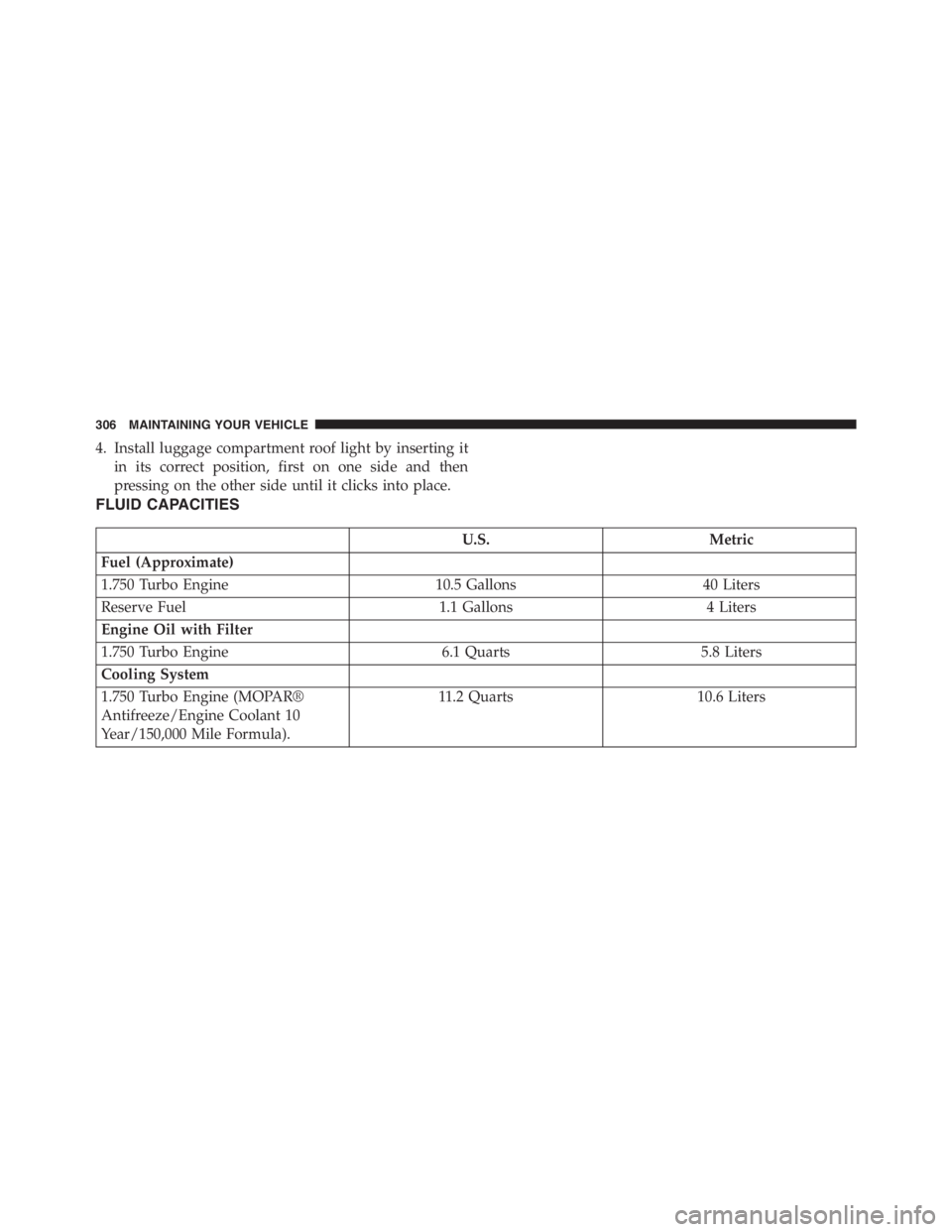
FLUID CAPACITIES
U.S. Metric
Fuel (Approximate)
1.750 Turbo Engine 10.5 Gallons 40 Liters
Reserve Fuel 1.1 Gallons 4 Liters
Engine Oil with Filter
1.750 Turbo Engine 6.1 Quarts 5.8 Liters
Cooling System
1.750 Turbo Engine (MOPAR®
Antifreeze/Engine Coolant 10
Year/150,000 Mile Formula).11.2 Quarts 10.6 Liters
306 MAINTAINING YOUR VEHICLE
Page 309 of 348
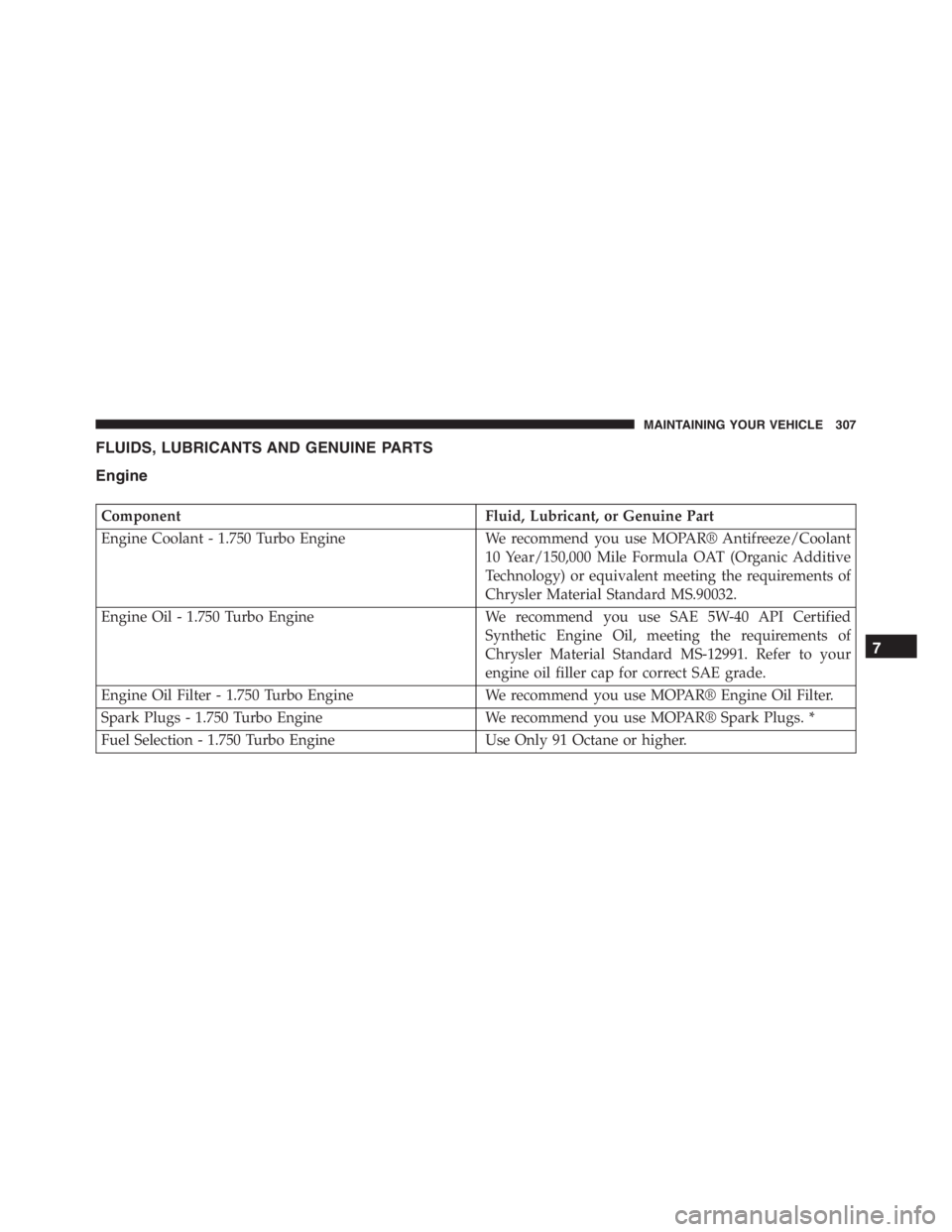
FLUIDS, LUBRICANTS AND GENUINE PARTS
Engine
Component Fluid, Lubricant, or Genuine Part
Engine Coolant - 1.750 Turbo Engine We recommend you use MOPAR® Antifreeze/Coolant
10 Year/150,000 Mile Formula OAT (Organic Additive
Technology) or equivalent meeting the requirements of
Chrysler Material Standard MS.90032.
Engine Oil - 1.750 Turbo Engine We recommend you use SAE 5W-40 API Certified
Synthetic Engine Oil, meeting the requirements of
Chrysler Material Standard MS-12991. Refer to your
engine oil filler cap for correct SAE grade.
Engine Oil Filter - 1.750 Turbo Engine We recommend you use MOPAR® Engine Oil Filter.
Spark Plugs - 1.750 Turbo Engine We recommend you use MOPAR® Spark Plugs. *
Fuel Selection - 1.750 Turbo Engine Use Only 91 Octane or higher.
7
MAINTAINING YOUR VEHICLE 307
Page 316 of 348
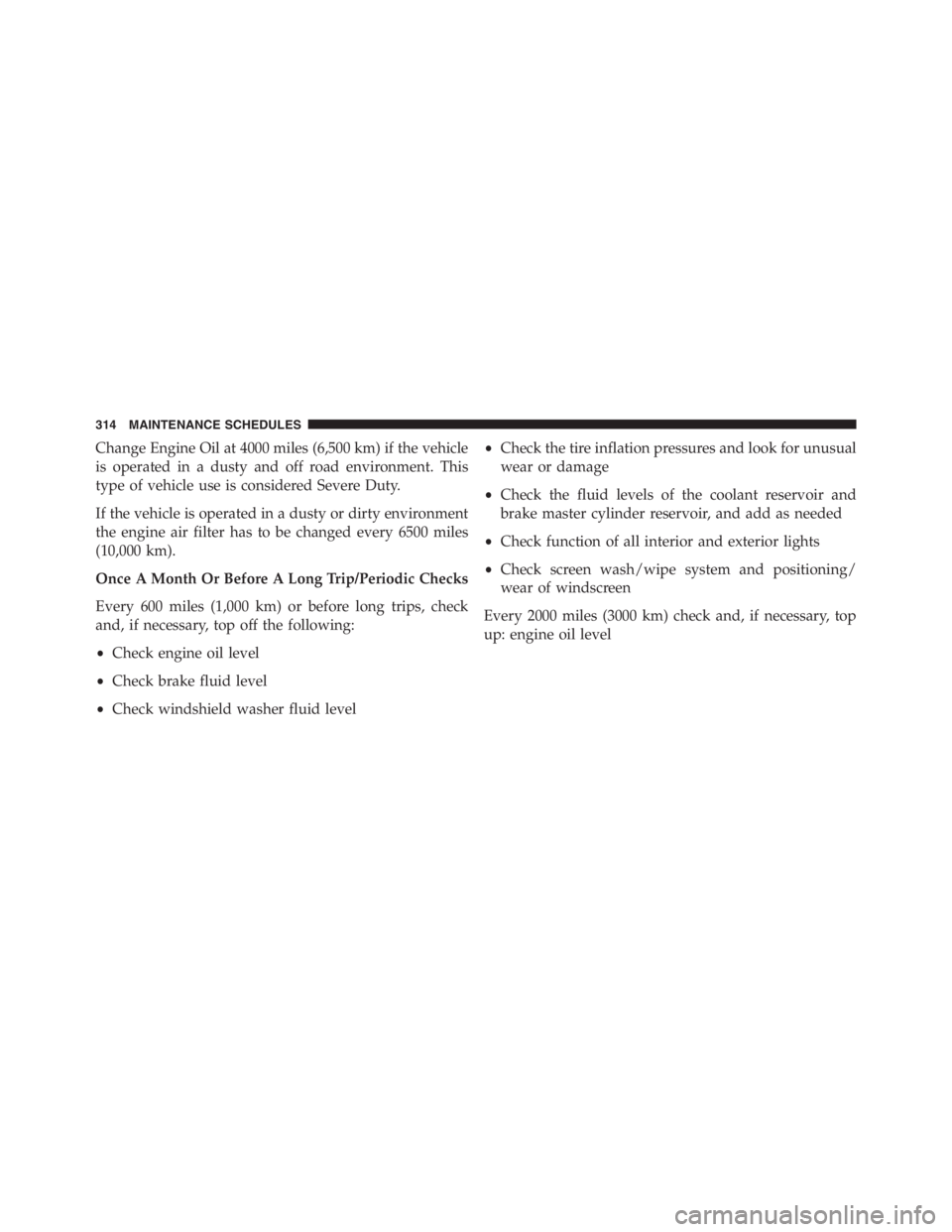
Change Engine Oil at 4000 miles (6,500 km) if the vehicle
is operated in a dusty and off road environment. This
type of vehicle use is considered Severe Duty.
If the vehicle is operated in a dusty or dirty environment
the engine air filter has to be changed every 6500 miles
(10,000 km).
Once A Month Or Before A Long Trip/Periodic Checks
Every 600 miles (1,000 km) or before long trips, check
and, if necessary, top off the following:
•Check engine oil level
•Check brake fluid level
•Check windshield washer fluid level•Check the tire inflation pressures and look for unusual
wear or damage
•Check the fluid levels of the coolant reservoir and
brake master cylinder reservoir, and add as needed
•Check function of all interior and exterior lights
•Check screen wash/wipe system and positioning/
wear of windscreen
Every 2000 miles (3000 km) check and, if necessary, top
up: engine oil level
314 MAINTENANCE SCHEDULES
Page 319 of 348
Mileage or time passed (whichever comes first)
12,000
24,000
36,000
48,000
60,000
72,000
Or Months: 12 24 36 48 60 72
Or Kilometers:
20,000
40,000
60,000
80,000
100,000
120,000
Check cleanliness of hood and deck lid locks, as well as cleanli-
ness and lubrication of associated linkagesXX X X X X
Visually inspect condition of: exterior bodywork, carbon monocoque,
aerodynamic bottom, pipes and hoses (exhaust, fuel supply system,
brakes), rubber elements (boots, driveshaft boots, sleeves, bushes,
etc.)XX X X X X
Check condition and wear of front brake pads and discs, and op-
eration of pad wear indicatorXX X X X X
Check condition and wear of rear brake pads and discs, and opera-
tion of pad wear indicatorXX X X X X
Check and top off, if required, fluid levels (engine coolant, brake/
hydraulic clutch fluid, windscreen washer fluid, battery fluid, etc)XX X X X X
Visually inspect the condition of accessory drive belt(s) X
8
MAINTENANCE SCHEDULES 317